Between the Cherubim

Learning to Speak and Listen
The Bible in a Year

“When Moses was gone into the tabernacle of the congregation to speak with him, then he heard the voice of one speaking unto him from off the mercy seat that was upon the ark of testimony, from between the two cherubims; and he spake unto him.” — Numbers 7:89

As we journey through Scripture together this year, we come to a quiet but powerful scene at the close of Numbers 7. The tabernacle has just been dedicated. For twelve days, the leaders of Israel brought offerings—carefully measured gifts of silver, gold, grain, and animals. There was structure, ceremony, and obedience. And then, when the public celebration concluded, Moses did something deeply personal: he went into the tabernacle to speak with God.

That detail arrests me. After the noise of dedication came the stillness of communion. Moses “was gone into the tabernacle… to speak with Him.” The Hebrew verb suggests intentional movement. He did not drift into prayer; he went. This is supplication—deliberate conversation with God. Moses sensed his need. Leadership without prayer would become hollow. Service without communion would become mechanical.

The lesson is simple and searching. Man needs to speak with God. If prayer is absent, spiritual vitality will wither. James writes, “Draw nigh to God, and he will draw nigh to you” (James 4:8). That is not poetic exaggeration; it is covenant principle. If God seems distant, the text gently implies that we have stepped back. As Matthew Henry observed, “Those that would have communion with God must carefully keep up their attendance on Him.” The life of prayer is not optional for the believer; it is oxygen.

Yet Numbers 7:89 reveals something more than supplication. It reveals reciprocation. “Then he heard the voice of one speaking unto him.” When Moses entered to speak, he discovered that God was already prepared to respond. This is the rhythm of relationship. Prayer is not monologue; it is dialogue. We do not pray into emptiness. We pray to the living God.

The principle woven throughout Scripture is that God delights to answer seeking hearts. Jeremiah 29:13 echoes it: “Ye shall seek me, and find me, when ye shall search for me with all your heart.” In the New Testament, Jesus assures us, “Ask, and it shall be given you; seek, and ye shall find” (Matthew 7:7). The God of the tabernacle is not silent toward His people. He speaks—through His Word, through conviction, through guidance shaped by truth.

But where did God speak from? The verse is specific: “from off the mercy seat… from between the two cherubims.” This is the location. It matters deeply. Exodus 25:22 records God’s promise: “There I will meet with thee, and I will commune with thee from above the mercy seat.” The mercy seat, or kapporet in Hebrew, was the covering of the ark of the covenant. It was the place where sacrificial blood was sprinkled on the Day of Atonement. It was the meeting place of justice and mercy.

The imagery points forward unmistakably to Christ. Paul declares in 1 Timothy 2:5, “For there is one God, and one mediator between God and men, the man Christ Jesus.” The mercy seat foreshadowed Calvary. God communes with man on the basis of atonement. We do not stroll casually into His presence; we come through blood—fulfilled in the cross. The Greek term for propitiation in Romans 3:25, hilastērion, carries the same idea as mercy seat. Christ is our meeting place.

This truth steadies my heart. Prayer is not grounded in my worthiness but in Christ’s mediation. I speak with God not because I have performed flawlessly, but because Jesus has reconciled me. That reality changes the tone of prayer from anxiety to gratitude.

As we reflect on this passage within our year-long study of Scripture, we should ask practical questions. Have we moved intentionally toward God, or do we wait passively for spiritual warmth? Do we cultivate space for quiet communion after seasons of activity? The dedication of the tabernacle was public and elaborate, yet the communion was personal and simple. Moses went in alone.

In our age of constant noise, that lesson is timely. We can fill our lives with religious activity and still neglect the quiet place. The tabernacle reminds us that worship culminates in relationship. A.W. Tozer once wrote, “The man who would truly know God must give time to Him.” That counsel remains wise.

And there is comfort here as well. If we speak, He responds. The verse does not describe thunder or spectacle; it describes voice. God spoke. He communicated. The covenant God remains relational. Through Scripture illuminated by the Holy Spirit, He continues to address His people.

So today, as part of our journey through the Bible in a Year, let us practice what we study. Go into your “tabernacle”—that quiet corner, that early morning chair, that evening pause. Speak honestly. Confess freely. Intercede faithfully. And then listen. Open the Word and expect the God who once spoke between cherubim to address your heart through Christ.

For further study on the significance of the mercy seat and its fulfillment in Jesus, consider this helpful article from Ligonier Ministries: https://www.ligonier.org/learn/articles/mercy-seat

The God who met Moses still meets His people—through the Mediator, by grace, in truth.

FEEL FREE TO COMMENT, SUBSCRIBE, AND REPOST, SO OTHERS MAY KNOW


#1Timothy25 #BibleInAYear #communionWithGod #drawingNearToGod #mercySeat #Numbers789 #prayerLife #tabernacle


Meeting God at the Mercy Seat

The Bible in a Year

“There I will meet with thee, and I will commune with thee from above the mercy seat, from between the two cherubims which are upon the ark of the testimony.” (Exodus 25:22)

As we continue our year-long journey through Scripture, this single verse from Exodus opens a doorway into the heart of biblical fellowship. God does not merely instruct Israel where to place the furnishings of the Tabernacle; He reveals where communion with Him truly occurs. The Lord says, “There I will meet with thee.” Not just anywhere, not on human terms, and not by instinct or intuition, but at a place He Himself appoints—above the mercy seat. That detail matters. It tells us that fellowship with God is never casual or accidental. It is graciously given, carefully framed, and deeply redemptive.

The mercy seat was the covering of the ark, placed in the Holy of Holies, the most sacred space in Israel’s worship. Once a year, on the Day of Atonement, blood was sprinkled there by the high priest. This was not a random ritual; it was a visible declaration that sinful people could only draw near to a holy God through mercy. Fellowship begins not with human worthiness but with divine grace. That truth remains unchanged throughout Scripture. Salvation, prayer, worship, and daily communion with God are all grounded in mercy, not merit. When we forget this, we subtly turn fellowship into a performance rather than a gift.

The ark itself functioned as a type—a foreshadowing—of Christ. Inside it were the tablets of the Law, Aaron’s rod, and manna, all symbols of God’s covenant faithfulness and human failure. The mercy seat covered it all. In the same way, Christ fulfills the Law we could not keep and covers our failures with His righteousness. Jesus later declares this truth plainly: “I am the way, the truth, and the life. No one comes to the Father except through Me” (John 14:6). Fellowship with God is not possible apart from Christ. A theology that tries to speak of God while bypassing Jesus may sound spiritual, but it cannot lead to communion. It leads instead to distance, because God has chosen to meet humanity in His Son.

This brings us to the third condition revealed in Exodus 25:22—fellowship is not apart from the blood. The blood sprinkled on the mercy seat once a year pointed forward to Calvary. Hebrews makes this connection explicit, reminding us that the earthly tabernacle was a copy and shadow of heavenly realities (Hebrews 9:1–11). God does not overlook sin in order to have fellowship with us; He addresses it. “Without shedding of blood there is no remission” (Hebrews 9:22). That statement is not harsh; it is hopeful. It means God Himself has provided the means by which sin is cleansed and fellowship restored. “The blood of Jesus Christ His Son cleanses us from all sin” (1 John 1:7).

Walking through this passage devotionally, I am reminded how easy it is to seek closeness with God while minimizing these conditions. We want intimacy without confession, spirituality without Christ, blessing without the cross. Exodus refuses to let us do that. God meets His people, but He meets them at the mercy seat. As John Stott once observed, “The essence of sin is man substituting himself for God… the essence of salvation is God substituting Himself for man.” Nowhere is that substitution clearer than at the mercy seat, fulfilled ultimately in Jesus.

This truth has daily implications for our walk. Fellowship with God today still begins with mercy. We come honestly, not pretending we are better than we are, but trusting that grace is greater than our failure. Fellowship continues through Christ. Our prayers, worship, and obedience are offered in Him, not alongside Him. And fellowship is sustained by the blood—not re-shed, but remembered. Each time we confess our sins, we are not reopening old wounds; we are reaffirming the sufficiency of Christ’s sacrifice.

As we move through the Bible this year, passages like this anchor us. They remind us that Scripture is not a collection of disconnected religious ideas, but a unified story of a God who desires to dwell with His people and who provides the way for that dwelling to be possible. The mercy seat in Exodus points us forward; the cross in the Gospels fulfills the promise; and our daily fellowship with God becomes the lived expression of that grace.

For further study on the mercy seat and its fulfillment in Christ, this article from Ligonier Ministries offers helpful background and theological clarity:
https://www.ligonier.org/learn/articles/mercy-seat

FEEL FREE TO COMMENT, SUBSCRIBE, AND REPOST, SO OTHERS MAY KNOW


#bloodAndAtonement #ChristInTheOldTestament #Exodus2522 #fellowshipWithGod #mercySeat

Mercy Seat

This is known in Hebrew as the kapporet.

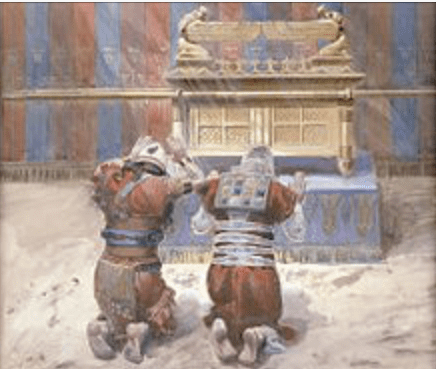
This was the solid gold lid put on the Ark of the Covenant. It had 2 cherubim at the ends to cover & make the space in which Yahweh/God appeared & lived. It holds major significance in Judaism & minor significance in Christianity. The Ark of the Covenant is mentioned only once in the Quran.

The design of the Mercy Seat was heavily detailed in the Book of Exodus (25:17-22). The space between the 2 cherubim was considered the earthly throne of God, the place where His presence (often described the Shekinah glory), where He would live & commune/communicate with Moses.

The Ark & Mercy Seat were kept in the Holy of Holies. This was the Temple’s innermost sanctuary which was separated from the other parts of the Temple by a thick curtain called a parochet. The Holy of Holies could only be entered by the High Priest on the Day of Atonement, or Yom Kippur. This is the holiest day of the year in Judaism.

The ritual described, in detail, in Leviticus chapter 16. The High Priest would sprinkle the blood of a sacrificial bull onto the Mercy Seat as an atonement for the sins of his own & his family. A sacrificial goat would be for the sins of the people of Israel. This act of sprinkling the blood would be a symbolic covering of the sins of the people. This allowed for a temporary reconciliation between a holy God & His sinful creation. The blood was a substitute representing a life given in place of the lives of the people who transgressed against God’s law.

For Christians the Mercy Seat is seen as a powerful foreshadowing of Jesus. The New Testament, in Hebrews & Romans, draws a direct & profound connection between the Old Testament ritual & Jesus’ work on the cross.

Jesus on the cross was a greater atonement & the formation of a New Covenant (Hebrews 9:3-15). The continual sacrifices for sin under the Mosaic Law/Covenant became obsolete following Jesus’ one-time sacrificial death, as the Lamb of God.

The author(s) of Hebrews explains that Jesus is the ultimate High Priest (Hebrews 9:11). Unlike the Old Testament priests who HAD to offer sacrifices for sins, Jesus was without sin (or original Sin for that matter) & offered Himself as the perfect sacrifice “once for all.”

The blood of the bulls & goats could only give a temporary “covering” of sin(s) (Hebrews 10:4). Jesus’ own blood, that was shed on the cross, is presented as a perfect & final atonement. THis provides a permanent solution to the problem of sin & guilt.

At the moment of Jesus’ death, the veil of the Temple that separated the Holy of Holies from the rest of the building was torn from top to bottom (Matthew 27:51). This is understood as a symbol that the separation between God & humanity had been removed. Thus through Jesus’ sacrifice, believers now have direct access to God’s presence.

The Greek word for Mercy Seat used in the Septuagint (the Greek Old Testament) is hilasterion. This is a term that carries the idea of an atoning sacrifice. In Romans 3:25, the Apostle Paul uses this exact word to describe Jesus: “…whom God puts forward as a propitation (or Mercy Seat) by His blood, to be received by faith.” This verse teaches that God’s righteous wrath against sin satisfied God’s justice in the Old Testament.

In this way, Jesus is seen as a fulfillment of everything the Mercy Seat represented. The place where God’s holiness & justice meet His mercy & love & the means by which humanity can be reconciled with God. The Mercy Seat was a physical representation of a spiritual truth, one that Christians believe was fully realized in the person & work of Jesus.

One-Time Monthly Yearly

Make a one-time donation

Make a monthly donation

Make a yearly donation

Choose an amount

$1.00 $5.00 $10.00 $1.00 $5.00 $10.00 $5.00 $10.00 $15.00

Or enter a custom amount

$

Your contribution is appreciated.

Your contribution is appreciated.

Your contribution is appreciated.

DonateDonate monthlyDonate yearly

#ApostlePaul #ArkOfTheCovenant #Cherubim #Christianity #Christians #Cross #DayOfAtonement #Exodus251722 #God #Greek #GreekOldTestament #Hebrew911 #Hebrews #Hebrews104 #Hebrews9315 #HighPriest #Hilasterion #HolyOfHolies #Israel #Jesus #Judaism #Kapporet #Leviticus16 #Matthew2751 #MercySeat #Moses #NewTestament #OldTestament #Parochet #Quran #Romans #Romans325 #Septuagint #ShekinahGlory #Temple #ThroneOfGod #Veil #Yahweh #YomKippur

Nick Cave and The Bad Seeds - The Mercy Seat (Live at the Paradiso, 1992)

YouTube

Fighting to Be a Father

As divorced fathers, particularly non-custodial ones, we quickly find ourselves without many of the rights and privileges related to our children that we had before. Some of these are taken from us by the nature of divorce, some by our ex, and some by the courts.

http://godinterest.com/2018/04/15/fighting-to-be-a-father/

#Faith #Children #Church #Courts #Divorce #Family #Father #God #MercySeat #Prayer