Question of the day: does somebody know a (recent) catalogue of galaxy groups and clusters in our local universe with redshift-independent distances, redshifts and member galaxy properties like vel-disps? (yes, we know cosmicflows but we are rather thinking of DESI or so)

#astronomy #LocalUniverse #Cosmology #DarkMatter #astrophysics s

Great news today! Wendy #Freedman has received the #NationalMedalOfScience at the White House. Cordial congratulations and I very much appreciate the work she has done to advance our understanding of late-universe #cosmology & #astrophysics.

https://news.uchicago.edu/story/wendy-freedman-awarded-national-medal-science

#science #astronomy #astrophysics #LocalUniverse

Wendy Freedman awarded National Medal of Science

UChicago cosmologist honored for pioneering research on Hubble constant

University of Chicago News

A wonderful good morning to the #Astrodon community!
The #Cosmoverse COST action releases the videos of its last workshop one after the other. Here is one of the latest ones that is quite interesting:
https://youtu.be/fVcUdg8uYHc?si=aOTLpBwC8yFzRG8w

#cosmology #NearFieldCosmology #LocalUniverse

CosmoVerse@Krakow: David Benisty: Constraining Dark Energy from Local Universe

This series is the recording of the CosmoVerse@Krakow conference that happened between 9 and 11 July 2024.David Benisty:Constraining Dark Energy from Local U...

YouTube
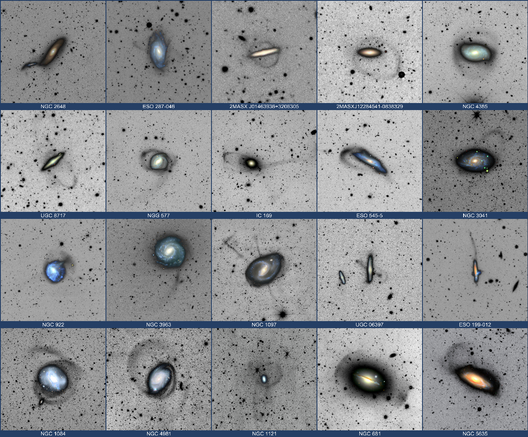
APOD: 2024 September 27 - Stellar Streams in the Local Universe

A different astronomy and space science related image is featured each day, along with a brief explanation.

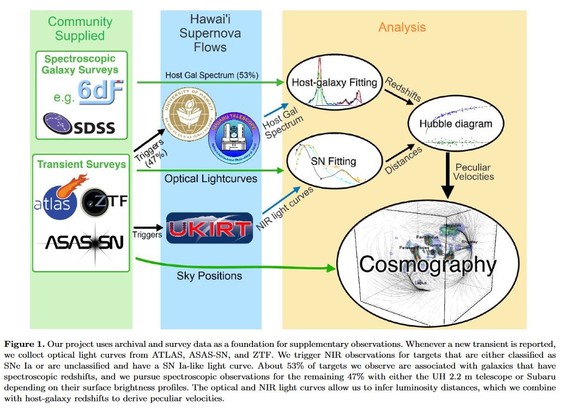
Hawai'i Supernova Flows: A Peculiar Velocity Survey Using Over a Thousand Supernovae in the Near-Infrared

We introduce the Hawai'i Supernova Flows project and present summary statistics of the first 1,217 astronomical transients observed, 668 of which are spectroscopically classified Type Ia Supernovae (SNe Ia). Our project is designed to obtain systematics-limited distances to SNe Ia while consuming minimal dedicated observational resources. To date, we have performed almost 5,000 near-infrared (NIR) observations of astronomical transients and have obtained spectra for over 200 host galaxies lacking published spectroscopic redshifts. In this survey paper we describe the methodology used to select targets, collect/reduce data, calculate distances, and perform quality cuts. We compare our methods to those used in similar studies, finding general agreement or mild improvement. Our summary statistics include various parametrizations of dispersion in the Hubble diagrams produced using fits to several commonly used SN Ia models. We find the lowest dispersions using the \texttt{SNooPy} package's EBV\_model2, with a root mean square (RMS) deviation of 0.165 mag and a normalized median absolute deviation (NMAD) of 0.123 mag. The full utility of the Hawai'i Supernova Flows data set far exceeds the analyses presented in this paper. Our photometry will provide a valuable test bed for models of SN Ia incorporating NIR data. Differential cosmological studies comparing optical samples and combined optical and NIR samples will have increased leverage for constraining chromatic effects like dust extinction. We invite the community to explore our data by making the light curves, fits, and host galaxy redshifts publicly accessible.

arXiv.org
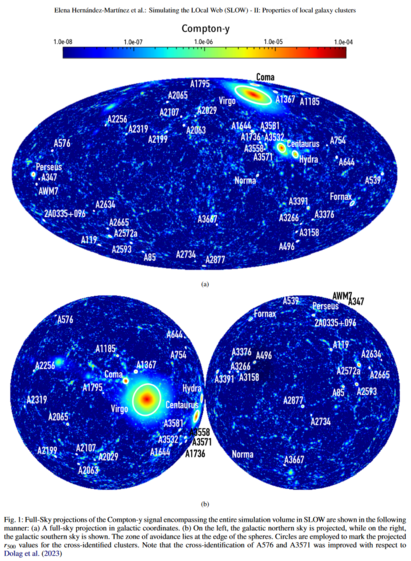
Simulating the LOcal Web (SLOW) II: Properties of local galaxy clusters

This is the second paper in a series presenting the results from a 500 $h^{-1}$Mpc large constrained hydro-dynamical simulation of the local Universe (SLOW). The initial conditions are based on peculiar velocities derived from the CosmicFlows-2 catalogue. The inclusion of galaxy formation treatment, allows to directly predict observable properties of the Intra-Cluster Medium (ICM) within galaxy clusters. Comparing the properties of observed galaxy clusters within the local Universe with the properties of their simulated counterparts, enables us to assess the effectiveness of the initial condition constraints in accurately replicating the non-linear properties of the largest, collapsed objects within the simulation. Based on the combination of several, publicly available surveys, we identified 45 local Universe galaxy clusters in SLOW, including the 13 most massive from the Planck SZ catalog and 70% of those with $M_{500} > 2\times 10^{14}$ M$_{\odot}$. We then derived the probability of the cross identification based on mass, X-ray luminosity, temperature and Compton-y by comparing it to a random selection. In relation to previous constrained simulations of the local volume, we found in SLOW a much larger amount of replicated galaxy clusters, where their simulation based mass prediction falls within the uncertainties of the observational mass estimates. Comparing the median observed and simulated masses of our cross identified sample allows to independently deduce a hydrostatic mass bias of $(1-b)\approx0.87$. The SLOW constrained simulation of the local Universe faithfully reproduces numerous fundamental characteristics of the galaxy clusters within our local neighbourhood, opening a new avenue for studying the formation and evolution of a large set of individual galaxy clusters as well as testing our understanding of physical processes governing the ICM.

arXiv.org

Double-feature today! Who's interested in constraining the cosmological constant from the local universe?
If you happen to speak German, then this video is for you:
https://youtu.be/tq1yCibk2Rg?si=u7xRELjXPlFgtAQE
If not, here is a paper I co-authored that is a follow-up with more details and systematic tests for more two-body-systems:
https://arxiv.org/abs/2310.11488

#astronomy #Astrodon #science #scicomm #cosmology #LocalUniverse

Messung der Dunklen Energie in unserer kosmischen Nachbarschaft | Jenny Wagner

YouTube

🚨 Advance publication by Camila Franco, Felipe Avila, and Armando Bernui, in #MNRAS on probing isotropy in the Local Universe, using the Arecibo ALFALFA survey data: study finds a signature of the Dipole Repeller we discovered back in 2017. That's just great!
https://doi.org/10.1093/mnras/stad3616

#dipolerepeller #cosmology #cosmography #cosmicflows #isotropy #universe #localuniverse #astrophysics #astronomy #astrodon #arecibo #arecibotelescope #alfalfa #survey #space #science #research #knowledge

Probing cosmic isotropy in the Local Universe

Abstract. This is a model-independent analysis that investigates the statistical isotropy in the Local Universe using the ALFALFA survey data (0 < z < 0.0

OUP Academic