Archive from October 2024: Looking forward for 2025!

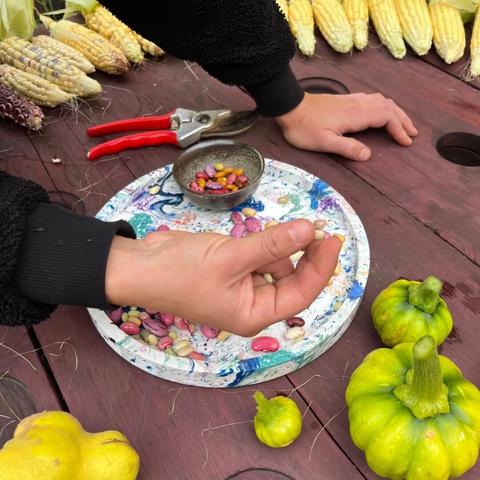
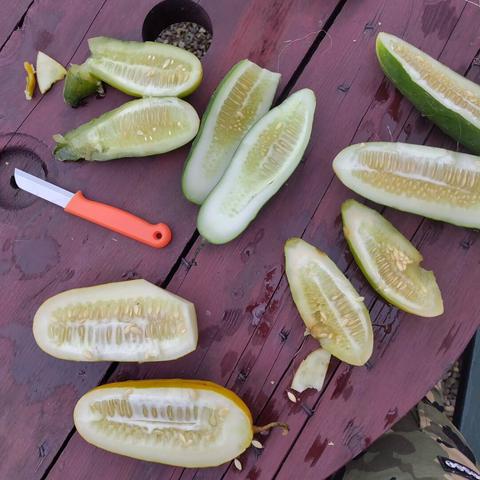
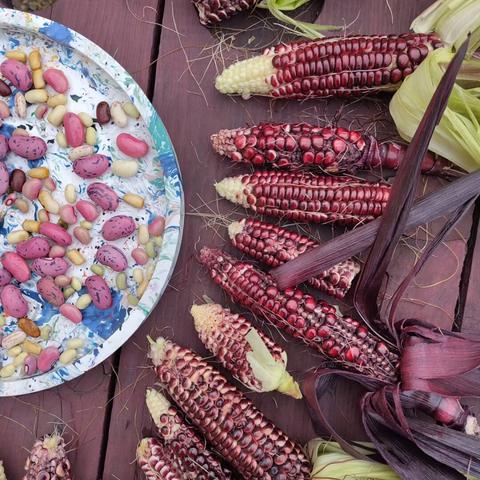
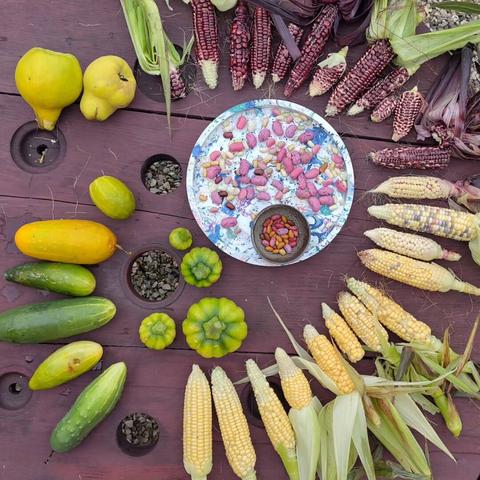
I'm locally adapting plants to my garden. This is the harvest of my first year. I got seeds from a serendipity seed swap (farmer seeds from different places in the world!).
I planted plants of very diverse genetics together: many varieties of sweet corn, many varieties of cucumber, pumpkins, beans etc. Many plants died, grew too slowly or didn't even germinate. That's part of the plan. Those that survived show me that they enjoy and fit my local conditions. They cross pollinated with each other. Their seeds are precious to me: I collect them and will plant them next season. Within 2 to 3 years, I'm expecting more abundance and will start selecting for flavour and other fun stuff of my liking. I also want to select for drought tolerance and climate change resilience.
In the meantime I'd love to exchange seeds with neighbors and friends.
This is nothing new but a very ancient and community based plant breeding technology. It's a lot of fun as well.

Big learning this year: my season was too short. Next year I want to help my plants better and give them a good time to grow. I'll start germinate in April, I promise maman

#adaptivegardening #landracegardening #localadaptation @goingtoseed1
New publication: Plant–soil interactions during the native and exotic range expansion of an annual #plant.
#rangeshift #climatechange #sustainablelanduse #biodiversity #evolution #globalchange #invasion #localadaptation
https://doi.org/10.1093/jeb/voae040
Plant–soil interactions during the native and exotic range expansion of an annual plant

Abstract. Range expansions, whether they are biological invasions or climate change-mediated range shifts, may have profound ecological and evolutionary co

OUP Academic

Is it typical for the effect of deleterious mutations to be conditional on environment? Mee et al. think so, and show that the accumulation of conditionally deleterious mutations ("CD load") has some important implications for studies of local adaptation. https://www.journals.uchicago.edu/doi/10.1086/730186

#mutations #environment #deleteriousMutations #localAdaptation

It seems we are caught in the gulf between what we want to impose on the world, and what the world actually wants from us.

Related: this conflict arises when we refuse to perceive that which we cannot measure.

Call it #LocalAdaptation, #Permaculture, #Indigenous, #SystemA; when we pay attention, we are invited to participate in a system that creates health for the whole, rather than struggle against a system that wants to turn our very life force into commodities.

A great review of the importance of Clausen, Keck & Hiesey's work on our understanding of #evolution, and their connection to (and neglect in) the #modernSynthesis.

Dissects their perfection of common garden #experiments, and contributions to our understanding of #adaptation ("one of the first field verifications of #localAdaptation by #naturalSelection"), #plasticity, #speciation, #polyploidy, #genetic architecture of trait variation.

And an excellent read.

https://www.journals.uchicago.edu/doi/abs/10.1086/420540

Evolution in Changing Environments: The

The studies of Clausen, Keck, and Hiesey (CKH) have been widely cited as exemplars of ecotypic differentiation in textbooks and in the primary literature. However, the scope of their findings and achievements is significantly greater than this. In this paper we analyze the research program of CKH, highlighting their major findings during the years when the modern synthesis of evolution was taking shape. That synthesis, curiously, drew little from their examples, although their studies at the Carnegie Institution represent conceptual and methodological work that is still relevant. The works of CKH not only embodied the principles of the nascent synthesis, but often provided needed supporting data. Their classic work, especially on Achillea and Potentilla, produced abundant evidence on population differentiation of many quantitative traits and plant phenotypes, as well as demonstrating the now commonly reported distinction between environmental and genetic determination of traits. Their ecological genetic investigations of quantitative traits in plants were in sharp contrast to contemporaneous animal studies on adaptation that focused on discrete polymorphisms-with correspondingly little influence of the environment on phenotypic expression. Of utmost importance was the demonstration by CKH of adaptive differentiation by natural selection and their approaches to understanding the genetic structure of populations.

The Quarterly Review of Biology
Spent an amazing day in the field with Daniel Ortiz-Barrientos (@dortizba) and his lab looking a populations of Senecio lautus that are locally adapted to headland versus sand dune habitats. You can read about some of their latest work in this recent paper: https://www.pnas.org/doi/10.1073/pnas.2004901118 #Evolution #LocalAdaptation #Speciation #plants #Australia

#introduction
 
Hi everyone 👋
I’m a postdoc in evolutionary biology working at #ColoradoStateUniversity.

I use experimental evolution with different #insects 🪰🪲 to study how populations #adapt to new environments. My main interests are #LocalAdaptation, #EvolutionaryRescue, #Adaptation and #PhenotypicPlasticity.

Can’t wait to follow new people here and talk about #ecology and #evolution.

Final revisions are finally incorporated so I'm sharing again!

Local Adaptation: Causal agents of selection and adaptive trait divergence

in Annual Review in Ecology, Evolution, and Systematics, coauthored with @SeemaSheth, @Emjo, Jill Anderson, and Megan DrMarshe.

Free access here: URL: http://www.annualreviews.org/eprint/BSW6GNXHHXPMFYNPZRET/full/10.1146/annurev-ecolsys-012722-035231

#LocalAdaptation #NaturalSelection