When the brakes don’t work: the thread about runaway trams

On this day in 1918 (June 23rd when written) there was an “Extraordinary Tramway Incident” in Edinburgh as a result of which, miraculously, nobody was hurt. This was the days of cable traction, when the city’s public transport wound its way slowly and noisily around the streets hauled by an endless loop of moving cable beneath the setts.

Edinburgh Cable Car on route 2, Gorgie Road. Unknown photographer, 1920, © Edinburgh City Libraries

It was just after 10 O’clock in the morning and an empty car (they were always called cars, never trams) was standing awaiting its next service at the Braids terminus, near where Comiston Road meets Braid Hills Road. The driver and conductor were on their break in the adjacent shelter (a replacement version of which is still there to this day). But the vehicle’s mechanical brakes had not been fully set and, imperceptibly slowly at first, the car began to creep away down Comiston Road towards the City.

The tramway shelter on Comiston Road, with a cable car waiting at the former line terminus.

The driver and conductor gave chase as soon as they noticed but were already too late and were unable to catch it as it began to speed up. The cable which moved the tramcars when in service was attached to by means of a mechanical “gripper” and whizzed anything attached to it along at a rather sedate 9½ mph (to which it was limited by Board of Trade regulations). The downhill runaway quickly passed this limiting speed and quickly caught up with the car running in service ahead of it. Fortunately there were no passengers aboard. The conductress saw the approaching danger, called a warning to the driver, and sensibly jumped for it. The inevitable collision happened and the two cars became entangled together. Luckily neither derailed. Less fortunately the driver – who had heroically stayed at his post – found that the gripper which connected his car to the traction cable had become jammed; the conjoined wreckage was thus firmly attached to the cable and was being hauled inextricably towards busy Morningside at a slightly less than terrifying nine and a half miles per hour. The danger was still real however as this was where Comiston Road changed from rural to dense urban in nature and the driver now had no way to stop at any approaching junctions, for any other tram cars ahead of him or to slow for any obstructions such as pedestrians, cyclists, horses, children crossing or workmen carrying sheets of plate glass across his path like they did in the movies then.

1918 Post Office map of Edinburgh, rotated to align Comiston Road on the long axis (it actually points north:south). The Braids terminus is on the left where the line representing the tramway peters out, Belhaven Terrace on the right at Morningside Station. Reproduced with the permission of the National Library of Scotland

At Belhaven Terrace, just one mile from where the runaway had started, there was a set of points manned by a pointsman for switching the cars which had terminated at Morningside Station between tracks. The driver managed to call out his predicament to the pointsman as he sailed helplessly past. The pointsman’s hut had a telephone connection to the winding house at Tollcross which was powering the cable and after a brief call the winding engine was stopped. This brought the runaway – and half of the tramway network in the south and west of the city which shared that cable – safely to a halt. It took time to untangle the damaged cars and extricate the gripper from the cable but within an hour and a quarter from the start of the incident the network was back up and running again as if nothing had ever happened. Sadly no further details were reported in the papers

West Tollcross – showing Central Halls on the right and to its left the Tramway Power Station. J. R. Hamilton, 1914. This is a photograph by a member of the Edinburgh Photographic Society © Edinburgh City Libraries

Runaways tramcars were fortunately very rare, but not unheard of. In April 1890 a horse-drawn vehicle had ran away down Montrose Terrace in the east of the city. One of the animals fell but its panicked companion dragged it and the tramcar along the ground a further 1,000ft before coming to rest outside the Abbey Church. “The passengers, who were greatly alarmed, were not, however, injured”. The same cannot be said about the poor fallen horse, as “on examination it was found… [to] not likely be of any more use.” Sadly it was probably a one way ticket to Cox’s Glueworks in Gorgie for that victim.

Horse tramcars on Princes Street, late 19th century. The lighter coloured car is heading for Morningside © Edinburgh City Libraries

On September 30th 1909 a cable tramcar was involved in a potentially much more deadly accident at Waterloo Place. The car approached the terminus from the direction of Abbeyhill to pick up passengers from a large crowd intending to travel to Musselburgh for the races, but failed to stop in the right place. The driver brought it to a halt further on at the top of Leith Street – outside the General Post Office – and got out to inspect why it had failed to stop in the correct place. The curious and frustrated crowd naturally gravitated towards the vehicle to see what the problem was and if they could board it.

The Waterloo Place tramway terminus for cars to Portobello and onwards to Musselburgh, decorated in 1903 for the coronation visit of King Edward VII and Queen Alexandra © Edinburgh City Libraries

Perhaps the driver prodded around underneath too hard, or perhaps an onlooker knocked something they ought not to have, but in an instant the car suddenly lurched back in the direction of Waterloo Place – and the thronging crowd – seemingly attached to the return cable by forces unknown. The vehicle ploughed through the crowd resulting in six people (including three police men) being injured. Again it was lucky that cable haulage did not work at faster speeds. But all was not yet over; “just at that moment a motor car.. appeared on the scene“. The motor became entangled in the front of the tramcar and was dragged along the road by it for thirty yards. The driver jumped clear, narrowly avoiding behind run over by another tramcar coming up Waterloo Place from Regent Road. And then, as soon as it started, the excitement was over: the tramcar released its unexpected grip on the traction cable and the tangle of public and private transportation ground to a halt.

Laurel and Hardy come off worst from an interaction between motorcars and tramcars

Of the four hospitalised, three had been in the car; the driver Archibald Carmichael and his passengers John McArthy and James Paton, through for the day from Gourock and Port Glasgow for the races. The fourth was a pedestrian, Mrs Mathieson of Gayfield Square. This wasn’t the result of black magic or enchantment however as a simple explanation was soon found. As the tramcar had approached Regent Road it had to switch between traction cables by releasing one cable with the rear gripper and grabbing the other with the front gripper (each tramcar had a front and rear gripper to attach itself to the cables.) At it had moved across the junction where Montrose Terrace branched off London Road the gripper had damaged the cable running in the slot between the rails. This had cut into some of the wire strands which had came started to unravel, preventing the gripper from releasing properly when the driver tried to stop on reached Waterloo Place. The fraying cable meantime had run around the pulley and come back towards the now stationary tramcar from the opposite direction and when the tangle of loose strands passed through the released gripper they quickly became tangled in it and enough unravelling wire built up to suddenly start the car in motion again in the return direction.

1907 Post Office map of Edinburgh. Waterloo Place is on the left above Waverley Station. The tramcar had approached from the east (right) and had damaged the cable when it diverted off London Road at Cadzow Place up Montrose Terrace towards Regent Road (the junction is at the right of the map, near where Abbehill Station is marked). Reproduced with the permission of the National Library of Scotland

It would prove to be a bad day for the Edinburgh & District Tramways Co. and there had already been an accident earlier that morning when at 11:40AM a car overshot a set of points and collided with the pawl near the Abbey Church between Abbeyhill and Meadowbank. This was an emergency stop device mounted in the traction cable slot beneath the road surface which, if it was hit by a tramcar gripper, detached it from the traction cable and brought the tram to a very instant stop. The pawl was a violent but important measure which prevent the gripper from entering and becoming entangled in the large underground pulleys around which the cable ran. The shock of hitting the pawl in this case was severe enough to snap the car’s front axle. But these were different and more efficient times; the tramway depot at Shrubhill simply sent out a gang with a complete new bogey, which they swapped out at the side of the road in Abbeyhill before getting the car quickly back in service.

Cable tramcar No. 150 passing the Abbey Church in Abbeyhill, c. 1900. It is heading east down London Road towards Meadowbank. SC1592743 via Trove.Scot

The return to service lasted just 15 minutes following the accident before the network had to be stopped again! A tramcar going from the Bridges to Leith Street had collided with another motor car and once again the pair became entangled and took some time to clear. This was the third and final accident of the day.

An altogether more tragic runaway accident took place on Saturday 17th October 1925 when an electric tramcar proceeding down a single line section on Ardmillan Terrace ran away and jumped the points at the foot of the hill, crashing into St. Martin’s Episcopal Church. Young Edward Stirling, aged just 8, had been out to buy a toy train for his brother who was in hospital. He was killed instantly when struck by the tram and was buried in Saughton Cemetery on Wednesday 21st. The tram driver, 3 passengers and another pedestrian were hospitalised. The Corporation sent a wreath and his funeral was attended by Councillor Mancor, Convenor of the Tramway Committee and R. S. Pilcher, the general manager of Corporation Tramways. The Lord and Lady Provost sent a letter of sympathy. A subsequent Board of Trade enquiry found no fault with the tramway equipment or tramcar and did not apportion blame to the driver, who had tried to use the resistance brake to slow the tram followed by the hand brake. There was some popular discontent with the Tramways, a correspondent by the pen name of A. Mother wrote to the ‘News to complain about the speed of the electric trams – “too fast for either safety or comfort“- and to protest about plans to increase their speed even further.

The next runaway took place in spectacular fashion on Saturday June 1st 1929. Miraculously, nobody was injured when car No. 349, waiting at the Liberton terminus with no crew but four elderly passengers aboard ran off down Liberton Brae. Anyone who has ever tried to cycle up (and down) that road can attest just how severe the gradient quickly gets! As the crew availed themselves of the facilities in the terminus shelter they didn’t notice their vehicle slowly begin to roll off down the hill; they had not applied the mechanical hand brake and the pressure had leaked out of the air brake hose causing it to slowly release.

Former tramway terminus shelter at Liberton Gardens, on Liberton Brae.

The four passengers (aged 59, 71, 71 and 84) were subjected to a terrifying half mile ride down the Brae before No. 349 came to the corner at Alnwickhill Road, jumped the tracks, slid across the road and pavement and impaled itself on a pole for the overhead wires before caming to rest in the garden of 42 Liberton Brae.

No.349 in the garden of 42 Liberton Brae after the accident of June 1st 1929. © Edinburgh City Libraries

Quite how only one passenger suffered only light bruising and all four had walked away from this defies logic. Indeed the two 71 year olds who had been aboard, a married couple from Leith Walk, simply waited for the next car and carried on home as if nothing else had happened. The house at number 42 was similarly unscathed, although the same could not be said for its garden wall, gate and neat privet hedging.

A News photo of No.349 in the garden of 42 Liberton Brae after the accident of June 1st 1929

As a result of this incident protective barriers were installed on the corner outside numbers 42 to 46 where they remain to this day; the dents in their metalwork show they still serve their intended purpose well.

Crash barriers, No. 42-48 Liberton Brae

Six years later, in 1935, an accident took place only a few hundred metres down the Brae at Braefoot Terrace. The current collection pole of a tramcar proceeding uphill became dislodged from the current wire and the vehicle lost power and ground quickly to a halt. The trailing SMT bus was following too closely to stop in time and swerved off the road to avoid a collision. Instead it demolished the shopfronts of a James Baxter’s butchers, Adam Smith’s chemist and the branch of the Commercial Bank of Scotland. There were fortunately no major injuries; the butcher’s boy had a lucky escape as he had just been sent outside to clean the windows only to find a thirty-two seater bus baring down on him. He was able to jump clear in the nick of time.

On 25th October 1945, 64 year old Brownlow Grigor of Leith, a Corporation tram driver with 30 years experience was fined £3 by the Burgh Court for “having driven a tram culpably and recklessly“. Grigor was in charge of car No. 42 and had not been paying sufficient attention as he was trying to stow away his thermos flask. He had approached the sharp bend where cars travelling between Morningside and Marchmont turned off Church Hill and onto Greenside Gardens too fast and the laws of physics did the rest. His vehicle jumped the tracks and demolished a 24-foot section of the wall of – coincidentally – number 42 Greenhill Gardens. The embarrassment was all the more severe as this house was St. Bennets, the official residence and private chapel of the Roman Catholic Archbishop of Edinburgh and St. Andrews! Grigor’s claim that it was defective rails that were at fault was not upheld.

1945 Ordnance Survey town plan of Edinburgh showing the traamway winding its way from Church Hill to Strathearn Place via Greenhill Gardens. Number 42, marked “RC Chapel (Private)” is St. Bennet’s, official residence of the Archbishop. Grigor’s car had jumped the rails as it made the sharp turn in front of it at too high a speed. Reproduced with the permission of the National Library of Scotland

Our last calamity took place in 1951 and it was the heroic figure of James Ferguson, a 53 year old worker from Portobello Power Station, who averted a real catastrophe. The busy tramcar he was on was hit by a lorry near Piershill which injured the driver and caused him to lose consciousness. Ferguson leapt to his feet, ran the length of the car, punched through the glass door to the driver’s compartment with his bare fist and let himself into the cab to disengage the power lever and apply the brakes. Ferguson was treated in hospital for cuts to his hands but was otherwise unscathed.

https://www.flickr.com/photos/127340508@N05/26917130321/in/photolist-226kxHm-2nsTewY-2nTHjmS-2hfcDKE-2iU8A9N-2jDXFBt-2n4mPiw-2n5L7wp-2j2SqzQ-QWjur3-UCFFfN-D5VnNV-dZN3tD-2iriC1Q-2eqrcdo-JXr4pn-DmKy8a-awA1sk-nwjsJs-awACNn-SETEZM-86nFZc-XaX2By-n1khke-2gwCUbu-QMWmmF-SYsgsg-KR12f3-e8bKFa-DwCURs-H1zk4P-E5T5Gs-2oCJnjm

If you have found this useful, informative or amusing, perhaps you would like to help contribute towards the running costs of this site – including keeping it ad-free and my book-buying budget to find further stories to bring you – by supporting me on ko-fi. Or please do just share this post on social media or amongst friends.

Explore Threadinburgh by map:

Travelers' Map is loading...
If you see this after your page is loaded completely, leafletJS files are missing.

These threads © 2017-2026, Andy Arthur.

NO AI TRAINING: Any use of the contents of this website to “train” generative artificial intelligence (AI) technologies to generate text is expressly prohibited. The author reserves all rights to license uses of this work for generative AI training and development of machine learning language models.

#Lochend #Logan #Restalrig #StMargaret
Mount Alvernia: the thread about the “Princesses of Poverty” would not leave Liberton in life or in death

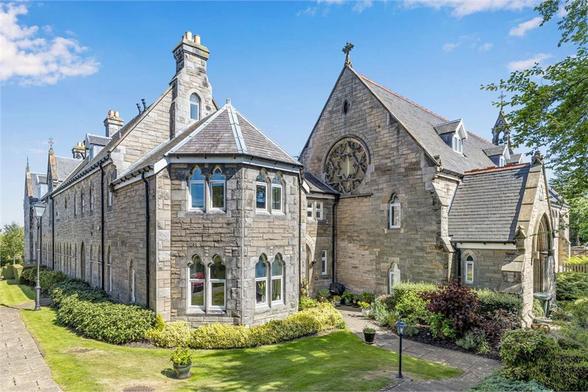
Every so often houses come up in Liberton on the Edinburgh property listings for a charming-sounding place called Mount Alvernia. You don’t have to look twice to guess that this development has been converted from some sort of past ecclesiastical use. And you’d be right, it was once a monastery. But it had no monks: it was home instead to a community of nuns. Perhaps more unusually, two times the authorities of the Catholic Church tried to use legal methods to displace these “Princesses of Poverty“. And twice they failed!

Estate agent’s photo of a nice-looking housing development in Liberton, which quite obviously appears to have been converted from some sort of ecclesiastical building.

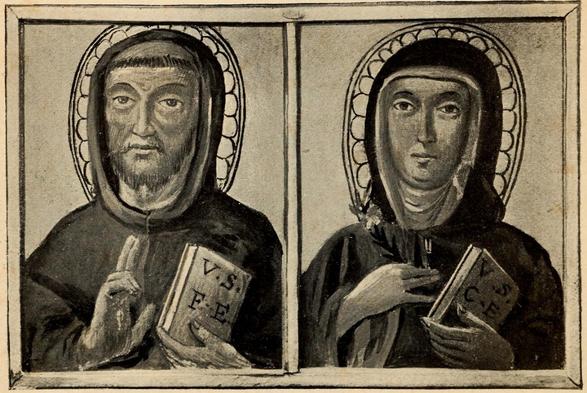
This monastery was opened in August 1897 by nuns of the Poor Clares (Colletines), a branch of the Order of Saint Clare. This order takes its name from St Clare of Assisi who founded it for women who gave up their worldly possessions to devote themselves to the spirituality of St Francis of Assisi. Mount Alvernia itself is in Sicily and its name is associated with the Franciscan order.

St Francis and St Clare, inside cover plate from “Princesses of Poverty: Saint Clare of Assisi and the Order of Poor Ladies” by Father Marianus Fiege, 1900

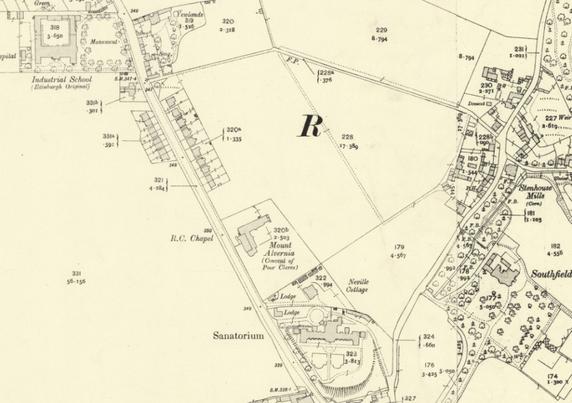
Six Poor Clares had come to Edinburgh in July 1895 to found a new house north of the Border. They had traveled from Baddesley Clinton in the West Midlands, where their order had established itself in England in 1850 for the first time since that country’s reformation. Two acres of ground at Liberton was acquired for their purpose, adjacent to Mount Vernon House which had recently been occupied by nuns of the Society of the Sacred Heart as a Home for Penitents and where a Roman Catholic Cemetery had been established. It was noted at the time that this site was particularly suitable owing to its proximity to the ancient estate of the Convent of St. Catherine of Sienna.

Ordnance Survey 1:25 inch map, 1914, of Edinburgh, centred on Mount Alvernia at Liberton

These Poor Clares were a closed, contemplative order who took solemn vows to lived a life of poverty. They fasted frequently and rejected the wearing of shoes. They observed continual silence and did not leave their cloister. They devoted themselves entirely to the worship of God and prayer for all people, particularly the suffering and needy. The rules of their house prohibited them being supported by endowments and instead they lived entirely upon charity. To facilitate communication between the Intern Sisters – those within the cloister – and the outside world there were a small number of Extern Sisters, who lived in quarters adjacent and to which they were not restricted. The Externs helped support the community through the baking of communion bread (St Clare and her order have a particular association with blessed loaves), producing handmade religious scrolls and through practical tasks such as marketing eggs and undertaking secretarial services.

The foundation stone of the monastery was laid by Archbishop Angus Macdonald of St Andrews and Edinburgh on 19th May 1896. The buildings were in a Collegiate Gothic style to the designs of A. E. Purdie, a London Architect, and it was built from local Craigmillar Stone faced with Dunfermline Stone.

Artist’s impression of the Monastery at Mount Alvernia from the Edinburgh Evening News, 15th May 1896

In a Presbyterian city, whose Catholic minority was notably poor, the nuns struggled to attract alms and the first 20 years of their existence saw a considerable debt being acquired. £1,384 was raised in time for their Silver Jubilee in 1920 to clear it. The money had been entirely collected by two local men, Bernard Flannagan and a Mr Higgins. However just 5 years later the community was in distress once more and the Glasgow Observer and Catholic Herald carried an urgent appeal for help, “their distress was never more pronounced“. Once more, Bernard Flannagan acted as collector on their behalf.

For 33 years, Mount Alvernia‘s resident chaplain was Rev. Father Patrick McMahon (1863-1945) and his golden jubilee of service was celebrated there in March 1938. But all was not well behind the closed doors of the cloister and an irreconcilable schism, brewing since 1934, had arisen between the five Extern Sisters (Sister Margaret Mary Clare – Agnes Burns; Sister Marie Colette Theresa – Laura Elizabeth Harrison; Sister Mary Clare – Edith Harris; Sister Mary Theresa – Catherine Morgan; and Sister Mary Joseph – Susan Higgins) and the 17 Interns, which included the Abbess and the Vicaress. The Externs Sisters refused to submit to the authority of the Abbess and had chosen Sister Mary Clare as leader, from their own ranks. The Archbishop of St Andrews and Edinburgh, Andrew McDonald, was unable to resolve the situation and took the drastic action of closing the monastery and dispersing the sisters to other houses.

Archbishop Mcdonald in 1920, when Abbot of St Benedict’s Abbey at Fort Augustus; By William Drummond Young. CC-by-SA 4.0, Blairs Museum via Wikimedia

The Diocese served notice for the community to leave in April 1938. The Intern Sisters left a week later but the Externs refused to go. The Church then had a Sheriff’s writ served evicting them from their home and cut off their electricity and gas. They were banished from their order and excommunicated. Sister Mary Clare, leader of the Externs, told the Evening News that they had been served a letter by the Church’s law agent informing them of their expulsion and stating they were no longer entitled to wear their habits. They were to return these on or before the 28th April in exchange for the sum of £10 towards replacement clothing and a pension of £1 10s per week, for just 13 weeks, to help them establish themselves in civilian life.

St Clare repelling the Saracens, plate from “Princesses of Poverty: Saint Clare of Assisi and the Order of Poor Ladies” by Father Marianus Fiege, 1900

Despite threats from the Church to withdraw even this pitiful pension the Extern Sisters remained defiant; they had made their vows and the Priest had commanded their Abbess” Receive this new spouse of Christ, keep her and guard her pure and spotless until you present her at the judgement seat of God. To Him you will have to give an account of her soul“. In short, their vows were sacred and perpetual and to leave the Monastery to return to civilian life would be breaking them. “Rome, and Rome alone, we must obey“, Sister Mary Clare told the Evening News, “Here we will live and here we will die.” The Externs intended to challenge their eviction and “trusted an answer would come from God“.

Fresco of Saint Clare and nuns of her order praying, Chapel of San Damiano, Assisi

That answer came in the form of their supporters whose number included the lawyer Doull Connolly, who acted for them and organised a defence at the Sheriff Court. A sympathetic cardinal Cardinal was written to, asking him to make an appeal to the Pope on their behalf. The Archbishop of Glasgow decided the Externs were not excommunicated in his jurisdiction and gave them the sacraments, for which transport was arranged thrice weekly. Even the local coalman slipped them a couple of bags every fortnight. While the dispute split opinion amongst Scotland’s Catholics, in Edinburgh it aroused considerable curiosity; numerous sightseers took a trip to Liberton to see Mount Alvernia for themselves, to bring gifts and to offer their support to the nuns within through the grille of the Monsastery’s doorway.

The case went to the Sheriff Court where T. J. D. Connolly acted as defence advocate. On July 5th Sheriff Substitute James Macdonald KC ruled in favour of the Extern sisters, who told the Daily Record that they hoped to be left in peace, but the Church appealed.

SUMMARY EJECTION NOT ALLOWED. Evening News headline, 6th July 1938

That appeal was heard in the Court of Session the next year. Connolly told that court the case, with 2 churchmen and 2 nuns as pursuers and 5nuns as defenders, was “unique” in its annals. On June 14th Lord Robertson held the defence was irrelevant and granted a decree for the Nuns removal.

EDINBURGH EXTERN NUNS MUST REMOVE. Evening News headline, 14th June 1939

The nuns appealed in turn and in March 1940 – on the same day that the Evening News reported 2 German bombers had been shot down in the North Sea – it also reported the case had been concluded in their favour and Lord Robertson’s decision was overturned.

LIBERTON NUNS WIN APPEAL. Evening News headline, 29th March 1940

The Externs could finally live on in piece, and alone, at Mount Alvernia. This they continued to do for over a decade until the early 1950s when a determined effort was made by Archbishop McDonald’s successor, Archbishop Gordon Gray, to heal the rift and re-open the Monastery to Interns. Two of the Extern holdouts were amongst the first Interns of the re-established Monastery, the other three agreeing to move to new homes in England at this time.

Portrait Of Cardinal Gordon Gray (1910 – 1993), Former Archbishop of St Andrews And Edinburgh

The re-established Poor Clares got on with their holy lives in peace and harmony until the decision was taken by the Abbess Mother Frances to close the monastery in 1992. Their ranks had dwindled from 22 to 13 and those who remained were of advancing age and unable to support themselves. A final Mass was given by Bishop Kevin Rafferty on 28th August. Their community was dispersed to other houses of the order, but left behind the bodies of the 24 nuns who had died during their lives at Mount Alvernia and who had been laid to rest in its burial ground.

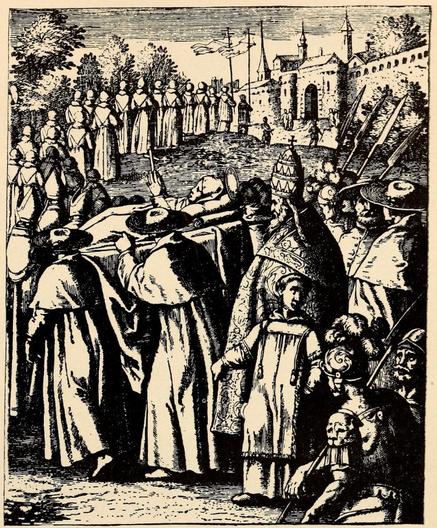
The Funeral Procession of St Clare, plate from “Princesses of Poverty: Saint Clare of Assisi and the Order of Poor Ladies” by Father Marianus Fiege, 1900

The premises were sold for £200k to the “Pastoral and Social Charity Ltd”, whose board was bishops and archbishops of the Scottish RC Church. They provoked outrage in 1994 when they proposed disinterring the 24 nuns laid to rest at Mount Alvernia and moving them to nearby Mount Vernon cemetery

Contemporary newspaper photo of the Mount Alvernia burial ground. Edinburgh Evening News, 23rd September 1994

The removal of the nuns’ remains was to prepare the site for sale to developers – they contented that future developers would be at liberty to remove headstones or cover the grave plots. But when the petition for the warrant to disinter came before the Sheriff Court, the District Council objected and were ordered to advertise it in the press to try and trace any relatives of the nuns (which was something in which the Pastoral and Social Charity had failed in its attempts).

Legal Notice inserted in the Scotsman, 15th March 1994, of the petition to disinter the nuns buried at Mount Alvernia

Of the nuns in question were Mother Mary Joseph (Susan Higgins) and Sister Mary Clare (Edith Harris) – who were the 2 Extern sisters who had been involved in the 1930s court battle and had become Interns when the house was re-established. Relatives were duly identified, including Sister Mary Clare’s great niece, and they appealed against the petition. Their objection noted the findings of the Court of Session in 1940 that when a woman joined the order, she bound herself “to live her whole life in the convent, thereafter being laid to rest within the convent grounds“.

Richard Carson, the Director of Environmental Services for the District Council submitted that four of five of the bodies in question would be in “horrific condition” due to having been buried relatively recently, the last in 1991, and stated that the District Council was willing to take on stewardship of the burial ground as it had done for other sites in the city. After hearing from both sides, the Sheriff Peter McNeill QC threw the Church’s petition out on the grounds insufficient evidence had been provided that the sale of the site was contingent on the burial ground being cleared. He ruled that “the remains were sacred” and could only be moved if a pressing reason could be proven. Veronica Harris told the Evening NewsIt’s a sign of the greed of this century that people can dispose of the remains just to make a fast buck” and that it was a “great relief” that the disinterment would not go ahead.

Mount Alvernia in 1998, after six years of closure, neglect and vandalism having taken its toll.

In 1998 planning permission was granted by the District Council to AMA (New Town) Ltd to redevelop Mount Alvernia for housing on condition the burial ground be walled off and maintained. The ever tasteful Daily Record reported this under the headline “Tomb With a View”.

Mount Alvernia, viewed from the burial ground, with the modern flats on the right, chapel on the left and range of the monastery between.

“Rest in Peace. But be Quick About it. Hallowed ground now bears a sell-by date and the grave is not necessarily forever.”

Annette McCann, Scotland on Sunday, 29th January 1995

If you have found this useful, informative or amusing, perhaps you would like to help contribute towards the running costs of this site – including keeping it ad-free and my book-buying budget to find further stories to bring you – by supporting me on ko-fi. Or please do just share this post on social media or amongst friends.

These threads © 2017-2026, Andy Arthur.

NO AI TRAINING: Any use of the contents of this website to “train” generative artificial intelligence (AI) technologies to generate text is expressly prohibited. The author reserves all rights to license uses of this work for generative AI training and development of machine learning language models.

#Catholic #Church #Court #Edinburgh #Liberton #Monastery #Nuns #Written2025
Рейтинг мультиварок 2024: найкращі моделі

Мультиварка дає можливість приготування різних страв з мінімальною участю людини. Цей пристрій є особливо корисним для тих, хто обмежений у часі через роботу, навчання або інші обов’язки; невеликих сімей із дітьми; вегетаріанців та веганів (оскільки може використовуватися для приготування складних бобових та зернових страв). А якщо на дачі, новенькій квартирі, в орендованому житлі немає доступу […]

ITC.ua

Edinburgh survey on Police Leadership (Please complete and boost).

https://edinburghinformatics.eu.qualtrics.com/jfe/form/SV_9LhzQI2slXFtYEK

MSc Criminology student Grace Bell is looking for Edinburgh residents to complete a 15 minute survey on police leadership for a degree project.

Please help by completing at the link above!

#Edinburgh #Leith #Granton #Gorgie #Dalry #Sighthill #Corstorphine #Liberton #Craigmillar #Muirhouse #Silverknowes #Cramond #Sighthill #Colinton #Slateford #Oxgangs #Marchmont #Blackford #Morningside

Public Opinions of Police Leadership

This survey is part of a student research project within the University of Edinburgh. It seeks to understand public opinions of police leadership. Your survey responses will be reported as part of a final project within the Applied Criminological Research Methods Course at the University of Edinburgh.

The thread about Edinburgh’s roadhouses; when the glamour of art deco hostelries took on the Temperance Movement (and won!)

This thread was originally written and published in January 2024.

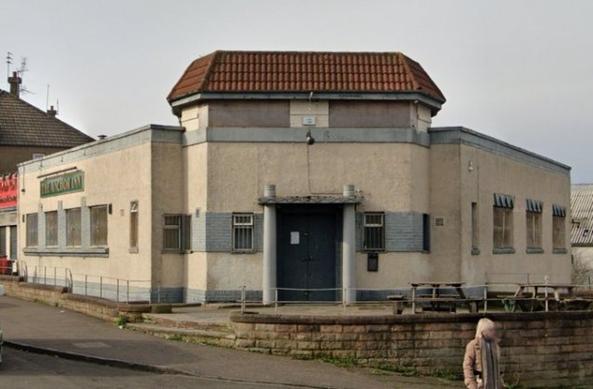
The pub in the picture below has been in the news for the wrong reasons recently but, despite its rather forbidding appearance these days, it’s a very important pub. It is a surviving example, serving its original purpose, of only a handful of such inter-war hostelries that were built in Edinburgh; the roadhouse. But these nine public houses didn’t just appear for no reason, they were the culmination of and response to a long political and social struggle around public drinking in the first half of the 20th century. Shall we unravel their story?

The Anchor Inn on West Granton Road.

The short version of the roadhouse story is this: they are a blend of 1930s architecture and design glamour that were used by the licensed trade to entice a new generation of sophisticated, Holywood-inspired, upmarket, car-driving drinkers. That’s partly true, but is by no means the full story.

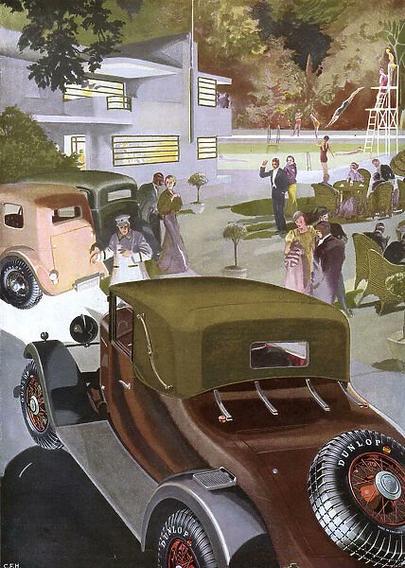
1934 Dunlop Tyres advert showing cars arriving at an Art Deco roadhouse. © Illustrated London News

To understand how Edinburgh got its roadhouses we have to go back to 1913 when the Temperance movement was at the peak of its power and the Temperance (Scotland) Act was passed. This was also known as the Local Veto Act as it allowed localities to force referendums on going dry – although this only applied to public houses, not restaurants or hotels. The veto ballots could be called by 10% of registered electors in a burgh, parish or ward petitioning for it. There were 3 options on the bill:

  • No Change, i.e. the area would stay wet
  • Limitation – there would be a 25% reduction in licences in the area
  • No Licence, i.e. prohibition

The No Licence option required a supermajority of 55% to pass, representing at least 35% of all electors in the area. If that hurdle failed to be passed, these votes were then counted towards Limitation.

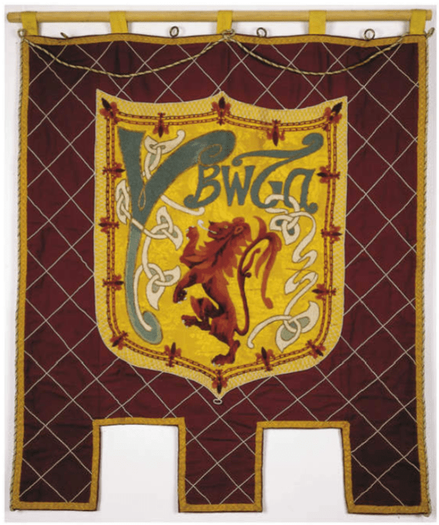
British Women’s Temperance Association banner of the Scottish Christian Union, 1900. © Edinburgh City Libraries

The Act had unforeseen consequences though: the brewers and licensed trade circled their wagons and got organised, forming defence committees to coordinate their response. They also put off investment in their estates in case of an unfavourable ballot; why spend money with the threat of a loss of licence hanging over you? As a result the quality of pubs got worse, not better. But the Temperance Movement had to wait until the conclusion of WW1 before making their next move. This came in 1920 to coincide with local elections and they launched their Pussyfoot Campaign to coordinate mass petitioning for local veto ballots across Scotland. This was named after an American prohibition campaigner who arrived in the UK in 1919, who had a tactic of pussyfooting around pubs incognito to gather evidence against them. And so in December 1920, Edinburgh (amongst many other Scottish localities) held its first Local Veto ballot. The terms of the act meant that public houses had to shut during polling hours. The Evening News reported record trade in Musselburgh as the city’s drinkers fled to the sanctuary of the Honest Toun for the day. 

“Edinburgh Drouths Annex Musselburgh”. Edinburgh Evening News – 6th December 1920

But after the last pint glasses had been emptied, the last drams downed and the ballot papers counted, the Temperance Movement were in for a disappointment: Edinburgh voted firmly for No Change in every ward – 68% overall. No Licence got 29%, less than half of what was needed, with a small minority voting for Limitation. The city would stayed wet. The Movement tried again in 1923 and although the polls shifted a few percent, once again every ward voted for a majority of No Change. Things were closest in Morningside where it was 51:46% between status quo and prohibition. You can spot something of a definite inner city / suburban and social order based split in the numbers.

Edinburgh 1920 & 1923 Local Veto Act, results for “No Change” by Ward.

So it was now 1923, 10 years since the Temperance Act was passed, and neither the Movement or the more moderate Reformers were any further forward in the city and the trade still refused to invest in their estates. And so the quality of pubs continued to deteriorate. Many in the trade did recognise the need to improve, however they wanted the threat of the 1913 Act pulling the rug from under their feet to be gone before they put their money where their mouths were. They were supported politically in this by reformers, led by Lord Novar in the House of Lords and Lord Salvesen of the Scottish Public House Reform League. The Reformers took as their template the New Model Inn developed by Harry Redfern for the Government in the Carlisle district after WW1 which aimed to use better design and an improved service offering to reduce drunkenness.

The Redfern Inn at Etterby, Carlisle

Despite the deliberately anachronistic appearance, these were a modern ideal of a public house, full of design innovations that we now take for granted. These included the practice of seated drinking around tables in open saloons where all corners and entries and exits could be viewed from the bar line; traditionally most pubs indulged in drinking standing around a small service bar, or in small rooms where what happened in the room stayed in the room. Public bars were accompanied by relaxed lounge bars, where women were tolerated in the company of their husbands, hot food was served and other wholesome diversions such as reading, writing and games rooms were included. The Scottish Reformers called these the Improved Public House on the Carlisle Model. Interestingly, they declined to follow a different but more local and established form of reformed public house; the Gothenburg. The Goth movement grew out of that city and had been established cooperatively across Scottish mining communities, but particularly in the Lothians and Fife. It is likely that the Goth principles were too Temperate and too verging on Socialism for the trade to accept.

The Prestongrange Goth, Prestonpans. CC-by-SA 2.0 Richard Webb

Reform was all well and good in practice, however the trade still had to get through the Licensing Courts, which were stuffed with conservatively-minded councillors who were frequently aligned with the Church and were heavily lobbied by well organised Temperance campaigners and their lawyers. The Courts were able to make it very difficult for new licenses to be obtained and all too easy for old ones to be lost. Over time they managed to reduce the overall numbers of licences in the City by granting fewer than were removed or expired.

The end result of all this was that there was a period of almost 20 years when no new pubs were built in Edinburgh. Things came to a head in 1933 when the President of the Edinburgh Local Veto Defence Association petitioned for a licence for a new inn in the new district of Balgreen. Robert Russell Hogg had kept a pub next to the City Chambers for 21 years, which the Corporation now wanted him to give up to allow them to extend that building. He pushed a test case to allow an Improved Tavern in an otherwise dry district as a direct challenge to Temperance – stipulating he wanted to be out of the city centre and in an area where he would not have to compete with established trade. Hogg was a keen reformer and stated he wanted “an inn after the English type, something the trade would be proud to have in Edinburgh“.

The Temperance Movement had thus far managed to keep all of Edinburgh’s new peripheral council housing schemes effectively “dry” by preventing licenses for pubs and off-licence grocers. They had a lot to lose here and rallied their troops; a petition of 181 owners and occupiers in the district against Hogg’s application was organised. The ministers of Saughtonhall Congregational Church, the Cairns Memorial Church and Stenhouse Church of Scotland all lodged protests. But lose lose they did, by 9-1 votes at the licensing court. And so on December 24th 1934, Edinburgh’s first newly built pub in at least 20 years opened; The Wheatsheaf Inn on Balgreen Road. It was in an Scottish interpretation of the Arts & Crafts style by architects Lorimer & Matthew. Hogg took out adverts calling it “Auld Reekie’s New Modern Inn“.

Promotional postcard for the Wheatsheef, showing interior of the establishment. Reproduced with kind permission of Sarah M (@sazz_mck).

When it opened it was almost 1/3 mile from the nearest house. It was spacious, with a large, open “tap room” with no corners that could not be observed from the bar line, a kitchen and dining room, a garden, car park and a flat for the landlord upstairs. To cock a snoot at the Temperance Movement, Hogg had an ornamental sculpture added with a legend taken from Omar Khayyam installed above the front door: “AND AS THE COCK CREW THOSE WHO STOOD BEFORE THE TAVERN SHOUTED OPEN THEN THE DOOR“.

Wheatsheaf, the main door was on the right, below the chimney and carving over the lintel. Picture by Fiona Coutts, via British Listed Buildings.

The Lord Provost was supportive of the new initiative, and hoped it would help put an end to the scourge of Vertical Drinking (or Perpendicular Drinking as he particularly called it). This was the practice of drinking standing around a serving hatch or bar (which many howffs at the time basically were), rather than seated politely around tables. The Improved Public House genie was now out of the bottle, but others in the trade held back a bit to see how Hogg got on. When it was clear he wad a success on his hands, others decided to join in on the action. The Licensing Courts sat twice a year and so the next two applications had to wait until April 1935.

First up was a widow, Mrs Johan Thom, who kept the Stenhouse Inn by Liberton. She wanted an Improved Pub to replace this old country tavern which she had run with her late husband and her application was successful. The Arts & Craft style Greenend Inn opened on Gilmerton Road on March 23rd 1936, but it has always almost been known by the nickname of its predecessor, The Robin’s Nest. You can see that particular bird on the prominent external sign. These elaborate, painted tavern signs were an import from England where the brewery trade had been trying to revive their ancient art. Mrs Thom had gone all out on the latest facilities, with lounge and public bars, a tea room, restaurant, “parking and accommodation for cars” and a skittle alley! The skittle alley (or space devoted to such other such traditional, wholesome games) would become something of a feature of the roadhouses.

The Greenend Inn, Edinburgh Evening News- 30 June 1936

The other application made at this time was something altogether different from these Arts & Crafts reinterpretations of the traditional Olde English country tavern, something instead inspired by the glamour of Hollywood and the ocean liner. This was the Maybury Roadhouse; “Scotland’s premier commercial establishment of the 1930s“.

Artist’s Impression of the Maybury Roadhouse. Edinburgh Evening News- 01 May 1935

Gone here were old world comforts of wood and the fireplace and in were sleek Streamline Moderne architecture (by Paterson & Broom) and the glitz of neon lights and jazz bands, the cocktail bar, the grill restaurant, the ballroom, balconies and a mezzanine gallery to watch it all from. As a nod to its ocean liner-influenced architectural styling, there was a rooftop garden complete with a quoits deck . The Maybury opened on 19th November 1936, despite 260 objections by the Temperance Movement and the usual protests of local ministers. Its licensees were Messrs P. McDougall, who had been in the trade for over 40 years, and it cost them £10,000 to build (c. £584k in 2023). Although sometimes referred to as a “roadhouse hotel“, actually a defining feature of the roadhouse was that they were not hotels, the Dundee Licensing Court defined them in 1937 as “a house which supplied all the services of the hotel without sleeping accommodation“. Certainly it was the ultimate expression of the roadhouse concept in Scotland, and endures (as a casino) as one of the finest monuments to Art Deco in the country. During WW2 it was a popular hangout for the officers from the nearby RAF base at Turnhouse and during renovation work in 1988 it was found that the roof structure had been damaged by gun emplacements fitted for the protection of that airfield during that conflict.

Maybury Gala Casino, CC-by-SA 2.0 Thomas Nugent

The scale and ostentatious glamour of the Maybury was a one-off, but it influenced subsequent applications in the city. Six months after its licence was granted, in October 1935, Mrs Jemima Hood Gair petitioned for a new roadhouse on Niddrie Mains Road to serve the housing estates there with all the latest features, including a billiards room. She had been in the trade herself for 11 years after the death of her husband and kept a licensed grocer at West Adam Street and a pub on Couper Street in Leith. The Temperance Movement were furious – this was a blatant attempt to introduce the public house to a housing scheme they considered to be dry (even though men who wanted to just went into town to drink) and sent in their lawyer, Duncan Maclennan SSC, to lead the objections. By 8 votes to 1, she prevailed, on the condition she relinquished her two existing premises, a compromise position that resulted in a net reduction in licences of one in the city. She was also obliged to serve hot meals as had been proposed. The White House opened on 18th October 1936, in an Art Deco style by Leith architects W. N. Thomson. It featured two public bars, a saloon, cocktail bar, a lounge bar, a skittle alley and billiards and darts rooms, as well as a cafe-cum-restaurant.

Opening announcement for the White House, Evening News, 22 October 1936. Mrs Gair is in the centre of the lower image, in the coat with dark fur lapels.

The April 1936 licensing committee takes us back where we started, the Anchor Inn on West Granton Road. This application, by James Birrell Rintoul, was approved that year to an Art Deco design by Thomas Bowhill Gibson, better known as a cinema architect (including The Dominion in Morningside). The Anchor is probably the furthest from the model of the Roadhouse of the lot; in reality it was just a modern and vaguely upmarket public house decorated with contemporary architectural details. The Temperance Movement were probably right to see it as merely a way to get a public house into an otherwise dry estate. They managed to make it a close run thing at the Licensing Court, again Duncan Maclennan SSC opposed, as well as all 36 church ministers in Leith. Rintoul relied on the casting vote of Lord Provost Gumley to get it through and was obliged to provide “hot luncheons, high teas, cooked food“.

The year following The Anchor, three roadhouse licenses were granted. The first to open was the Hillburn Roadhouse which was the project of John Maclennan Oman and his wife Nellie who kept a number of pubs across the city and been in the trade over 40 years. Despite it being, then, well away from anything else, they still struggled to get a licence and had to have it granted on appeal.

The Hillburn Roadhouse, a contemporary photograph provided by Colin Dale to a book by Malcolm Cant.

It featured all the usual roadhouse facilities, with three bars, a “first class restaurant” (serving luncheons, snacks, afternoon teas, grills, dinners, suppers etc.), an off-licence shop, car parking and “commanding a fine view of the Pentland Hills“. Latterly run as the Fairmile Inn and suffering the indignity of a Scottish & Newcastle ski chalet-themed 1970s refurbishment, the Hillburn sat empty for a number of years, unloved and unwanted, and was demolished in 2013. It’s the only Edinburgh roadhouse to suffer this fate.

Hillburn Roadhouse skittles alley. RIAS photo, picture from a book by Malcolm Cant

Johnnie Oman died in 1942. Nellie continued to run the Hillburn, living in the flat above, until retiring to the Grange in 1956. One of their other bars, the Duddingston Arms in Craigmillar, has long been known as Oman’s in their honour. It’s proximity to The White House can’t just be a coincidence, the Omans can’t have missed this new establishment along the road from them and were undoubtedly inspired by it.

Oman’s bar on Peffer Place. The finest glass brick pub facade in Edinburgh.

The following month after the Hillburn opened, James Daly opened the Abercorn Inn on the Portobello Road, near the Northfield and Piershill housing schemes. He too had to go to appeal to get permission for it. His establishment was back to the Arts & Crafts Style of the Robin’s Nest (and although I can’t find an architect name for either, I’d put money on them being one and the same)

The (former) Abercorn Inn. Photo © Self

It opened “in the Old English Style” on September 16th 1938 and had almost exactly the same facilities as its lookalike. The opening announcement proudly concluded that “Only First-Class Ales and Finest Whiskies and Wines Stocked“.

Opening announcement for the Abercorn Inn, 16th September 1938

The last of the trio of 1937 roadhouses opened on 11th October 1938, the House O’ Hill on the Queensferry Road at Blackhall. The licensee was Edward Cranston, a wine and spirit merchant whose premises included that now known as The King’s Wark on the Shore in Leith. Again it followed the Arts & Crafts style, but contrary to some sources was a new building and not converted from an older tavern or coaching house.

The House O’ Hill on the right, with the English-style pub sign outside. From an old postcard.

It too proved controversial, not because it was in a dry scheme this time, but because of its genteel surroundings. Lord Provost Gumley struggled to be heard over cries of “No!” and “Shame!” when announcing the granting of its licence. The 238 objectors claimed it was not Temperance that was their objection, but that the Queensferry Road was too busy during the day and too quiet at night to be acceptable for the motor car traffic “of the young and gay” that such an establishment would undoubtedly attract. But once again they failed to block it, and it opened with a mock-Tudor main bar with an “Old English style brick fireplace” and equipped with “small tables and comfortable modern chairs“. The “high-class restaurant” could seat 100, there was a games room with its own bar and a cocktail bar with feature lighting. Outside there were decorative gardens with fir trees and Japanese shrubs, and a car park for 25 vehicles. For as many years as I can remember, the place has been used as offices, but still retains its Olde English style pub signboard out front

The House O’ Hill these days, as offices for the Scottish Grocers Federation

Not all roadhouses got through the Licensing Court however, and the objectors were able to stop a few. One on East Milton Road was declined due to its proximity to two boarding houses for girls. Another at Stenhouse Road was knocked back, as was one on Northfield Broadway. The latter would eventually be built post-war, with the curious name of the Right Wing. This came from its landlord, Hibs’ legendary “Famous Five” right winger, Gordon Smith. It was demolished in 2018 for a speculative development which has yet to be built five years later.

The Right Wing in 2008.

But that’s a postwar roadhouse, and we’re here to talk about inter-war roadhouses. The last of these was approved at the licensing court of April 1938 and was one of two competing schemes on opposite corners of Parkhead Gardens at Sighthill, then a new and somewhat upmarket estate of privately rented houses and flats. Messrs. Mitchell, caterers, were successful in their application, but the opening was delayed until February 1st 1940 owing to the outbreak of war. The named it the Silver Wing in connection with the glamour of aviation. The green-tiled pagoda tower over the entrance is distinctive, but it’s not an early prototype for an all-you-can-eat Chinese Buffet! No, one of the directors of Messrs Mitchell & Co. had a pilots licence, and wanted the place to have an aeronautical theme. That pagoda is actually a control tower! The main bar floor was laid out as an aviators compass, the cocktail bar was called “The Cockpit” and painted panels and engraved mirrors around the bars represented flight-themed scenes, including of the Luftwaffe bombing raids over the Firth of Forth in October 1939. As well as a skittle alley it had a ballroom with capacity for 200 dancers.

The Silver Wing at Sightill

The Silver Wing was a forces favourite for dances during WW2 – being conveniently close to the RAF at Turnhouse (the officers preferred the Maybury) and also a prisoner of war camp a bit along the Calder Road.

A Company, Edinburgh Home Guard, dance at the Silver Wing, Evening News, January 11th 1941

Although only nine roadhouses were built in Edinburgh in the inter-war period, they did a fairly comprehensive job at positioning themselves on the principal approach roads from the city; staying true to the roadhouse ideal, even if some were really just glorified local pubs.

Map of Edinburgh’s inter-war roadhouse inns. Purple pins are establishments.

The Temperance Movement and the Local Veto polls never went away despite these reformist pubs, indeed it may have galvanised some in the movment. The last such referendum in Edinburgh was in Corstorphine & Cramond ward in 1938 where 76% voted for No Change. Polls continued in Scotland into the 1970s, before final abolition in 1976. You can still drink in the Anchor Inn, Robin’s Nest, Silver Wing and the Maybury (although the latter is a Casino, so you need to join first). The White House is looking good, but is a (dry) community facility. The Abercorn, House O’ Hill and Wheatsheaf are commercial premises.

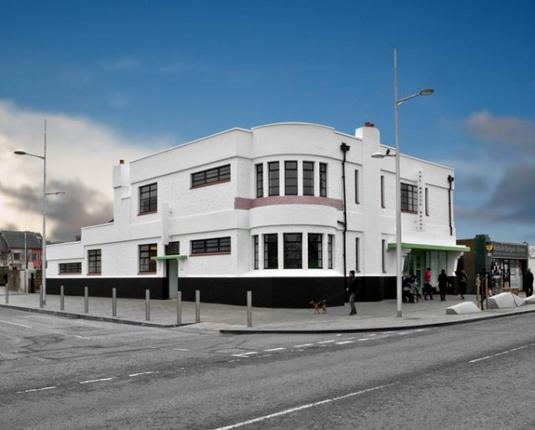
The White House after 2011 refurbishment – pic by Smith Scott Mullan Associates

If you have found this useful, informative or amusing, perhaps you would like to help contribute towards the running costs of this site – including keeping it ad-free and my book-buying budget to find further stories to bring you – by supporting me on ko-fi. Or please do just share this post on social media or amongst friends.

These threads © 2017-2026, Andy Arthur.

NO AI TRAINING: Any use of the contents of this website to “train” generative artificial intelligence (AI) technologies to generate text is expressly prohibited. The author reserves all rights to license uses of this work for generative AI training and development of machine learning language models.

#architecture #ArtDeco #Balgreen #Blackhall #Edinburgh #Liberton #LocalPolitics #Niddrie #publicHouses #pubs #Suburbs #temperance

@dubh

My neighbourhood in 1947, the first state houses are built around the school here. Our house will be built in the fields to the west of those houses in a couple more years.

via https://www.flickr.com/photos/dccgis/25834720594/in/album-72157667048586901/

#liberton #dunedin #aotearoa #nz #statehousing

K_49

Flickr

@dubh
Nobody here calls it that either IMO. Pine Hill is where it's at. There's a school with #liberton in its name ...

I dream of someone opening a tearooms & (separately) a retropie-based spacies parlour next door to the Mongrel Mob flat.

But do I really want gentrification? Can suburbs recover lost local businesses without going that path?