The rise and fall of high rise Edinburgh: the thread about multi-storey, public housing in the city
Between 1950 and 1973, Edinburgh built a total of seventy-eight municipal, multi-storey1 housing blocks which contained 6,128 flats (give or take a few) across 977 storeys.
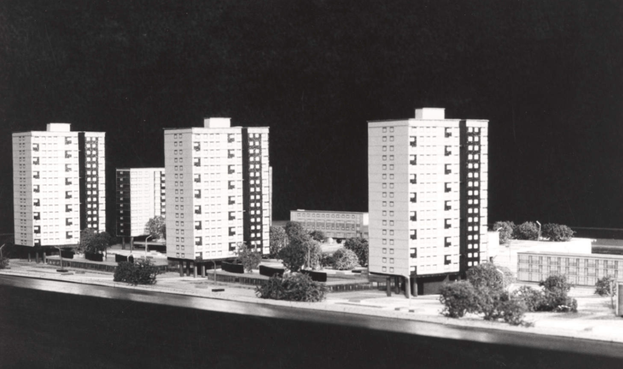
Developers model of the Sighthill Neighbourhhod Centre by Crudens, from 1963. © Edinburgh City Libraries
I’m interested in writing a few stories about some of these buildings, their histories, how and why they got built and attitudes to them at the time but wasn’t sure were to start. As a starting point I’ve made an inventory of them all; so let’s have a look at all of them in chronological order.
For this exercise I have only counted freestanding blocks of 7 storeys or more. Edinburgh traditionally had tenement buildings of this height and higher (up to 11 or even 13 stories in parts of the Old Town), however these were both built into a steep gradient and were not free-standing blocks, but supported by adjacent buildings. ↩︎1950-51 saw the first such building that meets the above criteria in Edinburgh, the 8 storey Westfield Court with 88 flats (and a childrens’ nursery on the roof!) It was constructed by local builders Hepburn Bros., better known for construction of interwar bungalows, with a steel and concrete frame clad in pre-fabricated concrete panels and an inner skin of traditional brick. Its design and facilities were heavily inspired by London’s Kensal House by Maxwell Fry. Although it was a starting point for the block that followed, it remains something of a one-off and is a rather unique, evolutionary dead-end in the city. I have written up its fuller story on this thread.
Westfield Court flats
Hepburns built their second and last multistorey block for the city from 1953-56. It is the 7 storey, 42 flat block of Maidencraig Court at Blackhall. It was constructed at a time of acute national materials shortages, and compared to Westfield it had to have its ceilings lowered and room dimensions reduced, and as much steel as possible removed. This led to the first use of cross-wall construction in the city’s public housing. This method uses load-bearing internal wall panels of reinforced concrete and offers economies of time and materials compared to traditional load-bearing external walls or the sort of internal steel and concrete framework employed at Westfield.
Maidencraig Court flats
After Westfield and Maidencraig there followed a series of experimental mid-height multi-storey blocks, which were variations on a basic theme, as a rather conservative local administration (headed by the Progressive Party) tentatively tried to work out what it wanted to do regards high-rise housing post-war. While there was a post-war housing emergency in the city, the authorities had purchased large volumes of temporary and permanent prefabricated housing (they were the most enthusiastic adopter of the former in Scotland) to meet immediate demands and the chairman of the Housing Committee, Councillor Matt A. Murray, was keen not to expand the city further on the outskirts but to focus on central redevelopments.
The 10 storey, 60 flat Inchkeith Court followed in 1956-57, located on Spey Terrace, just off of Leith Walk. Billed by the local press as “Edinburgh’s First Skyscraper“, it was built adjacent to a slum clearance zone on Spey Street, atop 139 piles on an old sandpit; an experiment in building on a confined site. The contractor was the Scottish Construction Company – ScotCon. The city specified a pitched roof be added to the design and also settled on each flat having its own hot water and heating supply under the control of (and paid for by) the tenant. The experiments in communal supplies at Westfield and Maidencraig had stung the Corporation with unexpectedly dramatic fuel bills as residents made the full use of the provision.
Inchkeith Court in 2023. Photo © Self
A month later the identical pair of Inchcolm Court and Inchgarvie Court completed in West Pilton. These were by English contractors George Wimpey and were also of 10 storeys and 60 flats each and also had almost apologetic pitched roofs. They differed in having an offset H-plan with a central access and service core and were of a different construction method. As at Westfield and Maidencraig, each flat had its own private balcony, although these were removed in later refurbishments.
Inchgarvie (r) and Inchcolm (l) Courts in 1982. Picture by Prof. Miles Glendinning, released under CC-by-4.0 licence through Tower Block archive
The following year, 1958, a further pair of 10 storey, 60 flat blocks were completed; Moat House and Hutchison House at Moat Drive in the Slateford area of the city. These were by local contractors James Miller and Partners (a firm headed by the City’s former Lord Provost) and adopted another variation of a Y-plan. They are of reinforced concrete construction with this frame in-filled with brickwork and rendered over and have external balconies for most (but not all) flats. The pitched roof however was abandoned; it was an anachronistic design throwback that added unnecessary additional demands for materials and labour on buildings that were meant to be ultra-modern and simpler to construct.
Moat House, with Hutchison House distant right
The last of the 1950s experiments were the pair of Holyrood Court and Lochview Court at Dumbiedykes, which were also built by Millers. Construction was rather protracted and did not finally complete until August 1963. These are 11 storeys tall, with 95 flats arranged on an H-plan; regular flats in the side wings of the “H” but maisonettes and top-floor artists studios (with enlarged windows and heightened ceilings to improve natural daylight) in the central arm. Each block had communal laundries, reducing the size demands of flat kitchens and requirements for hot water provision, with the the ground floor containing lock-up garages. Construction is of reinforced concrete, faced in brick and rendered-over but with an unusual original feature (now lost behind re-cladding) of traditional sandstone masonry the whole height of the building in the staircase areas. The roofs are of an ultra-modern, inverted pitch and clad in green copper; to conceal the rooftop services and clothes drying spaces from the view of those gazing down from Salisbury Crags or up from Holyroodhouse Palace.
Holyrood Court (r) and Lochview Court (l) in 1982. Picture by Prof. Miles Glendinning, released under CC-by-4.0 licence through Tower Block archive
The 1960s saw a step-change in the volume of building, and also in scale. After the experiments of the 1950s, a lot of “bells and whistles” were trimmed off the specifications, use of traditional techniques abandoned and there was a move to taller blocks with industrialised construction in the name of building more and faster. After 1962, the city’s energetic housing commissioner, Labour’s Pat Rogan, adopted a policy of replacing the post-war, low-density, low-rise prefabricated housing estates around the city’s periphery with new high-rise, high-density schemes, again to built more and build faster.
Between 1960-61, two different pairs of blocks were built at Muirhouse by Wimpey, in a scheme called Muirhouse Phase II. The first were the 9 storey slab blocks of Gunnet Court and May Court, with 48 flats apiece of reinforced concrete cross-wall construction with brick and pebble-dashed, pre-cast concrete panel infill. These blocks squeezed the build price down to c. £2,000 / flat from £2,800 of Westfield and all the flats were maisonettes; accessed from open “streets in the sky” decks to the rear. Such a layout, where the flats are all two storeys with their own internal staircases, did create initial engineering headaches, but meant that there only needed to be half the number of public passageways, lifts only had two stop at half the number of floors and sleeping and living areas of adjacent houses can be better spaced apart to reduce noise complaints.
Gunnet Court in 2018, before subsequent modernisation and re-cladding. The identical May Court can be seen in the background to the left of the tower block of Fidra Court
The other pair by Wimpey, at 15 storeys, were the city’s first real point blocks (i.e. buildings proportionally taller than they are wide or deep). These are Fidra Court and Birnies Court and have 56 flats each – however these proved to be 10% more expensive than the 9 storey slabs on account of the construction and engineering complexity of the extra height.
Fidra Court (right) and Birnies Court (left, distant) in 2022
The last multi-storey part of Muirhouse Phase II was a pair of 11 storey slab blocks by ScotCon; Inchmickery Court and Oxcars Court, with 76 flats apiece. The central part of the slab has deck-access maisonettes, with wings on each side of regular flats A flaw in the design of these blocks has the concrete load-bearing frames exposed, which forms cold bridges into the core of the building and resulted in endemic damp problems which are only now, 60 years later, due to be finally resolved in a renovation project.
Inchmickery Court, with Oxcars Court poking out on the right. Notice the prominent vertical bands of the reinforced concrete crosswalls, which have caused cold and damp problems in the buildings
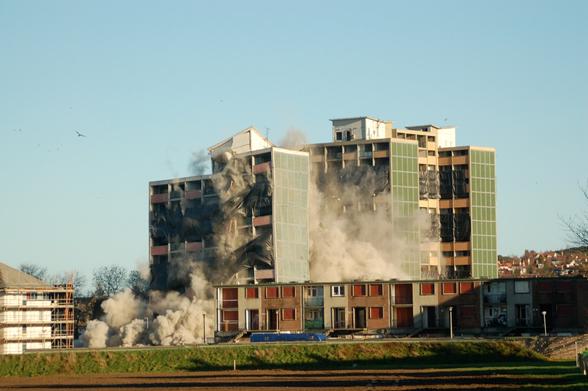
Lastly in the 1960-61 construction programme were the point block trio of Allermuir Court, Caerketton Court and Capelaw Court at Oxgangs, a site known as the Comiston Scheme at the time. Their names reflected some of the nearby Pentland Hills, the preceding blocks in Leith and Muirhouse having used the names of islands in the Firth of Forth. These 15 storey blocks had 80 flats apiece, 20 of which were maisonettes (on floors 2, 5, 8, 11 and 14), and were constructed by London-based John Laing & Co. I have seen them referred to as the Comiston Luxury Flats but I suspect this may be because in the newspaper columns where their Dean of Guild Court approval was reported, the announcement was alongside approval for “luxury flats” at Ravelston, under the headline of “Permit for £3m Housing; Edinburgh to Clear More Prefabs; Luxury Flats“. The laundry rooms were on the ground floor, and there were novel outside drying greens arranged in a spoked wheel pattern from a single, large, central pole. The flats were initially very popular, but suffered from long-term lack of maintenance and run-down of facilities and were demolished between 2005-06 as an alternative to refurbishment after a community campaign.
Allermuir and Caerketton Courts coming down in 2006. CC-by-SA 3.0 by 95469
Another trio of point blocks were started in 1960 but did not complete until 1962 – Fala Court, Garvald Court and Soutra Court in the Gracemount Housing Scheme, a post-war, greenfield site development. These were named after hills and parishes in the Moorfoots; Garvald was originally to be Windlestraw, but the name was changed at the suggestion of housing chairman Pat Rogan who felt it was ambiguous in its pronunciation. These were constructed by the local firm Crudens and each had 14 storeys and 82 flats. They were not built with sufficient ties between the inner and outer wall skins and this had to be remedied at a cost of £100,000 in 1986. All three were demolished in 2009 as part of the wider redevelopment in area.
Garvald Court with Fala Court beyond, emptied of life and stripped out in preparation for demolition. CC-by-ND 2.0 KaysGeog via Flickr
Last of the 1960 starts did not complete until 1963 and marked a step change in scale and construction methods – the infamous pair of Cairngorm House and Grampian Houses in the Leith Fort Comprehensive Development Area (CDA). These 21 storey, 76 flat towers were built by Millers and designed by Shaw Stewart, Baikie & Perry (John Baikie was principal architect, and was assisted by Michael Shaw Stewart and Frank Perry, all were working for the firm of Rowand Anderson, Kininmonth & Paul). The whole building was made up of interlocking, three storey repeating units, with single-storey flats in the middle surrounded by maisonettes above and below. One assumes that the names were a double reference both to their heights (they were the tallest residential structures in Scotland when completed) and how far you could see from the top. The core of each building was poured, reinforced concrete cross-walls and floors, clad in a system of prefabricated concrete panel units. These storey-high panels, of three standard widths, had external ribs to improve their strength but this contributed to their spartan, blocky appearance with almost no redeeming features beyond the labour savings their construction offered; it was estimated by Millers that the fifty men and external scaffolding that they had needed for each storey at Dumbiedykes had been replaced by four men and a crane to lift the prefabricated concrete panels into place. They came down in 1997, having been largely empty of residents since 1991 after a long period of neglect and decline, with the local press referring to them as Terror Towers and Withering Heights.
Grampian House (l) and Cairngorm House (r) in 1982. The rooftop “cages” contained drying “greens” and on the left is the brick and concrete block of Fort House (see below). Picture by Prof. Miles Glendinning, released under CC-by-4.0 licence through Tower Block archive
The next phase of the Leith Fort CDA scheme was Fort House – a 7-storey deck access block of 157 mainly maisonette flats on a rambling, wonky X-plan built by J. Smart & Co to a design also by Shaw Stewart, Baikie & Perry. This block sat on 162 large diameter piles, 3 feet wide and 30 feet deep and its odd plan was to make the maximum use of the available space as it was confined within the historic but oppressively high walls of the old Leith Fort. It was a reinforced concrete frame infilled with brown bricks degenerated into some of the city’s most infamous housing in the 1980s. Despite a renovation which saw pitched roofs, awkward looking rooftop pediments and additional insulation added, it was demolished in 2012-13 and replaced by low rise Colonies-style housing, with those prison walls greatly reduced in height.
Fort House, 1982. Picture by Prof. Miles Glendinning, released under CC-by-4.0 licence through Tower Block archive
1962-64 saw another tall pair of point blocks erected by Millers in Leith as part of a redevelopment scheme variously known as Citadel Area Phase 1 or Couper Street Area. These are the 20 storey, 76 flat John Russell Court and Thomas Fraser Court were designed by Robert Forbes Hutchison. Now known as Persevere Court and Citadel Court, respectively, John Russell was an antiquarian and author who wrote some of the first, comprehensive histories of Leith, and Thomas Fraser was his schoolmaster. Each block is comprised entirely of maisonette flats (except for four, top floor penthouses), with two separate wings joined by a service and access core, although neatly packaged to appear as a single, point block. Originally finished in concrete panels dashed with Norwegian quartz chips, 1980s makeovers had them insulated and clad in colourful blue and yellow corrugation at the same times as the names were changed and tenancies were restricted to those over the age of 35 and without children under the age of 16.
Persevere (left) and Citadel (right) Courts in 2011. Notice that the arrangement of yellow and dark blue panels on each building is inverted. Cc-by-NC-SA 2.0 by me!
The multi-storey flat peaked, literally, in Edinburgh in 1965 when Martello Court in Pennywell, Muirhouse completed. This 23 storey, 88 flat point block remains the tallest residential structure in Edinburgh and has unusual with wrap-around external balconies all the way up to the top. These served a dual purpose; as the building had only a single staircase, they were to assist escape in the event of a fire, however were unpopular with residents who wanted them gated off. Built by local contractor W. Arnott Mcleod to designs by Rowand Anderson, Kininmonth & Paul, it was intended to showcase local skills in the field of housing but was ultimately over-budget and delayed; the final project cost approximated £3,571/ flat, almost 60% more than neighbouring multis that had completed just 4 years before. Corporation Housing Architect Harry Corner branded the building “a disaster“. This was the first high-rise block to dispense with communal laundries since they had been introduced, with each flat having laundry facilities in the kitchen, and each floor having an external drying area. In a superstitious move, there is no thirteenth floor, the floors being number 1 to 12 and then 12A to 23.
Martello Court, towering over the neighbouring high rise flats at Muirhouse. It now has a dark red external cladding. Picture by Prof. Miles Glendinning, released under CC-by-4.0 licence through Tower Block archive
There was no such qualms about the number thirteen with another block in the Muirhouse area, Thirteen Muirhouse Way was never formally named (and confusingly was actually 11 to 21 Muirhouse Way!) This nine-storey, 44-flat slab block was part of the Muirhouse Temporary Housing Area Phase II scheme to replace the post-war prefabs to the south of Pennywell. It was very similar to the earlier Gunnet and May Courts nearby. This block was part of a scheme completed 1963-1965. In 1982 the residents set up a Tenant’s Steering Committee to lobby for improvements to deal with the windows, dampness, heating and insecure entry. The council did eventually draw up plans for a refurbishment but in 1987 branded it “one of the worst in the city” and instead used new borrowing powers to have the block demolished and replaced by a low-rise scheme of accessible housing. Demolition came in 1988, just shy of its twenty-third birthday.
The insipidly and threateningly named “13 Muirhouse Way” in the background. Picture by Prof. Miles Glendinning, released under CC-by-4.0 licence through Tower Block archive
Also completing in 1965 was a large scheme on a greenfield plot at Sighthill, known as the Sighthill Neighbourhood Centre. This scheme was initially mooted in 1957 and in 1962 a scheme for two 23 storey point blocks and an 8 storey slab was approved, but was challenged successfully by the Civil Aviation Administration over the proximity to the flightpath of Edinburgh Airport. This resulted in a change to three lower 17 storey, 95 flat blocks – Glenalmond Court, Hermiston Court and Weir Court – and an increase in height of the slab block to 11 storeys; the 98 flat Broomview House. Construction was by Crudens. The entire scheme was demolished between 2008 and 2011, and replaced by a new estate of low and mid rise housing, which includes streets named after Glenalmond, Weir and Broomview (but not Hermiston; probably to avoid confusion with other nearby areas of that name.) These names were taken from the Robert Louis Stevenson novel Weir of Hermiston.
Hermiston (l), Glenalmond (c) and Weir (r) Courts in 2011 just prior to demolition. Cc-by-NC 2.0, by me!
Yet another completion in 1965 was the well known “Banana Flats” of Cables Wynd House in Leith; officially Central Leith Phase 1 or Cables Wynd Redevelopment Scheme. The architect in charge was Robert Forbes Hutchison and the contractor was J. Smart & Co. This vast, 10 storey slab block of 212 largely maisonette flats has a distinctive curving plan to accommodate pre-existing roads and tenements and was designed to house up to 800 residents. The building has a concrete frame – a ground floor of columns and crosswalls above that – with a cladding of pre-cast concrete exterior panels covered in quartz chips. To reduce the number of lifts and stairwells, entry to the houses is deck access along three internal “streets in the sky“, which give access to the flats on floors above and below also. Bedrooms are arranged so that none are adjacent to the deck, to reduce noise disturbance. It was Category A listed in 2017.
Cables Wynd House, cc-by-sa 2.0 Tom Parnell
Cables Wynd was joined nearby in December 1966 by Linksview House, an 11-storey, 96-flat block by the same architect and contractor as the former. It sits at the northern end of the Kirkgate and was officially the Central Leith Phase 2 or Tolbooth Wynd Redevelopment Scheme. Although it is a regular, straight slab and is significantly smaller than its bendy neighbour, its construction and internal layout is fundamentally similar. It has reinforced concrete columns on the ground floor and crosswalls above that, similar precast cladding panels and again three access decks to maisonette flats.
Linksview House, at the end of Leith’s historic Kirkgate, CC-by-ND 2.0 KaysGeog via Flickr
Between 1965-66, at the Greendykes Temporary Housing Area, a pair of 15-storey, 86-flat point blocks was constructed by Crudens – Greendykes House and Wauchope House. These were part of Pat Rogan’s policy of quickly increasing completion of new housing by replacing the life-expired, low-density, low-rise estates of post-war prefab bungalows with mixed mid- and high-rise schemes. Population density in these areas was more than doubled, from 60 to 140 people per acre, meaning the sitting prefab tenants could re-homed and there were more new houses too. This facilitated the clearance of slum housing in the inner city – still a huge problem at the time.
Wauchope House (l) and Greendykes House (r), 1985. Picture by Prof. Miles Glendinning, released under CC-by-4.0 licence through Tower Block archive
February 1966 saw the completion of high-rise buildings in the north of the city, with Northview Court at West Pilton – again a prefab replacement build, officially Muirhouse Area 3. It was something of an afterthought, replacing a smaller block on the plans at a late stage. Its 16 storeys contain 61 flats and the contractor was Wimpey.
Northview court in 1982. Picture by Prof. Miles Glendinning, released under CC-by-4.0 licence through Tower Block archive
The Moredun Temporary Housing Area was next, where a row of four 16 storey blocks was constructed on the only thin strip of solid bedrock in an area othewise riddled by mining and subsidence. The contractor was Wimpey and the 91 flat blocks are called Castleview House, Marytree House, Little France House and Moredun House.
Left-to-Right, Castleview, Marytree, Little France and Moredun Houses.
The next phase here was two identical blocks to the previous four, which also completed in 1967. These are Moncrieffe House and Foreteviot House and are further up the hill and in a more exposed position than the first four. As a result of this exposure, and the way the wind swirls around and between the blocks, they have long suffered with windows blowing in (and out).
Foreteviot (l) and Moncrieffe (r) houses. The first phase of towers at Moredun is in the right distance
In 1967, to the west of Greendykes, a 15-storey pair of towers was completed at the site of the Craigmillar prefabs; the 57 flat Craigmillar Court and Peffermill Court. They were built by Concrete (Scotland) Ltd. on the prefabricated Bison large wall panel system – as a result they were 10% cheaper than Wimpey at Moredun
Peffermill Court (r) and Craigmillar Court (l) in 1967. © Edinburgh City Libraries
Between 1964-67, a pair of 13 storey blocks was completed at Restalrig Gardens; Lochend House and Restalrig House. Constructed by Millers, these 76 flat, T-plan point blocks are reinforced concrete construction with brick infill and external harling. They replaced the old Georgian villa of Restalrig House, which had been requisitioned during WW2 to act as a headquarters for the National Fire Service. It was acquired by the city in 1945 to act as a hostel for homeless families but was damaged by a fire in 1956 and evacuated, being used as a store for surplus council equipment thereafter.
Restalrig (r) and Lochend (l) Houses.
1965-67 proved to be a busy period, with 21 high-rise blocks completed in total, the fruits of Pat Rogan’s efforts as housing chairman. His successor – G. Adolf Theurer – was a Progressive (Liberal / Unionist / Conservative political grouping), but something of an ally and continued his basic policies.
In 1968, the Kirkgate Redevelopment Scheme was completed by the 64 flat Kirkgate House, built by the Token Construction Co. This had been intended to be a 25 storey crowning monument, but ended up being behind schedule, overbudget and only 18 storeys tall.
Kirkgate House as seen from South Leith Kirkyard in 2023. Photo © Self
A 1968 outlier, in geographical terms, is the 11 storey, 41 flat Coillesdene House at Joppa by Wimpey. It sits within the red brick walls of the villa of the same name. Like Restalrig House, this had been requisitioned during WW2 by the National Fire Service and acquired and ultimately demolished afterwards by the Corporation for housing, with some of its undeveloped garden land having been used for temporary prefabs.
Coillesdene House – the red brick walls of the villa are prominent in the foreground
Just along the road from Joppa, on Portobello High Street, Portobello Court completed in 1968. This 8 storey, 60 flat, T-plan block is the centrepiece of a mixed-rise housing scheme which replace the old tramway depot. It was built by J. Best.
South elevation of Portobello Court.
A further phase of temporary housing replacement completed at Sighthill in 1968, a scheme known as The Calders. This was another mixed height development by Crudens. The high rise element was three 13 storey, 136 flat slab blocks built on the Skarne large panel system. These are named after locations in West Linton parish; Cobbinshaw House, Medwin House and Dunsyre House (like the Sighthill Neighbourhood Centre, there may be a Robert Louis Stevenson connection here). The Ronan Point Disaster of May 1968 occurred while they were completing. This fatal partial collapse of a brand new large panel system tower block prompted an immediate national review of such structures, and an immediate halt was called on moving new tenants in to Cobbinshaw House and final construction paused on the other pair. Structural surveys and improvements were made, and the domestic gas supply was removed from Cobbinshaw and replaced with electric, with the other pair completing as all electric before they could be occupied. The buildings were renovated and re-clad in the early 1990s.
Left-to-Right, Medwin House, Dunsyre House and Cobbinshaw House
In 1968-69, two 15 storey, 85 flat blocks were completed at Hawkhill on the site of an old tallow melting works – Hawkhill Court and Nisbet Court. These used the no-fines poured concrete method – where there is no fine sand component in the aggregate, and therefore the end product is porous and has air pockets – to try and deal with the condensation and damp problems that plagued earlier concrete builds. The contractor was local firm J. Smart & Co. Nisbet is the name of an old local landowning family (Nisbet of Craigentinny), although not one that was ever specifically associated with Hawkhill.
Nisbet Court (l) and Hawkhill Court (r). At this time, the Hawkhill Playing Fields in the foreground were still in use. © Edinburgh City Libraries
The last pair of the blocks in the prefab replacement scheme, and the last residential point blocks built in Edinburgh were built between 1969-71 at Niddrie Marischal; the pleasant sounding Teviotbank House and Tweedsmuir House, names from the Scottish Borders. These were built by Hart Bros. and were 15 storey, 57 flat blocks using the Bison large panel system. As well as the last, they were some of the worst such houses Edinburgh ever built and they were devoid of residents by 1989 after only 18 years and were unceremoniously demolished in 1991. The blocks had the last laugh though and refused to collapse under controlled explosion, having to be carefully tipped over later by a giant hydraulic ram known as Big Willie.
Tweedsmuir House (l) and Teviotbank House (r) in 1983. Picture by Prof. Miles Glendinning, released under CC-by-4.0 licence through Tower Block archive
While Niddrie Marischal was still on the drawing board, Edinburgh’s public housing focus shifted away from the old Comprehensive Development Areas and Temporary Housing Sites to a grand new edge-of-the-city scheme at Wester Hailes. This was meant to be a “New Town within the town” for up to 20,000 people. However, despite the best of intentions, the Corporation was caught between price inflation and forced cost cutting by central government. As a result, it was forced to increase the housing density – putting multi-storey blocks back in favour again – and cut costs to balance the books. The cost cutting meant that construction quality was lacking, landscaping was bleak and that many of the facilities and public amenities that a growing community required were absent.
The overall Wester Hailes scheme is comprised of multiple, distinct neighbourhoods, within which there were multiple development contracts. These included three big groups of multis, all of which suffered from bad design, bad engineering and bad workmanship. Group one, by Hart Bros, was at Hailesland, and was comprised of six 10 storey slab blocks using the Bison large panel system. These blocks contained between 67 and 107 flats and were finished in stark, pebbledashed concrete panels. They were also shoddily built, to the point of compromising their very structural integrity. In 1990, after a life of only 18 years and a long period of uncertainty and partial vacancy, three of the blocks were demolished. The remaining three were repaired and renovated as there were not funds to write off and demolish structures on which the construction debt had yet to be paid off; these were renamed Kilncroft, Midcairn and Drovers Bank and were given colourful, corrugated cladding and pitched roofs.
Hailesland Bison flats. Picture by Prof. Miles Glendinning, released under CC-by-4.0 licence through Tower Block archive
The two remaining high rise groups at Wester Hailes were all built by Crudens on a proprietary system using a concrete frame and floors, in-filled with brick cladding and covered in harling. They were so badly built the render was falling off in huge chunks from the get go, and much of it had to be pre-emptively chipped off. Its application had been so lacking in control that the thickness varied between half and two and a half inches, as a result these nearly new flats were left looking decrepit and piebald. The Westburn Gardens group got no names, just the ominous sounding Blocks 1-7. They were built between 1970-72 and comprised seven slab blocks of 9 storeys with 55 flats each, except the last which got 112. They came down in 1993, aged just 22 years old.
Westburn Gardens, 1982. Picture by Prof. Miles Glendinning, released under CC-by-4.0 licence through Tower Block archive
The other Crudens Group was on the same system at Wester Hailes Drive and Wester Hailes Park. They at least got street numbers instead of block numbers, but were just as badly built as Westburn. Constructed from 1971-73, they came down in 1994 at the tender age of 21.
Wester Hailes Park (l) and Drive (r) flats in 1982. Picture by Prof. Miles Glendinning, released under CC-by-4.0 licence through Tower Block archive
The year 1972 was both therefore both the peak and the swansong of multi-storey housing in Edinburgh; 12 blocks were finished at Wester Hailes, pipping the 11 of 1967, and the final 5 completed the following year. Such was the fallout from the multitude of scandals at Wester Hailes (and wider elsewhere, both in the city and nationwide) and also the rapid and terminal reputational damage they suffered in the 1980s that Edinburgh has never again built residential multis.
Of the seventy seven blocks in this inventory, some forty four are still standing and thirty three have been demolished. Twenty of the latter were 22 years old or younger and the average age at demolition has been 30.3 years. The oldest block to be demolished was Fort House, aged 50, and the youngest were the Hailesland Bison Blocks, at only 18.
Graph of total number of residential multi-storey public housing blocks in Edinburgh
If you’d like to look at all these housing blocks on the map instead, just follow this link or click on the thumbnail below. This map is colour-coded by the number of storeys.
Google My Map – “High Rise Edinburgh”. I have made much use of the reference of the Tower Block Archive of Prof. Miles Glendinning and team, including facts and photos, and I recommend this resource to you if you have an interest in the subject. I can also recommend his publications “Rebuilding Scotland, The Postwar Vision 1945-1975” and “The Home Builders. Mactaggart & Mickel and the Scottish Housebuilding Industry” by Miles Glendinning and Diane M. Watters, amongst others, for further reading.I am also much obliged to Miles for letting me read his interview notes with key movers and shakers in local authority housing in Edinburgh in the 1950s and 60s, which are full of invaluable details and insights.
Note to readers: unfortunately in April 2026, a third-party plug-in more than exceeded its authority and broke many of the image links on this site. No images were lost but I will have to restore them page-by-page, which may take some time. In the meantime please bear with me while I go about rectifying this issue.
If you have found this site useful, informative or amusing then you can help contribute towards its running costs by supporting me on ko-fi. This includes my commitment to keeping it 100% advert and AI free for all time coming, and in helping to find further unusual stories to bring you by acquiring books and paying for research.
Or please do just share this post on social media or amongst friends and like-minded people, sites like this thrive on being shared.
Explore Threadinburgh by map:
Travelers' Map is loading...
If you see this after your page is loaded completely, leafletJS files are missing.
These threads © 2017-2026, Andy Arthur.
NO AI TRAINING: Any use of the contents of this website to “train” generative artificial intelligence (AI) technologies to generate text is expressly prohibited. The author reserves all rights to license uses of this work for generative AI training and development of machine learning language models.
#Lochend #Logan #Restalrig #StMargaret Andy Arthur - Threadinburgh
 The Victorian News

 The Edinburgh Minute

 The Edinburgh Minute