Battles, treachery, murder, witchcraft and execution: the thread about the dark and bloody history of the Quarryholes
This thread was originally written and published in September 2022.
The “things I’d like to write a thread about” intray can get pretty overcrowded so it brings me more than a little bit pleasure to say that it’s only taken me 7 months to get around to my promise of following up on writing about the Quarryholes. This is not one but actually two distinct places, the Upper or Over Quarryholes (blue on the map below) and the Nether or Lower Quarryholes (red below). You can see the tailburn of the loch at Lochend cutting between the two.
Roy’s 1750s Lowland Map of Scotland showing Upper (blue) and Lower (red) Quarryholes. Reproduced with the permission of the National Library of Scotland
As the name suggests, the Quarryholes were areas where quarrying had once taken place and left behind pits in the ground and a hamlet grew up at both of the locations.
The Quarry by William Strang, 1893. This is not a bad approximation of what the Upper Quarryholes might have looked like in the 18th century before the New Town expanded onto the Calton Hill.
In 1554 the Querrell Hollis feature in David Lindsay’s “Ane Satyre of the Thrie Estaits” as a location where a horse is drowned; the quarry pits had long been flooded and were dark and dangerous bodies of water. The distinct Ovir Querrelholis is recorded in 1588. Quarrel was the Scots for quarrying but obviously in modern use means a squabble or disagreement and that is quite apt given the subsequent history. In the early 17th century, the charter of both of the Quarryholes was in the possession of William Rutherford of Quarryholes, the son of an Edinburgh Burgess and merchant, one Bailie William Rutherford. William junior was a merchant and shipowner in Leith who in 1612 was in trouble for cutting off a man’s finger and in 1617 was back before the Privy Council for illegally exporting tallow and cheese.
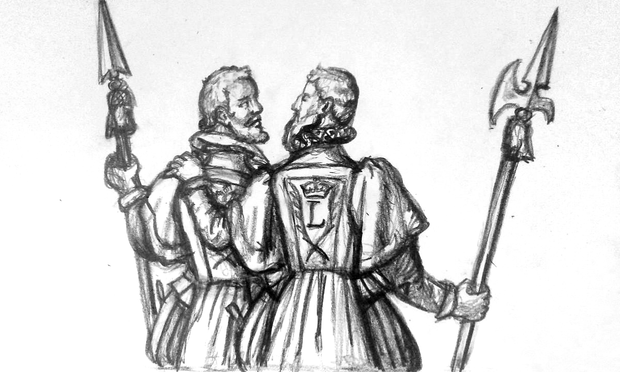
A son of William junior, also William, sold the Quarryholes to the City of Edinburgh in 1634, and they in turn passed them on to Heriot’s Hospital (Upper Quarryholes) and the Trinity College & Hospital (Lower Quarryholes). Another Rutherford son, Andrew, was born at Quarryholes in the early 17th century and would rise to become the Lieutenant-General of the Garde Écossaise, the bodyguards to the French Crown, and a favourite of King Louis XIV of France.
Two soldiers of the Garde Écossaise. CC-by-SA 4.0 Count of Zielin
On his return to Scotland, Andrew was made the Lord of Teviot by King Charles II and given a regiment to command. Later he was Governor of Dunkirk and arranged its sale to the French on behalf of the King. He died on active service in 1664 as Governor of Tangier, one year after becoming Earl of Teviot.
The Battle of Tangier, 4 May 1664. A Morrocan force under Khadir Ghailan ambushes the Tangier Regiment under Andrew Rutherford, killing ~470 including Rutherford, who died trying to rally his men.
But links with military violence and the Quarryholes were not just in far off Morocco. In July 1559 the Lords of the Congregation, the Scottish protestant nobility fired up by John Knox, who had been energetically “reforming” Churches in Stirling and Linlithgow now moved on to Edinburgh. At the Quarryholes they parlayed with supporters of Queen Regent Mary of Guise to agree a temporary mutual toleration, avert further conflict and avoid the potential for full blown urban warfare in the city.
A meeting of soldiers. An excerpt of the woodcut of the 1573 “Lang Siege” of Edinburgh Castle from the Hollinshead Chronicles – a very good representation of Scottish and English military forces in the mid-late 16th century.
Mary of Guise died the following year but things didn’t get much more peaceful as a result in Scotland; or at the Quarryholes. On 16th June 1571, during the ensuing Marian Civil War, “Drury’s Peace” took place at the Quarryholes – which proved to be anything but peaceful. “Black Saturday” as it was also known occurred when pro-Mary Queen of Scots forces under the Earl of Huntly rode out from Edinburgh Castle to confront pro-King James VI forces from Leith under the Earl of Morton and his enormous hat.
There was ample bad blood between Morton and Huntly and their heavily armed parties were spoiling for a fight. To try and negotiate between them, emissaries were sent to meet at the Quarryholes under the mediation of Sir William Drury, the English Ambassador . Drury (of Drury Lane, the Strand) proposed terms which both parties seemed to accept, but neither side could agree which would turn and leave the field first. Eventually he got them to agree that they would leave at the same time when he threw up his hat. The emissaries returned to their own lines and Drury duly threw up his hat.
The Queen’s men under Huntly duly turned and left as had been agreed but the King’s men under Morton treacherously did not and charged at their opponents retreating towards the Canongate and ran them down. They were “pursued with cruel and rancorous slaughter to the very gates of the city. The whole road was covered with dead and wounded“. Lord Home, several other gentlemen, 72 soldiers, colours, horses and two cannon were marched into Leith by a triumphant but treacherous Morton. Back in Edinburgh, the citizenry suspected that Drury had betrayed the Queen’s forces and he had to be protected from the city’s notorious mob.
“A skirmish outside Leith”, led by a gentleman in a very tall hat. From “British Battles on Land and Sea” by James Grant
The Quarryholes were the scene of a second military conflict 80 years later when English forces under Oliver Cromwell arrived in Musselburgh in 1650. Their goal was to try and take Edinburgh and Leith which were fortified and held by the Covenanter government of Scotland under Generals Alexander and David Leslie (no relations). The Leslies were a match for Cromwell and his New Model Army, but it turned out not for the interfering Covenanter ministers on their own side. However their initial plan of throwing up defensive lines between the Calton Hill and Leith, sitting behind them and waiting it out worked surprisingly well.
David (L) and Alexander (R) Leslie remonstrate with the Covenanter ministers in front of the arrayed forces of the Scottish Army in 1650.
The Covenanter army was reasonably well armed and equipped and had burnt the lands before it, it could afford to sit firm and let the elements, disease, hunger and dissent take care of Cromwell. Cromwell however, with his usual divine guidance, charged straight at the Leslies’ fortifications on the 24th July 1650. He chose the area of the Quarryholes as being a weak point and made a “furious attack… at the head of his whole army” from the east .
New Model Army infantry on the attack.
Cromwell’s forces approached from Restalrig and Jock’s Lodge while twelve of his warships fired on Leith from the Forth. The Leslies however were waiting and their artillery opened fire from positions on the Calton Hill and around Lower Quarryholes. Along a rampart constructed on the line of what is now Leith Walk the Scottish foot unleashed “a rolling fire of musketry” towards the English, supported by the cannon mounted on the old walls of Leith. The feared New Model Army was easily beat and rapidly “retired in confusion”
Covenanter musketeers form lines and fire. The ubiquitous “hodden grey” clothing and broad, blue felt bonnets were in practical terms a uniform for the Scottish infantry of this time.
Cromwell’s men left their dead and wounded and two cannon behind in their haste. Unperturbed, Cromwell circled around Arthur’s Seat and tried to attack the city from that direction. He was met by the regiment of Campbell of Lawers, one of the best in the Scottish Army. On seeing Cromwell’s intent, Campbell had marched double-time up the glen of Holyrood Park and taken up position around the ruins of St. Leonard’s chapel in the shelter of the numerous old walls there. Here he ambushed Cromwell’s men and caught them in an enfilade; firing into the exposed sides of his formations. Again the New Model Army broke. “They threw aside their muskets, pikes and collars of bandoleers and fled, abandoning their cannon, which were brought off by the [Scottish] horse brigade“. Cromwell – not used to being beaten twice in one day – retired to his HQ at Musselburgh to lick his wounds. He would rue the day he visited the Quarryholes, but ultimately had his revenge at the Battle of Dunbar – which went catastrophically badly for the Scots forces under the meddlesome interference of the Kirk men.
The Covenanter infantry are bested at Dunbar by Cromwell.
While this was the last time the Quarryholes was troubled by military matters, its dark and dangerous reputation persisted. Drownings in its dank and lonely pools were commonplace.
A Pond, by Adolphe Appian, 1867. A suitably dark and brooding representation that fits well the Quarryholes. From the collection of the Met.
As early as 1677 the Trinty Hospital had been ordered to fill up their holes on account of the danger. They did not, however, and in 1691 an English soldier, Lt. Byron, drowned there. The holes were ordered to be filled in again. Again they were not. In 1717, a chaplain by the name of Robert Irvine was found guilty of the murder of two boys in his charge by cutting their throats with a pen knife when out walking with them near the holes. Irvine was found lurking with the bodies that he had dragged into the place. Justice was swift and merciless; Irvine was sentenced to have his hands cut off and then hung until dead at the Gallow Lee at Shrubill. His hands were then placed on spikes on the Broughton Tolbooth and his body cast into the Quarryholes where he had committed his vile crimes.
Broadside Regarding the Trial and Sentence of Robert Irving, 1717,
see the full thing and transcription on the NLS site.In 1753 a butcher in the Grassmarket by the name of Nicol Brown was executed for the murder of his wife. He had gained notoriety for reputedly eating, for a drunken bet, a pound of flesh cut from the rotting corpse of wife murderer Nicol Muschet as it hung on the gibbet. Brown in turn killed his wife by setting her on fire. He too was found guilty, executed by hanging and hung in chains on the gibbet at the Gallowlee. But the body disappeared two days later, having been taken down by the Incorporation of Butchers and tossed into the Quarryholes. It was fetched back to the gibbet, but again 2 days later was back in the Quarryholes. It was said that the butchers felt mutual disgrace “thrown upon their fraternity by his ignominious exhibition there“.
The Gibbet, Sir John Gilbert. 1878
Philip V. Allingham.
In 1598 a court messenger named Thomas Dobie was found guilty of committing suicide by “drownit himself maist violentlie” in the Quarryholes. For such a slight to his profession his corpse felt the full wrath of the forces of justice. His body was taken to the Tolbooth and imprisoned before trial. Found guilty, he was sentenced to be dragged through the town backwards and hung (despite being dead) before being displayed on the gibbet. For good measure he was also handed down a fine of £1,340 Scots – the largest ever recorded in Scotland for a suicide.
“The Quarryholes had traditionally been used for ducking moral offenders or for executing women by drowning“. There are records of a woman being drowned in the Quarryholes over a case of infanticide. In 1585, Marion Clark was condemned “to be drounitt in the Quarrell hollis” for the crime of “going about the pestylens and seiknes beand apone her” i.e. she had caught the plague and had not stayed at home; concealing sickness and breaking quarantine was dealt with severely in the 16th c.
The gruesome history goes on. In 1649 a woman named Magie Bell from Corstorphine was executed for witchcraft. It was said that she had cursed a neighbour’s son to die, that he had fallen sick, and that she had then restored him by an appeal to god. Bell was further charged with making a girl sick who had refused to lend her thread, and then making worms come out of her mouth before she recovered. Under torture, Bell confessed that 18 years previously when living in the West Port of Edinburgh she had “met the Devil at the back of the town wall at the Quarrell Hollis” and was the only surviving witch of that coven, the others dying in the plague of 1646. On moving to Corstorphine she met with the devil “in the Broome” i.e. around modern Broomhall. She recanted her confession but was burned as a witch. Some of her accusers including the girl with worms in her mouth were also tried, convicted and burned.
By the middle part of the 18th century, the reputation of the Quarryholes finally began to improve. After a disastrous farming season in 1715 and relentless banditry and thieving of crops and cattle, the occupiers petitioned for the formation of the Leith Burlaw Court. Burlaw Courts were the lowest form of rural law enforcement, where disputes could be settled without going on to law courts. The farms of both Upper and Lower Quarryholes were entered into the books of the Burlaw Court. Quarrying was restarted at the Lower in the 1730s to provide local building stone but by 1766 those holes are recorded as having been filled in again. From that point on, the Lower Quarryholes was only ever a farm, and the OS town plans show it clearly .
Lower Quarryholes, from Fergus & Robinson’s 1759 plan of the North of Edinburgh. © SelfOS Town Plan of Edinburgh and Leith showing Lower Quarryholes farm. Reproduced with the permission of the National Library of Scotland
The farm survived until the late 1920s, and an 1887 photograph of it exists in “The Story of Leith” by John Russell, surrounded by new tenements. On the opposite corner of Easter Road is the pub of Tamson’s Bar, which at one time was the Quarryholes Bar.
Lower (Nether) Quarryholes taken from Easter Road, looking west along Dalmeny Street towards the tenements of Sloan Street.
The farm survived as long as it did due to protracted development of the tenements between Dalmeny Street and Lorne Street, which can be seen in the below 1918 Bartholomew plan for the Post Office.
Bartholomew 1918 Post Office plan of Edinburgh and Leith. Lower Quarryholes is the irregular shaped collection of 3 buildings in the centre, at odds with the alignment of the streets of Victorian tenements. Reproduced with the permission of the National Library of Scotland
The late 1920s Corporation housing infill on Dickson Street, Dalmeny Street and Easter Road marks the site of the Lower Quarryholes farm. Funny to think that as late as 1920 there was a farm on Easter Road.
Animated transition from current day Google Streetview to the photo of Lower Quarryholes farm. The mid-1920s Corporation flats at the corner of Easter Road and Dalmeny Street occupy this site now. © Self
At the Upper Quarryholes, quarrying commenced again in 1761. The holes and the buildings can be seen in the corner of a panoramic sketch by Thomas Sandby from Arthur’s Seat looking towards Leith in about 1751, looking over the roof of Holyroodhouse Palace and its Abbey church.
Looking towards Leith from Arthur’s seat, from a 1750s panorama by Thomas Sandby. Upper Quarryholes is the collections of building beyond the quarry pits in the centre of the image. The roof in the foreground is that of Holyroodhouse Abbey and Palace. CC-BY-SA National Galleries Scotland.
And the Fergus and Robinson survey of 1759 clearly shows the Upper Quarryholes and circular objects that one might imagine are actual holes!
Upper Quarryholes, from Fergus & Robinson’s 1759 plan of the North of Edinburgh. © Self
An 1801 feuing plan clearly shows the Upper Quarryholes farm buildings and at least one hole behind. The pencil lines give an idea of what was about to become of them.
1801 Feuing plan of Baron Norton’s estate at Abbeyhill. Reproduced with the permission of the National Library of Scotland
The Upper Quarryholes were in the way of Heriot’s Hospital’s feuing plan for the Calton Hill and of Robert Stevenson’s schme for Regent Road and so they had to go. They would have been demolished around 1819.
Kirkwood’s town plan of 1821, with new planned buildings coloured in pink. The Upper Quarryholes were located in the centre of the image, between the triangle of building around Norton Place and the curving terrace of Carlton Place. Reproduced with the permission of the National Library of Scotland
Some of the landscape features of mounds and depressions in the London Road Gardens are said to be the remains of some of the quarrying around the Upper Quarryholes.
The pits and mounds of London Road gardens, now ornamental features belying their past (CC-BY-SA Kim Traynor)
The Quarryholes, their quarries, holes and farms are long gone now, but the name does oddly linger on. If you walk to the bottom of Easter Road and look at a street sign outside the Persevere pub, you’ll see it pointing to Quarryholes. It’s not actually pointing to the site of the Quarryholes themselves but the name long persisted – both locally and officially – for the lands occupied by the Eastern Saw Mill, now the Leith Academy and its playing fields. A curiously low profile end of days for a placename that has both tumultuous and surprising (but brief) prominence in some key moments of Scottish history – and a thoroughly long and gruesome past.
The forlorn sign for Quarryholes at the foot of Easter Road.
Note to readers: unfortunately in April 2026, a third-party plug-in more than exceeded its authority and broke many of the image links on this site. No images were lost but I will have to restore them page-by-page, which may take some time. In the meantime please bear with me while I go about rectifying this issue.
If you have found this site useful, informative or amusing then you can help contribute towards its running costs by supporting me on ko-fi. This includes my commitment to keeping it 100% advert and AI free for all time coming, and in helping to find further unusual stories to bring you by acquiring books and paying for research.
Or please do just share this post on social media or amongst friends and like-minded people, sites like this thrive on being shared.
Explore Threadinburgh by map:
Travelers' Map is loading...
If you see this after your page is loaded completely, leafletJS files are missing.
These threads © 2017-2026, Andy Arthur.
NO AI TRAINING: Any use of the contents of this website to “train” generative artificial intelligence (AI) technologies to generate text is expressly prohibited. The author reserves all rights to license uses of this work for generative AI training and development of machine learning language models.
#Lochend #Logan #Restalrig #StMargaret Global News Kingston
 Andy Arthur - Threadinburgh


 Follow GOLF
 Gehtso
 GLOTTER
 Gabriel Morency 🤖
 🤘 The Metal Dog 🤘
 Angry Metal Guy

 Green Valley Radio Network

 penpusher