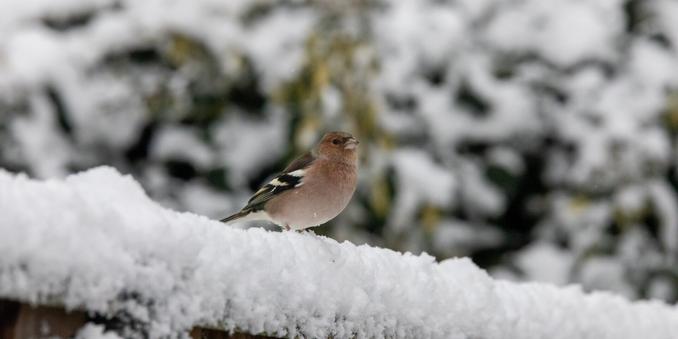
On the last day of snow, just before the thaw quietly set in, winter paused for a moment at our garden fence.

Perched there was a Eurasian chaffinch (Fringilla coelebs), known in Dutch as the vink. Alert, upright, and clearly assessing the situation, it seemed to be weighing its chances. The bird feeder was busy — mostly house sparrows, with a few blue tits and great tits darting in and out. Below them, pigeons, blackbirds, magpies and crows scavenged the ground for what inevitably falls. An efficient little ecosystem, even on a grey winter morning.

From the warmth of the house, I watched it all unfold. Outside, the world was cold and muted; inside, quiet and still. The chaffinch waited. This species is known for its adaptability, especially in winter, when flexible feeding strategies and patience can make all the difference. Rather than forcing its way in, it observed — conserving energy, reading movement, timing its next move.

The light was flat and overcast, typical for this time of year. With snow still present and clouds acting like a giant softbox, contrast was low. To keep detail in both feathers and background, I shot handheld with my Canon 5D Mark IV and Sigma 100–400mm at f/11, 1/250 sec, ISO 12800. Not ideal conditions — but honest ones. Winter photography is often about working with what little light you’re given.

There was no drama here. Just calm abundance. Even at the edge of thaw, winter was still quietly doing its work.

#EurasianChaffinch #FringillaCoelebs #Vink
#BirdPhotography #GardenBirds #WinterBirds
#NatureObservation #BackyardWildlife #UrbanNature
#EcologyInAction #NaturalBalance #BirdBehaviour
#WinterLight #OvercastDays #SnowDay
#Canon5DMarkIV #Sigma100400 #HandheldPhotography
#HighISO #NaturalLightPhotography
#DutchNature #NatureInTheNetherlands
#Pixelfed #PixelfedPhotography
#WonderingLens #ByMaikeldeBakker
#NatureStorytelling #WildlifePhotography #EverydayNature
The garden falls silent.

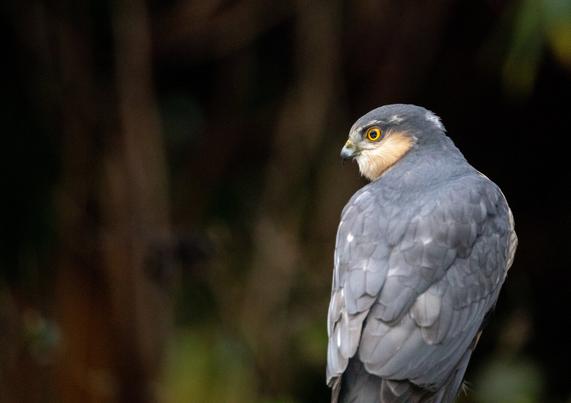
A few weeks ago, a Sparrowhawk turned our garden upside down in a storm of panic and wings. Yesterday, he returned. This time, there was no chaos — only anticipation. Every bird seemed to know what was coming. Long before I noticed him, the garden emptied itself. Not in panic, but with experience.

Only two House Sparrows (Passer domesticus — Huismus — House Sparrow) made a mistake. They chose low cover beneath the bird feeder house. When the Sparrowhawk (Accipiter nisus — Sperwer — Eurasian Sparrowhawk) landed on top of it, right above them, they froze. Perfectly still. Camouflage doing what evolution designed it to do.

The garden was silent. Too silent.

The sparrowhawk scanned the area, clearly disappointed. Then the two sparrows shifted… and briefly quarrelled. A fatal error. In a flash of muscle and feathers, the hawk launched himself downward. The sparrows reacted instantly — nimble, desperate, alive. They fled with the hawk right on their tail, vanishing beyond the garden.

I don’t know how it ended. That’s nature.

Predators like the Sparrowhawk don’t hunt for sport. They take what they need, removing weakness and maintaining balance. Without them, ecosystems collapse quietly and invisibly. Watching this unfold from my lunch table was a reminder that even the smallest garden is part of a much larger system.

Photographed handheld with my Canon 5D Mark IV and Sigma 100–400mm at f/6.3, 1/250 sec, ISO 3200 — overcast, calm, and deceptively peaceful.

Nature rarely announces itself loudly. Sometimes, it simply holds its breath.

#AccipiterNisus #Sperwer #EurasianSparrowhawk
#PasserDomesticus #Huismus #HouseSparrow
#BirdPhotography #GardenWildlife #UrbanNature
#NatureObservation #EcologicalBalance #Predation
#WildlifeBehavior #BirdsInTheGarden #NatureStory
#HandheldPhotography #Canon5DMarkIV #Sigma100400
#WinterWildlife #OvercastDays #NaturalSelection
#FoodChain #Ecosystem #BackyardNature
#PixelfedPhotography #WildlifeMoments
White on white.

A few weeks ago I photographed a black bird on black water. Yesterday, nature offered me the inverse: a white bird against a white world.

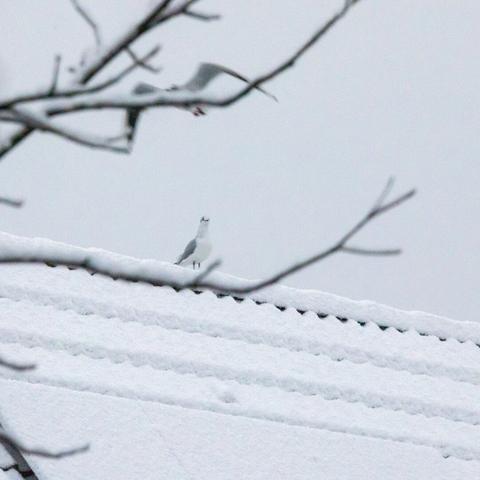
From the comfort of my couch — warm, while the outside was anything but — I noticed this gull resting on a snow-covered roof, silhouetted only by a uniformly grey winter sky. No contrast to lean on, no dramatic light. Just form, posture, and subtle tonal differences.

This is a Russian Common Gull
Larus canus heinei
Dutch: Russische stormmeeuw
English: Common Gull (heinei subspecies)

Although resting, the bird remained alert: neck stretched upward, scanning its surroundings. A typical posture in harsh winter conditions, where conserving energy must be balanced against constant awareness. In snowy, overcast weather like this, visibility is reduced and predators — or competition — can appear suddenly.

From a photographic standpoint, this was a quiet challenge. White subject, white background, flat light. Exposure becomes critical. Shot handheld with the Canon 5D Mark IV and the Sigma 100–400, I worked at f/29, 1/250 sec, and ISO 12800. The high ISO and relatively slow shutter speed tell the story of the light: dark, heavy cloud cover, even at 9 in the morning. Sometimes the data in the EXIF says as much as the image itself.

Ecologically, wintering gulls like Larus canus heinei are increasingly common visitors, adapting to shifting climates and food availability. Observing them — even from your own living room — is a reminder that wildlife is always closer than we think.

#ByMaikeldeBakker #WonderingLens #MaikeldeBakkerPhotography
#LarusCanusHeinei #CommonGull #RussianCommonGull #RussischeStormmeeuw
#BirdPhotography #WinterBirds #UrbanWildlife
#WhiteOnWhite #MinimalNature #SubtleTones
#Ecology #AvianEcology #BirdBehavior
#ClimateAndNature #WinterLight
#Canon5DMarkIV #Sigma100400
#HandheldPhotography
#NatureObservation #ScientificPhotography
#Pixelfed #NatureCommunity #BirdLovers #WildlifePhotography
Brr… it has been freezing. The snow has settled, hardened, and now crunches loudly under every step. Usually that sound sends birds and other wildlife scattering long before they come into range of my wondering lens. But not this one. No — this bird stayed.

Late in the afternoon, as the sun briefly pushed through heavy, snow-laden clouds in the Loonse en Drunense Duinen, I noticed a shape in the trees. Calm. Watching. Unimpressed. Almost as if it was thinking: “Hmm… a two-meter-tall human, 110 kilos, plus 15 kilos of camera gear. I’ve seen worse.”

There it was: the Long-eared Owl —
Dutch: Ransuil
English: Long-eared Owl
Latin: Asio otus

Despite its name, those “ears” aren’t ears at all, but feather tufts used for camouflage and communication. In winter, Long-eared Owls often roost quietly during the day, relying on stillness and pattern rather than flight. That stillness is what made this encounter possible, even with the snow betraying every step I took.

Photographing in these conditions is always a balance between physics and physiology. Cold air, fading light, and handheld shooting meant choices had to be made. I settled on f/16, 1/1000s, ISO 3200, using my Canon 5D Mark IV paired with the Sigma 100–400mm. A fast shutter to freeze even the slightest movement, high ISO to compensate, and a deep depth of field to keep that piercing gaze sharp.

#LongEaredOwl #Ransuil #AsioOtus #OwlPhotography #WinterWildlife #DutchNature
#LoonseEnDrunenseDuinen #NatureObservation #WildlifePhotography #BirdsofEurope
#Canon5DMarkIV #Sigma100400 #HandheldPhotography #ColdWeatherPhotography
#SnowCrunch #SilentHunter #FeatheredPredator #AvianEcology #NatureScience
#ForestLight #WinterMood #NatureStories #WatchingEyes #WildlifeEncounter
#RespectNature #ByMaikeldeBakker #MaikeldeBakkerPhotography #WonderingLens
#Pixelfed #NatureLovers #BirdWatching #SlowDownAndObserve
The Brave Robin

During a snow-covered walk through the Oisterwijkse Bossen, I ran into an old friend again — or at least, I hoped I did. The European robin (Dutch: Roodborst, Latin: Erithacus rubecula) has a habit of following me on walks, or so it feels. This one, however, was certainly not that robin — and that made the encounter no less special.

I settled at my favorite spot near Café Venkraai, warmly hosted as always by Bart and his team. While most people escaped indoors to sit by the fire, I stayed outside. I’m far more comfortable among feathered company than chatting humans ^.-
Robins were everywhere, joined by blue tits (Cyanistes caeruleus), great tits (Parus major), and, further off, the rhythmic tapping of a great spotted woodpecker (Dendrocopos major).

Robins are famously territorial, especially during breeding season. Yet in winter, when survival outweighs rivalry, they often tolerate each other — sometimes even appearing playful. Watching them hop, chase, and briefly share space was a quiet reminder of how behavior adapts to conditions.

While enjoying a chai latte and a vegan worstenbroodje, one robin joined me at the table, eyeing me hopefully. I shared a tiny crumb — sparingly — knowing bread isn’t ideal for birds. Note to self: bring dried mealworms next time.

This image was taken around 11:00 in freezing conditions, using my Canon EOS 5D Mark IV with the Sigma 100–400mm at 400mm, f/6.3, ISO 3200, 1/250s, handheld, sheltered under the café roof. A small moment of winter trust, quietly earned.

#EuropeanRobin #ErithacusRubecula #BirdPhotography #WildlifePhotography #WinterBirds #OisterwijkseBossen #DutchNature #BirdBehaviour #Canon5DMarkIV #Sigma100400 #HandheldPhotography #LowLightPhotography #NatureLovers #BirdLovers #VeganInNature #CaféVenkraai #ScienceAndNature #Pixelfed #PixelfedNature #ByMaikeldeBakker #MaikeldeBakkerPhotography #WonderingLens #QuietMoments #MindfulNature #BirdWatching #NatureConnection #ResponsibleFeeding
Heavy snow, slow motion lives

Heavy snow has a way of forcing the world to slow down. Yesterday that became very tangible when I watched a van and a car carefully pass each other on an icy, snow-covered road. Weather alerts were active across the Netherlands, and for many people this meant stress, risk, and necessary travel. For me, it meant something else: a rare chance to observe how landscapes and human behavior change under extreme conditions.

This image was taken handheld with the Canon 5D Mark IV and the Sigma 100–400mm, pushed hard at ISO 12800 and f/29 to hold enough depth and structure in the chaos of falling snow. In conditions like this, photography becomes a balance between physics and patience. Snow scatters light, reduces contrast, and confuses autofocus systems — your camera doesn’t “see” snow as atmosphere, only as obstacles. You have to work with that limitation, not against it.

What fascinated me most wasn’t just the snow itself, but the rare phenomenon that accompanied the storm: lightning during snowfall. Cold air aloft combined with moisture-rich clouds from the relatively warm sea can create enough vertical energy for electrical discharge — something we still rarely witness here.

If you don’t have to be on the road during days like these: grab your camera instead. But walk carefully. Nature may slow us down, yet it always gives something back to those who stop and look.

#snowstorm #winterphotography #extremeweather #documentaryphotography
#climateobservation #weatherwatching #snowinthenetherlands #handheldphotography
#canon5dmarkiv #sigma100400 #highisophotography #lowvisibility
#roadsafety #slowdown #natureandhumans #weatherpatterns
#scienceinnature #observationalphotography #landscapeinwinter
#tilburg #013tilburg #dutchwinter #stormchasing #lightninginsnow
#environmentalawareness #pixelfedphotography
#ByMaikeldeBakker #MaikeldeBakkerPhotography #wonderinglens
#ThroughTheWonderingLens
Mixed light, mixed feelings

Happy New Year.
I’ll start with a confession: I really dislike fireworks. Not the light itself, but everything around it. The pollution, the stress for animals, the damage to nature, and the yearly ritual of people discovering—once again—that playing with controlled explosions has consequences. Every year the harm increases, and every year we collectively act surprised.

So no, you won’t see me buying fireworks or lighting them myself.

But… I do photograph them.

Because once they are already in the sky, they become something else entirely. Brief, chaotic chemical experiments unfolding against a dark background. This image was taken handheld with my Canon 5D Mark IV and the Sigma 100–400, using a 1.6-second exposure at ISO 100. Long enough to let the explosion draw itself, short enough to keep structure and definition.

What fascinates me most is the physics and chemistry behind the colors. Yellow from sodium, red from strontium, and that elusive blue—one of the hardest colors to produce reliably in fireworks—created by copper compounds under very specific temperatures. Add bright white sparks, often magnesium or aluminum, and suddenly the sky looks less like a celebration and more like a fleeting nebula.

If you look closely, it almost resembles deep-space imagery: expanding clouds, glowing particles, tiny star-like points suspended in darkness. A reminder that the same physical laws govern both fireworks above our cities and stellar explosions light-years away.

I don’t celebrate the noise or the damage. But I do observe the light—brief, beautiful, and already fading.

#fireworksphotography #longexposure #nightphotography #scienceandart
#physicsinmotion #chemicalcolors #handheldphotography
#nightSkyVibes #urbanastronomy #photographicexperiment
#Canon5DMarkIV #Sigma100400
#NewYearsLight #mixedfeelings
#climateawareness #naturefirst
#PixelfedPhotography #Pixelfed
#WonderingLens
#ByMaikeldeBakker #MaikeldeBakkerPhotography
Short-toed Treecreeper — a quiet moment at the base of a tree

Some birds don’t announce themselves with color or sound. They whisper.
On the same morning walk through the Oisterwijkse Bossen, I noticed one of those whispers: a Short-toed Treecreeper — Certhia brachydactyla (Boomkruiper in Dutch).

Treecreepers are specialists. Their curved bills and stiff tail feathers are evolutionary tools designed for one task: spiraling up tree trunks while probing bark crevices for insects and spiders. This one was doing exactly that — hopping on and off the lower part of a trunk, pecking quickly, constantly alert. These birds are small, nervous, and very aware of their surroundings, which makes photographing them more about patience than speed.

I moved slowly, trying not to break the rhythm of its foraging. Early morning light was still scarce, and I was fully zoomed in with my Sigma 100–400mm on the Canon 5D Mark IV. That meant f/6.3, ISO 3200, and a shutter speed of 1/250s — about the slowest I’m comfortable with handheld while tracking a moving subject. Noise is a fair trade for sharpness and presence.

Then, unexpectedly, it paused. Just for a moment. Sitting on the ground at the base of the same tree it had been circling, staring ahead as if briefly lost in thought. No motion, no alarm. Just a pause.

That’s the frame that stayed with me. Not dramatic. Not rare in spectacle. But intimate. A small bird, perfectly adapted, taking a breath in a forest that barely noticed.

#ShortToedTreecreeper #CerthiaBrachydactyla #Boomkruiper
#BirdPhotography #ForestBirds #WildlifePhotography
#Canon5DMarkIV #Sigma100400 #HandheldPhotography
#LowLightPhotography #NatureObservation #AvianEcology
#BirdBehavior #WoodlandWildlife #DutchNature
#OisterwijkseBossen #SmallBirds #QuietMoments
#ScientificCuriosity #NatureDetails #FieldBiology
#PixelfedPhotography #NatureLovers #BirdWatchers
#ByMaikeldeBakker #WonderingLens
The Crested Tit — small bird, serious hairstyle

While walking through the Oisterwijkse Bossen, we noticed movement among the dead leaves on the forest floor. At first glance, it looked like just another tit hopping about. But then I saw it. The mohawk. A tiny, unapologetic punk haircut in the middle of the forest.

This was a Crested Tit — Lophophanes cristatus (Kuifmees in Dutch). A species I don’t encounter often, and even more rarely get the chance to photograph. Crested tits are small, fast, and prefer staying low, close to tree trunks, roots, and bushes. Which makes perfect ecological sense in a forest… and perfect photographic chaos.

They forage by flicking through leaf litter, bark, and moss, searching for insects and seeds. That behavior kept this bird constantly in motion, darting between shadows, branches, and undergrowth. Capturing it meant reacting fast and accepting technical compromises.

Light was limited, and depth of field still mattered. I shot this handheld with my Canon EOS 5D Mark IV at f/6.3, 1/250s, ISO 3200. The shutter speed is about as slow as I dare go handheld with a moving subject, but it allowed me to freeze the bird while keeping enough light to preserve feather detail. Noise can be managed; motion blur cannot.

What I love about this image is not just the rarity of the species, but its character. That crest isn’t decorative — it’s communication, posture, attitude. Evolution has a sense of humor, and sometimes it gives it a mohawk.

#CrestedTit #LophophanesCristatus #Kuifmees #BirdPhotography #ForestBirds
#WildlifePhotography #Canon5DMarkIV #HandheldPhotography #LowLightPhotography
#BirdBehavior #NatureObservation #FieldBiology #AvianEcology
#OisterwijkseBossen #DutchNature #WoodlandWildlife
#SmallBirdBigAttitude #NatureDetails #ScientificCuriosity
#PixelfedPhotography #NatureLovers #BirdWatchers
#ByMaikeldeBakker #WonderingLens
Early this morning, before sunrise, our garden briefly turned into chaos. House sparrows vanished into the firethorn (Pyracantha), blue tits and great tits scattered in all directions, pigeons took off, magpies protested loudly. Even the blackbirds dove for cover. Something was clearly wrong.

Then I saw it — a fast, agile silhouette cutting through the air, turning sharply mid-flight. A predator. Moments later it landed on the fence, right in front of us. A Eurasian Sparrowhawk (Accipiter nisus).

A Sparrowhawk on the fence

This small raptor is built for surprise and speed. Short wings, long tail, and razor-sharp focus — evolution’s answer to hunting in cluttered spaces like gardens and hedgerows. The firethorn, dense and armed with thorns, offered the sparrows temporary safety, much to the visible frustration of the hawk.

It was still very dark. No sunrise yet, only moody pre-dawn light. Technically, this was a challenge. I didn’t want motion blur from a slow shutter, but pushing ISO too far would destroy the fine feather detail. I settled on 1/250s (the slowest I trust handheld), f/6.3, ISO 3200, fully zoomed to 400mm on the Sigma, mounted on my Canon 5D Mark IV.

The Sparrowhawk scanned the garden, alert and tense, then eventually flew off — leaving silence behind. Moments like this are a reminder: even in our back gardens, wild systems are constantly at work. We just don’t always notice them.

#EurasianSparrowhawk #AccipiterNisus #UrbanWildlife #GardenWildlife #BirdsOfPrey #NatureObservation #WildlifePhotography
#Canon5DMarkIV #Sigma100400 #HandheldPhotography #LowLightPhotography #BirdBehavior #UrbanEcology
#MorningLight #PreDawn #NaturalHistory #FieldObservation #BackyardNature #PixelfedPhotography #NatureLovers #BirdWatching #ScientificCuriosity
#ByMaikeldeBakker #WonderingLens #wonderinglens