Tick, Tock, Train Station Clock

We’ve seen a few H-bridge circuits around these parts before, and here’s another application. This time we have an Old Train Station Clock which has been refurbished after being picked …

Hackaday

Обзор микросхемы DRV8870

DRV8870 - это старая простая микросхема управления коллекторным DC -мотором с токами в обмотках до 3.5 Ампер от компании Texas Instruments. По сути это драйвер H-моста . Причем H-мост встроен прямо внутрь корпуса самой микросхемы. Это полностью интегрированное решение. В этом тексте я произвел обзор микросхемы DRV8870. Посмотрим с какой стороны следует подходить к микросхеме DRV8870.

https://habr.com/ru/articles/952484/

#DRV8870 #hbridge #hмост #stm32 #DevEBoxSTM32F4XX_M_V30 #STM32F407VGT6 #pwm #TIMER #gpio #18650

Обзор микросхемы DRV8870

"Надо написать прошивку - спиннер" Пролог В этом тексте я произвел обзор микросхемы DRV8870. DRV8870 - это старая простая микросхема управления коллекторным DC-мотором с токами в обмотках до 3.5 Ампер...

Хабр

Электрический стол

Стол для программиста - это святое. От удобства стола зависит производительность труда программиста и, как следствие, качество результата всей работы. Именно за столом на работе по сути и проходит вся трудовая жизнь. В 2024 я купил себе в кабинет для работы стол с подъемной столешницей. Спустя год электроника подъёма внезапно перестала работать. Произошел полный отказ. Семи-сегментный индикатор стал показывать непонятный токен rE5 . Кнопки перестали слушаться. Столешница застыла под потолком. Я не знал, что мне делать. Пришлось разбираться, что же это такое за шайтан машина: электрический стол .

https://habr.com/ru/articles/946204/

#стол #reverseengineering #обратный_инжиниринг #стол_с_регулируемой_высотой #table #SHD20 #hbridge #ARM_CortexM0 #XMC1302T038X0032 #XMC1302

Электрический стол

Пролог Как говорят Чтобы стать хорошим инженером, надо изучать примеры успешных разработок. Взять хоть стол с подъемной столешницей. Стол для программиста - это вообще святое. От удобства стола...

Хабр

Fail of the Week: This Flash Drive Will NOT Self-Destruct in Five Seconds

#failoftheweek #datasecurity #flashdrive #fotw #hbridge #polarity #privacy #selfdestruct #superacid #thermite #voltagedoubler #hackaday

-- Delivered by RssEverything service

hackaday.com/2023/11/25/fail-o…

Fail Of The Week: This Flash Drive Will NOT Self-Destruct In Five Seconds

How hard can it be to kill a flash drive? Judging by the look of defeat on [Walker]’s face in the video below, pretty darn hard. To bring you up to speed, and to give the “Mission: Impo…

Hackaday
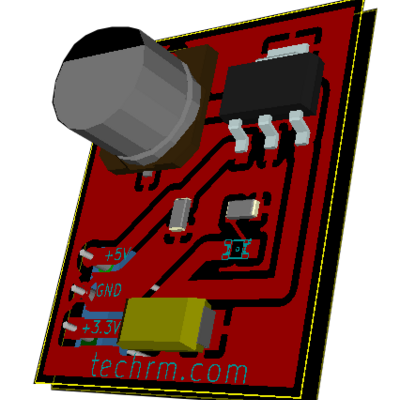
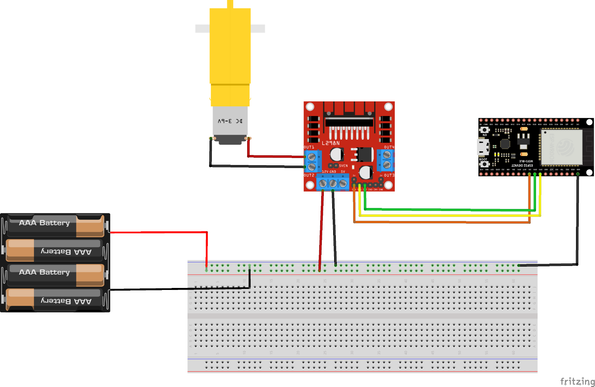
How to control a DC motor via ESP32 and Bluetooth with L298N on PlatformIO - Techrm

Welcome to this article where I will walk you step-by-step through a project on how to control a DC motor using an ESP32 and an L298N based H bridge. Follow

Techrm

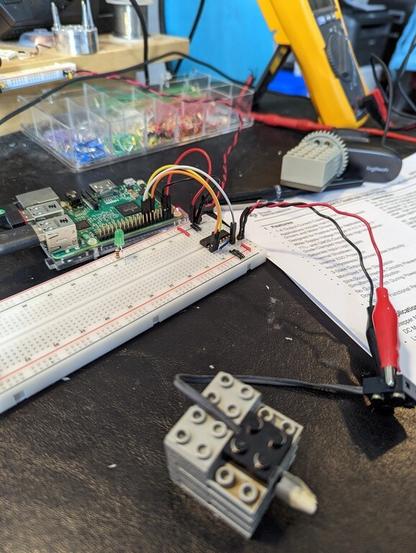
Having a lot of problems with my laziness-imposed constraint of cardboard #engineering. (I have a wood/#machineshop in the barn, but do I use it? Do I hell.)

After hacking a bunch of #Lego gears/connectors to fail to get the stepper turning the barrel, I wanted to build the structure out of Lego as well. Stepper now a problem.

You have Lego motors, nitwit!

Happen to have #HBridge ICs in stock, so threw together a #circuit to drive it from the SBC. Works! Now write a driver.

#catvideofeed

Electric Wheelchair Dump Truck Hack Really Hauls

Have you ever looked at a derelict electric wheelchair and thought "I bet I could make something great with that!" Of course you have- this is Hackaday, after all! And so did [Made in Poland], who managed to get a hold of a broken down electric wheelchair and put the full utility of his well equipped metalworking shop to work. The results? Lets just say it hauls.

What we really enjoyed about the build was that there wasn't much that couldn't be done by an average garage hacker with a drill press, angle grinder, and a stick welder. While it's definitely nicer to have a lathe and a high quality welding table, plasma cutter, and everything in between, nothing that [Made in Poland] did in the video is such high precision that it would require those extensive tools. There may be some parts that would be a lot more difficult , or lower precision, but still functional.

Another aspect of the build is of course the control circuitry and user interface. Keeping the skid steer and castor approach meant that each motor would need to be controllable independently. To achieve this, [Made in Poland] put together a purely electromechanical drive controlled with momentary rocker switches and automotive relays to form a simple H-Bridge for each motor.

Of course you just have to watch until the end, because it really proves that a man will do anything to get out of hauling wood around! Old electric wheelchairs can also make a great base for big robots, as it turns out.

#hardware #24v #electricwheelchair #electromechanical #hbridge #hydraulicpump #hydraulicram #mechanical #relay #relays

Electric Wheelchair Dump Truck Hack Really Hauls

Have you ever looked at a derelict electric wheelchair and thought “I bet I could make something great with that!” Of course you have- this is Hackaday, after all! And so did [Made in P…

Hackaday

Custom Christmas Light Controller Blocks Blinks

Finding that his recently purchased LED Christmas lights defaulted to an annoying blinking pattern that took a ridiculous seven button presses to disable each time they were powered up, [Matthew Millman] decided to build a new power supply that keeps things nice and simple. In his words, the goal was to enable “all lights on, no blinking or patterns of any sort”.

Connecting the existing power supply to his oscilloscope, [Matthew] found the stock "steady on" setting was a 72 VAC peak-to-peak square wave at about 500 Hz. To recreate this, he essentially needed to find a 32 VDC power supply and swap the polarity back and forth at the same frequency. In the end the closest thing he could find in the parts bin was a HP printer power supply that put out 30 volts, so the lights aren't quite as bright as they were before, but at least they aren't blinking.

To turn that into a pair of AC square waves, the power supply is connected to a common L298 H-Bridge module. You might expect a microcontroller to show up at this point, but [Matthew] went old school, and created his two alternating 500 Hz square waves with a 555 timer and a 74HC74D dual flip-flop.

Unfortunately, he didn't have the time to get a custom PCB made before Santa's big night. Though as he points out, since legitimate L298s are backordered well into next year anyway, having the board in hand wouldn't have helped much. The end result is that the circuit has to live on a breadboard for the current holiday season, but hopefully around this time next year we'll get a chance to see the final product.

#ledhacks #555timer #74hc74d #hbridge #powersupply #squarewave

Custom Christmas Light Controller Blocks Blinks

Finding that his recently purchased LED Christmas lights defaulted to an annoying blinking pattern that took a ridiculous seven button presses to disable each time they were powered up, [Matthew Mi…

Hackaday

Steppers and ESP32 Make This Retro-Modern Flip-Clock Tick

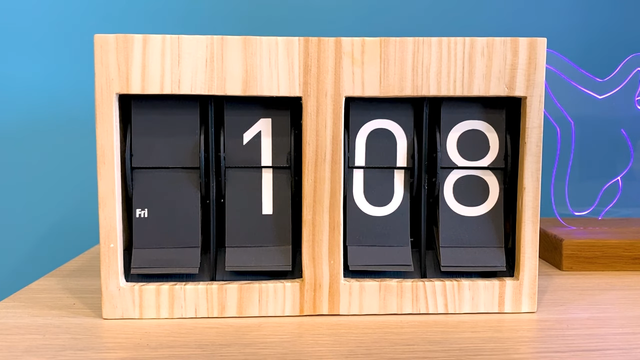
Before LEDs became cheap enough to be ubiquitous, flip-card displays were about the only way to get a digital clock. These entirely electromechanical devices had their own charm, and they have a certain retro cachet these days. Apart from yard sales and thrift stores, though, they're a bit hard to source -- unless you roll your own, of course.

Granted, [David Huang]'s ESP32-based flip clock is worlds apart from the flip cards of the "I Got You, Babe" era. Unfortunately, the video below is all we have to go on to get the story behind this clock, but it's pretty self-explanatory. [David] started the build by making the flip cards themselves, a process that takes some topological tricks as well as a laser cutter. 3D-printed spools are loaded with the cards, which are then attached to frames that hold a stepper motor and a Hall-effect sensor. The ESP32 drives the steppers via L298N H-bridge drivers, but it's hard to say if there's an RTC chip or if the microcontroller is just getting time via an NTP server.

[David] might not be the only one trying to recapture that retro look, but we've got to hand it to him -- it's a great look, and it takes a clever maker to not only build a clock like this, but to make a video that explains it all so clearly without a single word of narration.

[Bin Sun] sent us this tip. Thanks!

#clockhacks #analog #clock #digital #esp32 #flipclock #flipcard #hbridge #l298n #stepper

Steppers And ESP32 Make This Retro-Modern Flip-Clock Tick

Before LEDs became cheap enough to be ubiquitous, flip-card displays were about the only way to get a digital clock. These entirely electromechanical devices had their own charm, and they have a ce…

Hackaday

RoboTray is a Secret Tea Butler

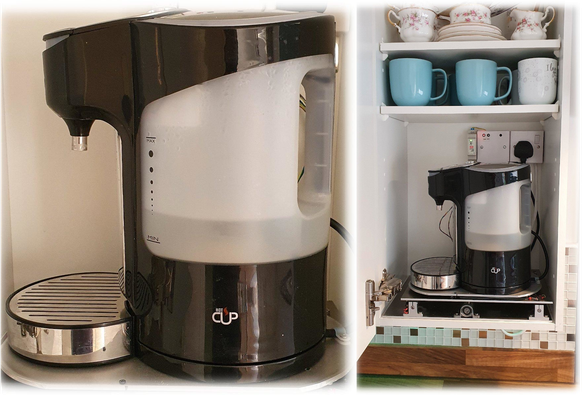
How far would you go for your cup of tea? [samsungite]'s missus doesn't like clutter on her countertops, so away the one-cup kettle would go back into the cupboard for next time while the tea steeped. As long as there's room for it in there, why not install it there permanently? That's the idea behind RoboTray, which would only be cooler if it could be plumbed somehow.

RoboTray went through a few iterations, most importantly the switch from 6mm MDF to 4 mm aluminum plate. A transformer acts as a current sensor, and when the kettle is powered on, the tray first advances forward 7 cm using a 12 VDC motor and an Arduino. Then it pivots 90° on a lazy Susan driven by another 12 VDC motor. The kettle is smart enough to turn itself off when finished, and the Arduino senses this and reverses all the steps after a ten-second warning period. Check it out in action after the break.

If [samsungite] has any more Arduinos lying around, he might appreciate this tea inventory tracker.

#arduinohacks #lifehacks #arduino #hbridge #tea #transformer

RoboTray Is A Secret Tea Butler

How far would you go for your cup of tea? [samsungite]’s missus doesn’t like clutter on her countertops, so away the one-cup kettle would go back into the cupboard for next time while t…

Hackaday