 Stephan Hacker
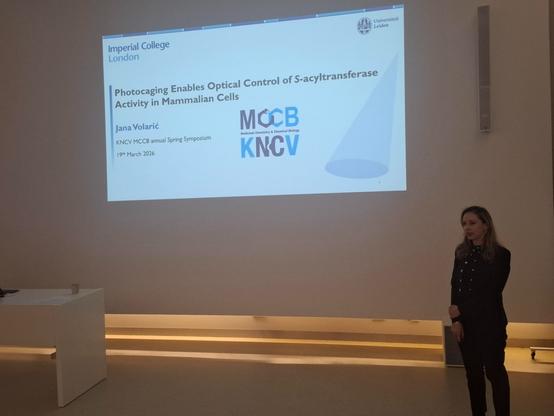
Amazing talk by Jana Volaric from our Molecular Physiology Department and @LED3hub at #KNCVMCCB2026. She talked about her postdoctoral research in the Ed Tate lab into optical control of S-acyltransferase activity in mammalian cells.
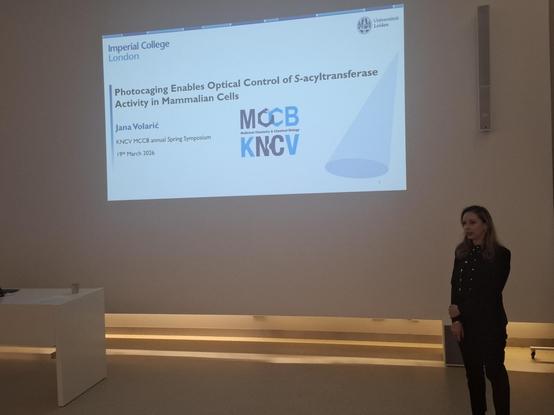
Amazing talk by Jana Volaric from our Molecular Physiology Department and @LED3hub at #KNCVMCCB2026. She talked about her postdoctoral research in the Ed Tate lab into optical control of S-acyltransferase activity in mammalian cells.
Interesting paper by the groups of Zhi Zhou and Xiang Sheng in Nature Communications. They developed a system, with which thiophenols can be fed to cells, converted into non-canonical amino acids and directly used for genetic code expansion in protein engineering.
https://www.nature.com/articles/s41467-025-63733-3
#Chemistry #ChemBio #GeneticCodeExpansion

Enzyme design with non-canonical amino acids has achieved rapid progress in biocatalysis. Here, the authors present an efficient strategy for the design of artificial enzymes with unnatural catalytic center by the combination of non-canonical amino acid biosynthesis and genetic incorporation into protein of interest.
Monumental paper of unnatural amino acid (UAA) mutagenesis in calcium release channels from Isabella Derler and team! Light-activated calcium release in complexes without STIM1 and tons of insights to structure function.

The Ca2+ ion channel Orai1 is crucial in immune cells. Here, the authors applied genetic code expansion to transfer light-sensitivity to the Orai1 channel and achieved precise control over its function.
Nice to see my friends Lilia Leisle, Alessio Accardi, Chris Ahern and more teaming up! Here, CLC-type ion channels, widely responsible for #chloride balance, were subjected to unnatural amino acid #mutagenesis. In a subtle example of the genre, the peptide backbone was changed at individual sites by introducing alpha-hydroxy amino acids.This showed that backbone amides coordinate permeating chloride ions.

CLC-type channels selectively transport Cl− across biological membranes, but it is unclear how discrimination between anions is maintained. Here, authors use a combination of non-natural amino acid substitutions, electrophysiology, and molecular dynamics simulations to determine Cl− specificity within this family of ion channels.
Nice to see this work from Alberto Gonzalez and Teresa Giraldez and collaborators online! My part was small but very happy with how it has turned out. Beautiful state-dependence of crosslinks, fingerprinting movements of the BK channel.
https://www.biorxiv.org/content/10.1101/2022.12.15.520511v1.article-info
 Stephan Hacker
 Andrew Plested