Cytology and Genetics
Noncanonical Structures in the Genome of Bovine Foamy Virus - Cytology and Genetics
Abstract— Bioinformatic methods have been used to identify putative perfect G-quadruplexes (G4s) and three-way junctions (3WJs) in the bovine foamy virus (BFV) genome. Artificial intelligence (AI) AlphaFold 3 was used to confirm putative G4s and 3WJs by building 3D models of these noncanonical structures. G4s are secondary structures formed by G-rich sequences. Multihelical 3WJs formed by three duplexes connected at the binding point and G4s are considered as alternative structures in DNA and RNA that differ from the classical double-stranded B-DNA. In the present paper, the localization map of putative conservative intramolecular G4s formed by two G-tetrads on the BFV genome was created. Seven putative conservative G-quadruplexes in the sense strand of BFV proviral DNA and 22 G4s in the antisense strand formed by two G-tetrads with G-score from 32 to 36 were found by the multiple alignment of 37 BFV isolates with complete genome. The density of G4s was 0.6 G4/kb for the sense strand of the BFV proviral DNA, while it was 1.8 G4/kb for the antisense strand. One conservative 3WJ motif with a length of 73 bp with 100% homology localized in the 5'-untranslated region and partially on the 5'-end of the gag gene was found for a set of 37 BFV isolates. The 3WJ structure in BFV RNA is stabilized by 20 complementary bp with a free energy ΔG of 19.8 kcal/mol. The significance of this structure for BFV functioning has been proven. The use of AI AlphaFold 3 to build 3D models of theoretically determined perfect G4s and 3WJs in the BFV genome allowed for reliably determining putative alternative structures in nucleic acids.
 Matej Lexa
 Scienza et Magia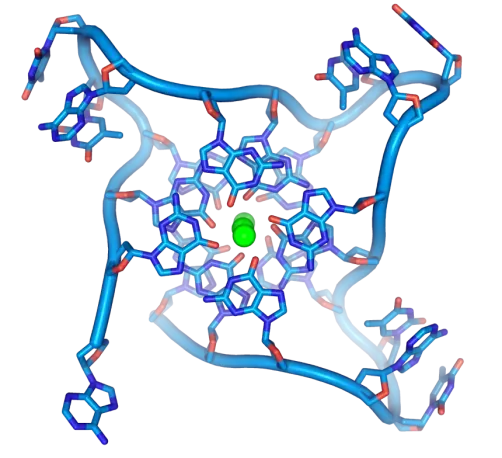

 O! ver