#Hardware #Howto #555timer #Functiongenerator #Squarewave #TL082opamp #Trianglewave
555-Based Square-Wave and Triangle-Wave Function Generator Build for Beginners
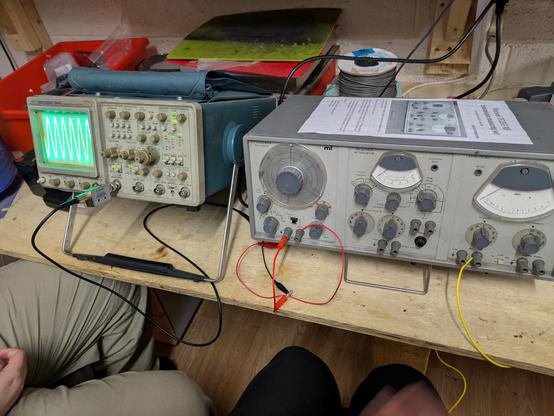
Check out this photo from last night’s Electronics Night at Tog Hackerspace. We were testing vintage gear, including this oscilloscope and function generator. Proper hands on fun.
#TogHackerspace #ElectronicsNight #VintageTech #TestEquipment #Oscilloscope #FunctionGenerator #Makers #HardwareHacking #DublinMakers #STEM
A friend gave me this Vintage #WaveTek ‘Model 19’ 2MHz function and sweep generator - it’s beautiful inside and seems to work just fine.
I can’t find a servicemanual or the schematics - even the regular user manual seems to have vanished in time..
Let me know if you find one somewhere 👌🏼🙂
I don’t plan to keep this, I’ll pass it on, but it’s fun to see old gear come to life like that 🥰
#rfengineer #functiongenerator #electronics #testandmeasurement #testgeartuesday #waveformwednesday #hamradio #hamr
Arbitrary Wave Generator For The Raspberry Pi Pico
#toolhacks #functiongenerator #raspberrypipico #hackaday
-- Delivered by RssEverything service
Retro Breadboard Gives Up its 1960s Secrets
When we see [Ken Shirriff] reverse engineering something, it tends to be on the microscopic level. His usual forte is looking at die photos of strange and obsolete chips and figuring out how they work. And while we love those efforts, it's nice to see him in the macro world this time with a teardown and repair of a 1960s-era solderless breadboard system.
If you'd swear the "Elite 2 Circuit Design Test System" featured in [Ken]'s post looks familiar, it's probably because you caught his partner-in-crime [CuriousMarc]'s video on the very same unit, an eBay score that arrived in non-working condition. The breadboard, which retailed for $1,300 in 1969 -- an eye-watering $10,000 today -- was clearly not aimed at the hobbyist market. Truth be told, we didn't even know that solderless breadboards were a thing until the mid-70s, but live and learn. This unit has all the bells and whistles, including three variable power supplies, an array of switches, buttons, indicator lamps, and jacks for external connections, and a pulse generator as well as a legit function generator.
Legit, that would be, if it actually worked. [Ken]'s contribution to the repair was a thorough teardown of the device followed by reverse-engineering the design. Seeing how this thing was designed around the constraints of 1969 technology is a real treat; the metal can transistor and ICs and the neat and tidy PCB layout are worth the price of admission alone. And the fact that neon lamps and their drivers were cheaper and easier to use than LEDs says a lot about the state of the art at the time.
As for the necessary repairs, [Marc]'s video leaves off before getting there. That's fine, we're sure he'll put [Ken]'s analysis to good use, and we always enjoy [Marc]'s video series anyway. The Apollo flight comms series was a great one, too.
#repairhacks #teardown #breadboard #functiongenerator #repair #retro #reverseengineering

Low-Cost, Two-Channel Scriptable Waveform Generator
Microcontroller addict [Debraj] decided to make his own programmable sine wave generator, and was able to put it together for under $40 USD. Other than low-cost, his list of requirements was as follows:
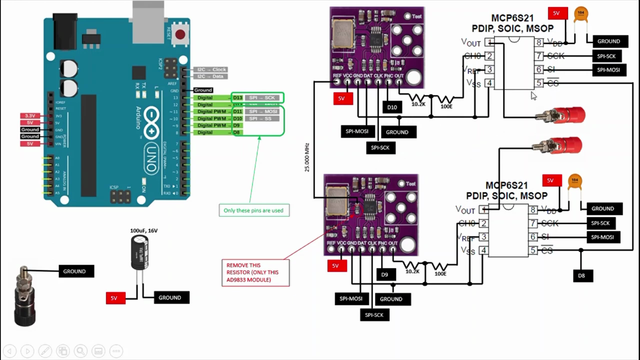
The heart of the project is the Analog Devices AD9833, a complete Direct Digital Synthesis (DDS) waveform generator system on a chip. If you've ever rolled your own DDS using discrete ICs or in an FPGA, you can appreciate the benefit of squeezing the phase accumulator, sine lookup table, DAC, and control logic all into a single ten-pin package. [Debraj] uses AD9833 modules from the usual online vendors for a few dollars each. He synchronizes the generators by disconnecting the reference crystal on the second module and driving it from the first one. The remaining specifications are met by the inherent characteristics of the DDS system, and the scriptable interface is accomplished with an Arduino controlling the AD9833 chips and two programmable gain amplifiers (MCP6S31). We like the confidence that [Debraj] displays by sketching the initial circuit diagram with a ball-point pen -- check out the sketch and the final pictorial schematic in the video below the break.
This is a good example of combining off-the-shelf modules to quickly build a project. This approach is great for one-off builds or as a proof-of-concept test bed that can later be spun onto a custom PCB. Another reason to use modules these days is that the modules are often in-stock but the chips are unobtainable. Though it appears [Debraj]'s only needs one of these generators, it would be an easy board to layout and build -- if you can buy the parts.
#digitalaudiohacks #toolhacks #ad9833 #dds #functiongenerator #lowcost
Protek B8010FD Function Generator - scanlime:010
https://diode.zone/videos/watch/0fb2084a-7110-4410-bb39-232e982a1104