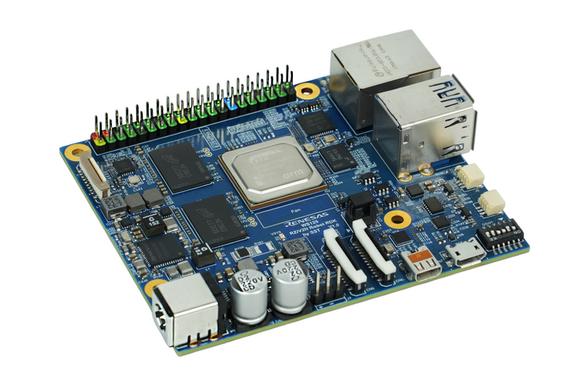
Renesas RZ/V2H Robotics Development Kit handles AI vision, motor control, and power management with a single board

Renesas WS125-V2HRDKREFZ is a Robotics Development Kit (RDK) powered by Renesas RZ/V2H Arm Cortex-A55/R8/M33 microprocessor and designed for high‑performance AI vision applications leveraging the MPU's built-in 80 TOPS (sparse) AI accelerator. The kit ships with 16GB LPDDR4, 64MB QSPI flash, a 64GB microSD card, and appears to be partially inspired by the Raspberry Pi 5 with a 40-pin Raspberry Pi GPIO header, a 16-pin PCIe Gen3 FFC connector, two MIPI CSI connectors, and a micro HDMI port. Other features include a Gigabit Ethernet port, two USB 3.2 ports, two CAN-FD interfaces, and a 12-24V DC input voltage range. Renesas WS125-V2HRDKREFZ specifications: SoC – Renesas RZ/V2H CPU/MCU cores 4x Arm Cortex-A55 cores up to 1.8 GHz 2x Cortex-R8 real-time cores up to 800 MHz Arm Cortex-M33 microcontroller core up to 200 MHz for system management GPU – Arm Mali-G31 GPU NPU - DRP-AI3 dynamically reconfigurable processor delivering up to 8 TOPS (INT8) or

CNX Software - Embedded Systems News
πŸš€πŸ˜‚ Oh great, yet another guide promising the ✨magic✨ of running #Rust on an ESP32-S3's second core! Because who doesn't love a weekend full of 'why won't this #CMake script work' and 'what even is an #assembly trampoline?' πŸ™„ Just pin a #FreeRTOS task and call it a day, hero. πŸ› οΈ
https://tingouw.com/blog/embedded/esp32/run_rust_on_app_core #ESP32-S3 #humor #HackerNews #ngated
Tingou Wu's Website

Tingou Wu's Personal Website

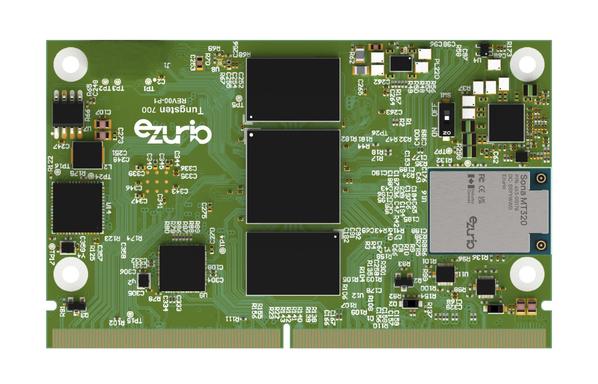
Ezurio Tungsten 510/700 SMARC SoM features MediaTek Genio 510/700 AIoT SoC, dual GbE, WiFi 6

Ezurio Tungsten 510 and Tungsten 700 SMARC 2.1 compliant system-on-module powered by MediaTek Genio 510 hexa-core and Genio 700  octa-core Cortex-A78/A55 AIoT SoCs with an up to 4 TOPS NPU. The SMARC modules feature 4GB or 8GB LPDDR4 memory and 16GB flash by default (upgradeable up to 128GB), offer dual Gigabit Ethernet, WiFi 6 and Bluetooth 5.2 connectivity, and various interfaces exposed through a standard 314-pin MXM connector, including  HDMI, DisplayPort, eDP, and MIPI DSI display interfaces, two MIPI CSI camera interfaces, two I2S audio interface, PCIe Gen2 x1, and more. Ezurio Tungsten 510/700 specifications: SoC (one or the other) MediaTek Genio 510 (MT8370) CPU - Hexa-core processor with 2x Arm Cortex-A78 core up to 2.2 GHz, 4x Cortex-A55 cores up to 2 GHz GPU - Arm Mali-G57 MC2 GPU VPU - 4Kp60 H.265, AV1, VP9, H.264 video decoding, 4Kp30 H.265 and H.264 video encoding Accelerators - Up to 3.2

CNX Software - Embedded Systems News
youtube.com/watch?v=RWuU... #QNX on #RISC-V has competitors #FreeRTOS and #WindRiverLinux. It has #Huawei & #Apple alternatives in the #VehicleOS market with #ISO26262 certification, but ties to China or USA are worrying in any operating system. And no sane person wants #IsraelInside a car at all.

'The government of Canada coul...
'The government of Canada couldn't be happier with the nature of the relationship': BlackBerry CEO

YouTube

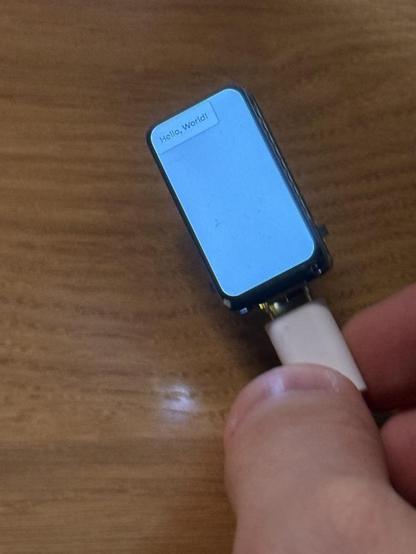
Learnt about ESP #IDF, #PlatformIO, #FreeRTOS, and took way too long to properly initialize the SPI bus so that I could get #LVGL running.
Hello, World!

#Swift #ESP32

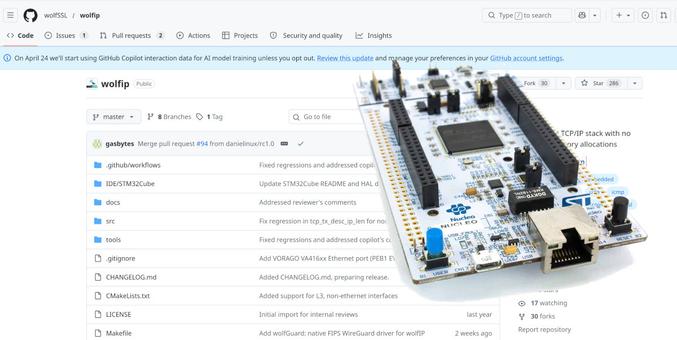
wolfIP – An open-source, lightweight TCP/IP stack with no dynamic memory allocations for embedded systems

https://fed.brid.gy/r/https://www.cnx-software.com/2026/04/07/wolfip-an-open-source-lightweight-tcp-ip-stack-with-no-dynamic-memory-allocations-for-embedded-systems/

wolfIP – An open-source, lightweight TCP/IP stack with no dynamic memory allocations for embedded systems

Better known for its open-source wolfSSL SSL/TLS library, wolfSSL (the company) has now released the wolfIP open-source, lightweight TCP/IP stack with no dynamic memory allocations (e.g., no malloc calls) designed for resource-constrained embedded systems. The company highlights that wolfIP "supports both endpoint-only mode and full multi-interface support with optional IP forwarding. By default, it operates as a network endpoint, but can be configured to forward traffic between multiple network interfaces".

CNX Software - Embedded Systems News
Nuvoton NuMicro M3331 Cortex-M33 MCU features built-in ARGB LED controller, optional USB 2.0 OTG interface

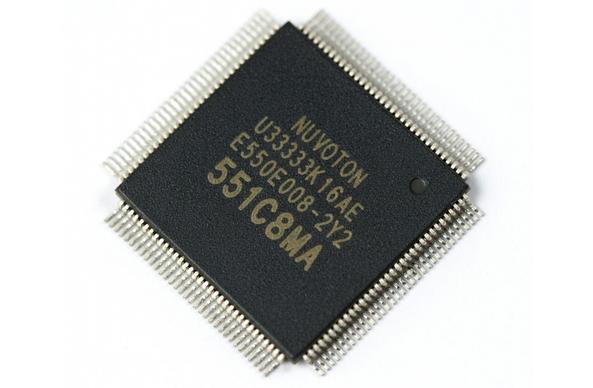
Nuvoton's new NuMicro M3331 is a series of 32-bit Arm Cortex-M33 MCUs clocked at 180 MHz that integrate an ARGB LED controller, a DSP instruction set, a single-precision FPU, and TrustZone security for smart factories, renewable energy systems, and consumer devices. In the past, we have written about other Cortex-M33 MCUs like the STM32U3B5/C5, Texas Instruments MSPM33C321A,  Nordic Semi’s nRF54LM20A, and various others, but the Nuvoton M3331 series specifically features a built-in Enhanced LED Light Strip Interface (ELLSI) and up to 10 standard LLSI channels. This allows the MCU to natively support gaming ARGB Gen1 and Gen2 LED control protocols, completely offloading the CPU to run fluid, dynamic LED effects. It comes in two variants, the M3333 series and the M3334 series, with the latter adding a high-speed USB 2.0 OTG controller with an integrated PHY. NuMicro M3331 specifications: MCU core – Arm Cortex-M33 32-bit CPU @ 180 MHz with single-precision

CNX Software - Embedded Systems News

Toradex OSM and Lino SoMs – 30Γ—30mm NXP i.MX 93/i.MX 91 modules with solder-down or B2B connector designs

https://fed.brid.gy/r/https://www.cnx-software.com/2026/03/31/toradex-osm-and-lino-soms-30x30mm-nxp-i-mx-93-i-mx-91-modules-with-solder-down-or-b2b-connector-designs/

Toradex OSM and Lino SoMs – 30Γ—30mm NXP i.MX 93/i.MX 91 modules with solder-down or B2B connector designs

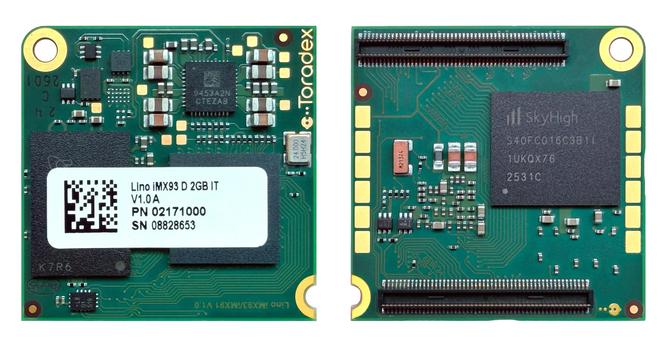
Toradex has launched two new ultra-compact (30x30mm) System-on-Module (SoM) families: OSM and Lino, powered by NXP i.MX 91 or i.MX 93 Arm Cortex-A55 SoC for Edge industrial and IoT applications. The OSM iMX91 and OSM iMX93 variants comply with the OSM Size-S standard, featuring a 332-ball contact grid designed to be soldered to the carrier board. The Lino is a proprietary format that keeps the OSM Size-S dimensions but features two board-to-board (B2B) connectors offering more flexibility for potential replacement or future upgrades. Toradex Lino iMX91/iMX93 system-on-module Toradex Lino specifications: SoC (one or the other) NXP i.MX 93 CPU 2x Arm Cortex-A55 up to 1.7 GHz 2x Arm Cortex-M33 up to 250 MHz GPU – PXP 2D GPU with blending/composition, resize, and color space conversion NPU – Arm Ethos-U65 NPU @ 1 GHz up to 0.5 TOPS Security – EdgeLock Secure Enclave NXP i.MX 91 CPU - Single-core Arm Cortex-A55

CNX Software - Embedded Systems News
Frequently find myself wishing #FreeRTOS xGroupEventWaitBits would run on set and unset. With just returning on set more code is required to handle the same functionality. hrmph.
Texas Instruments MSPM0G5187 and AM13Ex MCUs integrate TinyEngine NPU for Edge AI applications

Texas Instruments MSPM0G5187 and AM13Ex are two new microcontroller (MCU) families featuring the company's  TinyEngine neural processing unit (NPU) to enable low-latency, high-efficiency Edge AI/Machine Learning inference on the chips. TI claims that the TinyEngine NPU can run AI models with up to 90 times lower latency and more than 120 times lower energy utilization per inference than similar MCUs without an accelerator.  The MSPM0G5187 is a general-purpose, low-power Arm Cortex-M0+ MCU, while the AM13Ex Arm Cortex-M33 microcontroller targets real-time motor control, starting with the AM13E23019 SKU. TI MSPM0G5187 general-purpose Cortex-M0+ MCU Key features and specifications: CPU - Arm Cortex-M0+ @ 80 MHz Memory - 32 KB RAM with ECC Storage - 128 KB flash with ECC, 8 KB data flash with ECC Accelerators TinyEngine NPU for AI/ML delivering up to 2.56GOPS (Giga Operations Per Second) at 80MHz MATHACL math accelerator Peripherals USB - 1x USB 2.0 (12 Mbps) Audio

CNX Software - Embedded Systems News