Xie et al. use genotyping by target sequencing (GBTS) to generate an exome capture panel of the Triticeae D #genome and facilitate definition of the introgression landscape of Aegilops tauschii-#wheat derivatives.

https://doi.org/10.1111/jipb.70106
@WileyLifeSci
#PlantSci #JIPB #CropScience #botany #FreeAccess

🙂#Rice is a staple crop and vital to #FoodSecurity in #China.

☹️Rice Sheath Blight is caused by Rhizoctonia solani, a damaging and difficult-to-control #fungal #pathogen.

What if there was a win-win strategy for both rice #yield and RSB resistance?
🔖🔓⬇️

https://doi.org/10.1111/jipb.70033
#PlantSci #CropScience #openaccess #botany

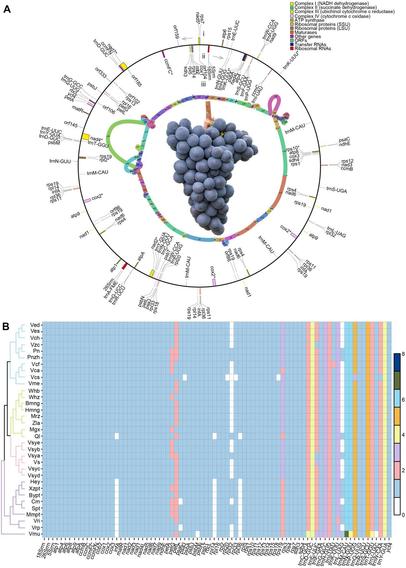
Hou et al. explore the potential role of cytoplasmic #genomes in #grape domestication, offering new insights into grape #evolution and #crop improvement.

🍇https://doi.org/10.1111/jipb.13968

@wileyplantsci
#PlantScience #JIPB #systematics #CropScience #MolecularBiology #gene #botany #OpenAccess

Colletotrichum gloeosporioides is a major threat to #mango #crops. Here, Xiang et al. report that Histone deacetylase MiHDA3 enhances #fruit resistance to this devastating #pathogen by deacetylating MiCAT1.

🥭https://onlinelibrary.wiley.com/doi/10.1111/jipb.70023

Wiley Plant Science
#PlantSci #CropScience #botany

We think #root #nodules are endlessly fascinating!
Not convinced? Then you'd better check out this #OA paper by Wang et al., published in #JIPB!

➡️https://doi.org/10.1111/jipb.70007

@wileyplantsci
#PlantScience #epigenetics #gene #peanut #legume #CropScience #FoodScience #FoodSecurity #botany

Iowa farmers push back on precision agriculture

(KMAland) -- A new report from a farm industry alliance showed high-tech ag practices in Iowa and the Midwest do not reduce pesticide and fertilizer use as much corporate ag

KMAland.com
🧬 Soybean's secret weapon against salt stress: GmHAK5, GmGSTU19, GmERF98 unlock crop resilience! Breeding the future of agriculture, one gene at a time 🌱 #Genomics #CropScience #PlantResearch https://emmecola.github.io/genomics-daily
Genomics Daily

My GitHub page

Moreno Colaiacovo
🍚❄️ Rice genomes just got cooler! Transposable elements reveal cold-fighting genes, potentially revolutionizing crop breeding for climate resilience. #Genomics #CropScience #ClimateAdaptation 🌱 https://emmecola.github.io/genomics-daily
Genomics Daily

My GitHub page

Moreno Colaiacovo

📗 'Identification of wheat varieties (lines) for #SaltTolerance and screening of germplasm in Ningxia spring wheat region' - an article from the Journal of #SouthernAgriculture on #ScienceOpen:

🔗 https://www.scienceopen.com/document?vid=e2347ec5-3d6f-4069-bb14-cc69a91bb1ce

#PlantBreeding #CropScience #WheatResearch

Identification of wheat varieties (lines) for salt tolerance and screening of germplasm in Ningxia spring wheat region

<p xmlns:xsi="http://www.w3.org/2001/XMLSchema-instance" dir="auto" id="d5884154e122"> <b>[Objective]</b> The salt tolerance of wheat varieties (lines) was identified in Ningxia spring wheat region, salttolerant germplasms were screened, in order to provide excellent germplasm resources for salt-tolerant genetic improvement of spring wheat in Ningxia. </p><p xmlns:xsi="http://www.w3.org/2001/XMLSchema-instance" dir="auto" id="d5884154e127"> <b>[Method]</b> Using 230 wheat varieties (lines) from home and abroad adapted to Ningxia spring wheat region as experimental materials. The salt tolerance at the bud stage and seedling stage and molecular marker analysis were identified respectively, and correlation analysis was also conducted on the phenotypic traits of salt-tolerant varieties (lines) with salt injury grade (SIG) ≤3 under salt stress. Moreover, a comprehensive evaluation was made by calculating the subordinative function value of salt-tolerant germplasms at both bud stage and seedling stage. </p><p xmlns:xsi="http://www.w3.org/2001/XMLSchema-instance" dir="auto" id="d5884154e132"> <b>[Results]</b> 1.0% NaCl was the appropriate concentration for wheat salt tolerance identification. The numbers of varieties (lines) with SIG grades of 1 (high tolerance), 2 (salt tolerance), and 3 (medium tolerance) at the bud stage were 15, 25 and 49 respectively, accounting for 6.52%, 10.87% and 21.30% respectively. The numbers of varieties (lines) with SIG grades of 1, 2 and 3 at the seedling stage were 0, 5 and 48 respectively, accounting for 0, 2.17% and 20.87% respectively. The SIG at both the bud stage and the seedling stage were mainly grade 3. The average distribution frequency of 22 molecular markers for salt tolerance in wheat reached 72.85% among 230 varieties (lines). Among them, a total of 10 molecular markers, namely Xgwm335, Xgwm558, WSSR4, WSSR39, WSSR85, WSSR126, Xbarc144, Xbarc324, Xcfd6 and Xwmc110, were distributed in 89 samples at the bud stage and 53 samples at the seedling stage of salt-tolerant varieties (lines) (SIG≤grade 3). they could be used for the assisted selection of salt tolerance at the bud stage and seedling stage of wheat. WSSR44 was only detected in Jiangxizao among salt-tolerant varieties (lines). The distribution of other 11 markers in 230 varieties (lines) was 2.17%-70.00%, and was lower than the average value (72.85%). For salt-tolerant varieties (lines) with SIG≤3 at both the bud stage and the seedling stage, their relative salt injury rates (RSIR) and salt injury indexes (SII) were not correlated with the phenotypic traits ( <i>P</i>>0.05). The subordinative function values of yield, important quality traits, RSIR and SII of 22 salt-tolerant varieties (lines) with SIG≤3 at both the bud stage and the seedling stage under normal growth conditions were calculated. The subordinative function values of 11 varieties (lines) were higher than the average, which not only showed better salt tolerance, but also were better in yield and important quality traits. </p><p xmlns:xsi="http://www.w3.org/2001/XMLSchema-instance" dir="auto" id="d5884154e140"> <b>[Conclusion]</b> 1.0% NaCl is the appropriate concentration for the salt tolerance identification of wheat. The salt-tolerant varieties (lines) with SIG≤3 identified at both the bud stage and the seedling stage are mainly MT. Ten molecular markers can be used as assisted selection markers for salt tolerance. The RSIR and SII of salt-tolerant varieties (lines) are not correlated with phenotypic traits. The 11 varieties (lines) show salt tolerance while also having better yield and important quality traits. </p><p xmlns:xsi="http://www.w3.org/2001/XMLSchema-instance" class="first" dir="auto" id="d5884154e146"> <b>摘要:【目的】</b> 对宁夏春麦区小麦品种 (系) 进行耐盐性鉴定, 筛选耐盐种质, 为该地区春小麦耐盐遗传改良提供优 异种质资源。 <b>【方法】</b>以适应宁夏春麦区的230个国内外小麦品种 (系) 为试验材料, 分别对其进行芽期和苗期耐盐性及 分子标记鉴定, 并对盐害级别 (SIG) ≤3级耐盐品种 (系) 在盐胁迫下的表型性状进行相关分析, 通过计算芽期和苗期 耐盐种质的隶属函数值对其进行综合评价。 <b>【结果】</b>1.0% NaCl为小麦耐盐性鉴定的适宜浓度。芽期SIG为1级 (高 耐) 、2级 (耐盐) 、3级 (中耐) 的品种 (系) 数分别为15、25和49个, 分别占6.52%、10.87%和21.30%, 苗期SIG为1、2、3级的 品种 (系) 数分别为0、5和48个, 分别占0、2.17%和20.87%, 芽期和苗期SIG均以3级为主。22个小麦耐盐分子标记在 230个品种 (系) 中平均分布频率达72.85%, 其中Xgwm335、Xgwm558、WSSR4、WSSR39、WSSR85、WSSR126、 Xbarc144、Xbarc324、Xcfd6和Xwmc110共10个分子标记在芽期89个和苗期53个耐盐品种 (系) (SIG≤3级) 中有分布, 可用于小麦芽期和苗期耐盐性辅助选择;WSSR44在耐盐品种 (系) 中仅江西早有检测结果;有11个标记在230个品种 (系) 中的分布频率 (2.17%~70.00%) 低于平均值 (72.85%) 。芽期和苗期SIG≤3级的耐盐品种 (系) 的相对盐害率 (RSIR) 和盐害指数 (SII) 与表型性状均无显著相关性 ( <i>P</i>>0.05) 。计算芽期和苗期SIG≤3级的22个耐盐品种 (系) 在正 常生长条件下的产量、重要品质性状、RSIR及SII的隶属函数值, 有11个品种 (系) 函数值的隶属函数值高于平均值, 说明这些品种 (系) 耐盐性较好, 且产量和品质性状也较优。 <b>【结论】</b>1.0% NaCl是小麦耐盐性鉴定的适宜浓度, 芽期 和苗期鉴定出SIG≤3级的耐盐品种 (系) 均以中耐为主。10个分子标记可作为耐盐辅助选择标记, 耐盐品种 (系) 的相 对盐害率和盐害指数与表型性状均不相关, 11个品种 (系) 表现耐盐, 同时还具有较优产量和重要品质性状。 </p>

ScienceOpen
Climate change linked to decline in nutritional quality of food

New preliminary research suggests that a combination of higher atmospheric CO2 and hotter temperatures contribute to a reduction in nutritional quality in food crops, with serious implications for human health and wellbeing.

EurekAlert!