 otheorange_tag
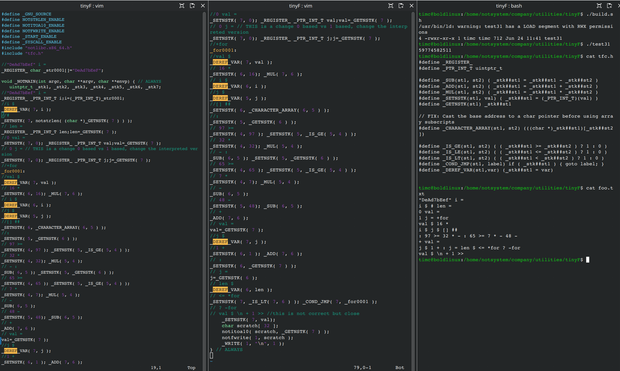
Hand #compiled tinyF code this matches the interpreted output, it is TINY, these tricks to get 12K footprint are well known but apparently NEVER used, everyone is just fine with 2-20Mbyte footprint? REALLY? that's 1000x bloat.
One year of Roto, a compiled scripting language for Rust
https://blog.nlnetlabs.nl/one-year-of-roto-the-compiled-scripting-language-for-rust/
#HackerNews #Roto #Rust #scripting #language #compiled #programming #languages #technology
By Terts Diepraam Almost exactly one year ago, we announced Roto, a JIT-compiled embedded scripting language for Rust applications. A lot has happened since then that we'd like to tell you about! 💡Along with this post, we published Roto v0.11.0! You can check out the changelog

6 track album
Unix "find" expressions compiled to bytecode
https://nullprogram.com/blog/2025/12/23/
#HackerNews #Unix #find #bytecode #compiled #programming #technology #efficiency
Roto: A Compiled Scripting Language for Rust
https://blog.nlnetlabs.nl/introducing-roto-a-compiled-scripting-language-for-rust/
#HackerNews #Roto #Rust #Scripting #Language #Compiled #Programming

By Terts Diepraam We are working on an embedded scripting language for Rust. This language, called Roto, aims to be a simple yet fast and reliable scripting language for Rust applications. The need for Roto comes from Rotonda, our BGP engine written in Rust. Mature BGP applications usually feature some
Things Zig Comptime Won't Do
https://matklad.github.io/2025/04/19/things-zig-comptime-wont-do.html
#HackerNews #Zig #Comptime #Compiled #Languages #Programming #Blog #Post
There are a lot of #tools and #libraries - in #Python and other languages - that are basically #wrappers around #compiled libraries written in C, C++, or other compiled languages. In general, installing the Python package from a repository declares the binary library package as a #dependency.
A name collision between the Python package and the underlying C library would be problematic. You could argue that a Python library that exposes the functionality of `libfrobnicate`, which is part of the `frobnicate` package, shouldn't itself be called `frobnicate` but something totally different - but people go searching for "Python for Frobnicate" so it's a natural enough name. And therefore the repository maintainers have to make it `python-frobnicate` etc.
In general, no, but in data science your chances of problems are a little higher. If you're relying on any binary wheels in your work, you may find it more difficult because many projects don't produce wheels for non-dominant architectures on any given OS. It was really common on MacOS when the Mx chips were newer, to find only x86 binary wheels.
So you may have to build wheels for compiled extensions, which can be fiddly.
Despite what the #systemd #devs might think, "42% less #Unix philosophy" is an anti-selling-point.
"Replace #sudo with #run0, let systemd do it" - sure. Throw away a well-audited, widely-used codebase which has worked well for decades, and instead turn it into a request to a #PID 1 process that is a huge modular-but-#monolithic codebase full of constant churn which has barely been #compiled, much less #understood.
Dollars to doughnuts there are more root holes lurking in systemd than in sudo.
What is the prevailing thought about adding a #compiled #docker #image to a #git #repository?
I understand it takes a lot of space, as does a backup though. Should I create a new repository just for the image?
Something like github/socialuser/myGreatProject and then github/socialuser/myGreatProject-binaries
Thoughts? Discussions?
 Hacker News
 Juan A. Zamarripa [E.]
 C.
C. Social User 🤿