 Digital Mark λ ☕️ 🚀 🌗
 screwlisp
 spnw
spnw Bozhidar Batsov (a.k.a. Bug)
How many people still remember this article? https://www.randomhacks.net/2005/12/03/why-ruby-is-an-acceptable-lisp/
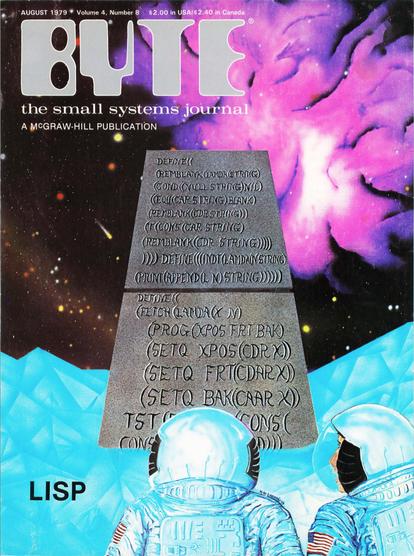
@djl @screwlisp Caveman Lisp was hard because you had to chisel it into stone monoliths.
#lisp
@mdhughes I would say anyone encountering that article would come away with incorrect beliefs about #lisp and the entire history of #computing. The introduction should say something like:
In the beginning, John McCarthy, the father of AI, created lisp in contrast to Fortran. Lisp's centrality to computing led to an explosion of incompatible variations. One was the lambda papers, which defined scheme. The lisp community resolved their differences via an ANSI standard process, ANSI common lisp.
How many people still remember this article? https://www.randomhacks.net/2005/12/03/why-ruby-is-an-acceptable-lisp/
@rusty__shackleford @screwlisp My "Lisp" book list is SICP:
https://archive.org/details/sicp_20211010/mode/2up
And watch the lectures (then do the chapter & problems, just like you would in college):
https://archive.org/details/mit_ocw_sicp
The Scheme Programming Language by R. Kent Dybvig:
https://scheme.com
For "Common" Lisp I liked Land of Lisp, esp the music video:
http://landoflisp.com
And Practical Common Lisp. CL is too bloated a language to really do in a book:
https://gigamonkeys.com/book/
#scheme #lisp
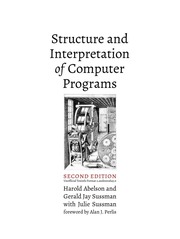
Structure and Interpretation of Computer Programs (SICP) is a computer science textbook, formerly used as the textbook for MIT's introductory course in...
Recently published my Lisp code "DPTherm" on codeberg, Licensed #AGPLv3
A Common Lisp application for preliminary design of Shell & Tube Heat Exchanger. It performs design calculations & Thermo-Hydraulic analysis based on KERN method.
https://codeberg.org/Deep-Pandya/DPTherm
Although I could not utilize more macros & make my program more Lispy, I believe this initial step will demonstrate the potential utilization of #LISP in the field of Thermal Engineering!
GravityLoops, a gravity simulator in Interlisp and LOOPS
#lisp #commonLisp I would say the lisp #wikipedia page has been vandalised to not mention ANSI standardisation until the last paragraph of the history subheading. #ANSI
Then, halfway through there is a one-line section:
Standardized dialects [edit]
Lisp has officially standardized dialects: R6RS Scheme, R7RS Scheme, IEEE Scheme,[60] ANSI Common Lisp and ISO ISLISP.
This is a significant departure from the former page. Also, calling it now sloppy sloppy sloppy slop
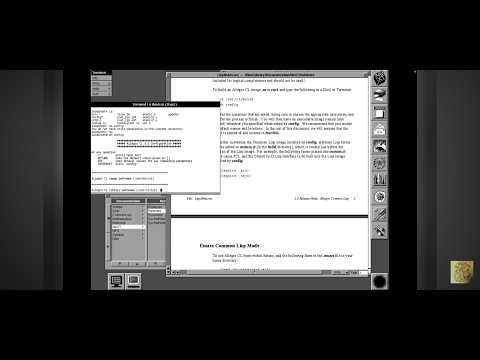
In addition to Allegro were there other Lisps for the NeXT or NeXTSTEP? I assume it was easy to port or build from source free systems. But I'm curious about commercial or research implementations specifically designed for the NeXT environment.
 Deep Pandya
 lisp
lisp
 Paolo Amoroso
 Daniel Kochmański