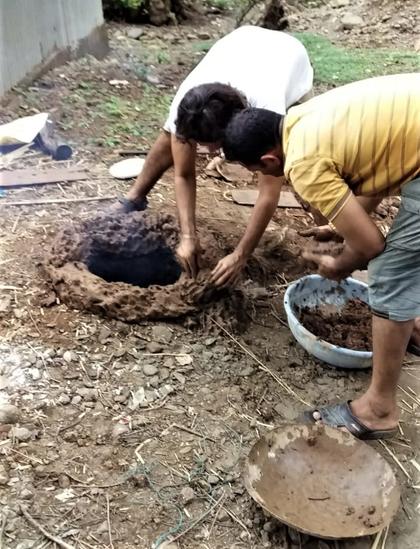
Again, don't do this with bare skin (use safety equipment and appropriate precautions)

#WoodAshCement

July 17, 2018, PrimitiveTechnology

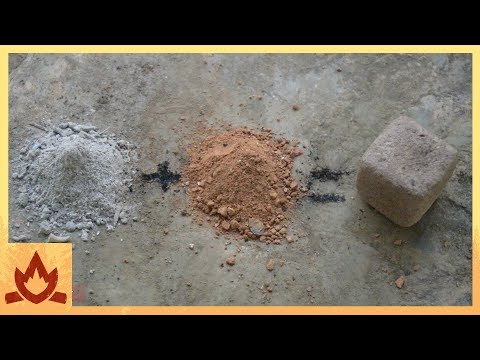
"I developed an experimental cement from made only from re-fired #WoodAsh as its #cementitious material. It was mixed with crushed #terracotta as an aggregate and formed into a cube. The cement set hard after 3 days and did not dissolve in water after this period.

"Process: First I burnt bark and leaves in a kiln at high temperatures to produce well burnt, mostly white wood ash. The ash was then mixed into water and stirred well. The excess water was poured off and the resulting paste was made into pellets and allowed to dry. A pellet was then re-heated in the #forge until it glowed about orange hot. This was then taken out, cooled and dropped in a pot of water. The pellet dissolved and boiled due to a chemical reaction with the water. The paste was stirred and crushed terracotta (old tiles from previous projects) was added and mixed to form a mouldable #mortar. This was formed into a cube and allowed to set for three days (in the video, a cube made exactly the same way 3 days previously was used due to time constraints). The resultant cube was strong and made a slight ringing sound when tapped with a finger nail. It was placed in water for 24 hours to simulate a very heavy rain event and did not dissolve or release residues into the water.

"My current theory: The main component of wood ash consists of #calcium in some form (e.g. #CalciumCarbonate, #CalciumOxide). This can be up to 45% from my research. Calcium is in higher concentration in the #bark and #leaves of a tree. When the ash is mixed with water, the soluble component of wood ash (10% pot ash) dissolves into the water. But seeing that it does nothing for the cementing process, it is drained off leaving the insoluble calcium (and other components) in the paste. Doing this probably raises the relative percentage of calcium in the paste to about 50% or more. Most of the other 50 % consists of silica and alumina which are #pozzolans, materials that chemically react with calcium hydroxide to increase the durability of the cement product. The paste was then made into a pellet and fired again to high temperature to convert all the calcium compounds to calcium oxide. It also reduces any charcoal in the pellet to ash if it hadn’t already been burnt the first time. This step seemed important as un-fired ash pellets only partially hardened and would fall apart in water, though retaining a weak undissolved 5mm thick crust. I can only surmise that re-firing the ash just gave a greater conversion of the calcium components to calcium oxide. The pellet is slaked in water converting the calcium oxide to calcium hydroxide. This cement was mixed with crushed terracotta which may also help in some way that I’m not aware of as I only did this one experiment and did not test other aggregates yet (e.g. sand, gravel etc.). Terracotta is porous and might hold together better than other materials. The mixture is allowed to set in air where carbon dioxide reacts with calcium hydroxide to form calcium carbonate cementing the aggregate together. After this, the cement will not dissolve in water.

"Use: I think this material might have a potential use as a mortar holding rocks or bricks together in wet environments where #limestone or #SnailShells are unavailable for making cement. Wood ash is a pretty ubiquitous material to most natural environments inhabited by people using biomass fuels. Wood ash cement turns a waste product into a valuable building material. From my research, wood ash is already being used as a partial replacement for cement in the building industry without decreases in strength of the final product. But I’ve only just started experimenting with it and don’t know its full capabilities and limitations. Calcium content of wood ash differs depending on the species of tree, the part of the tree burnt and the soil it’s grown on. Cautious experimentation is still required before committing to a hut built from this material."

Learn more:
https://primitivetechnology.wordpress.com/2018/07/17/wood-ash-cement/
#SolarPunkSunday #DIY #Cement #Woodashes #BuildingMaterials

Wood ash cement

I developed an experimental cement from made only from re-fired wood ash as its cementitious material. It was mixed with crushed terracotta as an aggregate and formed into a cube. The cement set ha…

Making And Using #Lime #Mortars

An article originally written for "Rural Wales" the magasine of CPRW

"The operation of modern #cement and lime mortar is quite different. Cements set by a non-reversible chemical action to form a solid, non yielding mass. #LimeMortars set by the absorption of #CarbonDioxide over a much longer period of time. An understanding of the chemical action of lime is therefore helpful.

"Lime is derived from #limestone or Calcium Carbonate (#CaCO3), which has been burnt in a lime kiln at over 800 degrees centigrade to produce #quicklime or #CalciumOxide (#CaO). In this process carbon dioxide and any water is driven off. Quicklime is potentially dangerous having an avid thirst for water. This process creates a lot of heat and produces #SlakedLime or #CalciumHydroxide (Ca(OH)2). Builders merchants stock this material having been reground to a fine powder and called #HydratedLime.

"The slaking process releases enough heat to cause the water to boil or spit. For this reason water must NEVER be added to quicklime. The lime must ALWAYS be added slowly into the water in a metal container. For the inexperienced builder or home craftsman, slaking is therefore not recommended.

"#HydratedLime can be used as the basis of all lime plasters and mortars. It will slowly absorb free carbon dioxide in the atmosphere and revert to #CalciumCarbonate. A triangle has therefore been completed converting the #calcium back to its original chemical form of limestone. For this reason lime mortars have the potential for #ContinuousRecycling."

Learn more:
http://www.users.callnetuk.com/~gwynedd21/home/JN/LIME.HTM

#SolarPunkSunday #SustainableBuilding #Recyclable #Reusable #LimePlaster #LimeMortar #AncientTechnology #TraditionalTechnology #SustainableBuildingMaterials #ZeroWaste

MAKING AND USING LIME MORTARS

#India - How to Make #Lime From Scratch

December 2018

"How did they create their own #QuickLime?

"First Gautam and his friends built the kiln out of cob (see above). Next, he collected a bunch of oyster and clam shells from seafood sellers. You don't crush the shells, they are left whole so they are easy to identify post burning, because the entire burned shell will be converted into #CalciumOxide or pure lime.

" 'Research stated the shells needed to be fired between 800-1200℃. Any less and it wouldn't have the reaction that turns it into lime, and any more would melt the shells,' he informed us.

"I asked him how he measured the temperature. 'Figuring out the temperature was tricky at first, but luckily a professional potter friend came to the rescue and we used a thermocouple to measure the temperature for the first two trials. After that it became easier because then I knew it took between 40-60 mins to achieve that 800-1200 degrees required for my kiln.'

Making Lime from Scratch - An Overview

1. Build a kiln from cob, or some other material that can stand 1000 degrees heat.
2. Collect some oyster/clam shells, or limestone (see video below).
3. Light a fire in your kiln and add your limestone/shells. Get the temperature up to between 800 and 1200 degrees.
4. Extract the shells (if using) and put them in a vat.
5. Put on protective clothing (mask, goggles, gloves, onesie etc)
6. Add warm water to the burned shells and watch the mixture bubble and throth. Be careful. Lime is caustic and can burn.
7. The longer you leave that substance slaking (submerged in plenty of water), the better quality lime you get."

https://www.themudhome.com/mudbuilding/how-to-make-lime-from-scratch

#SolarPunkSunday #DIY #ClamShells #OysterShells #CobBuilding #CobKiln #Kilns #Seashells #SeashellLime

How to Make Lime From Scratch

Lime. Oh lime. So versatile. So useful. But sometimes so difficult to know which kind you’re buying. You may remember my beginners' guide to different kinds of lime I penned last time . Sometimes...

THE MUD HOME
Suck carbon from the air? US facility launches novel climate solution

Direct air capture is a reality in California with plant that pledges not to take investments from oil and gas

The Guardian

Before electricity, theaters used quicklime (heated calcium oxide) to light their stages - hence the term 'in the limelight'.

#science #sciecefacts #quicklime #calciumoxide #InTheLimelight