Happy & proud to share our latest work with the #bluespot community, #locuscoeruleus enthusiasts, and anyone else willing to read 😉

https://www.biorxiv.org/content/10.1101/2023.10.16.562534v1

4 years ago, we had the idea that endogenous neuromodulatory systems are in place that control LC activity, thereby promoting adaptive behavioral responses in challenging environments.

We examined the role of Neuropeptide Y, as a possible candidate system for this, and identified a new population of #NPY-expressing neurons, distributed in the pericoerulean space.

We showed that peri-LC NPY cells innervate the region, providing #NPY input onto #noradrenergic neurons of the LC, and strongly inhibiting their activity, via Y1Rs.

Next, we showed that chemogenetic stimulation of NPY cells led to anxiety-relief, via Y1Rs, and conversely, inhibition of NPY neurons triggered an anxiogenic phenotype.

Together, we showed a novel role for NPY-mediated #neuromodulation of the LC in adaptive behaviors.

We re happy to hear your thoughts /ideas /feedback on our data.

Please share/boost. Happy reading 🔵

#preprint #neuroscience #systemsneuro #ephys #stress

A fantastic day for #bluespot enthusiasts, with the publication of scRNA seq of the mouse #LC.!!

The paper goes deep into neuropeptidergic subpopulations within the noradrenergic system, and using galanin (ephys & Ca2+ imaging), exemplifies the countless possibilities of LC neuromodulation by peptidergic signaling. ❤️❤️

Neuronal diversity of neuropeptide signaling, including galanin, in the mouse locus coeruleus | PNAS
https://www.pnas.org/doi/10.1073/pnas.2222095120

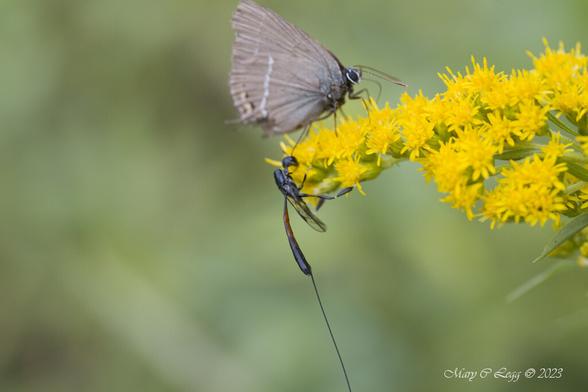
Gasteruption jaculator and Blue-Spot Hairstreak, Satyrium spini Canon 7D EFS 60 2.8 f/4.6 1/320 iso: 200 Srbsko, Czech Republic 7/23/2023 #Wasps #Gasteruption #parasitoid #BlueSpot #Satyrium #Lycaenidae #butterflies #SaveButterflies #Lepidotera #Macro #grasslands

Fantastic resource for the #bluespot community & noradrenergic research as a whole from the Patriarchi lab, available on Addgene

Sensitive multicolor indicators for monitoring norepinephrine in vivo
https://www.nature.com/articles/s41592-023-01959-z

Dreaming about all the cool fiber photometry experiments that are possible now!! 🔵🔵

Sensitive multicolor indicators for monitoring norepinephrine in vivo - Nature Methods

Red and green genetically encoded indicators for norepinephrine have been developed and employed to monitor norepinephrine during locomotion and reward behavior in mice. The strategy used for generating these indicators also produced indicators for other neuromodulators.

Nature

Plugging here for fellow #bluespot member & #locuscoeruleus enthusiast, Greyson Sipe:

"the Sipe lab officially started at Penn State in March, 2023 and we are actively recruiting graduate students and postdoctoral fellows! Please feel free to spread the news to anybody interested in studying neurons, astrocytes, and neuromodulators in arousal, stress and addiction. The lab is pretty much set up with a cutting-edge 2-photon microscope, a custom 1-photon widefield scope, two dual-color fiber photometry rigs, and a suite of behavioral rigs with optogenetics (mini-scopes are on the way)".

For inquiries check:
https://www.sipelab.com/openings

Opportunities — Sipe Laboratory

Sipe Laboratory

A series of extremely cool #locuscoeruleus manuscripts have been put out there recently, and I wanna take the opportunity to highlight them in this🧵

Would love input from other #bluespot enthusiasts, since I'm definitely missing papers!

Maybe we can keep adding by replying, and eventually create an easily accessible list of publications that currently shape the #LC field

🔵

#systemsneuro #neuroscience #noradrenaline #preprints

I am fascinated by the #brain 🧠, #neuroscience, #ageing, #Alzheimer's #dementia and #neurodegenerative #diseases - especially the #noradrenergic system of the #LocusCoeruleus ( #LC #bluespot 🔵🔵) and #vagusnervstimulation ⚡. Let's continue to exchange about it.