 Phillip Medhurst [Unofficial]
Bowyer Bible Luke: The Presentation
https://fed.brid.gy/r/https://phillipmedhurst.com/2026/06/27/bowyer-bible-luke-the-presentation/

Bowyer Bible Luke: The Presentation
https://fed.brid.gy/r/https://phillipmedhurst.com/2026/06/27/bowyer-bible-luke-the-presentation/
Quote of the day, 21 May: St. Raphael Kalinowski
My job at Kursk was to draw up the necessary plans for [construction of a railway line from Kursk, Russia to Odesa, Ukraine]. It was necessary for me to make many journeys to Putywl [Ukraine] and other places to pick up statistical and geographical ideas of which I was in need. Nowhere did I find a Catholic church…
At Kursk I lived near the Orthodox Church. I only set foot in there once, invited to a wedding by a family who were known to me. Perhaps here I could do some praying. That evening, the thought of the cemetery which was close to my room, and the cry of the owls that inhabited the neighbourhood, exercised a salutary impression on my mind.
The old sacristan who was a very honest man became a friend. When I returned after a long absence and asked him how he was, he would reply, “I am very well, thanks be to God and to your prayers.”
In all this expedition I can report only one benefit, not from my work, but from a little religious book, an anthology of prayers to the Blessed Virgin. It had been given to me by a young Polish man who helped me draw up the plans and it had been a keepsake of his mother.
The reading of this little book had a great influence on me. It instilled in me particularly a lively trust in the intercession of the Holy Virgin. One remark on the efficacy of the Hail Mary remained deeply engraved on my memory, and on one occasion when I found myself exposed to imminent danger, I recited the Ave and I emerged safe and sound.
What a powerful weapon prayer is! How easy it is to obtain everything through the intercession of Mary! What efficacious means of salvation Holy Church places in our hands through these religious books, which open the eyes of our souls to the splendor of divine truth!
Saint Raphael Kalinowski
Memoirs, ch. 2
Tierney, T 2016, Saint Raphael Kalinowski: Apprenticed to Sainthood in Siberia, Balboa Press Australia.
Featured image: Antique Russian Orthodox icon. Image credit: kalichka / Adobe Stock (Asset ID#: 148978092).
#AveMaria #BlessedVirgin #intercession #prayers #StRaphaelKalinowski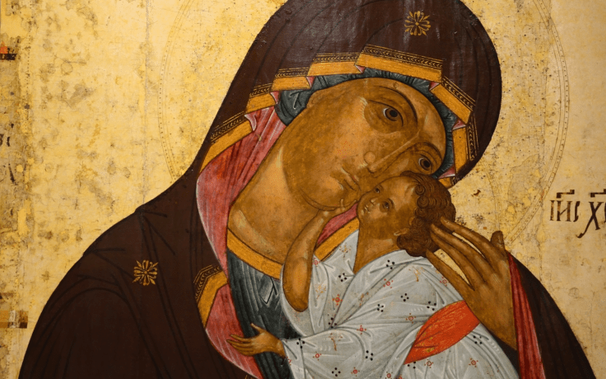
Quote of the day, 20 March: Blessed Francis Palau y Quer
God in His providence has ordained not to cure our ills or grant us grace without the intervention of prayer. He wishes us to help in saving each other by means of our prayer (cf. Jas 5:16f). If the heavens showered down dew and the clouds rained the righteous One, if the earth opened to bring forth the Savior (cf. Is 45:8), it was God’s good pleasure that His coming should be preceded by the prayers of that singular Virgin who by the beauty of her virtues drew into her womb the uncreated Word of God.
The Redeemer came, and by constant prayer, He reconciled the world to the Father. If Christ’s prayer and the fruits of His redemptive work are to be applied to any nation or people, or if the gospel message is to enlighten them and they are to have someone to administer the sacraments, it is indispensable that someone or even many persons should have previously won them over and reconciled them to God by earnest entreaties and supplications, by prayers and sacrifices.
Christ prayed throughout His entire life, whereas He spent only three years preaching. Since God does not distribute His graces to men except through prayer, because He wishes us to recognize Him as the source from which all good things flow; in like manner, He does not wish to save us from danger, or cure our wounds, or console us in affliction, except by means of this same exercise of prayer.
Blessed Francis Palau y Quer
From his spiritual writings
Note: Born in Aytona (Lérida) on December 29, 1811, Blessed Francis Palau y Quer entered the Carmelite Order in 1832 and was ordained in 1836. Amid civil unrest, he lived for years in exile. Returning to Spain, he founded the School of Virtue in Barcelona, later suppressed, and was again exiled—this time to Ibiza (1854–1860), where he lived in solitude at El Vedrá and deepened his mystical insight into the mystery of the Church. He went on to found the Teresian Carmelite Missionary Brothers and Sisters and devoted himself to preaching and Marian devotion. He died at Tarragona on March 20, 1872, and was beatified by Pope John Paul II in 1980.
Catholic Church 1993, Proper of the Liturgy of the Hours of the Order of the Brothers of the Blessed Virgin Mary of Mount Carmel and the Order of Discalced Carmelites (Rev. and augm.), Institutum Carmelitanum, Rome.
Featured image: Background: Es Vedrá is an islet in the Balearic Islands, near Ibiza, in Spain. It is part of the natural reserve of Es Vedrá, Es Vedranell and els illots de Ponent. The statue of Blessed Francis is found in the chapel of the Teresian Carmelite Missionary Sisters, Tarragona.
Image credits: Alejandro Tapia / Adobe Express (photo of the Balearic Islands) and bocachete / Wikimedia Commons (photo of the statue, public domain)
Quote of the day, 12 November: St. Thérèse
Loreto really charmed me! And what shall I say about the Holy House? Ah! how deep was my emotion when I found myself under the same roof as the Holy Family, contemplating the walls upon which Jesus cast His sacred glance, treading the ground bedewed with the sweat of St. Joseph, under this roof where Mary had carried Jesus in her arms, having carried Him in her virginal womb. I beheld the little room in which the angel had appeared to the Blessed Virgin. I placed my rosary in the little bowl of the Child Jesus. What ravishing memories!
Saint Thérèse of Lisieux
Manuscript A, folio 59 verso
My dear Thérésita,
Monseigneur is awaiting the end of the trip in order to make his decision.
Today, really confide your entire affair to the Blessed Virgin. There, in that blessed house where she worked, prayed, suffered, what delightful things she is about to make your heart understand. One does not go to the Blessed Virgin’s home without coming back with hands filled with graces. Oh, little home of Nazareth, you are worth a thousand times more than all the palaces of this world! There, truly, is heaven’s vestibule!. . .
Little Friend and fiancée of little Jesus, don’t forget that He grew up under this roof of mystery. . . . Don’t forget that He wept there often, very often; He wept there with love and with the desire to see all souls take flight towards Him, and He wept with sorrow when seeing so few would love Him in the future!
When the Blessed Virgin noticed that her Darling was weeping, it was then that she quickly placed the mysterious ball in His hand, and He smiled immediately. . . on the dear ball was written this name: Thérésita of the Child Jesus.
Adieu, adieu, little pilgrim, little toy of Jesus. Fear nothing, for Jesus says to you as He said formerly to St. Teresa: “Nobody will be able to snatch you from My Hands!”
Your confidante,
Agnes of Jesus
r.c.ind.
You should also pray to good St. Joseph, for he, too, worked for Him and suffered in this little house, thrice blessed.
Your little letter pleased me very much; don’t worry about your handwriting. When we are traveling, this is insignificant.
Agnès of Jesus, O.C.D. (Pauline Martin
Letter LC 57 From Sister Agnes of Jesus to Thérèse
November 9, 1887
Note: This letter was addressed to St. Thérèse at Loreto, Italy, mailed at the same time as two letters to St. Louis Martin and Céline Martin, and a note from Sister Marie of the Sacred Heart to Thérèse. At the beginning of this letter, Pauline explains Bishop Hugonin’s decision to postpone his answer concerning Thérèse’s vocation until after the trip to Rome was over. Thérèse took this as a negative answer: “I learned from one of your letters, Mother, that he was no longer favorably disposed toward me. My only plank of salvation was in the permission of the Holy Father, but to obtain it I had to ask for it, I had to dare speak to the pope in front of everybody. This thought made me tremble” (Ms A 62r).
Thérèse of Lisieux, S & Clarke, J 1982, General Correspondence: Letters of Saint Therese of Lisieux: Volume 1 1877-1890, Centenary ed., Institute of Carmelite Studies, Washington DC.
Thérèse & Foley, M 2005, Story of a Soul: The autobiography of St. Thérèse of Lisieux, Study edn, translated from the French by Clarke, J, ICS Publications, Washington DC.
We always refer to the website of the Archives of the Carmel of Lisieux for the vast majority of our quotes concerning Saint Thérèse, Saint Zélie, and Saint Louis Martin. If you would like to purchase English translations for the collected works of St. Thérèse, please visit the website of our Discalced Carmelite friars at ICS Publications.
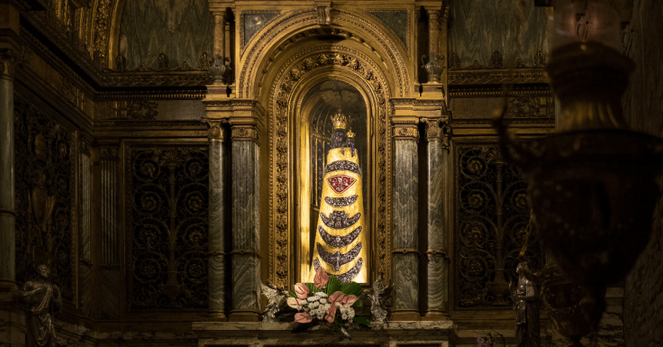
Featured image: The famed image of Our Lady of Loreto in the Basilica of the Holy House. Image credit: kppl / Adobe Stock (File 207764768).
#207764768 #BlessedVirgin #CelineMartin #ChildJesus #familyLife #HolyHouseOfLoreto #PaulineMartin #pilgrimage #SantaCasaDiLoreto #StThereseOfLisieux
Today's Flickr photo was taken in Pompeii: the dome of the Santuario della Beata Vergine del Rosario (Sanctuary of the Blessed Virgin of the Rosary).
#pompeii #church #architecture #dome #fresco #BlessedVirgin #rosary

Quote of the day, 16 May: Hermann Cohen
There may still be some who, from deference to the naturally staid, impassive character of the English, would counsel Catholics to maintain a certain reserve in their devotion to Mary, as though, indeed, there were any other than Mary who was to crush the head of error; as though there could be danger or excess where God has so wondrously surpassed Himself: can the love of Catholics for Mary ever rise to such a height, or can they honour her with glory so sublime, as that to which God Himself has chosen to exalt her?
As if this filial homage could be out of place in England, the birth-place of the devotion of the Holy Scapular, the favoured spot to which the Blessed Virgin came, bringing from heaven that pledge of salvation, to bestow it upon a Religious, not of Italy or of Spain, but on an English Saint, born and bred in England, English in his labors, in his mission, and in his election as General of the Carmelite Order.
This preference for England as the scene of that revelation, and the choice of an Englishman, St. Simon Stock, as the receiver of the promise attached to the Scapular is, to my mind, a pledge of the future conversion of that nation.
Servant of God Augustine of the Blessed Sacrament
Hermann Cohen
Lecture at Malines (3 September 1864)
Tierney, T 2017, A Life of Hermann Cohen: From Franz Liszt to John of the Cross, Balboa Press, Bloomington, IN
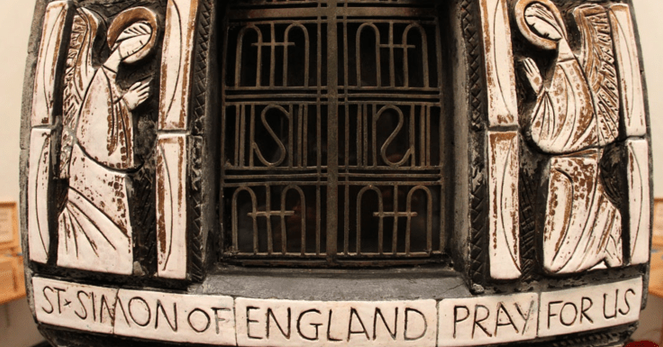
Featured image: This close-up photo shows the monumental reliquary of St. Simon Stock in the chapel of the Carmelite priory in Aylesford, England. Image credit: British Province of Carmelites / Flickr (Some rights reserved)
⬦ Reflection Question ⬦
Do I believe there can be “danger or excess” in loving Our Lady as God exalts her?
⬦ Join the conversation in the comments.
#BlessedVirgin #BrownScapular #CarmeliteOrder #Catholic #Catholics #conversion #England #HermannCohen #Mary #PriorGeneral #scapular #StSimonStock

Hermann Cohen was a star pupil of the great composer/pianist Franz Liszt in Paris in the mid 1800s. Cohen became an international concert pianist in his own right and mixed with many of the famous names of the day. He provided piano accompaniment for Giovanni Mateo De Candia ( Mario), the Pavarotti
Quote of the day, 19 January: St. Mary Magdalen de’ Pazzi
Turning to an image of the Blessed Virgin, [Sister Mary Magdalen de’ Pazzi] said:
“O Mary! I see after all the most pure and resplendent eyes of my Spouse, looking down upon me with a countenance no longer troubled but benign. But, pray! tell me, O my Jesus, what did I do in so short a space of time for which I may have deserved so sweet and smiling a look?”
And she was answered: “Conformity of will.”
In August of 1588, the wine in a keg in the monastery having become sour and the mother prioress having no means to provide good wine, she ordered Sister Mary Magdalen to pray to Jesus that He might be pleased to turn the spoiled wine again into good wine.
Then our Saint, strengthened by obedience, took a little framed picture which represented St. [James], and going with it to the wine cellar, after a short prayer, made the sign of the cross over the keg.
After this, the sister butler came to draw wine, and found it, in fact, restored to its former good taste. The nuns gave thanks to God, who had so miraculously provided for their needs.
A fellow sister, Mary Angiola Santucci, was then confined to her bed by a serious illness, and, on hearing of this miracle, asked for a drink of the wine. No sooner had she tasted it than she felt a notable relief from her illness, and, feeling her hope of ultimate recovery increase, she wanted to taste more of it on the following day. After this, she felt better; and on the third day, taking the same small quantity, she recovered her health entirely, to the inexpressible wonder of the sisters, who could not help being cognizant the double prodigy worked through the virtue of our humble and holy [Sister].
Father Placido Fabrini
Chapters 25 and 17 (excerpts)
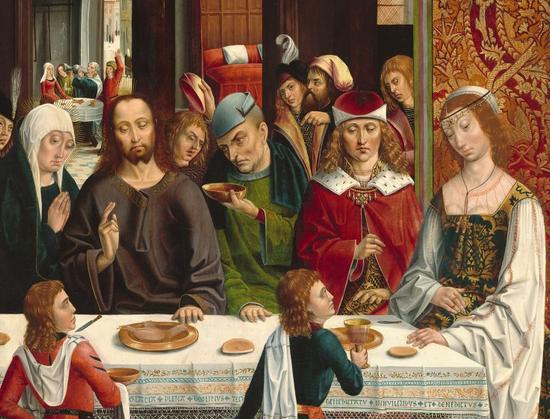
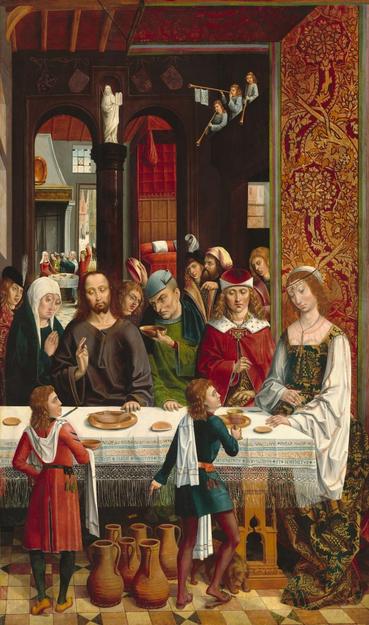
The Marriage at CanaFabrini, P. & De’ Pazzi, M.M. 1900, The life of St. Mary Magdalen De-Pazzi: Florentine noble, sacred Carmelite virgin, translated from the Italian by Isoleri A., [publisher not identified] Philadelphia.
#beloved #BlessedVirgin #conformity #miracle #obedience #StMaryMagdalenDePazzi #willOfGod #wine
Quote of the day, 30 December: St. John Paul II and St. Thérèse
The Marian pope was, in an exemplary manner, a man of hope. On this point, he is particularly close to Thérèse of Lisieux, who is par excellence the Doctor of Mercy and Hope—that is, of unlimited Hope in the infinite Mercy of the Redeemer. Already, in his first encyclical, John Paul II highlighted the Mystery of Merciful Love contemplated in Christ the Redeemer:
“God is love” (1 Jn 4:8). Above all, love is greater than sin, than weakness, than the “futility of creation” (cf. Rom 8:20), it is stronger than death; it is a love always ready to raise up and forgive, always ready to go to meet the prodigal son (cf. Lk 15:11–32), always looking for “the revealing of the sons of God” (Rom 8:19), who are called to the glory that is to be revealed” (cf. Rom 8:18). This revelation of love is also described as mercy (cf. St. Thomas, Summa Theol., III, q. 46, a. 1, ad 3); and in man’s history this revelation of love and mercy has taken a form and a name: that of Jesus Christ (Redemptor Hominis, n. 9).
In the same spirit, the pope would later write the encyclical Dives in Misericordia and would beatify and canonize Sister Faustina Kowalska. Along the same lines, he named the renowned theologian Hans Urs Von Balthasar as Cardinal, who was a steadfast advocate for the universal hope of salvation. Before him, the poet Charles Péguy had discovered the same reality of hope in Mary, “All Hope,” as we will see in one of our meditations.
But there is no doubt that the principal authority on this point is Thérèse of Lisieux as a Doctor of the Church. John Paul II’s expression at the end of the Letter to the Montfort religious family is certainly inspired by Thérèse of Lisieux: “Together with the Blessed Virgin and with the same maternal heart, the Church prays, hopes and intercedes for the salvation of all men and women.”
Here, it is necessary to summarize Thérèse’s doctrine, which we will explore more deeply in upcoming meditations. Indeed, it was already with the same maternal heart that young Thérèse, at the age of 14, before entering Carmel, hoped against all hope for the salvation of the criminal Pranzini, condemned to death and unrepentant, wanting “at all costs to prevent him from falling into hell.” She herself calls him “my first child,” affirming the full certainty of hope in his regard, which has as its sole foundation the infinite Mercy of Jesus (Ms A, 45v–46v).
This extreme hope explicitly becomes hope for all on the day of her religious profession when she asks her spouse: “Jesus, allow me to save very many souls; let no soul be lost today” (Pri 2)—that is, among all those who die today, let not one go to hell. Similarly, when she offers herself “as a victim of holocaust to Merciful Love,” she expresses her desire to “save souls on earth,” meaning all souls (Pri 6).
François-Marie Léthel, o.c.d.
The Light of Christ in the Heart of the Church
Meditation 4: The Splendor of Charity, Faith, and Hope Lived by John Paul II with Mary Most Holy
Lethel, F 2011, La lumière du Christ dans le coeur de l’Église : Jean-Paul II et la théologie des saints : retraite de carême avec Benoît XVI, 13-19 mars 2011, Parole et Silence, Paris.
Translation from the French text is the blogger’s own work product and may not be reproduced without permission.
Featured image: Photographer Frank McKenna captures this image of five birds in flight above the Pacific shore at San Diego, California. Image credit: Frank McKenna / Unsplash (Stock photo)
#BlessedVirgin #DoctorOfTheChurch #FrançoisMarieLéthelOCD #hope #Pranzini #salvation #StJohnPaulII #StThérèseOfLisieux

Quote of the day, 29 December: St. Thérèse
With a serious and gentle look, I don’t recall any longer the occasion, but she had been misunderstood:
“The Blessed Virgin did well to keep all these things in her ‘little’ heart. . . . [Lk 2:19, 51] They can’t be angry with me for doing as she did.”
Saint Thérèse of Lisieux
Her Last Conversations, 8 July 1897 no. 10
Thérèse of Lisieux, S & Clarke, J 1977, St. Thérèse of Lisieux, Her Last Conversations, Institute of Carmelite Studies, Washington DC.
Featured image: This detail of The Virgin and Child is from an undated oil on canvas painting by Raphael (Raffaello Sanzio da Urbino, Italian, 1483–1520). It comes from the collections at the Royal Cornwall Museum in Truro, England. Image credit: Royal Cornwall Museum / ArtUK (Public domain)
#BlessedVirgin #heart #misunderstood #model #StThérèseOfLisieux


The Birth of Jesus - In those days a decree went out from Emperor Augustus that all the world should be registered. This was the first registration and was taken while Quirinius was governor of Syria. All went to their own towns to be registered. Joseph also went from the town of Nazareth in Galilee to Judea, to the city of David called Bethlehem, because he was descended from the house and family of David. He went to be registered with Mary, to whom he was engaged and who was expecting a child.
 Bowyer Bible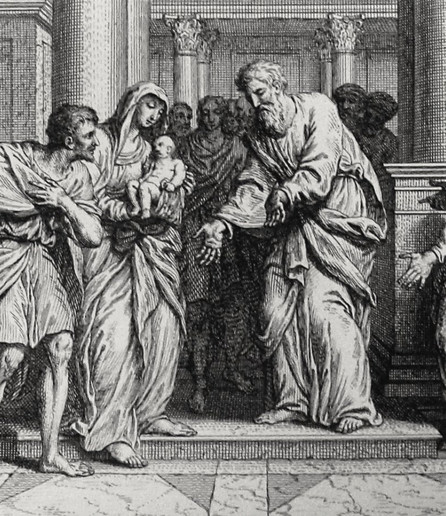
 Carmelite Quotes
 damian entwistle