Quote of the day, 25 February: Céline Martin

During the [clothing] ceremony, I received a special grace of intimate union with my Beloved; I could no longer see anything that was happening around me. The presence of the Bishop, the numerous clergy, the crowd of people who had flocked together, everything had disappeared before my eyes, I was alone with Jesus… when suddenly I was awakened from my inner silence by the chanting of Compline, which continued in vibrant and lively notes.

The choir sang the psalm: Qui habitat in adjutorio Altissimi (Psalm 90/91), and I could hear the meaning of it, and every word came down into my soul as a token of a sacred promise made to me by the One to whom I was uniting my life.

Sister Geneviève of the Holy Face, O.C.D.

Céline Martin
Histoire d’une petite âme, 265

Note: On 25 February 1959, Sister Geneviève of the Holy Face entered into eternity. She was 89 years and 10 months old and had just marked her 63rd year of profession as a Discalced Carmelite.

We always refer to the website of the Archives of the Carmel of Lisieux for the vast majority of our quotes concerning Saint Thérèse, Saint Zélie, and Saint Louis Martin. If you would like to purchase English translations for the collected works of St. Thérèse, please visit the website of our Discalced Carmelite friars at ICS Publications

Translation from the French text is the blogger’s own work product and may not be reproduced without permission.

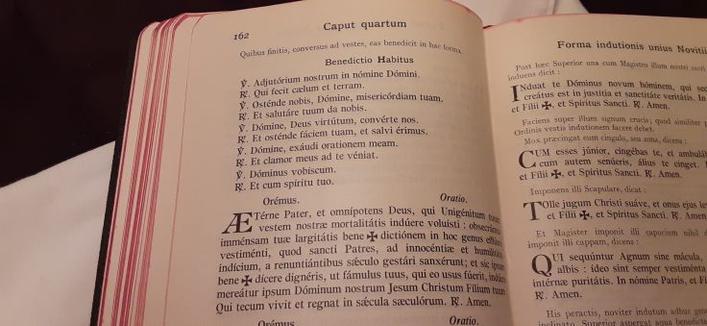
Featured image: Chapter four of the Manuale O.C.D. includes the prayer for the blessing of a Carmelite habit. Image credit: Photograph by Carmelite Quotes.

#CarmeliteHabit #CélineMartin #Clothing #monasticLife #SrGenevièveOfTheHolyFace

Quote of the day, 10 January: Céline Martin

At the beginning of her journey to Rome, [Thérèse] entrusted her purity to Saint Joseph, and nothing ever disturbed it, despite all that we encountered in museums and elsewhere. She once told me that as a child she had been ashamed of her body (cf. Last Conversations), and that the one thing that consoled her in having one was knowing that Jesus Himself had chosen to take a body like ours.

From Carmel, she wrote me many letters praising the beautiful virtue of purity. She often spoke of the “white lily,” which symbolized virginity, and contrasted its spotless beauty with the “yellow lily” (cf. Letters, LT 57), which in our everyday language represented marriage.

When all my sisters had entered religious life, and I remained alone in the world with our father, she showed a deeply maternal concern for my soul and suffered greatly, knowing that I now faced dangers she herself had never known. At that time, simple social expectations required me to take part, at least occasionally, in the life of the world around me.

She was always worried about me, but especially one day when she learned that I was expected to attend an evening gathering where there would be dancing. She later told me that she wept as she had never wept before, and asked that I be called to the parlor so she could speak to me and give her advice.

When I thought she was overreacting—after all, it didn’t seem realistic to refuse every social expectation—she became indignant and said to me firmly: “You, the spouse of Jesus (I had made a vow of chastity), do you really wish to compromise with the world by giving yourself over to dangerous pleasures?” (cf. Conseils et Souvenirs).

I was stunned and conquered [by her reasoning]. I resolved to follow her advice and remained faithful to it, though it cost me many sacrifices.

The Servant of God cherished holy purity so deeply that at her clothing, when she was given a reliquary to wear from that day forward, she chose only relics of virgins, setting aside all others—even relics of saints she loved dearly. She herself pointed this out to me as she showed me her reliquary. She also confided to me one day that she had never experienced temptations against chastity.

Geneviève of St. Teresa, o.c.d. (Céline Martin)

Ordinary Process, Response to the twenty-first question

Note: On 10 January 1889, St. Thérèse was clothed in the holy habit of Carmel. Concerning that day, she wrote: “The wait had been long, but what a beautiful celebration it was! Nothing was missing, not even the snow!”

We always refer to the website of the Archives of the Carmel of Lisieux for the vast majority of our quotes concerning Saint Thérèse, Saint Zélie, and Saint Louis Martin. If you would like to purchase English translations for the collected works of St. Thérèse, please visit the website of our Discalced Carmelite friars at ICS Publications

Featured image: The lilium longiflorum is also known as the Easter lily. Image credit: Golden Age Photos / Adobe Stock (Stock photo)

#CélineMartin #Clothing #purity #StThereseOfLisieux #theologyOfTheBody

Quote of the day, 12 November: St. Thérèse

Loreto really charmed me! And what shall I say about the Holy House? Ah! how deep was my emotion when I found myself under the same roof as the Holy Family, contemplating the walls upon which Jesus cast His sacred glance, treading the ground bedewed with the sweat of St. Joseph, under this roof where Mary had carried Jesus in her arms, having carried Him in her virginal womb. I beheld the little room in which the angel had appeared to the Blessed Virgin. I placed my rosary in the little bowl of the Child Jesus. What ravishing memories!

Saint Thérèse of Lisieux

Manuscript A, folio 59 verso

My dear Thérésita,

Monseigneur is awaiting the end of the trip in order to make his decision.

Today, really confide your entire affair to the Blessed Virgin. There, in that blessed house where she worked, prayed, suffered, what delightful things she is about to make your heart understand. One does not go to the Blessed Virgin’s home without coming back with hands filled with graces. Oh, little home of Nazareth, you are worth a thousand times more than all the palaces of this world! There, truly, is heaven’s vestibule!. . .

Little Friend and fiancée of little Jesus, don’t forget that He grew up under this roof of mystery. . . . Don’t forget that He wept there often, very often; He wept there with love and with the desire to see all souls take flight towards Him, and He wept with sorrow when seeing so few would love Him in the future!

When the Blessed Virgin noticed that her Darling was weeping, it was then that she quickly placed the mysterious ball in His hand, and He smiled immediately. . . on the dear ball was written this name: Thérésita of the Child Jesus.

Adieu, adieu, little pilgrim, little toy of Jesus. Fear nothing, for Jesus says to you as He said formerly to St. Teresa: “Nobody will be able to snatch you from My Hands!”

Your confidante,
Agnes of Jesus
r.c.ind.

You should also pray to good St. Joseph, for he, too, worked for Him and suffered in this little house, thrice blessed.

Your little letter pleased me very much; don’t worry about your handwriting. When we are traveling, this is insignificant.

Agnès of Jesus, O.C.D. (Pauline Martin

Letter LC 57 From Sister Agnes of Jesus to Thérèse
November 9, 1887

Note: This letter was addressed to St. Thérèse at Loreto, Italy, mailed at the same time as two letters to St. Louis Martin and Céline Martin, and a note from Sister Marie of the Sacred Heart to Thérèse. At the beginning of this letter, Pauline explains Bishop Hugonin’s decision to postpone his answer concerning Thérèse’s vocation until after the trip to Rome was over. Thérèse took this as a negative answer: “I learned from one of your letters, Mother, that he was no longer favorably disposed toward me. My only plank of salvation was in the permission of the Holy Father, but to obtain it I had to ask for it, I had to dare speak to the pope in front of everybody. This thought made me tremble” (Ms A 62r).

Thérèse of Lisieux, S & Clarke, J 1982, General Correspondence: Letters of Saint Therese of Lisieux: Volume 1 1877-1890, Centenary ed., Institute of Carmelite Studies, Washington DC.

Thérèse & Foley, M 2005, Story of a Soul: The autobiography of St. Thérèse of Lisieux, Study edn, translated from the French by Clarke, J, ICS Publications, Washington DC.

We always refer to the website of the Archives of the Carmel of Lisieux for the vast majority of our quotes concerning Saint Thérèse, Saint Zélie, and Saint Louis Martin. If you would like to purchase English translations for the collected works of St. Thérèse, please visit the website of our Discalced Carmelite friars at ICS Publications

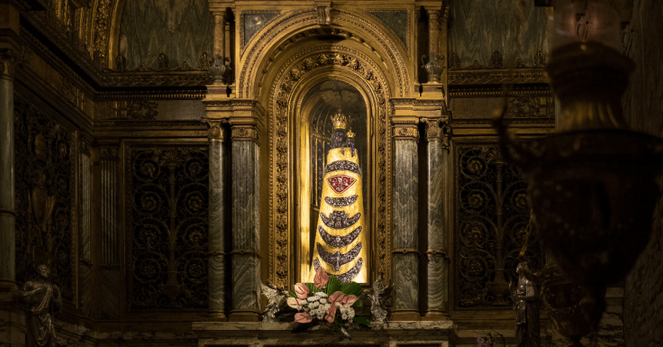
Featured image: The famed image of Our Lady of Loreto in the Basilica of the Holy House. Image credit: kppl / Adobe Stock (File 207764768).

#207764768 #BlessedVirgin #CelineMartin #ChildJesus #familyLife #HolyHouseOfLoreto #PaulineMartin #pilgrimage #SantaCasaDiLoreto #StThereseOfLisieux

Quote of the day, 18 June: St. Thérèse of Lisieux

Sister Thérèse accepted every reproach with a heavenly joy—not only from the superiors, but even from the novices. She let them say unpleasant things to her without ever correcting them in the moment.

“I’m happy to accept corrections when they’re justified,” I told her. “If I’m wrong, I’ll admit it. But I can’t stand being reprimanded when I haven’t done anything wrong.”

“For me,” she replied, “it’s just the opposite. I prefer to be accused unjustly, because then I have nothing to reproach myself for, and I offer that to the good God with joy. Then I humble myself by thinking that I’d be quite capable of doing what I’ve been accused of.”

Sister Geneviève of the Holy Face (Céline Martin)

Counsels and Reminiscences of a Novice

Translation from the French text is the blogger’s own work product and may not be reproduced without permission.

Featured image: This detail from Photo no. 9 was taken by Sr. Geneviève on 20 November 1894. Image credit: Discalced Carmelites (Used by permission).

⬦ Reflection Question ⬦
How does prayer help you cope with difficult relationships or unjust treatment?
Join the conversation in the comments.

#CelineMartin #humility #injustice #monasticLife #StThereseOfLisieux

Quote of the day, 17 May: St. Thérèse

I desire to accomplish your will perfectly and to reach the degree of glory you have prepared for me in your kingdom. I desire, in a word, to be a Saint, but I feel my helplessness and I beg you, O my God! to be yourself my Sanctity!
SAINT THÉRÈSE OF LISIEUX, PRAYER 6

Dearest little sisters,

How our hearts beat as one and exult with joy and gratitude toward our God of love, who has made our little Thérèse a masterpiece of grace and humility—in a word, a very great saint. How good He was to cause this flower of Paradise to blossom among us! But our dear parents were worthy of possessing her.

In the face of this triumph, this supreme glory, this song rises quite naturally from our hearts: “My soul magnifies the Lord, and my spirit rejoices in God my Savior” [Lk 1:46–47].

To tell the truth, human language is quite powerless to express what is taking place in the highest part of the soul. So it is silence alone that suits—like the silence reigning among the Blessed in Heaven.

You have no doubt noticed, as I have, dearest sisters, that the pilgrimage for the canonization departs on the 13th, the anniversary of our little sister’s healing: “The Blessed Virgin came toward me and smiled at me…” That was 42 years ago—how moving that is!

And the statue—have you received any news of it? I believe we must make the sacrifice of doing without it on the 17th. It’s a real pity, since our Reverend Superior was supposed to come to solemnly bless it. We’ll be having a great celebration here: exposition of the Blessed Sacrament all day, etc., etc… But don’t be disheartened—perhaps God wills this deprivation to be united to our prayers, for there is deep suffering in beautiful France, and what would we not do to help save her? Sacred Heart of Jesus, may Your Kingdom come!

We greatly admired the beautiful envelope used for the letter of thanks to the Holy Father, and how touched I was that my little Céline signed her name after mine. Truly, I recognize most humbly that she is far superior to me in every respect. I thanked with all my heart our beloved Mother [Superior] for her offering united to yours for the Holy Father. She is so exquisitely delicate, our Mother—I am often moved to tears by it.

Finally, my heart is so full of tenderness that it overflows into the Heart of our All Jesus, in whom our hearts are united on this incomparable day of glory.

Servant of God Françoise Thérèse Martin, V.S.M. (Léonie)

Letter to her sisters Marie, Pauline, and Céline
10 May 1925 from the Visitation Monastery in Caen

Note: The entire Carmelite family rejoices on this day, the 100th anniversary of the canonization of Saint Thérèse of the Child Jesus and the Holy Face at St. Peter’s Basilica in Rome, 17 May 1925.

Image credit: Father Lawrence Lew, O.P. (Some rights reserved)

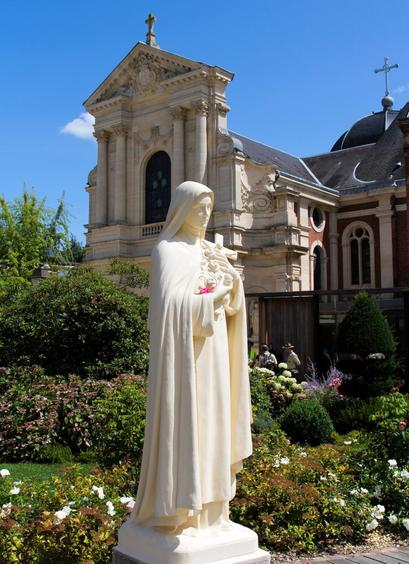
Thérèse aux Roses – The Iconic Statue

The statue affectionately known as Thérèse aux Roses—Thérèse with Roses—has become one of the most beloved and widely recognized images of St. Thérèse of Lisieux. Sculpted in 1922 by Father Marie-Bernard (Louis Richomme), a Trappist monk of Soligny-la-Trappe, the statue captures the spiritual essence of Thérèse’s “little way.”

Clothed in the Carmelite habit, Thérèse holds a crucifix entwined with roses—a visual embodiment of her promise to “let fall a shower of roses” from heaven. The sculpture was based on a 1912 charcoal drawing made by Thérèse’s sister, Céline Martin (Sister Geneviève of the Holy Face), whose artistic vision helped define her sister’s iconography. In all, Fr. Marie-Bernard sculpted 18 masterpieces of St. Thérèse in collaboration with the Carmel of Lisieux.

A white marble version of Thérèse aux Roses was placed outside the Carmel of Lisieux in 1923, just two years before Thérèse’s canonization. Since then, reproductions of Thérèse aux Roses have been enshrined around the world—from parish chapels to hospital corridors—each one a silent witness to the radiant simplicity of holiness.

We always refer to the website of the Archives of the Carmel of Lisieux for the vast majority of our quotes concerning Saint Thérèse, Saint Zélie, and Saint Louis Martin, but if you would like to purchase any of the English translations that appear on the Archives website, please visit the website of our Discalced Carmelite friars at ICS Publications

Translation from the French text is the blogger’s own work product and may not be reproduced without permission.

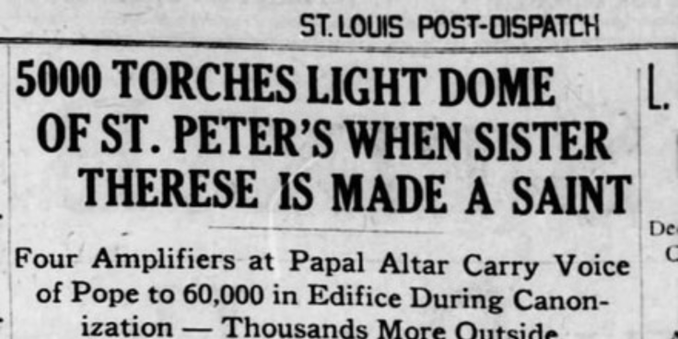
Featured image: “5,000 Torches Light Dome of St. Peter’s When Sister Therese Is Made a Saint” — headline from the* St. Louis Post-Dispatch*, reporting on the canonization of St. Thérèse of the Child Jesus, celebrated on Sunday, 17 May 1925. Image credit: Excerpt from the St. Louis Post-Dispatch, 18 May 1925. Sourced via newspapers.com (public domain).

⬦ Reflection Question ⬦
What prevents me from begging God to make me a great saint?
Join the conversation in the comments.

#anniversary #canonization #CélineMartin #familyLife #LéonieMartin #Saints #StThérèseOfLisieux #statue

Bible Gateway passage: Luke 1:46-47 - New Revised Standard Version Catholic Edition

Mary’s Song of Praise - And Mary said, “My soul magnifies the Lord, and my spirit rejoices in God my Savior,

Bible Gateway

Quote of the day, 14 April: St. Thérèse of Lisieux

We have only the short moment of this life to give to God… and He is already preparing to say: “Now, my turn…” What a joy to suffer for Him who loves us unto folly and to pass as fools in the eyes of the world.

We are not idlers, squanderers, either. Jesus has defended us in the person of the Magdalene.

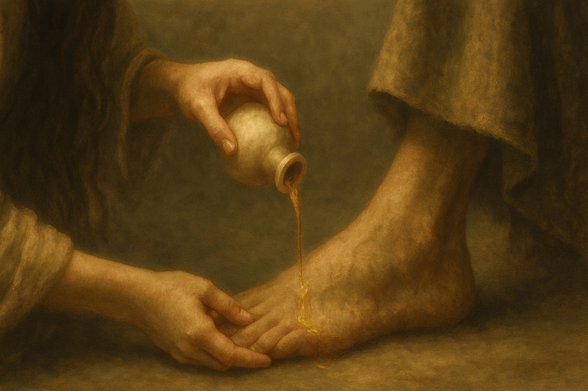
He was at table [cf. Mk 14:3–6, Jn 12:1–8], Martha was serving, Lazarus was eating with Him and His disciples. As for Mary, she was not thinking of taking any food but of pleasing Him whom she loved, so she took a jar filled with an ointment of great price and poured it on the head of Jesus, after breaking the jar, and the whole house was scented with the ointment, but the APOSTLES complained against Magdalene…

It is really the same for us, the most fervent Christians, priests, find that we are exaggerated, that we should serve with Martha instead of consecrating to Jesus the vessels of our lives, with the ointments enclosed within them.…

And nevertheless what does it matter if our vessels be broken since Jesus is consoled and since, in spite of itself, the world is obliged to smell the perfumes that are exhaled and serve to purify the empoisoned air the world never ceases to breathe in.

Saint Thérèse of Lisieux

Letter LT 169 to her sister, Céline (excerpt)
19 August 1894

Note: When St. Louis Martin died on 29 July 1894, Céline was at his bedside and closed his eyes. She buried him on 2 August, then traveled with her aunt and uncle, Céline Fournet and Isidore Guérin, to Caen. There, on 19 August, she wrote to Thérèse about the painful opposition she faced from their cousins, Francis and Jeanne La Néele, who resented her decision to enter the Carmel of Lisieux on 14 September. That same day, Thérèse responded with this letter—her tender, passionate defense of the “waste” of love, inspired by Mary of Bethany.

Thérèse of Lisieux, S & Clarke, J 1988, General Correspondence: Letters of Saint Therese of Lisieux: Volume 2 1890-1897. Centenary ed., Institute of Carmelite Studies, Washington DC.

Featured image: AI-generated artwork by Carmelite Quotes using DALL·E 3 (April 2025). Inspired by the style of John Singer Sargent. All rights reserved.

Reflection Question
Have you ever been misunderstood for choosing what you believed would please Jesus?
Join the conversation in the comments.

#apostles #CarmelOfLisieux #CélineMartin #Jesus #MaryOfBethany #misunderstood #perfume #StThérèseOfLisieux #vocation

The Letters of St. Thérèse of Lisieux, vol. 2

Quote of the day, 9 February: St. Thérèse

It was December 25, 1886, that I received the grace of leaving my childhood, in a word, the grace of my complete conversion. We had come back from Midnight Mass where I had the happiness of receiving the strong and powerful God.

Upon arriving at Les Buissonnets, I used to love to take my shoes from the chimney corner and examine the presents in them; this old custom had given us so much joy in our youth that Céline wanted to continue treating me as a baby since I was the youngest in the family. Papa had always loved to see my happiness and listen to my cries of delight as I drew each surprise from the magic shoes, and my dear king’s gaiety increased my own happiness very much.

However, Jesus desired to show me that I was to give up the defects of my childhood and so He withdrew its innocent pleasures. He permitted Papa, tired out after the Midnight Mass, to experience annoyance when seeing my shoes at the fireplace, and that he speak those words which pierced my heart: “Well, fortunately, this will be the last year!”

I was going upstairs, at the time, to remove my hat, and Céline, knowing how sensitive I was and seeing the tears already glistening in my eyes, wanted to cry too, for she loved me very much and understood my grief.

She said, “Oh, Thérèse, don’t go downstairs; it would cause you too much grief to look at your slippers right now!”

But Thérèse was no longer the same; Jesus had changed her heart!

Forcing back my tears, I descended the stairs rapidly; controlling the poundings of my heart, I took my slippers and placed them in front of Papa, and withdrew all the objects joyfully. I had the happy appearance of a queen.

Having regained his own cheerfulness, Papa was laughing; Céline believed it was all a dream! Fortunately, it was a sweet reality; Thérèse had discovered once again the strength of soul which she had lost at the age of four and a half, and she was to preserve it forever!

On that night of light began the third period of my life, the most beautiful and the most filled with graces from heaven. The work I had been unable to do in ten years was done by Jesus in one instant, contenting himself with my good will which was never lacking.

I could say to Him like His apostles: “Master, I fished all night and caught nothing” [Lk 5:5]. More merciful to me than He was to His disciples, Jesus took the net Himself, cast it, and drew it in filled with fish. He made me a fisher of souls.

Saint Thérèse of Lisieux

Manuscript A, folio 45 r°–v°

Note: St. Thérèse mentions “the strength of soul which she had lost at the age of four and a half.” Saint Zélie Martin died when St. Thérèse was aged four and a half. “After she had a hemorrhage, it was at the very beginning of Tuesday, August 28, 1877, at exactly thirty minutes after midnight, after a very short agony, that Madame Martin died gently.” Our thanks to expert Maureen O’Riordan for providing these details of St. Zélie’s precious death.

Thérèse & Foley, M 2005, Story of a Soul: The autobiography of St. Thérèse of Lisieux, Study edn, translated from the French by Clarke, J, ICS Publications, Washington DC.

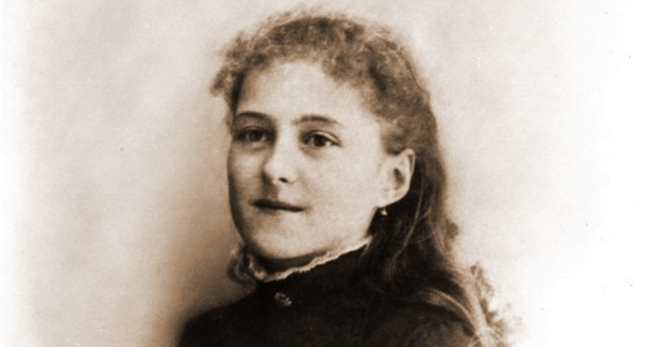
Featured image: Photo 3 in the series of photographs of St. Thérèse was taken by Monsieur Poupet in February 1886, when Thérèse was 13 years old. Her Christmas conversion occurred several months later, on the night of December 25, 1886. This photograph was donated to the Carmel of Lisieux in 1917 by the family of Mr. Poupet, a photographer from Alençon. The photograph had been retouched by Céline in gouache and pencil but was later returned to its original state by professional restorers. Image credit: © Archives, Carmel of Lisieux via Discalced Carmelites (All rights reserved)

#CélineMartin #charity #Christmas #conversion #saveSouls #sinners #soul #StThérèseOfLisieux #StZélieMartin #StLouisMartin #tears

Luke 5:5 - Bible Gateway

Quote of the day, 5 February: St. Thérèse

You have hidden me forever in your Face!…
Divine Jesus, deign to hear my voice.
I have come to sing the inexpressible grace
Of having suffered…of having born the Cross…

For a long time I have drunk from the chalice of tears.
I have shared your cup of sorrows,
And I have understood that suffering has its charms,
That by the Cross we save sinners.

It is by the Cross that my ennobled soul
Has seen a new horizon revealed.
Under the rays of your Blessed Face,
My weak heart has been raised up very high.

My Beloved, your sweet voice calls me:
“Come,” you said to me, “already the winter has fled.
A new season is beginning for you.
At last day is taking the place of night.

Raise your eyes to your Holy Homeland,
And on thrones of honor you will see
A beloved Father…a dear Mother
To whom you owe your immense happiness!…

Your life will pass like an instant.
On Carmel we are very near Heaven.
My beloved, my love has chosen you.
I have reserved a glorious throne for you!….”

Saint Thérèse of Lisieux

PN 16, Song of Gratitude of Jesus’s Fiancée

Note: On 5 February 1895, Céline Martin was clothed in the Carmelite habit and began her novitiate in the Carmel of Lisieux. St. Thérèse wrote the Song of Gratitude of Jesus’s Fiancée as a gift for her sister’s clothing.

Thérèse of Lisieux, S & Kinney, D 1995, The Poetry of Saint Thérèse of Lisieux, ICS Publications, Washington DC.

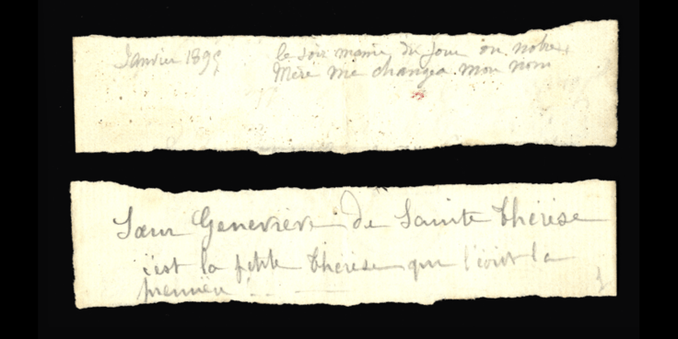
Featured image: These are images of the note marking the day of Céline Martin’s clothing in the Carmelite habit, receiving the name “Geneviève of St. Teresa.” Image credit: Discalced Carmelites

#CarmelOfLisieux #CelineMartin #Clothing #monasticLife #novitiate #religiousLife #SrGenevièveOfTheHolyFace #StThereseOfLisieux

The Poetry of St. Thérèse of Lisieux

Quote of the day, 3 December: Céline Martin

My dear little Jeanne,

You can write to my uncle (he’s in Evreux) that the day really wasn’t bad. This morning, there was the same restlessness as yesterday—no shouting, but laughter for one or two hours, crying, clapping, and conversations as if I were in his room and he was responding to something I said. This afternoon a complete calm, even sleep, he said that of course, I had made him take something to make him sleep. He wanted to be alone. There were loud shouts and again he was having conversations with himself.

Dear little Sister, the Cross is heavy, but Jesus is there. He carried it for us—why shouldn’t we carry it for Him?

Our Lord told Blessed Margaret Mary [Alacoque] that the Cross is the most precious pledge of His love that He can give us in this life.

St. Francis Xavier said: The absence of the Cross is the absence of life!

How vile the earth seems to those who see it from Heaven!

Dearest little sister, life is short.

Our little boat is being rocked by a violent storm right now; furious waves are submerging it and threatening to swallow it whole. But the dear Captain—Jesus—will not let it sink. Soon—the port… Soon—joy, rest, happiness! …

Right now, we’re not giving Jesus pearls, but diamonds and jewels of every kind. It’s up to us to draw from the inexhaustible source—and that source is suffering, bitterness. This treasure is the Cross!

Your little sister who loves you,

Céline

Céline Martin

Family correspondence, 21 or 22 January 1889

Note: In February 1889, Saint Louis Martin was committed to the Bon Sauveur Mental Hospital in Caen, France. This challenging chapter in the saint’s life was preceded by difficult days and months for his family. Much like dementia patients today, St. Louis wandered away from home and disappeared, causing great concern. This letter from Céline Martin to her cousin Jeanne Guérin, asking her to contact her father—Saint Zélie’s brother, Isidore—provides a glimpse into the struggles Céline faced while caring for her saintly father during this trying time.

Translation from the French text is the blogger’s own work product and may not be reproduced without permission.

Featured image: Lost memories … is the title of this haunting photo by Czech photographer Tomas Vimmr in Prague. Vimmr excels in black-and-white street photography. Image credit: Tomas Vimmr / Flickr (Some rights reserved)

#BonSauveurMentalHospital #Caen #CélineMartin #dementia #family #JeanneGuérin #restless #StLouisMartin #suffering #theCross #treasure

Lost memories ...

Flickr

Quote of the day, 20 November: St. Thérèse

Sunday, November 20, after dressing up according to Vatican regulations, i.e., in black with a lace mantilla as headpiece, and decorated with a large medal of Leo XIII, tied with a blue and white ribbon, we entered the Vatican through the Sovereign Pontiff’s chapel.

St. Therese of Lisieux

Even very young, the Servant of God said she would become a nun and consecrate herself to God, and nobody around her was surprised. She said she wanted to withdraw to the desert in order to belong to God alone. When our sister Pauline was admitted to the Carmel and the Servant of God heard what life inside was like, she realized it was in the Carmelite Order that her aspirations would be fulfilled.

You ask whether she prayed to God and sought counsel in order to resolve the problem of her vocation. I don’t think there was ever a problem of vocation for her. She never questioned whether or not she should consecrate herself to God. The answer was obvious to her. She wondered only how to reach her goal.

With regards to this, she sought counsel from Mother Agnes of Jesus, whom she would visit at the Carmel. The Jesuit priest Father Pichon, our family’s spiritual director, also encouraged her at this point. On Pentecost Sunday 1887, Thérèse shared her desire to become a Carmelite with our father. Marie, our eldest sister, had joined Pauline at the Carmel on 15th October 1886. With saintly faith and simplicity, our father gave her his consent, but our uncle and Thérèse’s legal guardian, Mr Guérin, was opposed to it. He said she should wait until she was a least 17. However he soon yielded, God having softened his heart in this matter.

There remained other difficulties to overcome: the ecclesiastical superior of the Carmel, Father Delatroëtte, refused to admit her because he considered her too young. Thérèse therefore had to appeal to the bishop. With this in view, she went to Bayeux with our father, but when she received only an evasive response, she decided that on her imminent trip to Rome, she would ask His Holiness Pope Leo XIII for the authorisation she sought [MsA 62r, ff]. She made this trip with our father and myself. The Holy Father did not give her a clear answer either [Papal audience, 20 November 1887] and referred the matter back to the Superiors of the Carmel and Providence.

Once back in France, Thérèse gave herself entirely over to the advice of her sister Pauline in the matter of her vocation [Cf. Ordinary Process, Witness 1, Sixteenth Question, 148r]. She wrote to his Lordship the Bishop of Bayeux, and on 28th December 1887, he replied and gave her the authorization she sought. However, desirous to appease the still protesting Superior, the Mother Prioress of the Carmel delayed her admittance until after Lent. It was therefore not until 9th April of the following year, 1888, that Thérèse stepped over the threshold to the cloister, accompanied by her father and the rest of her family.

Sr. Geneviève of St. Teresa, O.C.D.

(Celine Martin)
Apostolic Process, Witness 8
Response to Question 11

We always refer to the website of the Archives of the Carmel of Lisieux for the vast majority of our quotes concerning Saint Thérèse, Saint Zélie, and Saint Louis Martin. If you would like to purchase English translations for the collected works of St. Thérèse, please visit the website of our Discalced Carmelite friars at ICS Publications

Featured image: This portrait of Pope Leo XIII is a fumée engraving in black on tissue paper from the René Huyghe Collection at the National Gallery of Art in Washington, DC. American artist Charles M. Johnson created the engraving in 1899. Image credit: National Gallery of Art (Public domain)

#CarmelOfLisieux #CelineMartin #DivineProvidence #LeoXIII #papalAudience #pilgrimage #StThereseOfLisieux #testimony #vocations

Manuscript A — Archives of the Carmel of Lisieux

Archives du Carmel de Lisieux