11-Mar-2026
#Mussel #adhesion meets conductivity: new #bioglue for #bioelectronic #implants
11-Mar-2026
#Mussel #adhesion meets conductivity: new #bioglue for #bioelectronic #implants
Sustainable memristors from shiitake mycelium for high-frequency bioelectronics
https://journals.plos.org/plosone/article?id=10.1371/journal.pone.0328965

Neuromorphic computing, inspired by the structure of the brain, offers advantages in parallel processing, memory storage, and energy efficiency. However, current semiconductor-based neuromorphic chips require rare-earth materials and costly fabrication processes, whereas neural organoids need complex bioreactor maintenance. In this study, we explored shiitake (Lentinula edodes) fungi as a robust, sustainable alternative, exploiting its adaptive electrical signaling, which is akin to neuronal spiking. We demonstrate fungal computing via mycelial networks interfaced with electrodes, showing that fungal memristors can be grown, trained, and preserved through dehydration, retaining functionality at frequencies up to 5.85 kHz, with an accuracy of 90 ± 1%. Notably, shiitake has exhibited radiation resistance, suggesting its viability for aerospace applications. Our findings show that fungal computers can provide scalable, eco-friendly platforms for neuromorphic tasks, bridging bioelectronics and unconventional computing.
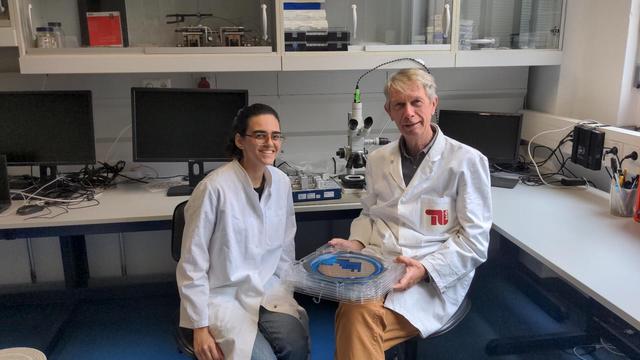
Today marks the conclusion of my internship at @tuberlin 🎓 I had an incredible research experience, thanks to my supervisor, Professor Mario Birkholz (see picture), and my advisors, Professor Anders Henriksson and Phillip Schrenk.
During this time, I learned about the innovative technology of silicon optical sensors 🔬💡 and developed as a researcher by enhancing my data collection methods 📊 and improving the experimental setup. ⚙️ I also honed my skills in interpreting numerical data 📈 and testing hypotheses.
How would a signal look like from our micro-ring resonator #MRR #biosensor?
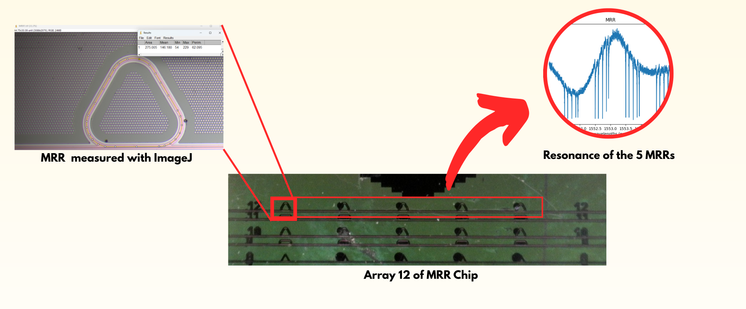
We observe a spectrum in a wavelength range around 1.55 µm by coupling the laser radiation into an array of five MRRs, see bottom figure. It is notable that each MRR has a curved triangular shape of different size this causes the resonance peak of each MRR to occur at different positions in the spectrum.
In the spectrum range investigated, we observed four groups of resonance peaks corresponding to four standing waves occurring to each of the five rings.
Determining the perimeter of the ring was challenging. I used #ImageJ to draw a polygon that approximated the triangular shape and measured the perimeter. Then, with the use of the formulas obtained from P. Steglich, et al(https://ieeexplore.ieee.org/abstract/document/9568878), it was possible to determine the effective refractive index nff and the order m of the standing wave.
I am pleased to share that I successfully coupled the laser radiation into the chip.
After two weeks of learning about the concepts of the micro-ring resonators (#MRR) and attempting to capture the resonances, I finally achieved my goal.
The main challenge I faced was accurately cutting the optical fiber and determining the optimal distance and angle between the fiber and the #waveguide for effective coupling. This process required a significant amount of trial and error. Additionally, for an entire week, I unknowingly worked with a chip that had broken couplers. When I adjusted the z-axis, I accidentally damaged the couplers with the fiber. Fortunately, I have a sufficient number of chips available for multiple trials.
How are the #microelectronic #bioelectronic chips produced?🤔
The production starts from the blank silicon wafers. Layering follows, where insulating and conductive materials are deposited onto the wafer. The #wafer is then covered with photoresist, and UV light is shone through a photomask to pattern the circuit of the sensor. Next comes the etching process, using chemicals or plasma to remove areas without photoresist. Doping is applied afterwards to alter the electrical properties of the silicon.
These steps are repeated in cycles to build the complex interconnected structure of the chip. Subsequently, layers of metal are deposited to establish connections between the circuit elements. Once completed, the wafers are tested for defects and then packaged 🤯 .
For a demonstration of this process, check out the video from #ihpmicroelectronics (https://www.ihp-microelectronics.com/news-2/mediathek/videos). In the previous post, we showed how the #silicon chip originated from this wafer.
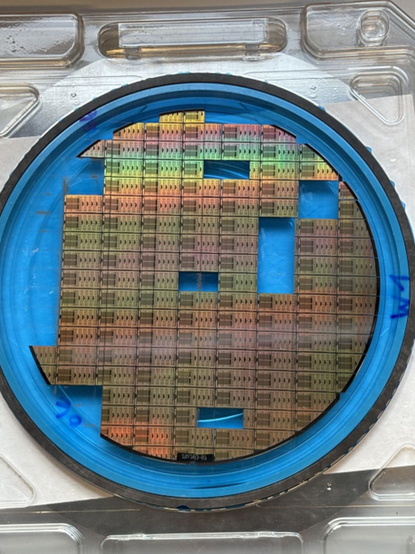
The picture shows a full wafer glued to blue tape for chip separation by sawing, from which some #biosensor chips have already been taken.
How does a real chip with a microring resonator (#MRR) look like? 🤔
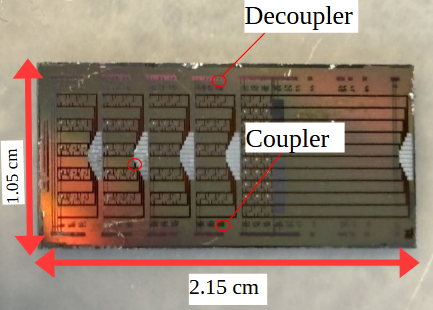
The #MRR were fabricated on #silicon wafers, with each chip measuring 2.15 by 1.05 cm. The surface of the chips has designated areas where the laser source can be coupled into the #waveguide known as the coupler. After the light passes through the #waveguide and into the MRRs, it is decoupled through an area called the decoupler. The analysis of this radiation by an oscilloscope allows the refractive index to be determined.
Between the coupler and decoupler zones, there are five #MRR structures designed to obtain information on four different analytes, with one structure serving as a reference 🤯.
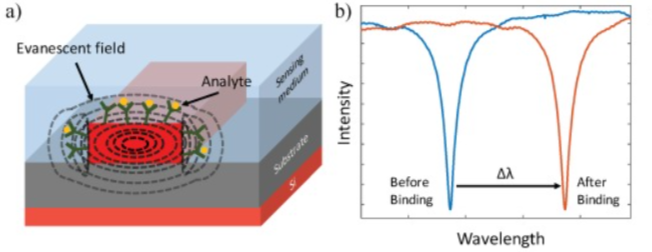
The microring resonator (#MRR) operates by the principle of evanescent field.
By what? 🤔
Sensors that operate by the principle of an #evanescent field utilizes the extension of the field inside the MRR into the surrounding. The range of this extension is in the order of the wavelengths of the radiation, ie in our case 1.5 micrometers. For #biodetection applications, target #biomolecules caused a variation of the refractive index in the surrounding and a shift in the resonance peak.
See the figure below from E. Luan et al (2018) https://doi.org/10.3390/s18103519
SciTech Chronicles. . . . . . . . .April 1st, 2025
#bioproducts #waste #polyhydroxyalkanoates #3D-Printing #Bellingshausen #A-84 #seafloor #sediment #PEDOT:PSS #crosslinker #ions #bioelectronic #polyfluoroalkyl #graphene #FJH #GAC #renewables #topology #forecasting #spatio-temporal
Organic electrochemical transistors enhance #bioelectronic #sensor sensitivity by three orders of magnitude.
https://phys.org/news/2025-02-electrochemical-transistors-bioelectronic-sensor-sensitivity.html
In a breakthrough that could transform bioelectronic sensing, an interdisciplinary team of researchers at Rice University has developed a new method to dramatically enhance the sensitivity of enzymatic and microbial fuel cells using organic electrochemical transistors (OECTs). The research was recently published in the journal Device.