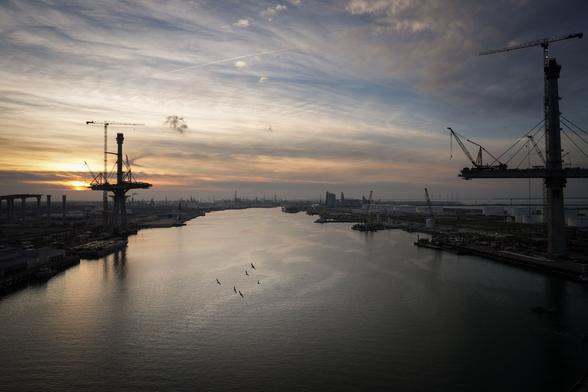
Panama Canal may face frequent extreme water lows in coming decades. A new study found historic droughts could become common for Gatún Lake, the main source of water for the Panama Canal locks. #commerce #PanamaCanal #water #drougth #aridification #climatechange https://news.agu.org/press-release/panama-canal-may-face-frequent-extreme-water-lows-in-coming-decades/
Panama Canal may face frequent extreme water lows in coming decades

AGU press contact: Liza Lester, [email protected] (UTC-4 hours)  Contact for researchers: Samuel E. Muñoz, [email protected] (UTC-4 hours) WASHINGTON — In 2023, Panama experienced one of the worst droughts in its recorded history, and it severely depleted water available to the Panama Canal, so much that it decreased shipping by 30%. A new study projected that those historic water lows could become the new norm if greenhouse gas emissions continue to rise. “If we mitigate emissions and we choose one of the lower emissions pathways, then it really keeps this system pretty stable,” said Samuel Muñoz, lead author of the study and a scientist at Northeastern. “But if we don't, then these low water levels that are really disruptive now become the norm by the end of the century.” The canal works by pulling water from freshwater sources such as Gatún Lake, a large man-made lake that also provides drinking water to thousands of residents in nearby Panama City and Colón. The water is pulled into the canal to raise and lower water levels in locks which allows heavy boats to pass through Panama to move between the Atlantic and Pacific oceans. More than 26 million gallons of water is needed to fill the locks for ships to pass through. In January 2024, the Woodwell Climate Research Center reported water levels in Gatún Lake, the main lake that feeds the Panama Canal locks, were lower than ever previously recorded. The lake was nearly 2 meters (6 feet) lower than it was just one year prior. This meant Panama Canal Authorities reduced how many ships could move through the canal from 38 to as low as 22 per day and the ship’s cargo needed to be lower in weight. Muñoz built a model to predict how water levels could change in the next 75 years in different greenhouse gas emissions pathways. The study was published in Geophysical Research Letters, AGU’s journal for high-impact, short-format reports with immediate implications spanning all Earth and space sciences. The different scenarios looked at how increased greenhouse gases would change variables like temperature, evaporation, rainfall and other factors that shift with climate change. The scenarios ranged from strong mitigation of greenhouse gas emissions to the current trending levels to extreme and worsening scenarios of emissions. Drying of the canal The model used projected evaporation and precipitation in different greenhouse gas emission scenarios to make its predictions and was compared to historical data to confirm its accuracy. The study found that the occurrence of historic droughts, like those experienced in the last few years, will double by the end of the century under high emissions pathways. The biggest contributor to projected droughts were decreases in rain during Panama’s wet season, particularly as drought compounded over months and years. Higher emissions were associated with increased evaporation and a decrease in rain across all months; however May through August saw the highest decrease of 50 mm (2 in) rain per month. In scenarios where emissions undergo more aggressive mitigation, water levels in the Gatún Lake looked as they have for the last century, with only slight decreases. If greenhouse gases continue to rise, however, droughts like the one in 2023 will become commonplace. Right now, Muñoz said we are at a crossroads where the world can mitigate emissions that would stabilize Gatún Lake water levels. But if we head down a pathway of less mitigation, the Panama Canal will continue to face operational challenges in the coming decades. Canal authorities are already improving water use efficiency and beginning the development of a new reservoir to adapt to a potentially drier future. Muñoz hopes to expand his study to include different operational decisions and scenarios, and to reduce uncertainties in climate model predictions for Panama. He expressed an interest in collaborating with Panamanian authorities and scientists in this work as they plan canal operations and adaptation strategies for the coming decades. Notes for journalists:   This study is published in Geophysical Research Letters, an open-access AGU journal. View and download a pdf of the study here. Neither this press release nor the study is under embargo. Paper title:  “Drying of the Panama Canal in a Warming Climate” Authors:   Samuel E. Muñoz, Department of Marine & Environmental Sciences, Department of Civil & Environmental Engineering, Northeastern University, Boston, Massachusetts, USA Lindsay Lawrence, Department of Marine & Environmental Sciences, Northeastern University, Nahant, Massachusetts, USA Shuochen Wang, Department of Civil & Environmental Engineering, Northeastern University, Boston, Massachusetts, USA AGU (www.agu.org) is a global community supporting more than half a million professionals and advocates in Earth and space sciences. Through broad and inclusive partnerships, AGU aims to advance discovery and solution science that accelerate knowledge and create solutions that are ethical, unbiased and respectful of communities and their values. Our programs include serving as a scholarly publisher, convening virtual and in-person events and providing career support. We live our values in everything we do, such as our net zero energy renovated building in Washington, D.C. and our Ethics and Equity Center, which fosters a diverse and inclusive geoscience community to ensure responsible conduct. # Contributed by Riley Thompson                                

AGU Newsroom
Panama Canal may face frequent extreme water lows in coming decades. A new study found historic droughts could become common for Gatún Lake, the main source of water for the Panama Canal locks. #commerce #PanamaCanal #water #drougth #aridification #climatechange https://news.agu.org/press-release/panama-canal-may-face-frequent-extreme-water-lows-in-coming-decades/
Panama Canal may face frequent extreme water lows in coming decades

AGU press contact: Liza Lester, [email protected] (UTC-4 hours)  Contact for researchers: Samuel E. Muñoz, [email protected] (UTC-4 hours) WASHINGTON — In 2023, Panama experienced one of the worst droughts in its recorded history, and it severely depleted water available to the Panama Canal, so much that it decreased shipping by 30%. A new study projected that those historic water lows could become the new norm if greenhouse gas emissions continue to rise. “If we mitigate emissions and we choose one of the lower emissions pathways, then it really keeps this system pretty stable,” said Samuel Muñoz, lead author of the study and a scientist at Northeastern. “But if we don't, then these low water levels that are really disruptive now become the norm by the end of the century.” The canal works by pulling water from freshwater sources such as Gatún Lake, a large man-made lake that also provides drinking water to thousands of residents in nearby Panama City and Colón. The water is pulled into the canal to raise and lower water levels in locks which allows heavy boats to pass through Panama to move between the Atlantic and Pacific oceans. More than 26 million gallons of water is needed to fill the locks for ships to pass through. In January 2024, the Woodwell Climate Research Center reported water levels in Gatún Lake, the main lake that feeds the Panama Canal locks, were lower than ever previously recorded. The lake was nearly 2 meters (6 feet) lower than it was just one year prior. This meant Panama Canal Authorities reduced how many ships could move through the canal from 38 to as low as 22 per day and the ship’s cargo needed to be lower in weight. Muñoz built a model to predict how water levels could change in the next 75 years in different greenhouse gas emissions pathways. The study was published in Geophysical Research Letters, AGU’s journal for high-impact, short-format reports with immediate implications spanning all Earth and space sciences. The different scenarios looked at how increased greenhouse gases would change variables like temperature, evaporation, rainfall and other factors that shift with climate change. The scenarios ranged from strong mitigation of greenhouse gas emissions to the current trending levels to extreme and worsening scenarios of emissions. Drying of the canal The model used projected evaporation and precipitation in different greenhouse gas emission scenarios to make its predictions and was compared to historical data to confirm its accuracy. The study found that the occurrence of historic droughts, like those experienced in the last few years, will double by the end of the century under high emissions pathways. The biggest contributor to projected droughts were decreases in rain during Panama’s wet season, particularly as drought compounded over months and years. Higher emissions were associated with increased evaporation and a decrease in rain across all months; however May through August saw the highest decrease of 50 mm (2 in) rain per month. In scenarios where emissions undergo more aggressive mitigation, water levels in the Gatún Lake looked as they have for the last century, with only slight decreases. If greenhouse gases continue to rise, however, droughts like the one in 2023 will become commonplace. Right now, Muñoz said we are at a crossroads where the world can mitigate emissions that would stabilize Gatún Lake water levels. But if we head down a pathway of less mitigation, the Panama Canal will continue to face operational challenges in the coming decades. Canal authorities are already improving water use efficiency and beginning the development of a new reservoir to adapt to a potentially drier future. Muñoz hopes to expand his study to include different operational decisions and scenarios, and to reduce uncertainties in climate model predictions for Panama. He expressed an interest in collaborating with Panamanian authorities and scientists in this work as they plan canal operations and adaptation strategies for the coming decades. Notes for journalists:   This study is published in Geophysical Research Letters, an open-access AGU journal. View and download a pdf of the study here. Neither this press release nor the study is under embargo. Paper title:  “Drying of the Panama Canal in a Warming Climate” Authors:   Samuel E. Muñoz, Department of Marine & Environmental Sciences, Department of Civil & Environmental Engineering, Northeastern University, Boston, Massachusetts, USA Lindsay Lawrence, Department of Marine & Environmental Sciences, Northeastern University, Nahant, Massachusetts, USA Shuochen Wang, Department of Civil & Environmental Engineering, Northeastern University, Boston, Massachusetts, USA AGU (www.agu.org) is a global community supporting more than half a million professionals and advocates in Earth and space sciences. Through broad and inclusive partnerships, AGU aims to advance discovery and solution science that accelerate knowledge and create solutions that are ethical, unbiased and respectful of communities and their values. Our programs include serving as a scholarly publisher, convening virtual and in-person events and providing career support. We live our values in everything we do, such as our net zero energy renovated building in Washington, D.C. and our Ethics and Equity Center, which fosters a diverse and inclusive geoscience community to ensure responsible conduct. # Contributed by Riley Thompson                                

AGU Newsroom
Implications pour la disponibilité de l'eau douce
À l'heure actuelle, le #pompage excessif des eaux souterraines est le principal facteur contribuant aux taux de déclin en #stockage de l'eau terrestre dans les régions en voie d'assèchement, amplifiant de manière significative les impacts de l'augmentation de la #température, de l'#aridification et des épisodes de #sécheresse extrême. La #surexploitation continue des eaux souterraines qui, dans certaines régions comme la #Californie, se produit à un rythme croissant, plutôt qu'à un rythme durable ou décroissant, compromet la sécurité régionale et mondiale de l'eau et de l'alimentation d'une manière qui n'est pas pleinement reconnue dans le monde entier.
L'épuisement des eaux souterraines est directement affecté par les décisions de gestion de l'eau et peut également être stoppé par celles-ci.
Dans de nombreux endroits où les eaux souterraines s'épuisent, elles ne se reconstitueront pas à l'échelle humaine. La disparition des eaux souterraines des #aquifères de la planète constitue une nouvelle #menace grave pour l'humanité et présente des #risques en cascade qui sont rarement pris en compte dans les #politiquesenvironnementales, la #gestion et la #gouvernance.
3/4
Southwestern #drought likely to continue through 2100, research finds
Southwestern #US is experiencing a #megadrought resulting in the #aridification of the landscape, a decades-long drying of the region brought on by climate change and the overconsumption of the region’s #water.
Using an ensemble of historical and future #climate models forecasting climate and precipitation patterns until 2100, they found that the PDO-like negative phase continues through this century.
https://arstechnica.com/science/2025/07/southwestern-drought-likely-to-continue-through-2100-research-finds/
Southwestern drought likely to continue through 2100, research finds

Weather patterns that drive drought in the Southwest may persist for several decades.

Ars Technica
India is a global warming ‘hole,’ and scientists aren’t sure why. Despite its extreme heat waves, the country’s decadeslong warming trend amounts to half the global average. #India #climatechange #water #heat #aridification https://www.science.org/content/article/india-global-warming-hole-scientists-arent-sure
Aral Sea drainage to satiate agricultural thirst leading to land uplift. #aridification #water #agriculture https://www.nature.com/articles/s41561-025-01664-w
Weak asthenosphere beneath the Eurasian interior inferred from Aral Sea desiccation | Nature Geoscience

The rheology of the lower crust and upper mantle influences Earth’s plate tectonic style of mantle convection, yet its spatial variability is poorly resolved, particularly in continental interiors. Here we use satellite radar interferometry to map the delayed uplift resulting from the desiccation of the Aral Sea, which has lost ~1,000 km3 of water since 1960. From this we constrain the rheology of the underlying upper mantle by elastic and viscoelastic modelling. We find a long-wavelength uplift of up to ~7 mm yr–1 between 2016 and 2020 that decays radially from the Aral Sea. This uplift pattern is best explained by viscoelastic relaxation of the asthenosphere below a strong lithospheric mantle. We estimate that the asthenosphere has an effective viscosity of 4–7 × 1019 Pa s below 130–190 km depth, slightly larger than the values inferred from post-seismic deformation at subduction zones, but 1–2 orders of magnitude smaller than estimates from glacial isostatic adjustment in other tectonically stable regions. Such uplift highlights the potential for human activities to influence deep-Earth dynamics and the interconnectedness of surface and mantle processes. The drying out of the Aral Sea has induced flow of the relatively weak asthenosphere beneath, demonstrating that human activity can influence mantle dynamics, according to numerical simulations of ground uplift measured by radar interferometry.

Aral Sea drainage to satiate agricultural thirst leading to land uplift. #aridification #water #agriculture https://www.nature.com/articles/s41561-025-01664-w
Weak asthenosphere beneath the Eurasian interior inferred from Aral Sea desiccation | Nature Geoscience

The rheology of the lower crust and upper mantle influences Earth’s plate tectonic style of mantle convection, yet its spatial variability is poorly resolved, particularly in continental interiors. Here we use satellite radar interferometry to map the delayed uplift resulting from the desiccation of the Aral Sea, which has lost ~1,000 km3 of water since 1960. From this we constrain the rheology of the underlying upper mantle by elastic and viscoelastic modelling. We find a long-wavelength uplift of up to ~7 mm yr–1 between 2016 and 2020 that decays radially from the Aral Sea. This uplift pattern is best explained by viscoelastic relaxation of the asthenosphere below a strong lithospheric mantle. We estimate that the asthenosphere has an effective viscosity of 4–7 × 1019 Pa s below 130–190 km depth, slightly larger than the values inferred from post-seismic deformation at subduction zones, but 1–2 orders of magnitude smaller than estimates from glacial isostatic adjustment in other tectonically stable regions. Such uplift highlights the potential for human activities to influence deep-Earth dynamics and the interconnectedness of surface and mantle processes. The drying out of the Aral Sea has induced flow of the relatively weak asthenosphere beneath, demonstrating that human activity can influence mantle dynamics, according to numerical simulations of ground uplift measured by radar interferometry.