 The New Oil
#Starmer gives tech firms ultimatum to block explicit images on children’s phones
#privacy #censorship #cybersecurity #politics #UK #AgeVerification
#Starmer gives tech firms ultimatum to block explicit images on children’s phones
#privacy #censorship #cybersecurity #politics #UK #AgeVerification
Information and references 📚🧵
Portal of resources about age verification (EFF):
https://www.eff.org/issues/age-verification
Everything You Wanted to Know About a Kids’ Social Media Ban (Michael Geist):
https://www.michaelgeist.ca/2026/06/everything-you-wanted-to-know-about-a-kids-social-media-ban-but-were-rightly-afraid-to-ask-a-faq-on-age-verification-and-mandated-id-for-everyone/
How and Why to Fight Back Against Social Media Bans (EFF):
https://www.eff.org/deeplinks/2026/06/how-and-why-fight-back-against-social-media-bans
Transgender youth 5 times more likely to attempt suicide, study finds (CBC):
https://www.cbc.ca/news/canada/prince-edward-island/pei-transgender-youth-suicide-1.6487787
Age Verification Lobby Pushes For Age Verification Checks For VPN Use (Reclaim The Net):
https://reclaimthenet.org/lobbyists-propose-vpn-age-checks
Reddit User Uncovers Who Is Behind Meta’s $2B Lobbying for Invasive Age Verification Tech (Gadget Review):
https://www.gadgetreview.com/reddit-user-uncovers-who-is-behind-metas-2b-lobbying-for-invasive-age-verification-tech
Firm that verifies mugshots for ChatGPT and Roblox feeds US surveillance apparatus with 269 distinct checks (Cybernews):
https://cybernews.com/privacy/persona-leak-exposes-global-surveillance-capabilities/
Discord says hackers stole government IDs of 70,000 users (Ars Technica):
https://arstechnica.com/security/2025/10/discord-says-hackers-stole-government-ids-of-70000-users/
(9/9)
#StopIDSurveillance #Privacy #HumanRights #AgeVerification #CanPoli #Canada
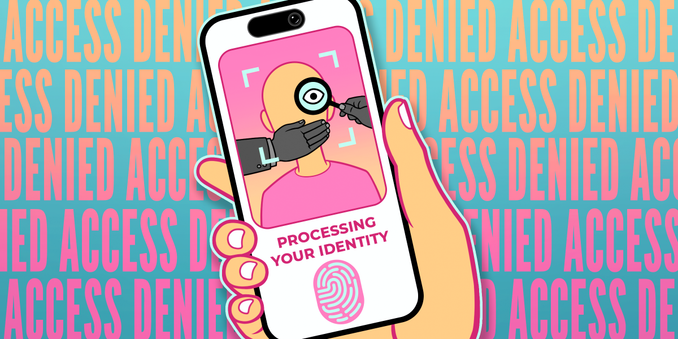
Age verification (or age-gating) laws generally require online services to check, estimate, or verify all users’ ages—often through invasive tools like ID checks, biometric scans, or other dubious “age estimation” methods—before granting them access to certain online content or services. Governments in the U.S. and around the world are increasingly adopting these restrictive measures in the name of protecting children online. But in practice, these systems create dangerous new forms of surveillance, censorship, and exclusion. Technologically, the age verification process can take many forms: collection and analysis of government ID, biometric scans, algorithmic or AI-based behavioral or user monitoring, digital ID, the list goes on. But no matter the method, every system demands users hand over sensitive and immutable personal information that links their offline identity to their online activity. Once that valuable data is collected, it can easily be leaked, hacked, or misused. (Indeed, we’ve already seen several breaches of age verification providers.) EFF has long warned against age-gating the internet. Age verification technology itself is often inaccurate and privacy-invasive. These restrictive mandates strike at the foundation of the free and open internet. They are tools of censorship, used to block people from viewing or sharing information that the government deems “harmful” or “offensive.” And they create surveillance systems that critically undermine online privacy, chill access to vital online communities and resources, and burden the expressive rights of adults and young people alike. EFF.org/Age: A Resource to Empower Users Age-gating mandates are reshaping the internet in ways that are invasive, dangerous, and deeply unnecessary. But users are not powerless! We can challenge these laws, protect our digital rights, and build a safer digital world for all internet users, no matter their ages. This resource hub is here to help—so explore, share, and join us in the fight for a better internet.
Canadians need better privacy protections 🔒🧵
Canadians need better and stronger privacy protections, not less. A ban on social media for children is effectively a mandatory ID checks for all adults.
I hope that you will consider these important risks in your evaluation this week, and that you will favour regulations to make social media safer for everyone instead. Excluding children from social media is a decision that should remain a parent's responsibility, not a government one.
As a Canadian citizen who care deeply for the safety of all Canadians, I thank you for taking the time to read this letter and consider my concerns.
(8/9)
#StopIDSurveillance #Privacy #HumanRights #AgeVerification #CanPoli #Canada
This is nothing like showing ID at the liquor store 🪪🧵
Finally, it's important to take note that age verification online is nothing like showing an identification card to be able to purchase alcohol. This often-used comparison is disingenuous.
If we stay within this analogy of the analogue world, then online age verification is more comparable to showing an official identification card at the liquor where the cashier would make thousands of photocopies of it, store some in an unlocked drawer, share some with all other liquor stores worldwide, also share some with grocery stores, newspapers, their friends, and random strangers on the street. Then leave a bunch of copies on the floor, for anyone to grab.
Nobody would accept to show their ID at the liquor store if it was happening that way. But sadly, most people ignore the extent to which data is shared, lost, and stolen online, on a daily basis.
(7/9)
#StopIDSurveillance #Privacy #HumanRights #AgeVerification #CanPoli #Canada
Adults would be harmed by this ban 🧑🧵
In addition to the already stated dangers of increasing the risk of identity theft, fraud, devaluation of official documents, attacks on the most vulnerable, discrimination against marginalized groups, and self-censorship, a ban of social media for children would give a free pass for corporate platforms to perpetuate the harm they also currently cause to adults.
All that is harmful to children on social media is also harmful to adults.
Social media are an integral part of modern communication and it has many benefits, but commercial platforms have been exploiting their users for decades, much beyond what our society should deem reasonable.
It is time for the Canadian government to regulate social media, yes. Not by excluding children and teens from it, but by obligating platforms to be responsible in protecting the safety and sanity of its users. It should be more profitable to run a platform that is open, transparent, and healthy for its users than one that is not.
A ban on addictive algorithms and data reselling, strong privacy protections and user controls, mandated transparency and effective moderation, an obligation to implement proven safety measures, and important consequences for platforms that prioritize profits over users' safety would all be much more effective at protecting everyone on social media, including the children.
(6/9)
#StopIDSurveillance #Privacy #HumanRights #AgeVerification #CanPoli #Canada
Children would be harmed by this ban 🧒🧵
Despite how it might feel at first glance, a ban of social media for children would actually create new harm for children.
First, many children would try to circumvent the ban, this is already happening in countries with such legislation, like Australia.
Second, children who cannot circumvent the ban might be pushed to darker corners of the web to rebuild their social lives, on worse platforms, without any moderation or safety measures. Moreover, being pushed out of the legal frame, these teens and children might feel less inclined to report any abuses experienced to a trustworthy adult, effectively making the situation much worse.
Then, children living with abusive or unsupportive families could lose their support network overnight. It is quite common for 2SLGBTQ+ teens and children living with families that do not support them to find emotional support in a network of peers online. This is often vital to survival. Losing this support suddenly can have devastating permanent consequences.
(5/9)
#StopIDSurveillance #Privacy #HumanRights #AgeVerification #CanPoli #Canada
Lobbyists are influencing policies more than experts and advocates 💰🧵
Unfortunately, there are many groups that are putting pressure on governments all around the world to increase surveillance under the guise of protecting the children. The rapidly growing, for-profit, age assurance industry has all to gain in influencing governments to push for age verification processes and bans of social media for children.
Even Meta has reportedly invested heavily in a network of organisations to discreetly lobby for age verification at the operating system level.
Meanwhile, nonprofit organisations and advocates who genuinely care for the well-being of the public have been warning for years about the dangers of age verification and social media ban legislation, but have much less money and power to influence policies at the government level.
I implore you, as the elected representatives for all Canadians, to consider this threat of corporate influence cautiously in your decisions, to listen to the warnings from advocates and experts in the field, and to prioritize first and foremost the well-being and safety of all Canadians.
(4/9)
#StopIDSurveillance #Privacy #HumanRights #AgeVerification #CanPoli #Canada
A ban does nothing to address the harm caused by social media 🧨🧵
The things that harm children on social media also harm adults. A ban of social media for children sadly does nothing to reduce the harm caused by social media, it only reserves it to adult, and postpones it for children.
The addictive and manipulative black-box algorithms, the privacy-intrusive data collection, the harmful violent content and misinformation, are all hurting adults as well.
Moreover, children who do not go around the ban before the restricted age (other implementations have shown that most children will attempt to circumvent the ban) will find themselves completely ill-equipped to protect themselves from social media harm once they come of age, and will be made even more vulnerable by our own legislation claiming to protect them.
A true solution to this is to regulate corporate platforms to forbid addictive algorithms, targeted advertising, intrusive data collection, third-party data sharing, violent content, weak moderation, manipulative tactics, and other abusive mechanisms used by certain platforms to prioritize profits over the safety and sanity of its users.
This would not only help children, but adults and society as a whole as well.
(3/9)
#StopIDSurveillance #Privacy #HumanRights #AgeVerification #CanPoli #Canada
Age verification processes are dangerous to Canadians ⚠️🧵
Unfortunately, there is no magical solution: A ban of social media for children necessarily means a requirement to identify every adult using social media. This means that intrusive age-verification processes would have to be put in place by social media platforms, therefore collecting an immense quantity of very sensitive information from every Canadian adult using social media.
This is dangerous in many ways.
First, it means many (if not most) platforms will delegate this task to private for-profit third-party vendors with little to no incentive to protect this information properly. We have already seen data breaches of sensitive information in this process. This would increase the risk of Canadians becoming victims of identity theft and fraud, and would diminish the value of Canadian identification documents over time.
Secondly, this can create a permanent record of legal identities tied to social media accounts. This would endanger users who rely on pseudonymity online for safety, such as victims of domestic violence, trans and gender diverse people (for whom the legal identification might not match the name used on social media), performers using stage names online, and other people that are part of marginalized groups regularly targeted online (women, people of colour, 2SLGBTQ+ people, etc.).
All these vulnerable groups would only be one data breach away from incredible harm with the implementation of mandatory identity checks to access social media.
Furthermore, risking to link every social media account to a legal identity can have a silencing effect for activists, journalists, and whistleblowers. This can lead to self-censorship of topics important to discuss publicly in a free democracy.
(2/9)
#StopIDSurveillance #Privacy #HumanRights #AgeVerification #CanPoli #Canada

 Jo - pièce de résistance
 Em
Em 