 FunHouse Radio
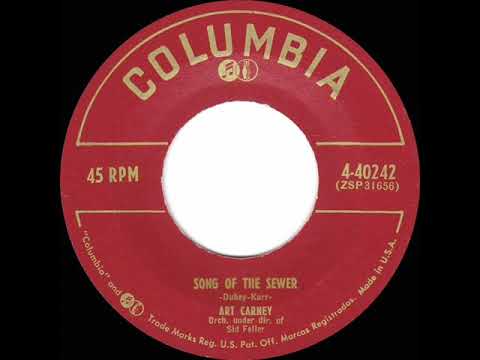
IN ROTATION > https://youtu.be/3eYijde8Eo8
MORE MUSIC > https://FunHouseRadio.com
#novelty #retro #vinyl #45s #78s #fun
MORE MUSIC > https://FunHouseRadio.com
#novelty #retro #vinyl #45s #78s #fun
I'll be volunteering for the Old Town School of Folk Music Record Sale on May 9. It's an event worth checking out if you're in the #Chicago area. Tons and tons of items, and the proceeds benefit the school's #library I've volunteered there for more than 20 years.
https://www.oldtownschool.org/community/recordsale/
Founded in 1957, the Old Town School of Folk Music provides a wide range of music, dance, theater, and visual arts courses to people of all ages, abilities, and backgrounds. Whatever one's interest, the Old Town School provides broad access to more than 700 accredited class offerings, private lessons, and workshops that span an array of artistic genres.
Vinyl?
Vinyl?
Nah, I’m waiting for shellac 78s to come back.
Better still wax cylinders.
#78s #AucklandComedy #Comedy #NZComedy #Shellac #Vinyl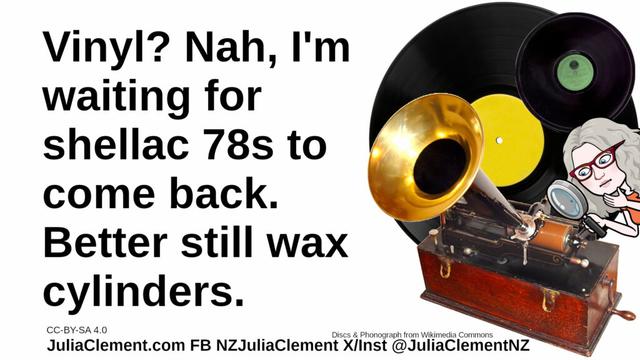
*I'm saying we, since I would need to work with an expert. I am not only totally blind (who knows if this would be accessible), but I know nothing about this sort of thing.*
To make a very long story short, I am aware that there is severe frequency loss in acoustic recordings. That is why they sound so tinny, even when compared to the earliest electrics. Some voices are affected more than others, but even the ones with the best recordings still experience some of it. With the advances in technology at our disposal in 2025, however, I am wondering if it would be possible to attempt to restore some of those frequencies. Ideally, it might sound like something from the 1940's, but I doubt that is possible, at least with the earlier records, so at least the 1920's or 1930's would be great.
The thing is, I don't know exactly what is lost. So my idea is to record a modern singer (with at least a somewhat similar voice to the original) on period equipment and digitally symultaneously. In this way, we would have the live singer, plus two very different recordings. We could then compare the live, electric, and acoustic versions with a device or software that measures frequencies. Once we have determined what is lost, we could then try to restore the actual records in question.
If we were doing this with a cylinder machine, it would be very easy. Not only can one literally still record at the Edison Museum, but there are people today who record in wax with both real machines and reproductions, including commercially! However, the first singer whom I have in mind for this, Francesco Tamagno, recorded on disks, which complicates everything. I was very familiar with cylinder recording prior to designing this project, though I had never done it myself, but I knew absolutely nothing about 78s. Then, I learned.
https://www.scienceandmediamuseum.org.uk/objects-and-stories/making-gramophone-records
As I was saying, it is beyond complicated! Even if we took a chance and recorded the wax master and then used it for playback, skipping the step of actually making a shellac record, there is still the issue of finding recording equipment from Tamagno's time, which is ridiculously rare and doubtlessly too expensive for most people to consider buying. You might ask why we couldn't just use a cylinder machine, since they were certainly around in 1903. The problem is that their frequency loss was different from shellac records, so it would ruin the experiment if the difference was significant. Is it? Can anyone tell me? Do we even need to make a modern recording, or is technology good enough that we can simply add in the frequences from previous knowledge? If this can be perfected, or at least made feasible, there are hundreds of singers whose voices can finally be let out of the can, at least a little, and made to sound more life-like! Many of these didn't live to see electric recordings. I'm sure everyone would jump on this if I said Enrico Caruso was on the list, for example. But he, too, recorded on disks. I wonder if we can skip the recording experiment and use a singer, such as Tito Schipa (my personal favourite), whose recordings span both the acoustic and electric eras, from 1913 to 1964, as a control and gauge the frequency loss that way. If we wanted someone who recorded earlier, we could try someone like Alessandro Bonci or Mattia Battistini, but both only made it to the 1920's.
#78s #acoustic #cylinders #electric #music #opera #production #project #recording #records #restoration #science #SoundRestoration #technology

With the help of images from the Daily Herald Archive, this story explores the process of making gramophone records—one of the earliest platforms for distributing recordings, and the medium that launched a multinational industry.

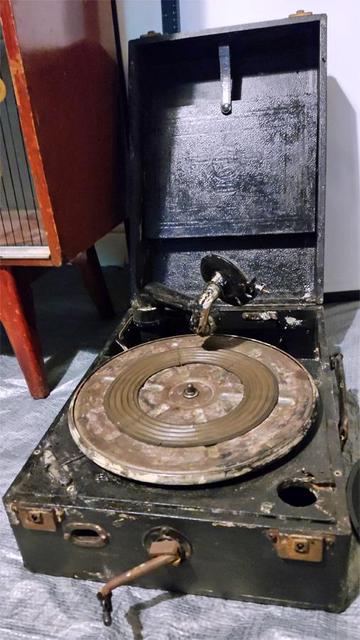
The gramophone I was given. It's rusty, the soundbox is loose, the handle broken, but it still works ! and plays ok if I keep hold of the soundbox.
I think it's a 1920s/30s Columbia 109a.
I'm not sure why the inside, including the arm, horn, and case that typically is some sort of leatherette, has a thick badly applied covering of black gloss paint!
It should be worth refurbishing, although removing the paint might be a messy and long job....
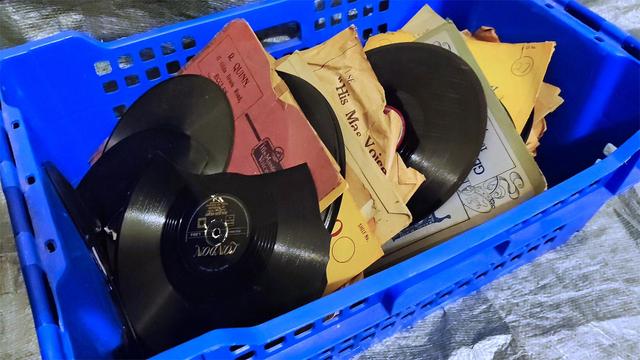
The box of 78s I was given. They were in an attic for many years, and I guess at some point, another box with put un top.
Lots of broken records, I'd take one out of a sleeve and it would come out in jagged bits. Around 40% are broken. The bits will be given to arty people for art projects.
 Matilda T. ZombieQueen
 A Joke A Day
 Tony Wells
 Georgiana Brummell
 Julia Clement
 Revival Records