 Angry Fish Head
Big Town (1994) Review
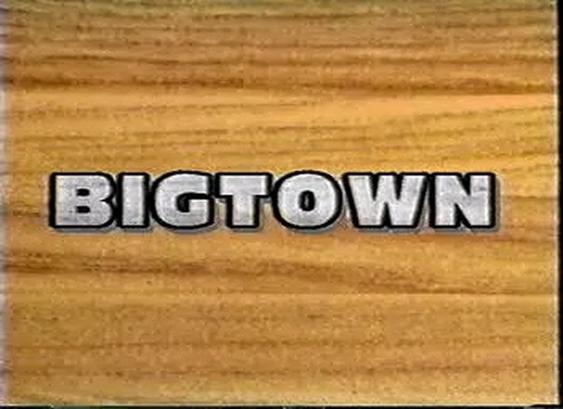
Contrary to the title shot, there isn’t any lumber to be seen what-so-ever. Plenty of wood though.Released by Plum Productions in 1994, directed by Anthony Spinelli, this is a porn feature film starring the likes of Jon Dough, Rebecca Bardoux, Nikki Sinn, Celeste, Heather Lee, Steve Hatcher, Steven St. Croix, Tina Tyler (Credited as Tina Tedeschi), and Woody Long. A star-studded cast for sure. Anthony Spinelli is a prominent figure in the feature film porno category, having directed a number of hits in the genre, many with notable budgets. A veteran by this time, though it only casually shows in this picture. He knows what he’s doing, he just doesn’t feel like doing it at his best.
The film revolves around the voyeuristic exploits of a bum named Bob, as he walks around the city (the titular “Big Town”) watching people have sex. That’s really all there is to it.
The foible of the main character through which we experience these raunchy jaunts around the “City” (Which are really just re-arranged dingy backdrops), is that he is – or we assume him to be telling the truth – a man of stature who has fallen on hard times. A biochemist who somehow lost everything and his wife left him, and now he rummages through the streets for wine bottles trying to ogle people fucking. Sounds like my kind of guy, to be honest.
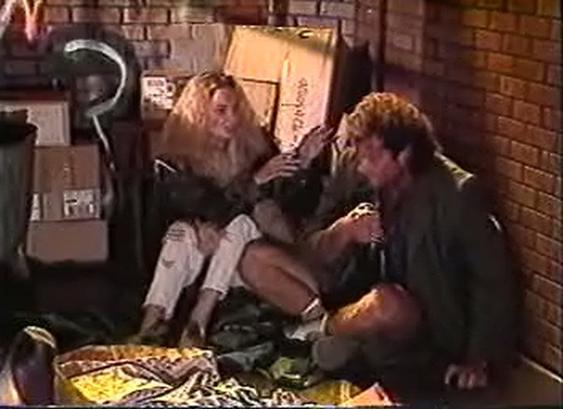
That is the cleanest back-alley brick wall I have ever seen in my entire life.The first scene stars the beautiful Rebecca Bardoux, who is fighting over a bottle with Bob. She stole it while he was flagrantly yelling at shadows, giving us the tip-off that he’s not just some random sleazy bum, he’s “Einstein!” (in his own words). He nails the mannerisms of being drunk, unfortunately he is not convincing even superficially as being a drunk in his actual acting. I paid 10 dollars to see a drunk bum fuck Rebecca Bardoux, you could at least TRY to emulate the aftermaths one of the many party ragers I know you’ve ended up wasted and blacked out on the floor from.
The scene itself is rather blunt. He takes his bottle back, they chit-chat briefly and he tells her to suck his cock. But she will NOT do it…Unless he asks nicely. Now damn, why the hell didn’t I think of that? I’m off to the convenience store to try that on the hot cashier always dropping my Juul’s on the floor!
That’s the nicest ass I think I’ve ever seen on a “bum”. Don’t ask what I have to compare it to.The scene itself is rather straight forward; some oral, some vaginal, then we finish with a filthy anal scene. How fitting. The highlight would be the oral scene, which features very intimate close-ups, almost uncomfortable in how it relishes her lips around his cock. We also have a nice close-up shot of them making out. Very oral focused, which is not something I would have assumed.
The dominating lighting for the scene seems to be an overhead key light that gives the whole scene a rather moody, harsh, and dramatic appeal. The only way we can see their faces properly illuminated is if they look upwards, or are laying down, making the whole act feel depraved in a subconscious sort of way, evoking the theme of them being at the very bottom, with the literal spotlight being on them in this moment. Or hell maybe they only had enough money for the one light, fuck if I know.
“I’m so glad we chose this location, right next to the seedy bum-filled alley with the window looking out directly at a brick wall to have sex!”The next scene features the very wasted potential of the amazing Celeste, and Woody Long, who are in a rather interesting scene to shoot for a porno; a long narrow corridor. You honestly do not see that very often. What you see even less often, is a sex scene in a hardcore porno where there is ZERO penetration action. You see some spirited oral action, with Celeste working her face off to try and get him rock hard, but he seemingly was just not able to perform.
The most action we see from him is getting a blowjob, and then working her over with his mouth and a dildo. All the “penetration” we see is implied, with a couple of glimpses showing that he is doing the softcore trick of just dry-humping as we can see a hint of what I believe is his flaccid penis at a couple points, sporadically mixed in with some shots of Bob lingering outside, looking through the window watching these…newlyweds? Party-goers? Who cares, people in fancy clothes “fucking” (emphasis on the quotes).
The scene is bathed in a nice red key light, at one point painting their entire bodies in red, with some white highlights from fill lights, and nice backdrop lighting of yellow and blue creating a scene that screams warm, inviting, and intensely urban.
“Don’t you know it’s illegal to be sexy? Now bend over and let me show you my Night Stick!” – Or something like that.The scene transitions as quickly as possible to the next one with Nikki Sinn and Steve Hatcher, where the dynamic in this vignette is a cop taking a hooker into an alleyway to coerce sex from her.
This scene is hampered by the fact that Nikki Sinn cannot suck cock at all. She is biting it, flailing her tongue at it, and bobbing up and down on it like she’s trying to stab herself in the throat. This is leveraged though by the fact that she has a fat, dumpy ass. Perfectly balanced, as all things should be.
If you’re wondering, yes, he splits that ass wide open.The aftermath of this scene has her kissing the cop, and going back to her street corner, as she has a small chit-chat with Bob (which is where we learn he is a biochemist, after a comedic exchange). Bob is trying his hardest not to pass out while listening to the hooker go on and on about loving fucking cops and talking about Sarah Lee cakes. I am not sure if Jon Dough was actually on the verge of falling asleep listening to this dialogue, or if he was acting, but I feel for him. God damn I feel for him going through this scene.
Following that encounter we are introduced to Steven St. Croix, acting as a pimp, and the recently deceased Heather Lee (Rest in Peace, Latina mommy). Now, I am sure there have been greater disparities in acting, but this film does an excellent job inadvertently highlighting the difference between Jon Dough’s acting, and Steven St. Croix’s. Croix is what we like to call “Crossover Talent”, a pornstar who can perform, but also act, and he can act surprisingly well. His portrayal of the pimp is soft, seductive, with a hint of threat that oozes from his two-bit character.
The overhead key light is doing some heavy lifting, but I’m sure he’d be just as seductively imposing without it.Again we are treated to a lot of intensely intimate oral play, although this time the color dominating the scene is not from the key light, but the back light, giving them shimmering blue highlights, making it feel urban but in a more somber, subtly threatening way.
The main draw of this scene is the blowjob. My god the blowjob. Can Heather Lee ever suck a dick, I mean holy shit. The way she uses her mouth makes me think she would almost be better at sucking than she would be at fucking. Of course, we also get some of that too, although with much less fanfare, as they finish in an intense missionary on a soiled grimy mattress.
This all culminates though in the finale, where Bob comes face to face with a woman out of time, who does not know who she is, or where she is, but she sees Bob. Shortly after her introduction, we are led to believe this is Marilyn (Tina Tyler), I.E. Marilyn Monroe, and surely a hallucination.
Even her shitty, breathy Marilyn Monroe impersonation is better than Jon Dough’s drunkard.We get a long-winded monologue about how he is all washed up. She coaxes it out of him after doing a rendition of “Happy Birthday Mr President” in the most stereotypical Marilyn way possible. He was a biochemist, he lost everything, his wife, and he loved her, and so on and so forth.
She convinces him it is not too late to try to get her back, that he can salvage her, somehow, he just has to try. The camera really focuses on Jon’s face for this whole thing, and we get a near 30 second long take purely for dialogue and his acting alone, which is moderately impressive, especially for a porno film, as he waxes poetic about how he misses her, how she felt in his arms. I have absolutely no fucking clue what this is doing in this movie though, since it seemingly comes out of left field in terms of the emotional whiplash, although I guess you could argue there is a seedy, depressing undercurrent running through the film, now starting to get put together about how he misses his wife and his ogling of these other people makes him long for her. You COULD argue that. But it would be incredibly difficult due to the fact that there was zero buildup to it outside of the very first scene, and his brief single sentence worth of lines with the hooker.
So, after his monologue, this long, overly emotional release valve for something that was barely gaining any steam to begin with, what does our protagonist, “Bob”, do? He fucks her, naturally.
My wife…My wife! But how often do you get sucked off by Marilyn Monroe?Listen, when a pretty amnesiac blond woman who thinks she’s Marilyn Monroe walks into your life, you don’t pass up that opportunity blindly, even if she did just convince you to try and get back with your wife. There is a really nice quick-shot of the silhouettes of their shadows fucking against the wall, unfortunately we only get a glimpse of that. This scene plays out very similarly to the previous ones; heavy oral focus, typical fucking.
After fucking Marilyn, Bob “wakes up”, stuck in the same pile of trash he was in at the beginning, the other woman now gone; both the woman at the beginning and the Marilyn impersonator, with what appears to be morning light beaming through a window above from the left-hand side. It leaves you questioning if he imagined all of the sex, just the last girl, or if he simply passed out afterwards and woke up, deciding not to change anything. A surprisingly effective closer for this vignette-based film, and unusually depressing.
Overall, it was decent for a porno in regards to sets, the well-executed focus on oral, and the selection of women; their profiles matching their character types moderately well. However the failure of utilizing Celeste (Arguably the best woman on screen here) to her fullest potential, the shitty performance from Jon Dough, and the rushed scene transitions all drag it down, but not by much. I would say it is worth sticking around for the oral scenes, and if you are a fan of blowjobs this is definitely a great skin-flick, but overall, it manages to fall very slightly short.
4/10
For other recent blog posts…
Careful, He May Be Watching (1987) – Review
Released shortly after the fall of the Golden Age of Porn, due to the disintegration of grind house cinema and tighter regulation of what kinds of films could be shown in theaters, “Careful, He May Be Watching,” is not the finale of narrative-driven porn that dominated the 70’s and half of the 80’s, but it…
by theangryfishheadApril 12, 2026April 12, 2026GENRE: Arcade Action / Block BreakerGAME LENGTH: Variable (5 minutes to several hours, depending on your patience, or skill)REPLAYABILITY: HighDIFFICULTY: Desk-smashingly Annoying Released in 1976 in the arcades, this was a – no pun intended – breakout success. It became so popular it spawned an entire genre of imitators, most notably in Japan, with the…
by theangryfishheadNovember 20, 2025November 20, 2025Anatomy of a Weak Argument: A Case Study in Bad Criticism (Featuring SugarPunch)
So, as a joke, a friend of mine posted a link to some youtube essayist criticizing ‘Mortal Kombat X’. “Great!” I think to myself. I am always up for seeing well-informed and nuanced discussions, especially around content that I love. For example, seeing peoples reactions to the 1995 ‘Mortal Kombat’ movie is always interesting because…
by theangryfishheadJune 24, 2025November 20, 2025 #1994 #90S #bigTown #blowjob #celeste #erotic #erotica #feature #fiction #film #flick #heatherLee #movie #Movies #nikkiSinn #oral #porn #rebeccaBardoux #retro #reviews #sex #smut #stevenStCroix #tinaTyler #vintage #woodyLong #writing

 mirror
 Mediathekperlen.de


 Blütensthaub
 DrWeb
DrWeb