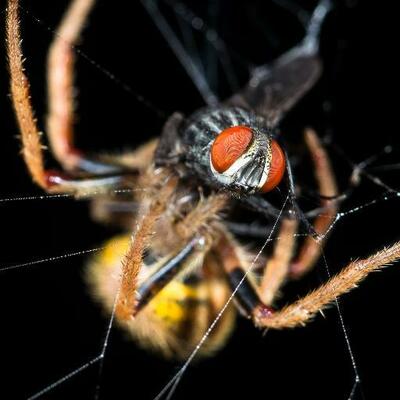
 Arachtober
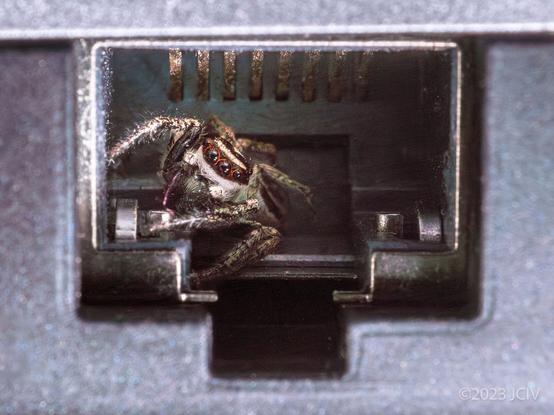
Leptofreya ambigua. Jumping Spiders don't make webs, but this one wished it could get on the World Wide Web.
#jumpingspider #spider #macrophotography #macro
#jumpingspider #spider #macrophotography #macro
| pronouns | xe/xem/xyr (/zeɪ/, /zɛm/, /ziɹ/) or they/them |
| Alt 🦣 (technical) | @tkphd |
| observations | https://www.inaturalist.org/lifelists/tkphd |
| #avatar #attribution | https://www.deviantart.com/carnegriff/art/Nightflight-521392752 |
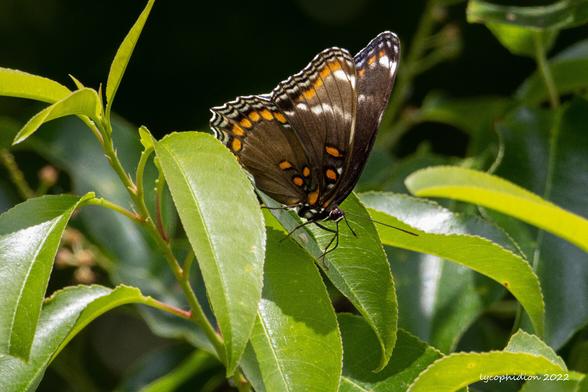
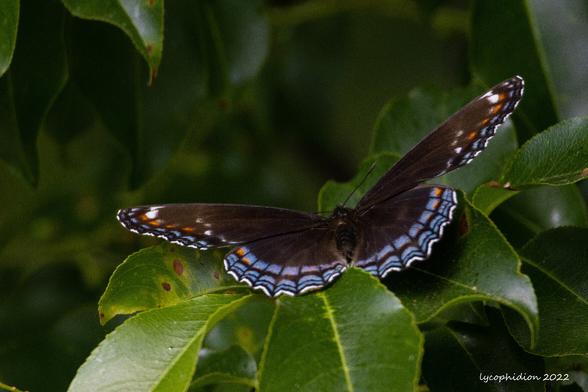
This butterfly, the Red-spotted Admiral, is fairly widespread in North America and consists of two recognized subspecies or morphs, the Red-spotted Purple, and the White Admiral, previously considered separate species.
Where this becomes really interesting is that this divergence is driven by Batesian mimicry, involving a toxic or venomous model and a harmless mimic. The model, the Pipevine Swallowtail, is toxic to would-be predators, which it warns away with its bright red closed wing spots and showy white-spotted purple upper wing surfaces. Where the Red-spotted Admiral shares the swallow-tail's range, it has evolved a color pattern closely resembling the Pipevine pattern. This is the Red-spotted Purple. Where it lives outside the swallowtail's range, the Admiral's fitness advantage of maintaining its conspicuous pattern vanishes, and it has evolved a cryptic pattern to blend with its surroundings. This is the White Admiral.
And in between, across quite a broad geographic band, there is a transition where one form intergrades into the other. This particular specimen is a transitional form, sometimes denoted "White Admiral × Red-spotted Purple," although it is not a hybrid.
#biodiversity #insects #butterflies #nature #naturephotography
how URLs work

A delightful little #OpenAccess paper from Gustavo Hormiga (who, despite his name, is an arachnologist) and William G. Eberhard, on the surprising diversity of linyphiid and pimoid spiderwebs. Includes many photos of some fantastic spider architecture.  https://doi.org/10.3099/MCZ75
Also featuring this fantastic line…

A Pacific Northwest bumble bee queen (Bombus melanopygus) bathes in crocus pollen.
I learned recently (in a book I’d *highly* recommend: “What A Bee Knows” by Stephen Buchmann) that early Cretaceous proto bees are believed to have fed on tiny flower-loving thrips (small insects) whose bodies were coated in protein-rich pollen. This sheds light on bees’ evolutionary transition from carnivorous predatory wasps to their pollinating vegetarian lifestyles (characterizing most—though not all!—bees).
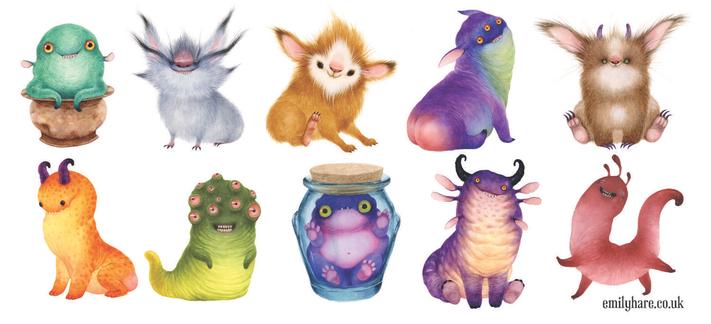
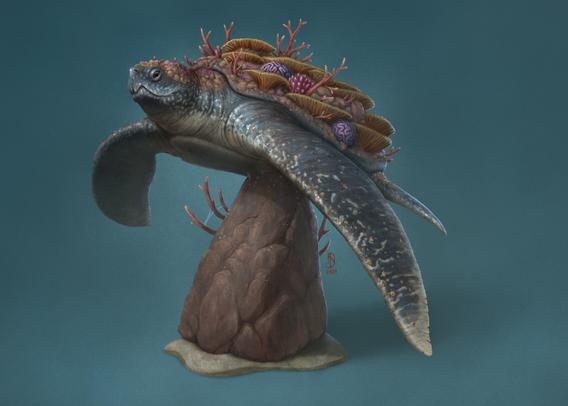
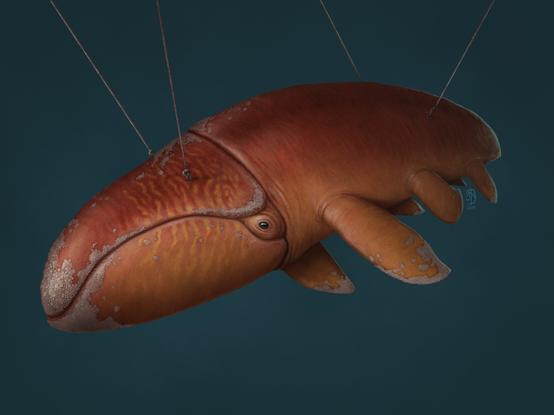
Hi there #PortfolioDay
I'm Dan, a 2D/3D artist from #Massachusetts
I'm a big fan of #zoology #speculativebiology #paleontology


 MikeF
MikeF Julia's Reruns Bot
 neville park
 Save Bees
 Emily Hare
 Katie Mack
 dananddna
 Decolonial Atlas