 Randahl Fink
Right before leaving office, Trump's Director of National Intelligence shares the Kremlin narrative of "Ukrainian biolabs".
I look forward to the investigations into how much money she made working for Russia.
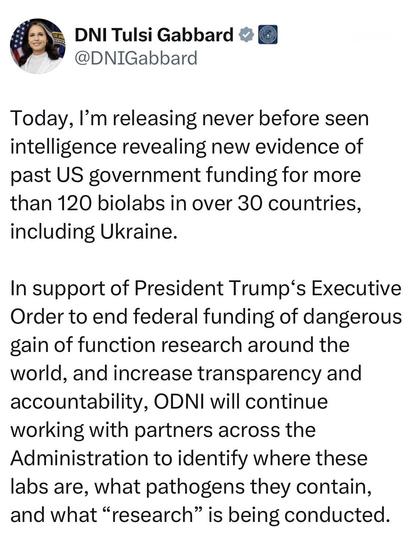

Right before leaving office, Trump's Director of National Intelligence shares the Kremlin narrative of "Ukrainian biolabs".
I look forward to the investigations into how much money she made working for Russia.
RE: https://c.im/@msbellows/116718432761990018
Absolutely nuts. The US wants to host the World Cup, then detains other countries’ players when they arrive because — surprise — they are foreigners!!!
Researchers found that writers using biased AI agents to auto-complete suggestions had their sociopolitical values shifted without their knowledge it was happening.
https://www.science.org/doi/10.1126/sciadv.adw5578
We worry about cognitive capture, what the LLMs of big tech are doing to our ability to identify and think through problems. We should be equally worried about them making a grab for our ethos, what we care about, and at population scales.
Canada dumps Trump.
Instead of buying the Boeing E-7, Canada has chosen the Swedish Saab Global Eye, which is the monitoring and control aircraft currently used by Ukraine.
Right in this moment, Trump cost Boeing more than 4 billion dollars.
Are you "tired of winning” yet MAGA?
Let’s talk being able to talk when internet and cell phone service both go down
This is something I’ve been thinking about a lot for the last year plus, and with the EFF coming out a number of days ago and strongly encouraging other people to think about it too, I thought it would be a good time to share my findings with all of you.
So here are three decent ways to have communications that keep working when both the internet AND cellphone networks go down.
1: AMATEUR RADIO, a.k.a. HAM Radio
the most capable but with the biggest barrier to entry
This isn’t going to be an option for most of you because you’re going to have to make time to study, take the qualifying exam to get a license (I’m KK7ZLU if you have one), purchase that license, then purchase a radio and antenna(s) you need and yes those are separate, and get it all set up if you want long-range communications.
On the plus side, this is filled with people who already know what they’re doing. So if you’re good at tests and have the money and time to take all the steps? Great! Please do it! The more the merrier.
2: FRS AND/OR GMRS RADIO
surprisingly capable least-effort handheld radios
Okay, so, you want a modern walkie-talkie, and not junk? Something with some range? And maybe with a base station that sits in your house or car? But you don’t want to have to study for a license examination?
Welcome to the overlapping worlds of FRS and GMRS.
FRS (‘Family Radio Service’) and GMRS (‘General Mobile Radio Service’) are two separate but very compatible radio standards. The radios – typically hand-held – have numbered channels, many of which are used by both kinds of radio. By using them together, you improve both.
Using them is very simple: pick a channel, push the button to talk, then let off the button and listen for a reply. Done.
So: how are they different?
First, GMRS radios are much more powerful – and so longer-range – than FRS radios.
Second, GMRS radios can use “repeaters,” which are automated radios that can pick up your signals and resend them over a much larger area. I can from home talk to people across much of western Washington State because of these repeaters.
Third, Because of these two features, GMRS radios require a license, whereas FRS radios do not. But there is NO test for this license. No studying, no prep, no examination. You just buy one online, and you can do it tonight if you want. Once you have bought the license, your whole family can use it. It costs $35 for 10 years. (I’m WSLT671.)
By contrast, FRS radios can be used by literally anyone, INCLUDING SMALL CHILDREN. There are several families around here who have bought sets of FRS radios for their kids. I know this because I pick them up all the time on my GMRS base station. It’s like hearing neighbour kids play over the fence or down the block.
So how does using them together improve both?
In general, GMRS licensees have more technical leeway than FRS users. FRS radios have small, simple antennas you are not allowed to modify, which limits their range. With GMRS radios, you can buy – or even make – much better antennas.
Between the better antennas and the higher power, having GMRS on one end of any conversation extends the effective range of the FRS radios you’re talking to. Using GMRS on shared channels lets you both hear and talk to FRS users from further away.
E.g., in hilly terrain, you’ll be lucky to get one and a half to two miles with FRS alone. But with GMRS on one end and FRS on the other, you can get eight miles or more even in bad conditions. Under ideal conditions, 30 miles is not impossible. Two FRS users may not be able to talk to each other at the same time at those sorts of distances, but if they can both talk to the GMRS station, the GMRS user can pass messages along.
In short: having a GMRS radio in the mix makes FRS radios better, extending their range, sometimes dramatically, which means fewer licenses, cheaper radios, and better access in the short run.
Finally:
3: TEXT OVER RADIO
LoRa digital text radios
LoRa is a kind of digital two-way radio being used here for texts. If you want to be able to text across long distances when both the internet and cell phones are down, this is a good way to do it, as long as everyone involved has LoRa devices. (LoRa texting does NOT work with regular cell phone texting, in the same way that Discord doesn’t work with it either. It is an entirely separate thing.)
There are LoRa devices that bundle all the functionality into one piece of equipment, and also LoRa “companion” devices with LoRA transmitters inside which work with software on a computer, phone, or tablet.
An example of a dedicated device is the LilyGo T-Deck. If you remember Blackberry devices, it looks like a Blackberry device. But instead of using cell phone services or the internet, it’s just directly talking over radio. No cell service, no internet: just radio.
An example of a “companion” device is the WishMesh Tag. It’s a rectangle about the size of a debit card, but thicker. If you turn its GPS receivers off, it’ll run a solid four, maybe five days on a single charge. You connect your phone, tablet, or computer to it via bluetooth using special software (the previously-mentioned MeshCore or Meshtastic) and run the accompanying app to send and receive encrypted text messages with individuals or groups.
Again: even though it can work on a cell phone, NONE OF THIS REQUIRES INTERNET OR CELL SERVICE. The “phone” isn’t being used as a cellphone here, it’s being used as a small computer that has bluetooth.
In much of the US, the most commonly used software is Meshtastic. Here in Cascadia, MeshCore (download at https://meshcore.io ) is the standard, and it is a very large area network. It seems to work better than Meshtastic does in our mountainous geography, which is why everyone switched.
Both are open source, although closed-source/commercial versions also exist.
Unfortunately, as above, the two packages don’t cross-communicate! So you want to find out what’s most common in your area and use that one, whatever it happens to be.
What do I recommend? Glad you asked.
Being me, I’ve got all three options listed here up and running. I’m just like that; if I can have a contingency plan, I will have a contingency plan; my noise in fiction about how “Sombra always has a plan” is straight-up me.
But that’s not the answer you’re looking for. The answer really depends upon what people are already using around you, because it’s easier to join an existing network than make a new one. But if you’re somewhere all three are active, or somewhere none of them are active, my answer is conditional:
So basically, now’s a real good time to reach out to the kind of people you’d want to be able to reach regardless. Get a conversation going amongst the willing and interested, settle amongst yourselves on at least one of these, then set up and actually use it until you know it works and you’re comfortable with how it works.
After all – you never know what kind of emergency might happen, or when. And the time to be ready is beforehand, not during… when you won’t have the time to get comfortable with anything.
#AmateurRadio #politics #radio #techThis is how corrupt it is:
Trump abuses his role as president to terminate the public lease on non-profit golf course, so he can push out the non-profit organisation and take control of the course.
Then when illegally tearing down The White House East Wing, Trump dumps all the polluted rubble full of led and chromium on the golf course — where children play golf — because that is cheaper than taking proper care of the polluted rubble.
https://www.theguardian.com/us-news/2026/may/05/trump-ballroom-rubble-toxic-metals-dc-golf-course
A brand new diamond open-access math journal for students to publish in. Could be good!
----- New Journal Announcement -----
Incepta Mathematica (https://journals.calstate.edu/im) supports research in all fields of mathematics, conducted by scholars without a Ph.D. (or equivalent) degree. It publishes research articles and surveys, with no length requirements. It is diamond open access (free for readers and authors alike), fully peer reviewed, online only.
Research article submissions are welcome from students at all levels, from high school to graduate school, as well as from amateur mathematicians. Typically, up to one coauthor who has a Ph.D. is permitted (normally a research mentor), but not as a sole author. Research articles must be written to a high standard, both in writing style and in mathematical content. They are evaluated by the editorial board and (if suitable) reviewed by two professional mathematician referees.
Survey submissions are welcome from research-active mathematicians, writing about a topic they know well, which they feel would be suitable for student research. They should include problems at various levels -- from class projects to open research questions -- and an adequate amount of appropriate, recent, references. Authors considering a survey submission are encouraged to first contact the editorial board to discuss their plans. Student coauthors are not expected for surveys. Survey submissions are reviewed by one referee.
𝐇𝐞 𝐝𝐮𝐠 𝐭𝐨𝐨 𝐝𝐞𝐞𝐩 𝐢𝐧𝐭𝐨 𝐄𝐥𝐬𝐞𝐯𝐢𝐞𝐫'𝐬 𝐟𝐨𝐬𝐬𝐢𝐥 𝐟𝐮𝐞𝐥 𝐭𝐢𝐞𝐬: "𝐈 𝐰𝐚𝐬 𝐬𝐡𝐨𝐜𝐤𝐞𝐝"
If you're into science or medicine, you may have heard of journals like Cell or The Lancet. You might also be familiar with their parent company Elsevier / RELX, and their predatory practices: sometimes charging more than 10,000 dollars for publications whose running costs don't reach a tenth of that amount.
What you might not know is that beyond pocketing public research money, Elsevier is also contributing to climate breakdown, pouring millions into tools and journals providing information about areas yet to be exploited for oil and gas extraction, as well as new technologies needed to dig up oil more efficiently in the Arctic and the Canadian tar sands. The motto of one of their online tools, Geofacets, used to be that, thanks to it, “exploration has never been more seamless.”
But that's the tip of the iceberg. For years, RELX's political action committee REPAC has been providing support to climate denialist politicians in the US, preventing carbon mitigation bills from reaching a vote in Congress.
I document this and other complicities of big academic publishers in my new book Science in Resistance, where I interview Kip Lyall, a former employee of the journal Cell, who was fired after asking too many questions about the company's fossil fuel ties.
Excerpt below. 👇
#Science #OpenScience #Fossilfuels #Climate #Climate #Activism #Journal

 Terence Tao
 Julian Oliver
 Gil Durán
 solarbird

 John Carlos Baez
 Fernando Racimo