Preston A. Rickwood

@ob1quixote
196 Followers
249 Following
467 Posts

The World's Most Boring Tooter

#mefite

MetaFilter.com is 25 years old today, a milestone that feels somehow both remarkable and inevitable. For a part of the Old Web, a literal 20th century artefact, to still be operating and lively is such a rare thing.

And yet its the sort of place that *can* live that long life: an online community organized not around profit or prestige but around people and a sense of space, a place that has rebuilt and renewed itself yearly out of a shared desire to simply keep a something important alive.

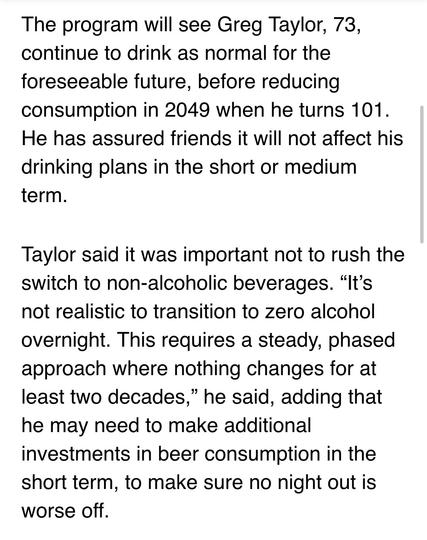
Man Announces He Will Quit Drinking by 2050.

A Sydney man has set an ambitious target to phase out his alcohol consumption within the next 29 years, as part of an impressive plan to improve his health.

The program will see Greg Taylor, 73, continue to drink as normal for the foreseeable future, before reducing consumption in 2049 when he turns 101. He has assured friends it will not affect his drinking plans in the short or medium term.

Taylor said it was important not to rush the switch to non-alcoholic beverages. “It’s not realistic to transition to zero alcohol overnight. This requires a steady, phased approach where nothing changes for at least two decades,” he said, adding that he may need to make additional investments in beer consumption in the short term, to make sure no night out is worse off.

https://theshovel.com.au/2021/10/26/man-announces-he-will-quit-drinking-by-2050/

#GlobalWarming #Oil #BigOil #FossilFuel #Climate #ClimateChange #ClimateCrisis #Drinking #Problem

Man Announces He Will Quit Drinking by 2050 — The Shovel

He has assured friends it will not affect his drinking plans in the short or medium term.

The Shovel

I hate to be such a Debbie Downer, always offering so many gloomy posts — but I’m afraid that’s just the reality we’re living in. The more I learn, the more carefully I think about what the future holds and what our actual prospects are, the more bleak it appears.

That doesn’t mean there’s not occasionally good news or uplifting points to consider. I often look for things that will brighten my day, and perhaps yours too.

But ultimately I feel there is great danger in looking away for too long from the darkness ahead, ignoring it all in the hopes that maybe it never will happen. It seems much smarter to me to face reality, to accept it, perhaps grieve for a while, but then get to work taking whatever action steps seem right to each of us.

Anyway, that’s what I have as an introduction for yet another unpleasant piece about our collective future. This one focuses on the terrible condition of US politics and its resulting impacts on our struggle to avert catastrophic climate chaos. The author, Stan Cox (@CoxStan), does a brilliant job of describing recent history, how we got to where we are, along with the daunting challenges we now face.

It don’t look good…
_______________________________

The enactment of bold new climate policies — bold enough to quickly drive US greenhouse-gas emissions down to zero — can succeed only if we defeat the looming threat of far-right authoritarianism. And today, the nation’s anti-democracy, fossil-fuel-loving political minority appears more determined than ever to gain enough power to turn us into a sweltering autocracy.

But suppose for a moment that we do succeed and thwart MAGA extremists’ attempt to gain power over the federal government’s three branches. The road from there to bold climate policies, and many other urgently needed measures, will remain as rough and twisty as ever. Groundswells of public pressure will still be required to convince the timid souls on Capitol Hill to defy corporate resistance and enact strong, effective policies. And even then, it will be a long, hard struggle.

And it won’t be a one-and-done victory. Especially with a goal like eliminating greenhouse-gas emissions, laws will have to be protected from repeal for decades, and policies pursued with little or no interruption. That will require defeating anti-climate, anti-democracy forces in the Electoral College every four years while relegating them, through fair-and-square elections, to a permanent minority role in Congress.

With that, we would essentially be living in a one-party state. Would we still be calling ourselves a democracy?

Ambitious climate mitigation policies could be implemented more easily by an authoritarian state than by a pluralistic democracy. But a healthy, multiparty democracy is necessary if we’re to build a society that operates within critical ecological limits while also guaranteeing justice, equity, and sufficiency to all people.

We need to achieve both pluralistic democracy and strong measures against greenhouse-gas emissions if we’re to have a livable future. But on both counts, trends are running against us.
_______________________________

I strongly urge you to read Stan Cox's entire essay. It's superb.

FULL ARTICLE -- https://www.resilience.org/stories/2023-11-30/can-we-keep-voth-fascism-and-climate-doom-at-bay-for-decades-to-come/

#USA #Politics #Climate #ClimateChange #ClimateCrisis

Can we keep both fascism and climate doom at bay for decades to come?

The enactment of bold new climate policies—bold enough to quickly drive US greenhouse-gas emissions down to zero—can succeed only if we defeat the looming threat of far-right authoritarianism. And today, the nation’s anti-democracy, fossil-fuel-loving political minority appears more determined than ever to gain enough power to turn us into a sweltering autocracy.

resilience

Kalief Browder was 100% innocent. He was a good student and had never been arrested. He was accused of stealing a backpack, even though no backpack was found on him or anywhere near him when he was arrested. There was literally zero evidence. But they sent him to Rikers for 3 years, hoping he would confess to something that everyone knew he didn't do. He never confessed. And it broke him.

https://m.youtube.com/watch?v=kv6gSl4JcFA

If he had paid the $3,000 for bail, the prosecutors would have dropped the case.

Kalief Browder's Life Behind Bars and Who He Might Have Been

YouTube

This week a young woman took to the airwaves. Her name is Riley Gaines. What she said put me in mind of the Nazis who invaded Charlottesville, and corrosive rage that demolishes even those who channel it, among other things.

Read on (thread or essay): https://armoxon.substack.com/p/channels-of-rage

Channels of Rage

On the vile and corrosive replacement myth, those who push it and why they do, and what it really replaces.

The Reframe
Um.

Okay, sorry, here is my second MUST READ article of the day. I promise not to overburden you like this on a regular basis, but I hope you will indulge me this time and read and share this vitally important piece from Jason Hickel (@jasonhickel) in which he tackles the question of Green Growth vs Degrowth...
_________________________

Some prominent commentators seem to assume that the debate is primarily about the question of technology, with green growth promoting technological solutions to the ecological crisis, while degrowth promotes only economic and social solutions. In fact, degrowth scholarship *embraces* technological change and efficiency improvements, to the extent (crucially) that these are empirically feasible, ecologically coherent, and socially just.

But it also recognizes that this alone will not be enough: economic and social transformations are also necessary, including a transition out of capitalism. The debate is therefore not primarily about technology, but about science, justice, and the structure of the economic system.

Degrowth does not call for all forms of production to be reduced. Rather, it calls for reducing ecologically destructive and socially less necessary forms of production, like sport utility vehicles, private jets, mansions, fast fashion, arms, industrial beef, cruises, commercial air travel, etc., while cutting advertising, extending product lifespans (banning planned obsolescence and introducing mandatory long-term warranties and rights to repair), and dramatically reducing the purchasing power of the rich. In other words, it targets forms of production that are organized mostly around capital accumulation and elite consumption.

At the same time, degrowth scholarship insists on strong social policy to secure human needs and well-being, with universal public services, living wages, a public job guarantee, working time reduction, economic democracy, and radically reduced inequality. These measures abolish unemployment and economic insecurity and ensure the material conditions for a universal decent living — again, basic socialist principles. This scholarship calls for efficiency improvements, yes, but also a transition toward sufficiency, equity, and a democratic postcapitalist economy, where production is organized around well-being for all, rather than around capital accumulation.

It is now well-established that green growth scenarios suffer from a difficult problem. They start with the assumption that the rich countries in the “core” of the world-system should continue to increase aggregate production and consumption (“growth”) for the rest of the century. But growth does not come out of thin air. It requires energy. To resolve this issue, green growth scenarios resort to deeply problematic assumptions.

They assume we can overshoot the Paris Agreement limits now and rely on mass deployment of speculative negative emissions technology in the future (mostly bioenergy with carbon capture and storage, or BECCS), to pull excess carbon out of the atmosphere. Scientists have raised major red flags about this approach. BECCS would require vast tracts of land for biofuel monoculture, up to three times the size of India, appropriated overwhelmingly from the Global South, exacerbating deforestation, soil depletion, water depletion, biodiversity loss, and other ecosystem damages, while constraining food availability.

Relying on this approach is unjust and ecologically incoherent. It is also risky, because if, for whatever technological or political reasons, this scheme cannot be scaled in the future, then we will be locked into a high-temperature trajectory from which it will be impossible to escape.

Green growth scenarios maintain high levels of energy use in high-income countries by constraining energy use, and therefore development, in the Global South — in some cases to levels that are below what is required for even basic needs. Yes, we need renewable energy transition. But needlessly high energy use in rich countries means this transition will be slower and the social and ecological costs will be higher.

In sum, green growth scenarios play loose with science, assume incredibly unjust arrangements, and gamble with the future of humanity — and all of life on Earth — simply to maintain ever-increasing levels of aggregate output in high-income countries.
_________________________

FULL ESSAY -- https://monthlyreview.org/2023/07/01/on-technology-and-degrowth/

#Science #Environment #Climate #ClimateChange #Capitalism #Degrowth

hot new meme ive invented
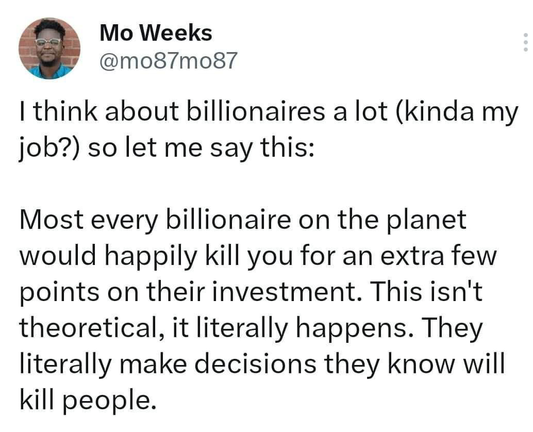
No political discussion can happen without agreeing that this is true, that significant slices of the population can and do kill people for fun.