Today's talk will be:
Isaac Wong (Dunn School, Oxford)
Mechanical Principles of Centrosome Assembly and Function
CTU 0.08/09 at 13.05

| Website | http://mechanochemistry.org |
Today's talk will be:
Isaac Wong (Dunn School, Oxford)
Mechanical Principles of Centrosome Assembly and Function
CTU 0.08/09 at 13.05
It's Tuesday! That means it is CMCB lab talk day.
A bittersweet occasion today as it will be the last talk from the Cross Lab 😢
Note the room change for today 24th Feb - it's in 0.42 at 1pm
🚨 NEW PAPER 🚨
Vishakha and colleagues in the Cross group show that ATPγS causes single kinesin molecules to pause under load in an Await-Isomerisation (AI) state that leaks hand-over-hand backsteps.
"ATPγS substantially defeats the biasing mechanism for kinesin steps”
ATPγS, a slowly-hydrolysed ATP analogue, causes kinesin to take extra backsteps under load. Here, the authors examine single-molecule mechanics and propose a state in which forward steps and coupled ATP hydrolysis are turned off, but unsteered steps are allowed.
🚨 We have a new preprint out!
In this paper we look at GLUT4 trafficking. This is a short explainer thread, but please read the paper!
https://www.biorxiv.org/content/10.64898/2026.02.16.706132v1
#CellBiology #Microscopy #Diabetes #Glucose #Insulin
1/n

New paper:
"A geometrically informed permutation test for dependency in spatiotemporal patterns of protein species in microscopic images”
Honnor et al.
CellShapeExplorer from the Straube lab is in the Imaging Spotlight.
https://focalplane.biologists.com/2026/02/05/imaging-spotlight-shapespaceexplorer/
New paper:
Connections between physics and metabolism in brain functions
Mochel et al.
New paper from Burroughs and McAinsh groups:
Bayesian data driven modelling of kinetochore dynamics: Space-time organisation of the human metaphase plate
Koki et al. PLoS Comp Biol

Author summary Cell division segregates newly duplicated chromosomes into two daughter cells. This is a mechanical process orchestrated by the mitotic spindle, a self-assembling molecular machine comprising dynamic fibres called microtubules. Chromosomes are attached to microtubules at protein complexes called kinetochores, forces from these attachments driving chromosome movements. During cell division the chromosomes are aligned at the cell equator, where they undergo pseudo-periodic oscillations for ∼10 minutes before chromosome segregation begins. The purpose of this 10-minute ‘holding pattern’ is however unclear. By tracking kinetochores in 3D, we estimated the forces acting on individual kinetochores using reverse engineering techniques. We discovered that kinetochore dynamics is very variable within a cell, with substantial dependence of forces on spindle location and substantial changes in forces occurring in the lead up to anaphase and segregation. We speculate that this variability is a design feature, with forces adapting to the local spindle curvature, whilst random variability may be important to prevent oscillation synchrony. This work establishes a framework to quantitatively analyse how kinetochores work collectively at the cell level, and how individual variability may contribute to cell division robustness. Our work demonstrates that kinetochores are not equal, a fact that may be crucial in unravelling error detection and correction mechanisms.
New paper from the @AnneStraube lab describing their ShapeSpaceExplorer tool to analyse cell shape
Paper: https://doi.org/10.1371/journal.pcbi.1013864

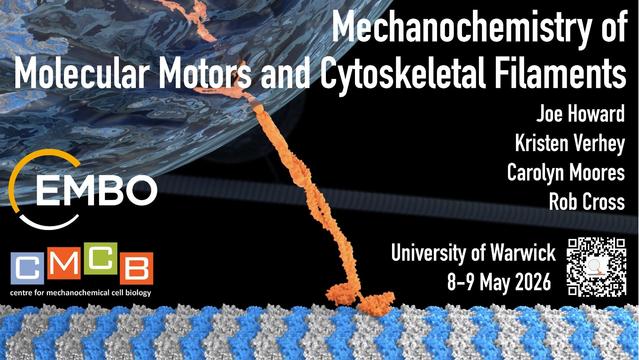
Calling all #MotorsInQuarantine fans: Please join us for 1.5 days of science on motors and the cytoskeleton as we celebrate the career of Rob Cross. More info and sign-up here:
 Stephen Royle