2.1K Followers
1.4K Following
594 Posts
Prof at MIT working on misinformation/fake news, social media, intuition vs deliberation, cooperation, politics, and religion.
(he/him)
Google Scholarhttps://scholar.google.com/citations?view_op=list_works&hl=en&hl=en&user=C0ANojIAAAAJ
Misinfo-related research linkshttps://docs.google.com/document/u/0/d/1k2D4zVqkSHB1M9wpXtAe3UzbeE0RPpD_E2UpaPf6Lds/mobilebasic
Websitehttps://davidrand-cooperation.com/
MIT News Profile "Playing a New Tune"https://news.mit.edu/2020/david-rand-0412

🚨New PNASNexus🚨
Reserach on misinformation & harmful language as often studied separately. Here we look at how they relate to each other, and find:
-More harmful language in tweets w low-quality news links β=0.1 & in false headlines β=0.19
-Users who share more misinformation use more harmful language in non-news tweets β=0.13

PDF: https://academic.oup.com/pnasnexus/article/3/3/pgae111/7626151

w @mohsenmosleh

🚨New WP🚨

Field experiments with 33 million FB users & 75k Twitter users: Ads prompting users to think about accuracy reduce misinformation sharing!

Accuracy prompts offer platforms a content-neutral approach that is scalable and preservers user autonomy https://osf.io/preprints/psyarxiv/u8anb

OSF

🚨New WP🚨
"Pro-Climate Statements from Elon Musk can Persuade Republicans on #Climate Change"
https://osf.io/preprints/psyarxiv/v9mzk/

How can more Republicans be convinced of the importance of #climatechange?

We show tweets from Elon Musk
- a favorite of the right, but still pro-climate - sig increase climate concern/action among Reps. Musk can be a powerful climate messenger!

In recent years, Musk has embraced the political right – fighting with prominent liberals like AOC, Bernie Sanders, buying Twitter & reinstating people like Trump etc. But he has remained consistent in expressing pro-climate beliefs. This creates an opportunity!

We test whether highlighting Musks’s conservative credentials and then showing some of his pro-climate tweets can persuade Republicans on climate change.

RESULT: Yes! Seeing the tweets increases belief in and support for addressing climate change, pro-climate behavior intentions - but has no effect on attitudes towards Musk.

🚨Out in PNAS🚨
https://www.pnas.org/doi/10.1073/pnas.2301491120
"No association between numerical ability and politically motivated reasoning in a large US probability sample"

Know that influential finding that more numerate people are more politically biased?

We did NOT replicate it in a probability sample 2x larger than the original paper.

Across 5 different contentious issues, we found that people with higher numeracy gave more correct answers, regardless of whether the correct answer aligned with their politics.

We did, however, find a main effect of political alignment ( that was robust to controlling for priors) - that is, people were more likely to get the answer right when the correct answer aligned with their politics.

These results raise serious questions about the claim that motivation hijacks reasoning, while nonetheless supporting the existence of some form of motivated processing.

🚨Out in PoPS🚨
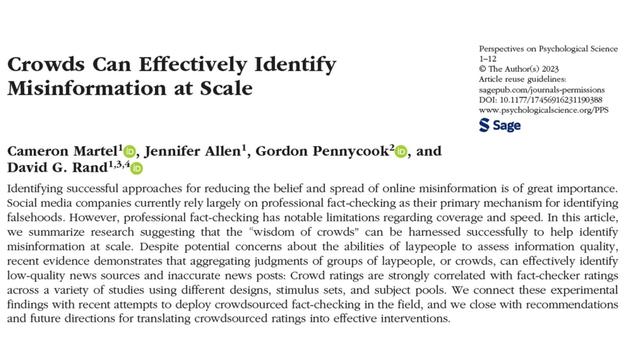
https://journals.sagepub.com/eprint/NMKPE6FS32EDG7BJMIBV/full
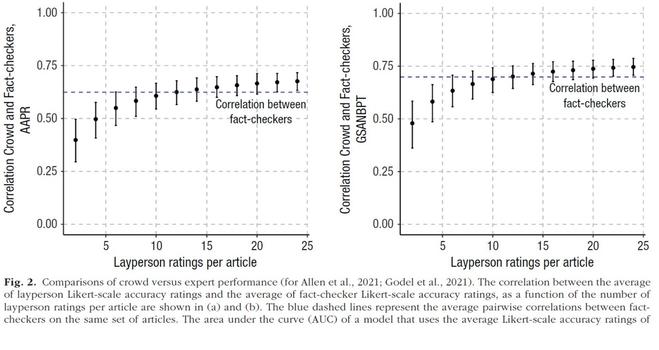
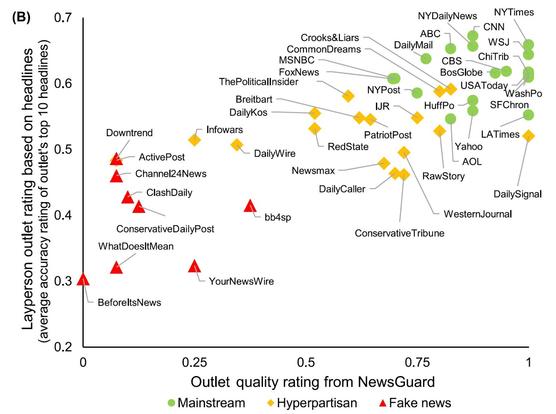
Can crowds help identify #misinformation at scale? YES! In this #review we overview a range of scientific studies of using the "wisdom of crowds" to help social media platforms meet the misinformation challenge. We show that seemingly contradictory findings in the literature about crowd performance can be explained simply by different papers using analytic approaches. When analyzed in the same wall, all evidence suggests that crowd ratings are highly correlated with expert ratings. We discuss the various limits and challenges of crowdsourced news evaluation, but conclude that crowd ratings are one important part of the anti-misinformation toolkit
Crowd ratings=useful signals!

#psychology #crowdsourcing #fakenews #socialmedia #socialscience

🚨New WP🚨
What label should be applied to content produced by generative AI?

PDF: https://psyarxiv.com/v4mfz

With the rise of #generativeAI, there has been a recent push for disclosing whether content is produced by #AI. However, it is not clear what the right terms are to use for such labels. In this paper, we investigate how the public in the USA, Brazil, and Mexico understands the mapping between ten potential labeling terms and 15 different types of content that vary in the extent to which they are AI generated, and the extent to which they are potentially #misleading. Across all three countries, ``AI Generated'' is one of the terms most consistently associated by participants with content that is generated using AI, regardless of whether that content is misleading. Conversely, ``Manipulated'' and ``Not real'' were two of the terms most consistently ascribed to content that is misleading, regardless of whether the misleading content was generated using AI.

New DEEPLY insightful review by Jillian Jordan in TICS about how reputation works, and what the implications are for our psychology. Highly recommend giving it a read! https://www.sciencedirect.com/science/article/pii/S1364661323001493

🚨New paper in press @ JEPG🚨
Http://psyarxiv.com/8fkpy
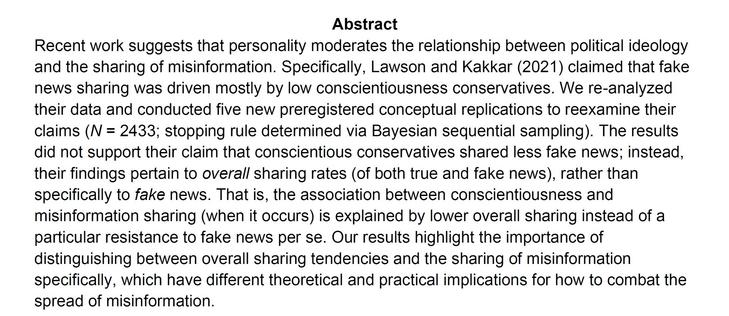
Remember the paper showing that it’s specifically *low-conscientious* #conservatives who share fake news? It got lots of coverage. BUT it seems like that claim isn't actually true - in a new paper, we fail to replicate it in 5(!) times and also show that even the original data don't support the claim (because they look at overall sharing, not specifically at sharing of false claims).

Bottom line: conservatives are more likely to share #misinformation, regardless of their level of #conscientiousness.

Check out the ungated paper: "Conscientiousness does not moderate the association between political ideology and susceptibility to fake news sharing" at http://psyarxiv.com/8fkpy

#ideology #politics #fakenews #personality

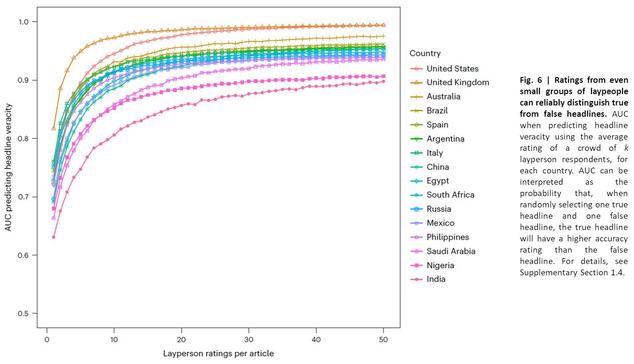
"Understanding and combatting #misinformation across 16 countries on six continents" out today in Nature Human Behavior! There have been a huge number of msinfo-related studies in the past 5 or so years, but almost all of them have been US/Western populations. So here we examined the #psychology of #misinformation, and the effectiveness of various #interventions, across 16 countries (total N=34k).

We find:
➤Consistent #cognitive, #social & #ideological predictors of misinfo belief across countries
➤Interventions (accuracy prompts, digital literacy tips, using crowdsourcing to identify misinfo) are all broadly effective across countries

Give it a read and let me know what you think! https://rdcu.be/dfGtT

🚨Out in PNAS!🚨
https://www.pnas.org/eprint/AWU8WZ9GVGPPGP9FJT3D/full

#Political #microtargeting has become a topic of great concern (eg Cambridge Analytica) But does it actually WORK? To find out, we ran a large-scale experiment to quantify the persuasive advantage of political microtargeting for US issue advocacy campaigns

The answer is complicated...

We find a sizable benefit of #targeting (~70% more persuasive than showing everyone the best overall message) - but little additional benefit from *micro*targeting on numerous different characteristics simultaneously

Our study used a 2-step process. First, we trained machine learning models on experimental data to learn which messages are most persuasive/for whom.

Then, we recruited 5k new people randomized them into [Control; Random message; Best overall message; or Microtargeted message, chosen by training targeting model on 1, 2, or 4 different participant characteristics] & compared persuasion across conditions.

Give the paper a read to see details!