 Ricki Yasha Tarr
If you live with chronic pain, what strategies/meds have helped you the most?
 J.D. MacLeod 🇨🇦
@RickiTarr icepacks
 Raindrops and Roses
@RickiTarr Depends on the pain. Massage and heating pads.
 Joe (TBA)
@RickiTarr I have found stretching for my cronic back pain. I injured it at 13, so it's been 57 years, ugh. I also have severe arthritis in my right thumb. I get an injection into the joint every 3-6 months. I use CBD oil and MAXX pain relief roll on.
 Tanek Rune
@RickiTarr
Learning not to be embarrassed to use mobility aids when necessary instead of just staying home.
Learning not to be embarrassed to use mobility aids when necessary instead of just staying home.
 TeflonTrout
  he/him
@Cassandra_Complex @RickiTarr another vote for this, I was a 38 yo with a cane
@TeflonTrout @RickiTarr
Same, except I barely just turned 40. People are quick to stare and all I want is to not fall down.
Same, except I barely just turned 40. People are quick to stare and all I want is to not fall down.
 Shantell Powell
@RickiTarr cannabis for me. I basically microdose on it. A tiny puff now and then. A single joint lasts me more than a week unless the pain is extra bad.
@Shanmonster @RickiTarr +1 for cannabis.
I have a pair of ruptured Achilles'. Rest, Ice, and Elevation (RICE) helps a lot, as does compression and ibuprofin for the inflammation. Physical therapy exercise daily.
I get the same amount of relief from a puff or two of a vape. When I add cannabis to the mix I am able to be active enough that the exercises become redundant.
 𝙉𝙤𝙖𝙝 𝙨𝙖𝙣𝙨 𝙨𝙚𝙧𝙞𝙛
@RickiTarr It changes as I acclimate to different medications. Currently though my regimen that helps me live is a time release Tramadol, fast acting hydrocodone, and a hellishly expensive prescription topical ketamine compound that I’m happy to share the recipe for that helps me sleep at night and helps on days where the meds aren’t helping as much as they usually do.
 Wintergreen
I will just say this:
At my worst point, I used naproxen until its effect started to drop off. By happenstance, I was given declofenac (Voltaren) because they didn't have any naproxen. It worked better. Overall, I think it's better.
Notes:
-declofenac requires a prescription in many countries. I was living somewhere that you can just walk into a pharmacy and get most things (not opioids or strong stuff)
1/2
 Puncha Not See
Acceptance. I hate how trite that sounds, but it's true. Everything avoidant seems to make my fibro harder to endure. The only thing helping me to keep going is my inner peace.
Oh, and sobriety. That's made a huge impact. Coming up on 2 years now. 🩷🩷🩷
 Staff Chief of Joints
@RickiTarr
Yoga, exercise, Voltaren.
Yoga, exercise, Voltaren.
 cstephens2
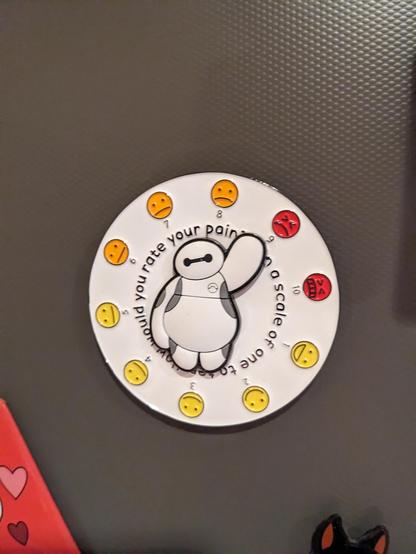
@RickiTarr Finding things to amuse myself with when I can, like this spinner magnet with Baymax that's on the refrigerator. The level of the pain can change, but it's been at almost 9 for the better part of 3 weeks now. Not continuously but for too much of the time. I've been taking 800 m of ibuprofen twice a day, and sometimes it helps, and sometimes it doesn't. It's the only thing I've got.
 Nature Punk
@RickiTarr I'm currently writing something on slow hiking that includes stuff about pain. It's not until you write about your own chronic pain you remember how disabling it is. :(
I'm trying to learn to live more slowly and listen to my body more. I know I've made my issues worse by being wilfully ignorant of my own needs and I can't emphasise enough how listening to your body is the key.
I strongly agree. Slowing down and tuning in. 🌸
 Petra
PetraFirst and foremost, pain education
Then, in different times and circumstances:
Distraction
Mindfulness - no really!
Warm baths
Resting when I need to
I have had chronic pain for nearly 25 years now
Edit to add: listening to music from before I had chronic pain helps too
 Hotter, More Cross Bunny
Weed
My beloved huge ice pack
A WEARABLE ice pack
A 3" memory foam mattress topper
Water physical therapy
 Cainmark Does Not Comply 🚲
Each person is a little different.
Where it's legal, gummies seem to work the best.
Other than that, non-aspirin like Tylenol or generic. Mobic or Ibuprofen for inflammation.
These only lessen the pain some, not remove it.
 Wendroid 🇺🇦
@RickiTarr For aching knees, joints I overlap one ibuprofen & one acetaminophen. Sounds like weak tea, but it keeps me comfortable
 DB
DB@RickiTarr Meds: Gabapentin for neuropathy, muscle relaxer, Tylenol. Heating pads, ice, magnesium oil spray. Therapeutic massage and/or PT, need to do more often, plus walking. I’ve also had surgery. Need more of that as well
 Will
Will@RickiTarr
If it doesn't generate pain while doing it, daily movement of any kind (walking, stretching, yoga, tai chi, gentle exercise). And mix up the type of movement you do, often.
If it doesn't generate pain while doing it, daily movement of any kind (walking, stretching, yoga, tai chi, gentle exercise). And mix up the type of movement you do, often.
 Idzie
Idzie@RickiTarr high THC cannabis (in the form of edibles) for migraine pain for me.
@RickiTarr stretching and exercise when pain allows also seems to help a little
 Abhijit Menon-Sen
@idzie I know cannabis helps a lot of people who suffer from chronic pain. Do you find it like taking a painkiller? Or does it help by letting you "focus away" from the pain?
@amenonsen well, for me painkillers mostly don't work so I don't find it's much like a painkiller lol. But for how it feels, I'd say a mix of both? It definitely reduces the pain levels, but then it also makes it easier to function with the remaining pain that's still there, makes it easier to ignore it.
 🕯️Curious Magpie 🕯️
@RickiTarr I use:
^ slow gentle movement - walking, stretching, qigong
^ focusing on the pain and breathing slowly, imagining I am dissolving it
^ gabapentin - though I have been decreasing the dosage (which my neurologist says is already a baby dose)
^ accepting this is part of my life and accommodating it while not clinging to it as my identity
^ slow gentle movement - walking, stretching, qigong
^ focusing on the pain and breathing slowly, imagining I am dissolving it
^ gabapentin - though I have been decreasing the dosage (which my neurologist says is already a baby dose)
^ accepting this is part of my life and accommodating it while not clinging to it as my identity
 Ari "Two Sheds" Jackson
@RickiTarr I finally got a prescription for low-dose naltrexone and that has helped with my overall fatigue and my feeling like I've been hit by a truck every morning. However, I still have chronic pain that manifest in the weirdest and most frustrating ways. I usually "manage" it through hot and cold therapy, bodywork, cleaning up my diet, and trying to get better sleep. I can't really take NSAIDs and I'm allergic to opiates. When it's really bad, sometimes I take my anti-anxiety medication which dulls the sense reactions to pain a bit. I also have a muscle relaxant prescription that knocks me out. Can't take it during the day. Some forms of CBD like CBN help; THC is not yet legal here.
 Dr Emma Kate Ward
Absolute game-changer for me was learning about "position of true rest" and making time to get as close to that as possible for even a few minutes a day. For me it's a soft seat, soft reclined back, feet up, arms supported, head supported and leaning back. I watch TV and read like this now. It helps even if imperfect but it's much better if all the cushions are exactly perfect, so learning how to tell and then adjust is hard.
Trying to really not do things that make it worse unless they're very worth it. eg I go to the office as little as possible now and I let work buy me a fancy chair, in my spare time I try and go to events where I can move around often and where the seating options are supportive, I try and carry an absolute minimum (light shoes, light coat, no bag unless it's really necessary). A metal-framed rucksack with hip straps if I really need to carry something. Stabilising myself is a big difficulty for me so if there's seating for people who need it, like on the train, I admit to myself that I need it and I ask for it. The hardest part of all this is accepting my needs and valuing my wellbeing over what I think I "should" be able to do.
Physio with someone who understands my condition and listens when I say something is too hard even if it sounds easy. Stretches and fascial release and foam rollers.
Qigong and walking and not "working out". Wiggling in ways that probably look weird.
Making sure I'm warm enough.
 Hedgewizard 🐈
@emma_cogdev @RickiTarr
Do you have a reference for what you learned about that position? Nothing jumps off the hellscraper for me
Do you have a reference for what you learned about that position? Nothing jumps off the hellscraper for me
I went to an osteopath who specialises in difficult cases and she taught me. I think the idea is that your muscles and joints are in as relaxed a position as possible, not working to stay put. It can also be referred to as a neutral position.
I struggled to find anything too but there's this very short piece
https://dorsetpain.org.uk/SiteUploads/45/Uploads/B8.2%20True%20Rest.pdf
@emma_cogdev @RickiTarr
Thanks! I reckon mine might be on a sofa covered with cats in an alcove just off a bakery
Thanks! I reckon mine might be on a sofa covered with cats in an alcove just off a bakery
 Niklas Zenit
@RickiTarr Having sincere, understanding, and loving people around you. (But who has that luxury?)
 Pomegranate_Stew
@RickiTarr
Depends on which pain it is. Some I rest and alternate ice and heat, and medicate (joint pains). Others I push through, because if I don’t, the muscles lock down even more and I have less range of motion (back/sciatica). I don’t medicate for this unless I catch it early, because it doesn’t seem to help.
Depends on which pain it is. Some I rest and alternate ice and heat, and medicate (joint pains). Others I push through, because if I don’t, the muscles lock down even more and I have less range of motion (back/sciatica). I don’t medicate for this unless I catch it early, because it doesn’t seem to help.
 Mary Holstege
Joints/back
1. Yoga/daily spin on the cycle to loosen up that old knee
2. 2gm hyluronic acid
3. Hot bath
4. The distraction of making things (yes, typing hurts my wrists, but only if I'm not lost in the flow of what I'm typing...)
 Dwight (DB) 🇨🇦
🍁
Dwight (DB) 🇨🇦
🍁@RickiTarr ⚠️ I Do Not Recommend This ⚠️
but a weird thing happened with my many debilitating chronic pain issues recently. I had a cardiac arrest event while at emergency (for chronic pain) 4 weeks ago.
As the pain of that extreme trauma continues to subside, and my nervous system re-establishes connections and functionality, I notice that my other chronic pain has not returned.
I don't know if it will last, but a system reboot of some sort may be key. ??? 🤔🤷🏼♂️
Otherwise, Distraction helps.
 Ani Keaten
@RickiTarr depends on the pain, but generally I have a variety of maintenance efforts like a coccyx cushion, physical therapy routine, daily walks, sunscreen (lupus), dietary choices. Those are just to try to keep it from max pain to more like bad pain. Then I try to go for aspercreme, compression, TENS, massage device, over the counter meds. Then prescriptions. Sadly I don't ever expect to feel below average or no pain again. So part of my coping is acceptance.
 hsarfaraz
@RickiTarr Homeopathic meds.. depends on the nature of the pain. Yogic meditation helps as well.
 Darkas Vim
@RickiTarr I don't talk about it much but I suffer from chronic joint pain (I wrecked my body working construction in my youth) The doctors are stumped but it's there. I've been taking Kratom for it. 2 capsules every 4 hours and it helps.
 Rev Nathan Ⓥ↔️🇺🇦🇨🇦🇵🇸🇬🇱
@RickiTarr @TheBreadmonkey before someone thought to say “hey, maybe your pain is the result of your spine being broken” sometimes a certain amount (not too much, not too little) of vodka would ease the pain. I know that's not very helpful, but if you drink alcohol you may want to experiment.
 Ian Turton
@RickiTarr various strengths of paracetamol, nsaid, nerve blockers and opioids. Apparently, the only other option is anaesthetic one I'm not on and he won't prescribe it for me 😔.
I'm trying to achieve a low enough pain level to be able to add light exercise but currently that's tricky most days.
 ImmedicableME
@RickiTarr Distraction. I have TV or an audiobook playing most of the time. Cannabis when the pain pushes me to tears, because it’s the fastest way to distance myself enough from the pain to survive a few more minutes. I’ve used mindfulness and guided meditation when I had more severe chronic pain. Ice, heat, topicals, muscle relaxers, CGRPs (migraine prevention medications), NSAIDs, and lots of anti-inflammatory supplements are part of my strategy as well.
 peterfisherbooks.com=freescify
@RickiTarr hash oil aka rick simpson oil aka rso about half a gram an hour straight up smeared on a fig newton before bed doesn't stop the pain but does aid sleep. embrace the entropy: realize you can easily make it worse without trying then divert your mind :)
 ytscorp
@RickiTarr
I have cervical pain and get botox injections every three months from my neuro surgeon. It has completely eliminated my pain. Botox offers an excellent savings plan for payment that makes it affordable.
I also found spinal traction to be extremely effective. Some chiropractors offer this as treatment.
I have cervical pain and get botox injections every three months from my neuro surgeon. It has completely eliminated my pain. Botox offers an excellent savings plan for payment that makes it affordable.
I also found spinal traction to be extremely effective. Some chiropractors offer this as treatment.
 Eric Lawton
A friend has been using Dilaudid for a few years and has been getting good results from ketamine for the last few months, though people at the clinic report very varied responses and there are too few clinical studies to isolate the factors that make the difference.
 qurlyjoe
@RickiTarr
50 years ago for Crohn’s disease, any sort of opiate pills I could scrounge (or outright steal) from drs. or friends, sometimes with actual prescriptions. Would be hard to pull that off today. Everybody’s down on opiates 🤷🏽. Bowel resection surgery fixed that pain & I stopped those drugs. For chronic migraines I took Benadryl, Sudafed, and ibuprofen as soon as possible when I felt one coming on. Retiring & moving to Colorado seems to have cured the migraines.
50 years ago for Crohn’s disease, any sort of opiate pills I could scrounge (or outright steal) from drs. or friends, sometimes with actual prescriptions. Would be hard to pull that off today. Everybody’s down on opiates 🤷🏽. Bowel resection surgery fixed that pain & I stopped those drugs. For chronic migraines I took Benadryl, Sudafed, and ibuprofen as soon as possible when I felt one coming on. Retiring & moving to Colorado seems to have cured the migraines.
 Matthias Rex 🦣
@RickiTarr The only medications that truly worked were the ones I got addicted to. Other than that, indomethacin is a powerful anti-inflammatory that helps if the problem involves joints.
Regular exercise endorphins help with the emotional toll and can take the edge off a bit over time.
 Giles Paterson
@RickiTarr 30 years of knee pain due to a badly formed joint meant I tried lots of different things. Distraction was one strategy that worked temporarily - rapid jiggling of my leg was a favourite.
I never had much success with pain killers or typical physio stretches.
In the end, though, it was exercise that brought me relief. I took up running 2 years ago and that has meant I've built up sufficient muscles in my legs to hold everything in place properly, so now I have virtually no pain (in my knee).
I never had much success with pain killers or typical physio stretches.
In the end, though, it was exercise that brought me relief. I took up running 2 years ago and that has meant I've built up sufficient muscles in my legs to hold everything in place properly, so now I have virtually no pain (in my knee).
 MrGrumpyMonkey
@RickiTarr Weed. And keeping those joints active. Both of which sound counter productive, but it works.
 Ann T. Phở
@RickiTarr Heat, ice, stretching, & lots of orgasms.
 Orion Ussner kidder
@DrSaucy @RickiTarr I appreciate your honestly. :)
 Tiggy
TiggyAccepting I can't do everything I wanted to do.
Strong painkillers so I can do some things.
Acceptance, finally, by doctors and diagnoses.
Having the courage, finally, to reject graded exercise, ie pushing myself a bit more each day - it's the worst thing for CFS and fibromyalgia.
Knowing I can push through if I really want to do some thing as long as I plan 'bed days' after to recover.
I still get some nurses shocked by the fact that I have prescribed opioids but my doctors are happy to prescribe them. And I'm one of the lucky ones genetically, so I dont get addicted.
 Innocent Loverboy
@RickiTarr Genuinely naproxen has helped more than anything else I've ever tried.
 Nix is Ready for Spring
@RickiTarr knowing/respecting my limits, learning better sleep habits, tylenol, and for many years, gabapentin.
 Monsieur_Lepetit
@RickiTarr
Pilates and Jim Beam
Pilates and Jim Beam
 Magnus Idode
@RickiTarr
Music 🎶 "Afrobeat"
Music 🎶 "Afrobeat"
 Jenica Lake เหล็ถเลถ
@RickiTarr acceptance that my mornings may never feel good and acceptance that medication can and does help.
A balance of rest and movement, I can't run every day, and I can't sleep every day, but going to the place that I run and sitting in meditation makes my spirit happy.
Telling other people what my pain level is and having them care helps me to not carry the mental load of chronic pain alone.
Ganja is most effective for the pain and for the anxiety that comes with a migraine attack. The anxiety is rooted in a fear that I will never get better and the pain will never stop. The reality is that the intensity of the pain changes and my ability to cope within the pain also changes. Some days are just bad and no amount of ganja will stop that--some days a visit to the hospital is the only option.
Botox and biological meds made the biggest shift in the several year long chronic migraine. At the worst of it, avoiding the triggers of sunlight and sound were the only way I survived. Just giving my nerves time to calm.
Distraction is good, would give me a few hours of enjoying something and then the pain returns full force. Sometimes distraction is avoidance for me, should be taking meds but instead end up working on a tiny painting for hours.
A balance of rest and movement, I can't run every day, and I can't sleep every day, but going to the place that I run and sitting in meditation makes my spirit happy.
Telling other people what my pain level is and having them care helps me to not carry the mental load of chronic pain alone.
Ganja is most effective for the pain and for the anxiety that comes with a migraine attack. The anxiety is rooted in a fear that I will never get better and the pain will never stop. The reality is that the intensity of the pain changes and my ability to cope within the pain also changes. Some days are just bad and no amount of ganja will stop that--some days a visit to the hospital is the only option.
Botox and biological meds made the biggest shift in the several year long chronic migraine. At the worst of it, avoiding the triggers of sunlight and sound were the only way I survived. Just giving my nerves time to calm.
Distraction is good, would give me a few hours of enjoying something and then the pain returns full force. Sometimes distraction is avoidance for me, should be taking meds but instead end up working on a tiny painting for hours.