 Fesshole 🧻
I'm a brit living in America. At my office there's no kettle, but we have a hot water dispenser. Today it's broken. When I lamented I can't make a cup of tea, a colleague suggested I microwave the water. Trump is not the only thing that makes this place a hellscape.
 Axel Gutmann
@fesshole Honest question: why not? The tea won't care how the water got hot.
 Kévin ⏚
 proedie
 FiXato
@proedie are you sure about that? https://insideenergy.org/2016/02/23/boiling-water-ieq/ seems to suggest otherwise.
Even though the 500ml used in above test is about double of a cup, I find it difficult to imagine that that volume difference would be enough to overcome the energy efficiency difference of 50% for the microwave vs the 80% efficiency of an electric teakettle.
Though being able to wait for the water to boil may be more efficient in the long term since I don't risk forgetting I have put the kettle on 😂
But perhaps switching to an induction stove with a 'traditional' kettle with a whistle may solve that by needing to turn off the source of the noise 😅
@virbonus @kc @fesshole
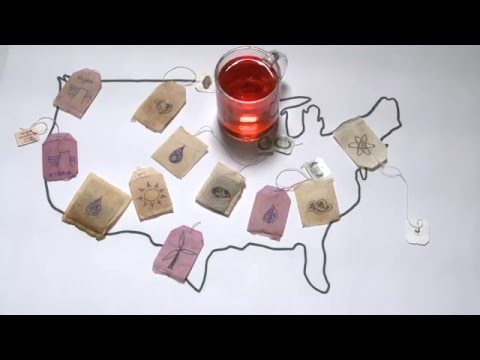
A Watched Pot: What Is The Most Energy Efficient Way To Boil Water?
What is the most energy efficient way to boil water? And which method has the smallest carbon footprint? The familiar act of boiling water lets us examine how the choices we make daily roll up to global energy consumption.
 Space Hobo
@spacehobo @virbonus @fesshole we also enjoy boiling the colour out of vegetables, we’ve all got our quirks.
In more seriousness it’s more of a whole affair, generally you can diffuse a dispute between people by angrily and silently watching the kettle boil then being more chilled out by the time the tea is at a drinkable temperature before recommencing. Generally the monster sugar thing is what we call a builders tea
 David Todd McCarty
I wondered the same. It can’t affect the taste. Is it a principle thing? I boil a kettle on a stovetop every morning for coffee I make in a French press because that’s how I like to do it, but I’d microwave a cup of water for tea in a pinch.
Also don’t really trust the hot water from the tap. Idk why.
 Cassman
 Jernej Simončič �
 Ben Aveling
 Stéphane Charette 🇨🇦
@BenAveling If boiling water drives out oxygen...that means all you have left is a cup of hydrogen?
Science class was a long time ago for me. But I think a cup of hydrogen would have some interesting side effects. Nevermind what it would do to the taste of coffee or tea!
Heating a compound so it goes from solid to liquid to gas doesn't chemically change the compound. Whether it is heated up on the stove, in a kettle, or in a microwave, hot water is hot water.
 Richard Nairn
@charette @BenAveling it is actually true. What you are removing is the dissolved free oxygen. You aren’t cracking water like hydrolysis.
 Nicovel0 🍉
@RichardNairn @charette @BenAveling you’re also removing the dissolved CO2, so if you need still water but have only sparkling heating it up turns it flat. (YMMV some sparkling waters also have high % of minerals like Perrier that alter the taste)
 The Photonsphere
 Daniel
@spacehobo @Cassman @dtm @virbonus @fesshole I coloured in the rim of my espresso maker with a green marker pen, I found it improves clarity and midrange and also is beneficial for stereo imaging. I'm also shopping for a coffee jar made of oxygen-free copper, which I've read should tone down the brashness slightly and reduce jitter
 Skjeggtroll
It really _does_ affect the taste.
I suspect it's because boiling water in the microwave takes less time and doesn't induce convection currents so that the water retains more dissolved air than when boiled in a pot or a kettle, but that's just my personal theory.
(Re-heating a cold cup of tea in the microwave is fine.)
I’ll accept the premise that you believe it tastes different regardless of whether that’s factually correct, and that’s enough.
Get an electric kettle, I say.
@skjeggtroll @dtm @fesshole Sincerely doubt that. Solubility of air in water is a direct function of temperature. Of course one should make sure the water has time to equalize the temp.
 Oliver Schafeld
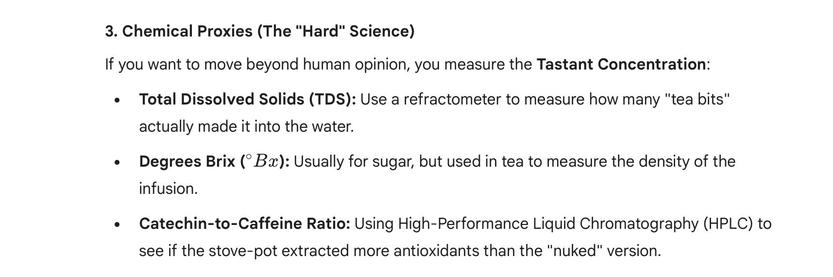
@oliver_schafeld And how do you intend to measure "gustatory quality"?
 Twotired
@virbonus @oliver_schafeld Double blind taste test.
(Personally, I’m skeptical that microwaved water tastes any different)
(Personally, I’m skeptical that microwaved water tastes any different)
 C++ Wage Slave
@skjeggtroll @virbonus @fesshole
This is the most Fediverse convo. The scientific quandary of boiling water using microwaves and the existential crisis of physics on the aesthetics of tea.
Judd Apatow tells the story of his mother when he was young. She was having financial difficulties after her divorce but still she went out and bought a Mercedes. Why, Judd asked? Why not get a Honda and have money left over?
“Because I’m not an animal,” she said.
I'd assume that lack of convection means less lost dissolved oxygen, but I'd also suspect that lack of convection means the average temperatures is sub-boiling, even when the outside layer is at least 100 degrees.
@skjeggtroll @dtm @virbonus @fesshole
@skjeggtroll @dtm @virbonus @fesshole
 Ed
Ed
 Ben Fulton
 RolloTreadway
@dtm @virbonus @fesshole I'll leave physics to everyone else, but it can affect the taste if the microwave isn't sufficiently clean.
Given it's in a workplace, well, maybe American offices have a greater devotion to keeping kitchen equipment in perfect condition - but I would never boil water in a microwave at my office, it would have subtle hints of tuna casserole and cheap lasagne.
@RolloTreadway @virbonus @fesshole
First off, anyone microwaving tuna casserole at work should be taken out back and shot.
@dtm @RolloTreadway @fesshole A female colleague once microwaved her cheese noodles (with ripe Munster!!). One could smell it all along the 20m of office hallway. (She survived)
But normally our microwave is very clean - could be because our's is a predominantly female business?
But normally our microwave is very clean - could be because our's is a predominantly female business?
@virbonus @RolloTreadway @fesshole
Many years ago I banned the use of microwave popcorn in the office because the smell is so strong.
@dtm @RolloTreadway @fesshole You sure wouldn't last a week in our office with that fine a sense of smell ...
 Mr Don a mediocre man