 Mariela
 Jae
JaePassports didn’t list sex until the 1970s when governments around the world stated freaking out about men with long hair and unisex clothes. Now we pretend like this was some always set, eminently important thing that must carry value. We only got it as enforcement of binary gender.
I think that enforcing AGAB markers on passports is conservative self soothing on the importance and necessity of binary gender. That it must intrinsically mean something. It’s a targeting vector more than anything, to inform authorities to the way the system thinks people should be treated.
 Ya Girl, Chimerelda E. Error
@me it reminds me of the people trying to bring back phrenology by suggesting that AI can analyze face photos to decide who would make a good hire
it's vitally important to them that they be able to treat the "wrong" people poorly and the "right" people well
it's baked into how they see society needing to be
 Shar(yna)Tran/Shark(aeopteryx)
@chimerror @me augh I just read (skimmed) that article and I'm pretty sure it gave me acid reflux
 AJ Sadauskas
@chimerror @me It would also be interesting to know how many of the long-haired people in unisex clothes would have described themselves as "non-binary", had the term been as well-known in the '70s as it is now.
Or how many eventually came out as trans or non-binary.
Because I very strongly doubt that number is zero.
Or how many eventually came out as trans or non-binary.
Because I very strongly doubt that number is zero.
 Droppie
@aj @chimerror @me
No no
 Juho Mäntysalo
To clarify: "unisex clothes" in those days tended to mean women wearing men's jeans instead of a skirt.
 AnneH
AnneH@annehargreaves @aj @chimerror @me
Sure.
But it's also worth noting that 1970s was the time when people started to wear tshirts as outer wear, and women started to wear pants in larger number.
I suppose there were also some counter-culture clothes, afro-americans reclaiming their heritage etc, but mostly what at times were then seen as unisex, we mean regular semiformal clothes.
That's the médian the passport people would be thinking, not someone dressed like an Indian guru.
@iju @aj @chimerror @me I don't think the passport people in UK were at all interested in clothing. They only cared if you were Mr, Mrs or Miss.
@annehargreaves @aj @chimerror @me
Apparently "you can't tell boys from girls anymore" was a real concern back in the day (though I'm speaking based on old TV shows, not on research).
And if the older people were raised to identify people based on skirts, then having it spelled out may have been helpful.
But don't know much more: would like to know more, though.
 ashley foxdragon
@chimerror @me they will see patterns in the noise wherever possible if it means they can say science justifies racism
 John Breen
@chimerror @me People who tell me to use AI are like people who would recommend Trepanation to me.

 The Little Wars
@me I dunno, I just keep coming back to "none of my trans friends could afford to use their passport, if they have it" and so I have trouble being too outraged by that.
@me realistically the venn diagram of trans people I know and people who have their name right on their passport is two different circles.
 Mees 🔻
 Light
Light@me Well. It does mean something. But I don't see why it would belong on passports. For that matter I don't see why most info would belong on passports. If you must enforce border controls just verify citizenship, visa, criminal record, etc.
Or maybe all that requires other info such as sex. Idk.
Or maybe all that requires other info such as sex. Idk.
 masukomi
 bewilderbeast23
@me Hatred and Distraction are their twin motivaters.
 Sparks
 Owen
Owen sidereal
@me Didn’t even need a passport until WWI-era anti-spying laws that never went away. Still just barely within living memory. We act like all this invasive government paperwork is a normal part of life but it’s just not.
 Andrea (Drea) Tamar Pinski
 jcriecke
 Scar
Scar 
@me passports started listing sex/gender as early in the twentieth century. It is tied to the policing of the movement of women. (See League of Nations passport conference, 1920, 1926).
What you are probably referring to is the ICAO standard from 1977, which mandates sex markers from participating countries.
 Juha Autero
@me Was the reason for not listing sex the fact that originally only men had passports because there were no independent women?
 Trammell Hudson
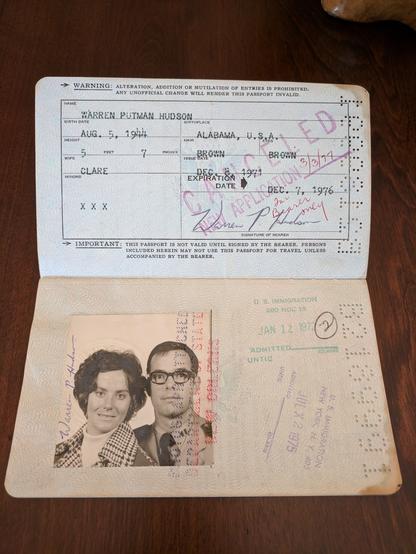
@me some passports in the 70s were implicitly gendered since they had separate fields for Name and Wife's Name
 🪨
🪨@annehargreaves @th @me "accompanied by his wife" and her maiden name, no need for a gender field then...
 Anja
Anja@me In the US. Because different countries have different dates and different reasons. F.e. in The Netherlands the "V" (F) has been there since about 1956. It was an accomplishment of the women's liberation movement. Before it was inconceivsble that a woman would travel on her own and a passport had only "M".

 Stephan Matthiesen
@me Oh, interesting. I was wondering where that sex entry came from, as I never understood why it is relevant for anything.
The German ID card doesn't show the sex entry (although it is in the resident registration database), but the passport does, presumably due to international agreements.
 r-hold
 Kevin Lyda
@me Huh. You're right. Not sure about the cause, but passports didn't have gender markers till 1977 or so.
I have all of my passports, but also all of my parents' passports. The earliest passport with a gender marker is from 1977. They also used to have 5 year expiry dates. And my mom's Irish passport from the last 50s had a field for "shape of face".
 Erin, OSHA Denialist
@me am I too autistic if i don't understand the concept of gender binary?
 Frank Hightower 🐁
@me Dang, I always thought it was because one-too many a lady with rough features got mistakenly referred to as "sir"
 Mactonex
@me my brother used to write passports back in the days when they were handwritten and still had ‘identifying marks’ on the form. Somebody once put ‘mole on left buttock’ and they had to write to him and suggest he didn’t put that on the form unless he was willing to drop his trousers in every airport he ever went through.
 James Kemp
 Angela Scholder
@me In NL the gender/sex marker in passports was introduced in the early 90's.
 Anthony Sorace
@me @me_ I had never thought about this before. I happen to have a stack of my parents old US passports, and I just went downstairs and checked. Sure enough, the ones issued as late as 1971 contain no space for a gender marker (and were the cooler, larger green format), while one’s issued in 1977 do.
The ones until 1971 have a spot for “wife” (even my mom’s), changed to wife/husband on the 1977 ones.
 whitefish
 Zenny
Zenny@me
There is nuance there as passports did have gender information on them but more in the from of title's and pronounce.
There is also was that period that women where put on the passport of their husband under "his wife"
 Tuukka R
I don't think Finnish passports had anything like "Mr." or "Ms." on them, because we've never had as strong a culture about using them as for example Sweden and England did.
 Steve Bellovin
@me I hadn't realized this, but I just checked my and my wife's 1971 US passports—yup, no gender listed. (And yes, I had long hair…) Our 1985 passports do show gender.
https://www.nytimes.com/2025/11/07/opinion/supreme-court-trump-passports-gender.html puts the date of the US change as 1976.
https://www.nytimes.com/2025/11/07/opinion/supreme-court-trump-passports-gender.html puts the date of the US change as 1976.

 The Lady (La Donna)
@me
Not having a passport until recently, when I saw this gender marking debate come up, I asked why gender is even on a passport. Photo, name, country of origin, sure, but why does gender matter?
Not having a passport until recently, when I saw this gender marking debate come up, I asked why gender is even on a passport. Photo, name, country of origin, sure, but why does gender matter?
 tomate 🍅
@me this is just not true - there were times when „Herr“ or „Frau“ were written before the name in the German Kaiserreich. Which is a sex indicator.
1800 only a man could have a passport and there was a „accompanied by his spouse“ field. These are sex indicators. 1890 Prussia wrote „Reisepass des/der“ which are sex indicators.
This has to do with German grammar, though. The German equivalent of the English word "of" unavoidably includes information about gender.
It wasn't there in order to be a gender marker. In an English translation they would have translated the "der" or "des" as "of" without thinking about somehow "having" to figure out a way to tell the person's gender.
 ericjames* 🐺‼️ (they/it)
@me today i learned 
 Kevin Karhan