TOPIC>
Space Culture Club
(Feel free to contribute, rather as a reply than using the hashtag)

"Welcome to Space's Culture Club! Make yourself comfortable and treat yourself to a good cup of tea in a pleasant atmosphere. We deal with space-related topics in terms of cultures, history, philosophy, art, literature and more in friendly company whether member or not!"

Human as Spaceship
* Space Image Credit: NASA, ESA, Hubble, and J. Maiz- Apellániz (IAA);
https://www.iaa.es/
https://www.spacetelescope.org/
https://www.esa.int/
https://www.nasa.gov/
* Acknowledgement: D. De Martin;
* Human Image Copyright: Charis Tsevis;
https://www.tsevis.com/
* Composition: R. J. Nemiroff
https://www.mtu.edu/physics/department/faculty/nemiroff/

Explanation:
You are a spaceship soaring through the universe. So is your dog. We all carry with us trillions of microorganisms as we go through life. These multitudes of bacteria, fungi, and archaea have different DNA than you. Collectively called your microbiome, your shipmates outnumber your own cells. Your crew members form communities, help digest food, engage in battles against intruders, and sometimes commute on a liquid superhighway from one end of your body to the other. Much of what your microbiome does, however, remains unknown. You are the captain, but being nice to your crew may allow you to explore more of your local cosmos.

https://apod.nasa.gov/apod/ap190818.html

#space_related #astrophotography #astroart #art #photography #science #nature #NASA #philosophy #biology #culture #literature #Space_Culture_Club

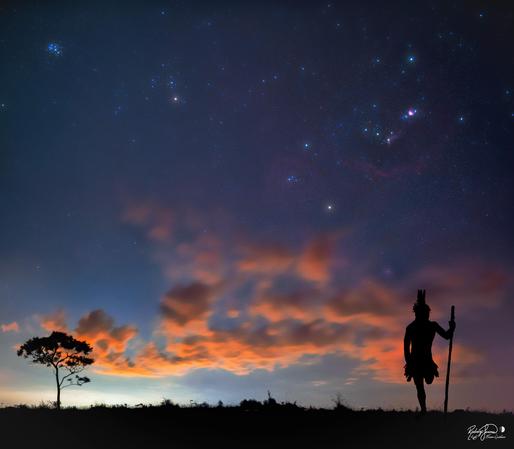
2021 January 12

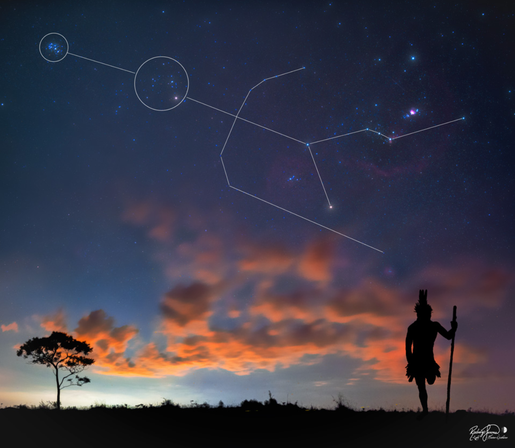
A Historic Brazilian Constellation
* Image Credit & Copyright: Rodrigo Guerra
https://www.instagram.com/rodrigoguerra13/

Explanation:
The night sky is filled with stories. Cultures throughout history have projected some of their most enduring legends onto the stars above. Generations of people see these stellar constellations, hear the associated stories, and pass them down. Featured here is the perhaps unfamiliar constellation of the Old Man, long recognized by the Tupi peoples native to regions of South America now known as Brazil. The Old Man, in more modern vernacular, may be composed of the Hyades star cluster as his head and the belt of Orion as part of one leg. Tupi folklore relates that the other leg was cut off by his unhappy wife, causing it to end at the orange star now known as Betelgeuse. The Pleiades star cluster, on the far left, can be interpreted as a head feather. In the featured image, the hobbled Old Man is mirrored by a person posing in the foreground. Folklore of the night sky is important for many reasons, including that it records cultural heritage and documents the universality of human intelligence and imagination.

+ Culture
https://www.jstor.org/stable/43392390
https://en.wikipedia.org/wiki/Tupi_people

+ Constellation
https://apod.nasa.gov/apod/ap191206.html
https://apod.nasa.gov/apod/ap161204.html
https://apod.nasa.gov/apod/ap200101.html
https://apod.nasa.gov/apod/ap190901.html

https://apod.nasa.gov/apod/ap210112.html

#space_related #astrophotography #astroart #art #photography #science #nature #NASA #philosophy #biology #culture #literature #Space_Culture_Club
2018 March 19

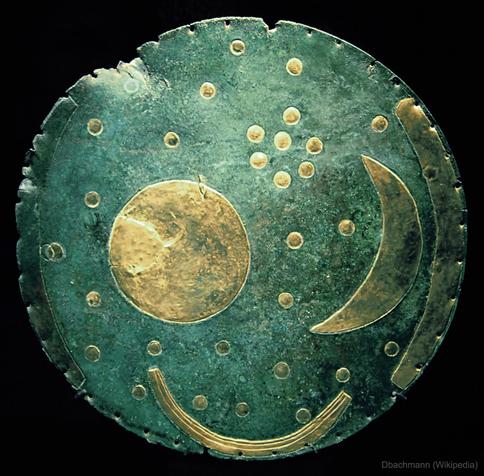
The Nebra Sky Disk
* Image Credit: Dbachmann, Wikipedia
https://en.wikipedia.org/wiki/User_talk:Dbachmann
https://commons.wikimedia.org/wiki/File:Nebra_Scheibe.jpg

Explanation:
Some consider it the oldest known illustration of the night sky. But what, exactly, does it depict, and why was it made? The Nebra sky disk was found with a metal detector in 1999 by treasure hunters near Nebra, Germany, in the midst of several bronze-age weapons. The ancient artifact spans about 30 centimeters and has been associated with the Unetice culture that inhabited part of Europe around 1600 BC. Reconstructed, the dots are thought to represent stars, with the cluster representing the Pleiades, and the large circle and the crescent representing the Sun and Moon. The purpose of the disk remains unknown -- hypotheses including an astronomical clock, a work of art, and a religious symbol. Valued at about $11 million, some believe that the Nebra sky disk is only one of a pair, with the other disk still out there waiting to be discovered.

+ #History & Culture
https://en.wikipedia.org/wiki/Nebra_sky_disc
https://www.worldhistory.org/article/235/the-nebra-sky-disk---ancient-map-of-the-stars/
https://en.wikipedia.org/wiki/Nebra_(Unstrut)
https://www.science.org/content/article/slaughter-bridge-uncovering-colossal-bronze-age-battle
https://en.wikipedia.org/wiki/%C3%9An%C4%9Btice_culture
https://en.wikipedia.org/wiki/1600s_BC_(decade)
https://en.wikipedia.org/wiki/Bronze_Age_Europe

https://apod.nasa.gov/apod/ap171107.html

+ Constellation
https://apod.nasa.gov/apod/ap171114.html
https://apod.nasa.gov/apod/ap160919.html
https://apod.nasa.gov/apod/ap180318.html

#space_related #astrophotography #astroart #art #photography #science #nature #NASA #philosophy #biology #culture #literature #Space_Culture_Club
2019 October 23

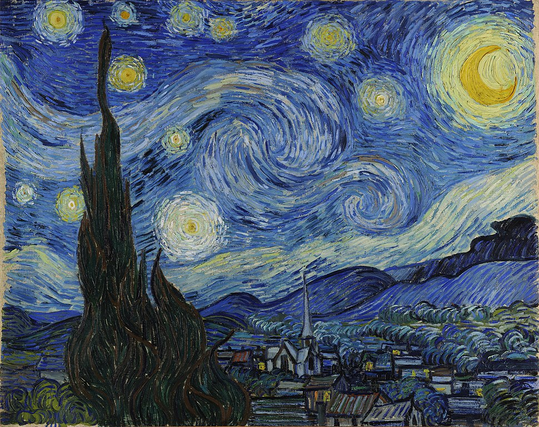
Starry Night by Vincent van Gogh
* Painting Credit: Vincent van Gogh;
https://en.wikipedia.org/wiki/Vincent_van_Gogh
* Digital Rendering: MoMA, Google Arts & Culture, via Wikipedia
https://www.moma.org/collection/works/79802

Explanation:
The painting Starry Night is one of the most famous icons of the night sky ever created. The scene was painted by Vincent van Gogh in southern France in 1889. The swirling style of Starry Night appears, to many, to make the night sky come alive. Although van Gogh frequently portrayed real settings in his paintings, art historians do not agree on precisely what stars and planets are being depicted in Starry Night. The style of Starry Night is post-impressionism, a popular painting style at the end of the nineteenth century. The original Starry Night painting hangs in the Museum of Modern Art in New York City, New York, USA. https://en.wikipedia.org/wiki/The_Starry_Night

!>> https://sketchfab.com/3d-models/the-starry-night-756b03a918544497b7a4ba644e37550b
https://www.ibiblio.org/wm/paint/auth/gogh/
https://vangoghletters.org/vg/
https://en.wikipedia.org/wiki/Starry_Night_Over_the_Rh%C3%B4ne
https://www.andreaplanet.com/mosaic/starrynight/
https://en.wikipedia.org/wiki/Post-Impressionism

https://www.moma.org/

https://apod.nasa.gov/apod/ap191023.html

#space_related #astroart #art #photography #science #nature #culture #Space_Culture_Club

2024 September 14

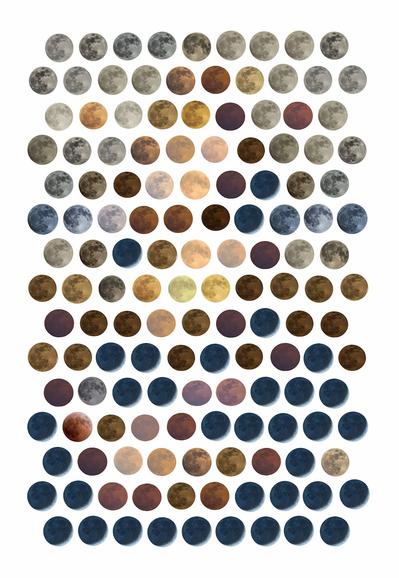
The Moona Lisa
* Image Credit & Copyright: Gianni Sarcone and Marcella Giulia Pace
https://en.wikipedia.org/wiki/Gianni_A._Sarcone

Explanation:
Only natural colors of the Moon in planet Earth's sky appear in this creative visual presentation. Arranged as pixels in a framed image, the lunar disks were photographed at different times. Their varying hues are ultimately due to reflected sunlight affected by changing atmospheric conditions and the alignment geometry of Moon, Earth, and Sun. Here, the darkest lunar disks are the colors of earthshine. A description of earthshine, in terms of sunlight reflected by Earth's oceans illuminating the Moon's dark surface, was written over 500 years ago by Leonardo da Vinci. But stand farther back from your screen or just shift your gaze to the smaller versions of the image. You might also see one of da Vinci's most famous works of art.
https://en.wikipedia.org/wiki/Gianni_A._Sarcone

https://artsandculture.google.com/asset/portrait-of-lisa-gherardini-wife-of-francesco-del-giocondo-known-as-monna-lisa-la-gioconda-or-mona-lisa-1503-1519-leonardo-di-ser-piero-da-vinci-dit-l%C3%A9onard-de-vinci-1452-1519-paris-mus%C3%A9e-du-louvre/uQGZ28lYUJ3OGw?hl=en&ms=%7B%22x%22%3A0.7%2C%22y%22%3A0.3638750021607957%2C%22z%22%3A9%2C%22size%22%3A%7B%22width%22%3A2.4024024024024024%2C%22height%22%3A0.75%7D%7D

https://svs.gsfc.nasa.gov/5187/

https://apod.nasa.gov/apod/ap240914.html

#space_related #astrophotography #astroart #art #photography #science #nature #NASA #literature #Space_Culture_Club

2021 July 10

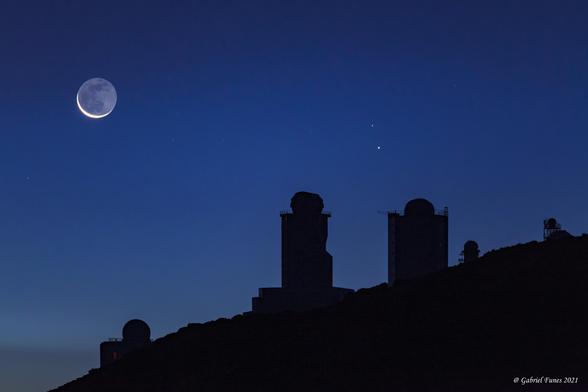
Mercury and the Da Vinci Glow
* Image Credit & Copyright: Gabriel Funes

Explanation:
On July 8th early morning risers saw Mercury near an old Moon low on the eastern horizon. On that date bright planet, faint glow of lunar night side, and sunlit crescent were captured in this predawn skyscape from Tenerife's Teide National Park in the Canary Islands. Never far from the Sun in planet Earth's sky, the fleeting inner planet shines near its brightest in the morning twilight scene. Mercury lies just below the zeta star of the constellation Taurus, Zeta Tauri, near the tip of the celestial bull's horn. Of course the Moon's ashen glow is earthshine, earthlight reflected from the Moon's night side. A description of earthshine, in terms of sunlight reflected by Earth's oceans illuminating the Moon's dark surface, was written over 500 years ago by Leonardo da Vinci. Waiting for the coming dawn in the foreground are the Teide Observatory's sentinels of the Sun, also known as (large domes left to right) the THEMIS, VTT, and GREGOR solar telescopes.
https://earthsky.org/astronomy-essentials/visible-planets-tonight-mars-jupiter-venus-saturn-mercury/
https://earthobservatory.nasa.gov/IOTD/view.php?id=83782
https://science.nasa.gov/mercury/

https://science.nasa.gov/science-news/science-at-nasa/2005/04oct_leonardo

https://www.iac.es/en/observatorios-de-canarias/teide-observatory

#space_related #astrophotography #astroart #art #photography #science #nature #NASA #biology #Space_Culture_Club

So I think that was a pretty nice start for our newly founded
Space Culture Club,
wasn't it?

But after so much but somewhat dry theory, I would suggest a short entertainment break for the next 5 minutes. Something romantic, emotional, humorous or in short "something for the heart" perhaps? Let's see...

*** Please contact our Equal Opportunities Officer Mr. Spock for complaints about gender-specific roles.

#space #space_related #kids #humor #fediverse #mastodon #entertainment #Space_Culture_Club

"Ahem, yes.. and no this is not First Mate Piggy's spacesuit and not Michael Jackson's costume for one of his most famous stage performances, even if this sculpture was called "Mooooonwalk", but read on for yourself..."

Suiting Up for the Moon
* Image Credit & Copyright: Robert Nemiroff (Michigan Tech. U.)
https://www.mtu.edu/physics/
https://www.mtu.edu/physics/department/faculty/nemiroff/

Explanation:
How will cows survive on the Moon? One of the most vexing questions asked about space, scientists have spent decades debating this key issue. Finally, after extensive computer modeling and over a dozen midnight milkings, engineers have designed, built, and now tested the new Lunar Grazing Module (LGM), a multi-purpose celestial bovine containment system. By now, many of you will not be surprised to be wished a Happy April Fool's Day from APOD. To the best of our knowledge, there are no current plans to launch cows into space. For one reason, cows tend to be large animals that don't launch easily or cheaply. As friendly as cows may be, head-to-head comparisons show that robotic rovers are usually more effective as scientific explorers. The featured image is of a thought-provoking work of art named "Mooooonwalk" which really is on display at a popular science museum.

+ Tech
https://www.ominous-valve.com/images/1954_c64.jpg
https://apod.nasa.gov/apod/ap140627.html

+ Science
https://science.nasa.gov/planetary-science/programs/mars-exploration/

+ Music
https://www.youtube.com/watch?v=lXKDu6cdXLI

+ Culture
https://en.wikipedia.org/wiki/April_Fools%27_Day

+ Nature
https://www.wikihow.com/Milk-a-Cow

https://apod.nasa.gov/apod/ap150401.html

#space_related #space #astrophotography #astroart #art #photography #science #nature #NASA #biology #culture #physics #Space_Culture_Club #tech

A sorrow shared is a sorrow halved, so they say ...

Shared joy is multiple joy, is another old wisdom ...

So we share the joy of you accompanying me to this party in the inner Mongolian steppe, where we are happy about little scattered light and some heavenly surprises, together with some joyful local astrophotographers:

"The Awe Perseid Meteors Party"

Feel free to make good whishes everytime you see one ...

Video Credit: Jeff Dai (TWAN); Music: Ibaotu catalog number 771024

https://spaceplace.nasa.gov/meteor-shower/en/
https://science.nasa.gov/solar-system/meteors-meteorites/facts/
https://apod.nasa.gov/apod/ap230809.html
https://apod.nasa.gov/apod/ap151118.html
https://www.youtube.com/watch?v=1NnMJUvU1L0
https://science.nasa.gov/solar-system/meteors-meteorites/perseids/
https://en.wikipedia.org/wiki/Geminids

#space_related #space #astrophotography #science #nature #culture #Space_Culture_Club #fun #wisdom

"Here, too, great parties have already been celebrated and this time with a very special fireworks display!"

2024 August 12

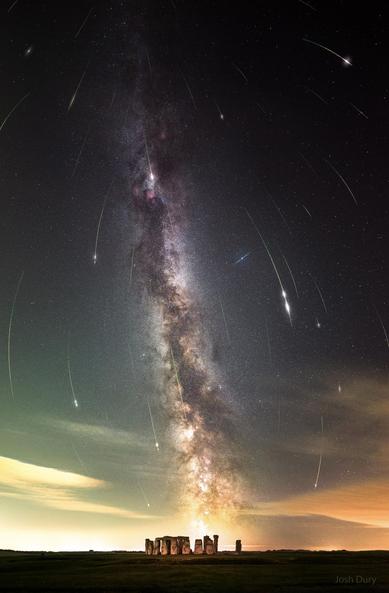
Perseid Meteors over Stonehenge
* Image Credit & Copyright: Josh Dury
https://www.instagram.com/josh_dury_photomedia/

Explanation:
What's happening in the sky above Stonehenge? A meteor shower: specifically, the Perseid meteor shower. A few nights ago, after the sky darkened, many images of meteors from this year's Perseids were captured separately and merged into a single frame. Although the meteors all traveled on straight paths, these paths appear slightly curved by the wide-angle lens of the capturing camera. The meteor streaks can all be traced back to a single point on the sky called the radiant, here just off the top of the frame in the constellation of Perseus. The same camera took a deep image of the background sky that brought up the central band of our Milky Way galaxy running nearly vertical through the image center. The featured image was taken from Wiltshire, England, being careful to include, at the bottom, the famous astronomical monument of Stonehenge. Although the Perseids peaked last night, some Perseid meteors should still be visible for a few more nights.
https://en.wikipedia.org/wiki/Perseids
https://apod.nasa.gov/apod/ap240811.html
https://en.wikipedia.org/wiki/Radiant_(meteor_shower)
https://en.wikipedia.org/wiki/Perseus_(constellation)
https://en.wikipedia.org/wiki/Stonehenge

https://apod.nasa.gov/apod/ap240812.html

#space_related #space #astrophotography #photography #science #nature #culture #Space_Culture_Club

This is the hottest party location in any case!

2013 February 26

Coronal Rain on the Sun
* Video Credit: Solar Dynamics Observatory, SVS, GSFC, NASA;
http://sdo.gsfc.nasa.gov/
https://svs.gsfc.nasa.gov/
http://www.nasa.gov/centers/goddard/home/index.html
http://www.nasa.gov/
* Music: Thunderbolt by Lars Leonhard
http://www.lars-leonhard.de/

Explanation:
Does it rain on the Sun? Yes, although what falls is not water but extremely hot plasma. An example occurred in mid-July 2012 after an eruption on the Sun that produced both a Coronal Mass Ejection and a moderate solar flare. What was more unusual, however, was what happened next. Plasma in the nearby solar corona was imaged cooling and falling back, a phenomenon known as coronal rain. Because they are electrically charged, electrons, protons, and ions in the rain were gracefully channeled along existing magnetic loops near the Sun's surface, making the scene appear as a surreal three-dimensional sourceless waterfall. The resulting surprisingly-serene spectacle is shown in ultraviolet light and highlights matter glowing at a temperature of about 50,000 Kelvin. Each second in the above time lapse video takes about 6 minutes in real time, so that the entire coronal rain sequence lasted about 10 hours.
https://en.wikipedia.org/wiki/Coronal_mass_ejection
https://apod.nasa.gov/apod/ap031029.html
https://apod.nasa.gov/apod/ap090726.html
https://en.wikipedia.org/wiki/Coronal_rain

https://apod.nasa.gov/apod/ap130226.html

#space_related #space #sun #astrophotography #Photography #science #physics #nature #Space_Culture_Club

2025 May 31

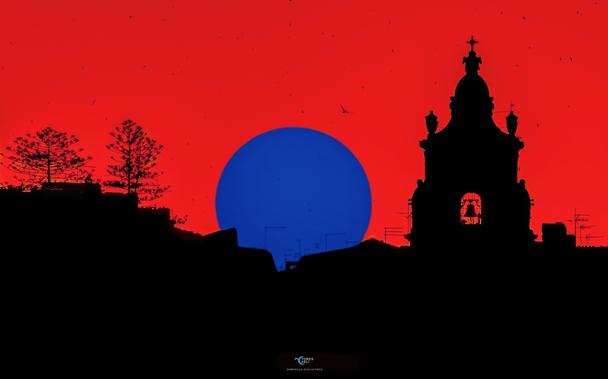
Afterimage Sunset
* Image Credit & Copyright: Marcella Giulia Pace
https://greenflash.photo/about-me/

Explanation:
On May 7, the Sun setting behind a church bell tower was captured in this filtered and manipulated digital skyscape from Ragusa, Sicily, planet Earth. In this version of the image the colors look bizarre. Still, an intriguing optical illusion known as an afterimage can help you experience the same scene with a more natural looking appearance. To try it, find the sunspots of active region AR4079 grouped near the bottom of the blue solar disk. Relax and stare at the dark sunspot group for about 30 seconds, then close your eyes or shift your gaze to a plain white surface. In a moment an afterimage of the sunset should faintly appear. But the afterimage sunset will have this image's complementary colors and a more normal yellow Sun against a familiar blue sky.
https://en.wikipedia.org/wiki/Afterimage
https://skyandtelescope.org/online-gallery/ar4079-giant-sunspot-with-eyes/
https://science.nasa.gov/sun/sunspots/

#space_related #space #sun #astrophotography #Photography #science #physics #nature #Space_Culture_Club

Electronic System is a project of the Belgian synthesizer legend Dan Lacksman.

He has performed under his own name, and in groups (most notably Telex). He was an early adopter of synth music, to the point where the first synthesizer he bought, just 3 years before the release of this song, was the first one in Belgium!

“Skylab” is a 14 minute long voyage through time and space. It’s definitely more of a lazy pleasure cruise than a hyperspace rush; you get plenty of time to appreciate the scenery.

And what scenery! The basis of the track is a sort of slow, jazzy strut, with a smooth bass part and a relaxed drum section. The dreamy electric piano lays down the primary texture for the song, which is embellished by confident Moog noodling.

The track was released in 1974 on the album Tchip.Tchip (Vol. 3), although a different version was released first in 1973 on a different version of the album called Electronic System 3, which is credited to “Dan Lacksman With Moog Synthesizer”.

Credit:
mymusic365.co.uk

#space_related #space #music #jazz #moog #skylab #grobi_muzak #Space_Culture_Club

Apollo 18 Mission:
Pride Flag Hoisting on the Lunar Surface
* Music Credit:
REM - UMan On The Moon

Explanation:
The Apollo 18 mission, which was originally planned but never executed by NASA, became a symbol of unity and inclusivity when a group of enthusiasts from the LGBTQ+ community and space aficionados covertly sent a spacecraft to the moon, culminating in the historic hoisting of a Pride flag on its surface. This unprecedented event was a testament to the human spirit and the universal reach of the Pride movement.

The Apollo 18 mission was conceived as a tribute to the 50th anniversary of the Apollo 11 moon landing, which marked the first time humans set foot on the lunar surface. While NASA had long ago abandoned the idea of sending another manned mission to the moon under the Apollo program, the dream was not lost on a group of individuals who believed in the power of symbolism and representation.
The decision to plant the Pride flag on the moon was a poignant gesture. The flag, a symbol of the LGBTQ+ community's struggle for equality and visibility, now stands as a beacon on a celestial body that has historically been a symbol of human ambition and exploration. It serves as a reminder that space belongs to everyone, regardless of their gender identity, sexual orientation, or nationality.
While the Apollo 18 mission was not an official NASA endeavor, it adhered to strict safety protocols and international space laws.
The hoisting of the Pride flag on the moon is a monumental event in the history of space exploration. It not only showcases humanity's technological achievements but also exemplifies the universal quest for equality and representation. As we continue to reach for the stars, this small yet significant gesture serves as a powerful reminder that the spirit of Pride is not bound by gravity, extending far beyond our planet into the cosmos

#space_related #moon #photography #music #NASA #fediverse #mastodon #nature #Space_Culture_Club #grobi_muzak

And now to something completely mist irious:

2019 June 24

Anticrepuscular Rays Converge Opposite the Sun
* Image Credit & Copyright: Juraj Patekar
https://apod.nasa.gov/apod/ap190624.html

Explanation:
Is there ever anything interesting to see in the direction opposite the Sun? Sometimes there is. Notable items include your own shadow, a shadow of the Moon during a total solar eclipse, a full moon -- in eclipse if the alignment's good enough, a full earth, planets at opposition, glints from planets, the gegenschein from interplanetary dust, the center of a rainbow, hall-of-mountain fogbows, an airplane glory, and something yet again different if your timing, clouds and Sun position are just right. This different effect starts with clouds near the Sun that are causing common crepuscular rays to stream through. In the featured rare image taken from an airplane in mid-April, these beams were caught converging 180 degrees around, on the opposite side of the sky from the Sun, where they are called anticrepuscular rays. Therefore, it may look like something bright is shining at the antisolar point near the image center, but actually it is reverse-shining because, from your direction, light is streaming in, not out.

https://apod.nasa.gov/apod/ap190624.html

#space_related #space #sun #astrophotography #Photography #science #physics #nature #Space_Culture_Club

2014 August 23

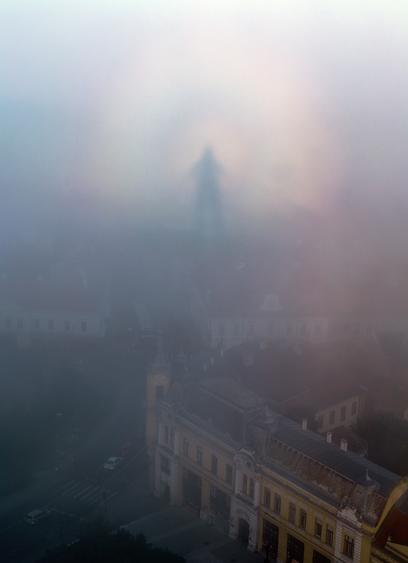
The Spectre of Veszprem
* Image Credit & Copyright: Tamas Ladanyi (TWAN)
https://www.asztrotajkep.hu/

Explanation:
The city of Veszprem, Hungary was only briefly haunted by this mysterious spectre. On the morning of August 11, its monstrous form hovered in the mist above municipal buildings near the town center. A clue to its true identity is offered by the photographer, though, who reports he took the picture from the top of a twenty story building with the rising Sun directly at his back. That special geometry suggests this is an example of an atmospheric phenomenon called the Glory or sometimes "the Spectre of the Brocken". Also seen from mountain tops and airplanes when looking opposite the Sun, the dramatic apparition is the observer's shadow on clouds or fog, the small droplets of water scattering light back towards the Sun through complex internal reflections. Careful night sky watchers can also encounter this spectre's analog in astronomy, a brightening of zodiacal light opposite the Sun known as the gegenschein.

https://apod.nasa.gov/apod/ap140823.html

#space_related #space #mist #astrophotography #Photography #science #physics #nature #Space_Culture_Club

Partager la « Nuit de la Vue Magnifique » avec la chèvre

2018 August 7

Eclipsed Moon and Mars over Mountains
* Image Credit & Copyright: Clèment Brustel

Explanation:
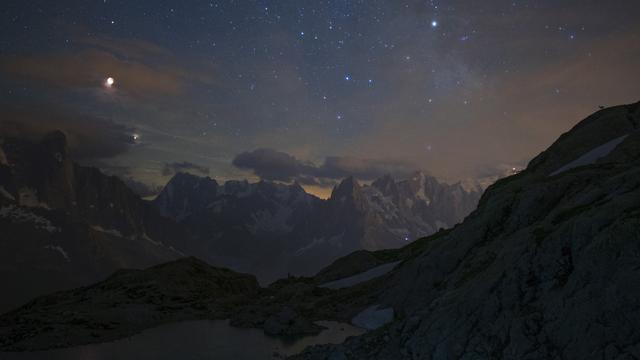
There is something unusual about this astronomically-oriented photograph. It's not obvious -- it was discovered only during post-processing. It is not the Moon, although capturing the Moon rising during a total lunar eclipse is quite an unusually interesting sight. It is not Mars, found to the lower right of the Moon, although Mars being captured near its brightest also makes for an unusually interesting sight. It is not the foreground mountains, although the French Alps do provide unusually spectacular perspectives on planet Earth.
It is the goat.

#space_related #space #moon #mars #mountain #astrophotography #Photography #nature #Space_Culture_Club

2013 September 28

Equinox Earth
* Image Credit: Roscosmos / NTSOMZ / zelenyikot.livejournal.com
https://zelenyikot.livejournal.com/17213.html
* Courtesy: Igor Tirsky, Vitaliy Egorov

Explanation:
From a geostationary orbit 36,000 kilometers above the equator, Russian meteorological satellite Elektro-L takes high-resolution images of our fair planet every 30 minutes. But only twice a year, during an Equinox, can it capture an image like this one, showing an entire hemisphere bathed in sunlight. At an Equinox, the Earth's axis of rotation is not tilted toward or away from the Sun, so the solar illumination can extend to both the planet's poles. Of course, this Elektro-L picture was recorded on September 22nd, at the northern hemisphere's autumnal equinox. For a moment on that date, the Sun was behind the geostationary satellite and a telltale glint of reflected sunlight is seen crossing the equator, at the location on the planet with satellite and sun directly overhead

https://apod.nasa.gov/apod/ap130928.html

#space_related #space #earth #equinox #astrophotography #Photography #science #nature #Space_Culture_Club

2014 January 14

The Gegenschein Over Chile
* Image Credit & Copyright: Yuri Beletsky (Las Campanas Observatory, Carnegie Institution)

Explanation:
Is the night sky darkest in the direction opposite the Sun? No. In fact, a rarely discernable faint glow known as the gegenschein (German for "counter glow") can be seen 180 degrees around from the Sun in an extremely dark sky. The gegenschein is sunlight back-scattered off small interplanetary dust particles. These dust particles are millimeter sized splinters from asteroids and orbit in the ecliptic plane of the planets. Pictured above from last year is one of the more spectacular pictures of the gegenschein yet taken. Here a deep exposure of an extremely dark sky over Las Campanas Observatory in Chile shows the gegenschein so clearly that even a surrounding glow is visible. Notable background objects include the Andromeda galaxy, the Pleiades star cluster, the California Nebula, the belt of Orion just below the Orion Nebula and inside Barnard's Loop, and bright stars Rigel and Betelgeuse. The gegenschein is distinguished from zodiacal light near the Sun by the high angle of reflection. During the day, a phenomenon similar to the gegenschein called the glory can be seen in reflecting air or clouds opposite the Sun from an airplane.

https://apod.nasa.gov/apod/ap140114.html

#space_related #space #gegenschein #astrophotography #Photography #mountains #science #physics #nature #Space_Culture_Club

"The last and only time I saw a full circle rainbow was at an exhibition by Olafur Eliasson at the ARoS Museum Aarhus in Denmark. And in a completely unspectacular room with a black floor, walls and ceiling, to which a curved black garden hose peppered with fine holes was attached, from which a mist floated downwards. On two opposite walls hung a construction lamp, which shone light on the fog in the middle of the room at a 45° angle downwards. I walked through the fog with my eyes open and saw a complete rainbow ring that closed from the outside in, opened again and then disappeared."
https://olafureliasson.net/
https://www.aros.dk/en

2014 September 30

A Full Circle Rainbow over Australia
* Image Credit & Copyright: Colin Leonhardt (Birdseye View Photography)
https://www.birdseyeviewphotography.com.au/contact.shtml

Explanation:
Have you ever seen an entire rainbow? From the ground, typically, only the top portion of a rainbow is visible because directions toward the ground have fewer raindrops. From the air, though, the entire 360 degree circle of a rainbow is more commonly visible. Pictured here, a full circle rainbow was captured over Cottesloe Beach near Perth, Australia last year by a helicopter flying between a setting sun and a downpour. An observer-dependent phenomenon primarily caused by the internal reflection of sunlight by raindrops, the 84-degree diameter rainbow followed the helicopter, intact, for about 5 kilometers. As a bonus, a second rainbow that was more faint and color-reversed was visible outside the first.

https://apod.nasa.gov/apod/ap140930.html

#space_related #space #rainbow #astrophotography #Photography #science #nature #Space_Culture_Club

"Now it's time for me and I wish you a pleasant night and endless beautiful dreams. Thanks for the nice chat in between. Stay hopeful."

2025 March 30
A Partial Solar Eclipse over Iceland
* Image Credit & Copyright: Wioleta Gorecka
https://www.instagram.com/wiola.gorecka/

Explanation:
What if the Sun and Moon rose together? That happened yesterday over some northern parts of planet Earth as a partial solar eclipse occurred shortly after sunrise. Regions that experienced the Moon blocking part of the Sun included northeastern parts of North America and northwestern parts of Europe, Asia, and Africa. The featured image was captured yesterday over the Grábrók volcanic crater in Iceland where much of the Sun became momentarily hidden behind the Moon. The image was taken through a cloudy sky but so well planned that the photographer's friend appeared to be pulling the Sun out from behind the Moon. No part of the Earth experienced a total solar eclipse this time. In the distant past, some of humanity was so surprised when an eclipse occurred that ongoing battles suddenly stopped. Today, eclipses are not a surprise and are predicted with an accuracy of seconds.
https://science.nasa.gov/eclipses/future-eclipses/mar-29-2025-eclipse/
https://science.nasa.gov/eclipses/types/
https://en.wikipedia.org/wiki/Eclipse_of_Thales
https://apod.nasa.gov/apod/ap240310.html
https://www.timeanddate.com/eclipse/accuracy.html
https://en.wikipedia.org/wiki/Iceland
https://www.youtube.com/watch?v=ZxIPyR6-bko

https://science.nasa.gov/earth/facts/
https://apod.nasa.gov/apod/ap250330.html

#space #earth #sun #moon #eclipse #astrophotography #photography #science #nature #iceland #NASA

2004 August 6

The Giant and the Glory
* Credit & Copyright: Franz Kerschbaum (Univ. Vienna)

Explanation:
On a flight from Vienna to Brussels, astronomer Franz Kerschbaum looked out the window and photographed this beautiful atmospheric phenomenon, the glory, shining in the direction directly opposite the Sun. Before airplanes, the glory, known to some as the heiligenschein or the Specter of the Brocken, was occasionally seen from mountaintops. There, when conditions were right, one could look away from the Sun and see what appeared to be the shadow of a giant surrounded by a bright halo. Of course, the giant turns out to be the observer, and in the modern version a silhouette of a plane frequently occupies the glory's center. The cause of the glory is relatively complex. Briefly, small droplets of water reflect, refract, and diffract sunlight backwards towards the Sun. The phenomenon has a counterpart in astronomy, where looking out from planet Earth in the direction opposite the Sun yields a bright spot called the gegenschein.

https://apod.nasa.gov/apod/ap040806.html

#space_related #space #rainbow #astrophotography #Photography #science #physics #nature #Space_Culture_Club

2012 March 31

Paris by Night
* Image Credit & Copyright: Serge Brunier (TWAN)

Explanation:
Do you recognize the lights of Paris in this picture? In the cityscape taken on March 25 from the top of the 210 meter tall Montparnasse skyscraper, many will spot the looming Eiffel Tower, or the large domed structure of Les Invalides (right), or the colorfully lit elevated Metro train line gently curving toward picture center. You can even pick out the Arc de Triomphe close to the horizon on the right. But regardless of your location, the celestial lights near the western horizon should look very familiar. The lovely triple conjuntion of brilliant Venus (top), Jupiter, and a young crescent Moon was visible in evening skies around planet Earth.

https://apod.nasa.gov/apod/ap120331.html

#space_related #space #earth #paris #astrophotography #photography #nature #science #Space_Culture_Club

2009 October 23

A Galilean Night
* Credit & Copyright: Jens Hackmann

Explanation:
Driving along on a summer evening, near the small town of Weikersheim in southern Germany, photographer Jens Hackmann had to stop. He couldn't resist pointing his camera and telephoto lens at this lovely conjunction of a Full Moon and planet Jupiter looming near the steeple of a local church. Of course, 400 years ago, Galileo couldn't resist pointing his newly constructed telescope at these celestial beacons either. When he did, he found craters and mountains on the not-so-smooth lunar surface and discovered the large moons of Jupiter now known as the Galilean Moons. Jupiter's Galilean moons are just visible in this photo as tiny pinpricks of light very near the bright planet.

https://apod.nasa.gov/apod/ap091023.html

#space_related #space #moon #astrophotography #Photography #science #nature #Space_Culture_Club

2000 November 18

Jupiter And Family
* Credit & Copyright: Galileo Project, Voyager Project, JPL, NASA
https://www.jpl.nasa.gov/search/?query=Galileo

Explanation:
This composite image features classic portraits of members of one of the Solar System's most prominent families - Jupiter and its four large "Galilean" moons. Starting from the top the moons are Io, Europa, Ganymede, and Callisto. The top-to-bottom order is also the order of increasing distance from Jupiter. These are big moons indeed which attend the largest planet. The smallest of the lot, Europa, is the size of Earth's moon while Ganymede is the largest moon in the Solar System. In fact, Ganymede with a diameter of 3,100 miles, is larger than the planets Mercury and Pluto. The swirling Great Red Spot appears at the edge of Jupiter. A hurricane-like storm system that has persisted for over 300 years, two to three earths could fit inside it. Battered Callisto's image was recorded during the 1979 flyby of Voyager. The other portraits were taken by the Galileo spacecraft which began exploring the Jovian system in 1995.

https://apod.nasa.gov/apod/ap001118.html

#space_related #space #galileo #astrophotography #Photography #science #nature #Space_Culture_Club

2011 November 25

A Glimpse of CLIMSO
* Image Credit & Copyright: Alain Sallez (picdumidi.org)

Explanation:
A tantalizing glimpse inside this dome was captured after sunset at the mountain top Pic Du Midi Observatory in the French Pyrenees. But while most are just beginning their work at sunset, this observatory's day was done. The instrument looming within is CLIMSO (for Christian Latouche IMageur Solaire), dedicated to exploring dynamic phenomena across the surface and atmosphere of the Sun. To image the solar atmosphere or corona, CLIMSO uses coronagraphs. Developed by French astronomer Bernard Lyot in the 1930s, coronagraphs block light from the center of the telescope beam to create an artificial solar eclipse and allow a continuous view of the solar corona. In this surreal twilight scene above a sea of clouds, the dome's interior was revealed by the single, long exposure as the open slit rotated across the field of view. https://eclipse.gsfc.nasa.gov/OH/OH2011.html#SE2011Nov25P
https://www.swsc-journal.org/articles/swsc/pdf/2020/01/swsc200034.pdf
https://www.aanda.org/articles/aa/pdf/2019/11/aa32504-17.pdf

https://apod.nasa.gov/apod/ap111125.html

#space_related #space #observatory #astrophotography #Photography #science #nature #Space_Culture_Club

Music is a fantastic code and a holistic language and since about the age of twelve I have been thinking from time to time about what music I would send into the universe if i ever could and then at some point it occurred:
It is not the case that I decide to think about sending a certain music into the universe so that another being hears the same as me .. no, it's the music that speaks for itself and tells me "Send me out into infinity, I'm just as needed there as I am here"

And how much I would like to accompany her ..

This is one of my favourite tracks ever.

Music Credit:
Jah Wobble
5th track of the album "Heaven And Earth", 1995.
Bill Laswell / Pharoah Sanders / Nicky Skopelitis / Jah Wobble

Jah Wobble has created a marvelous brilliant pan-cultural concept album using classical influences and colours from all around the world with elements of chilling tunes, ambient, dub, and hip-hop in the whole album.

Also, Bill Laswell lends his distinctive touch on this song, with Pharoah Sanders' mind-bending flute and horn solos and Bernie Worrell's synth textures.

A full scene of emotions and sensations.
Gone to Croatan track is a sublime mix of deep colours on an infinite canvas.

https://en.wikipedia.org/wiki/Croatan

#space_related #voyager #Space_Culture_Club #music #jazz #art #photography #grobi_muzak

2025 June 20

Major Lunar Standstill 2024-2025
* Image Credit & Copyright: Luca Vanzella, Alister Ling
https://www.flickr.com/people/53851348@N05/
https://www.flickr.com/people/99775232@N07/

Explanation:
Edmonton, Alberta, Canada, planet Earth lies on the horizon. in this stack of panoramic composite images. In a monthly time series arranged vertically top to bottom the ambitious photographic project follows the annual north-south swing of sunrise points, from June solstice to December solstice and back again. It also follows the corresponding, but definitely harder to track, Full Moon rise. Of course, the north-south swing of moonrise runs opposite sunrise along the horizon. But these rising Full Moons also span a wider range on the horizon than the sunrises. That's because the well-planned project (as shown in this video !>>) covers the period June 2024 to June 2025, centered on a major lunar standstill. Major lunar standstills represent extremes in the north-south range of moonrise driven by the 18.6 year precession period of the lunar orbit.
https://en.wikipedia.org/wiki/Lunar_standstill
https://griffithobservatory.org/extreme-moon-the-major-lunar-standstills-of-2024-2025/

https://earthsky.org/tonight/june-full-moon/
!>> https://www.youtube.com/watch?v=u1tkLRdaFNk
https://earthsky.org/astronomy-essentials/everything-you-need-to-know-june-solstice/
https://apod.nasa.gov/apod/ap160922.html

https://apod.nasa.gov/apod/ap160922.html

#space #space_related #earth #moon #sun #astronomy #astrophotography #photography #science #nature #Space_Culture_Club

The Major Lunar Standstill - a real, visual representation
by
Luca Vanzella: https://vanzella.com/luca-vanzellas-astronomy-page/
Alister Ling: https://www.astronomy.com/author/alister-ling/
This video shows thirteen moonrise and thirteen sunrise images from June 2024 to June 2025, to visually depict the change in moonrise/sunrise position over a year and to illustrate that the greatest northern and southern positions of the Moon extend beyond those of the Sun during a Major Lunar Standstill (https://griffithobservatory.org/extre....

Short Story

Celebrating the northeastern and southeastern extremes of sunrise points (solstices) are familiar experiences to all casual skywatchers but the moonrise extremes (lunistices) mostly go unnoticed except to attentive observers. As the Moon’s orbit slowly regresses in an 18.6 year cycle, the span of moonrise points varies between two extremes: the minor and major lunar standstills. In a major lunar standstill, the extreme moonrise points are several degrees farther north and south than the sunrise ones. Inspired by an earlier project ( • A Year of Sunrises ) of creating a time slice of sunrises, we wanted to capture these events photographically in a manner both educationally and visually compelling.

Technically the Major Lunar Standstill is a point in time on the dates of the extreme north and south lunar declinations, both occurring in March 2025, but similar to solstices, it is best appreciated in the context of a period of observation. Any consistent phase would reveal the pattern, but a full Moon is the most eye-catching and stands out best in very wide images.

The period from the June 2024 solstice to thttps://defcon.social/keyboard-shortcutshe June 2025 solstice nicely surrounds the standstill, so we shot thirteen full moonrises and thirteen sunrises to represent the Major Lunar Standstill with a vertical time slice composite image and this video.

#space #space_related #earth #moon #sun #astronomy #astrophotography #photography #science #nature #Space_Culture_Club

June solstice in 2025: All you need to know
By Editors of EarthSky
June 15, 2025

A solstice lasts only a moment, when the sun is at its farthest north in our sky for an entire year. In 2025, the solstice moment will fall at 2:42 UTC on June 21. That’s 9:42 p.m. on June 20 for us in central North America. Yet many will celebrate this solstice for a whole day. What makes this day so special? And what is a solstice? Join EarthSky’s Deborah Byrd with a preview of the June solstice 2025. Watch in the player below.

https://earthsky.org/astronomy-essentials/everything-you-need-to-know-june-solstice/

#space_related #space #earth #sun #solstice #astronomy #science #nature #Space_Culture_Club

2025 July 1
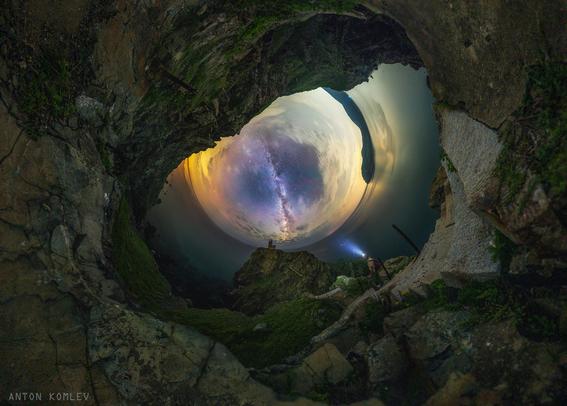
A fisheye image of the sky is shown on the left with the landscape-foreground surrounding it. The plane of our Milky Way Galaxy runs down the center. At first glance the sky looks like oddly like an eye of a dragon.

Eye Sky a Dragon
* Image Credit & Copyright: Anton Komlev
https://www.instagram.com/komlev.av/

Explanation:
What do you see when you look into this sky? In the center, in the dark, do you see a night sky filled with stars? Do you see a sunset to the left? Clouds all around? Do you see the central band of our Milky Way Galaxy running down the middle? Do you see the ruins of an abandoned outpost on a hill? (The outpost is on Askold Island, Russia.) Do you see a photographer with a headlamp contemplating surreal surroundings? (The featured image is a panorama of 38 images taken last month and compiled into a Little Planet projection.) Do you see a rugged path lined with steps? Or do you see the eye of a dragon?
https://www.instagram.com/p/B1r5mYWIi9k/

Location:
https://www.youtube.com/watch?v=MBRMXR8y9Nc
https://www.rbth.com/arts/travel/2013/09/27/islands_of_riches_off_vladivostok_29725
https://en.wikipedia.org/wiki/Russia

DIY:
https://www.photographymad.com/pages/view/little-planet-photos-5-simple-steps-to-making-panorama-worlds

For Your Desktop:
https://getwallpapers.com/collection/dragon-eye-wallpaper

https://apod.nasa.gov/apod/ap250701.html

#space_related #milkyway #astrophotography #astroart #photography #science #astronomy #nature #NASA #Space_Culture_Club

"Welcome back to the
Space Culture Club
(Feel free to contribute, rather as a reply than using the hashtag)
https://defcon.social/@grobi/114663418339078163 "

2023 September 17

Moon Mountains Magnified during Ring of Fire Eclipse
* Credit & Copyright: Wang Letian (Eyes at Night)
http://www.luckwlt.com/About%20Me.html

Explanation:
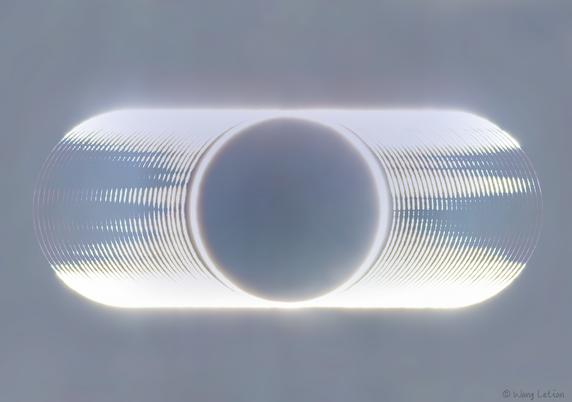
What are those dark streaks in this composite image of a solar eclipse? They are reversed shadows of mountains at the edge of the Moon. The center image, captured from Xiamen, China, has the Moon's center directly in front of the Sun's center. The Moon, though, was too far from the Earth to completely block the entire Sun. Light that streamed around the edges of the Moon is called a ring of fire. Images at each end of the sequence show sunlight that streamed through lunar valleys. As the Moon moved further in front of the Sun, left to right, only the higher peaks on the Moon's perimeter could block sunlight. Therefore, thehttps://defcon.social/@grobi/114663418339078163 dark streaks are projected, distorted, reversed, and magnified shadows of mountains at the Moon's edge. Bright areas are called Baily's Beads. Only people in a narrow swath across Earth's Eastern Hemisphere were able to view this full annular solar eclipse in 2020. Next month, though, a narrow swath crossing both North and South America will be exposed to the next annular solar eclipse. And next April, a total solar eclipse will be visible across North America.

https://apod.nasa.gov/apod/ap230917.html

#space_related #earth #sun #moon #eclipse #astrophotography #astroart #art #photography #science #nature #NASA #Space_Culture_Club

2020 June 15

A Ring of Fire Sunrise Solar Eclipse
* Video Credit: Colin Legg & Geoff Sims
https://www.facebook.com/ColinLeggPhotography
https://www.facebook.com/BeyondBeneath
* Music: Peter Nanasi
https://www.peternanasi.com/about

Explanation:
What's rising above the horizon behind those clouds? It's the Sun. Most sunrises don't look like this, though, because most sunrises don't include the Moon. In the early morning of 2013 May 10, however, from Western Australia, the Moon was between the Earth and the rising Sun. At times, it would be hard for the uninformed to understand what was happening. In an annular eclipse, the Moon is too far from the Earth to block the entire Sun, and at most leaves a ring of fire where sunlight pours out around every edge of the Moon. The featured time-lapse video also recorded the eclipse through the high refraction of the Earth's atmosphere just above the horizon, making the unusual rising Sun and Moon appear also flattened. As the video continues on, the Sun continues to rise, and the Sun and Moon begin to separate. This weekend, a new annular solar eclipse will occur, visible from central Africa, the Arabian Peninsula, and a narrow band across Asia, with much of Earth's Eastern hemisphere being able to see a partial solar eclipse.

https://apod.nasa.gov/apod/ap200615.html

** Note by grobi:
"To upload this video, I converted it and compressed it to a smaller file-size under #linux with the free software ffmpeg and the corresponding command:

'ffmpeg -i video_in.mkv -vcodec libx265 -crf 28 video_out.mp4'

Maybe you would like to post a corresponding video on a scientifically related topic, but it is perhaps too big? Then try ffmpeg."

#space_related #earth #sun #moon #eclipse #astrophotography #astroart #art #photography #science #nature #NASA #Space_Culture_Club

Eclipses in mythology and culture

from Contributors to Wikimedia projects

Eclipses of the Sun and of the Moon have been described by nearly every culture. In cultures without an astronomical explanation, eclipses were often attributed to supernatural causes or regarded as bad omens.
---
Religious and cultural practices

While solar and lunar eclipses are today understood astronomically as one celestial body shadowing another, their appearance from Earth does not intuitively belie a similar cause for each.
Mark Littmann, Fred Espenak, and Ken Willcox classified solar eclipse mythologies into four distinct genres:

+ A celestial being (usually a monster) attempts to destroy the Sun.
+ The Sun fights with its lover the Moon.
+ The Sun and Moon make love and discreetly hide themselves in darkness.
+ The Sun god grows angry, sad, sick, or neglectful.
---
Abrahamic religions

In the Talmud, solar eclipses are described as ill omens and several events in the Hebrew Bible are said to have occurred during eclipses. Judaism at large has been accepting of the modern astronomical explanation of eclipses and today many rabbis consider eclipses to be reminders of divinity and a time for prayer and introspection.
___
The periodicity of lunar eclipses been deduced by Neo-Babylonian astronomers in the sixth century BCE and the periodicity of solar eclipses was deduced in first century BCE by Greek astronomers, who developed the Antikythera mechanism and had understood the Sun, Moon, and Earth to be spherical celestial bodies since Aristotle. The astronomical understanding of eclipses was thus well understood in the Ancient Near East in which Christianity developed.
___
The New Testament describes the sky as darkening for hours during the crucifixion of Jesus. As the event's lengthy duration and occurrence on the day of a ...
Read more
https://en.wikipedia.org/wiki/Eclipses_in_mythology_and_culture#

#space_related #astroart #art #photography #science #nature #philosophy #culture #literature #Space_Culture_Club
2020 April 5

Color the Universe! 🎨
* Image Credit: Unknown

Explanation:
Wouldn't it be fun to color in the universe? If you think so, please accept this famous astronomical illustration as a preliminary substitute. You, your friends, your parents or children, can print it out or even color it digitally. While coloring, you might be interested to know that even though this illustration has appeared in numerous places over the past 100 years, the actual artist remains unknown. Furthermore, the work has no accepted name -- can you think of a good one? The illustration, first appearing in a book by Camille Flammarion in 1888, is used frequently to show that humanity's present concepts are susceptible to being supplanted by greater truths.
https://en.wikipedia.org/wiki/Flammarion_engraving
https://www.historyofinformation.com/detail.php?id=3329
https://www.youtube.com/watch?v=6zp60ODhbb4
https://gallica.bnf.fr/ark:/12148/bpt6k408619m/f4.image
https://books.google.com/books?id=ScDVAAAAMAAJ&pg=PA163
https://en.wikipedia.org/wiki/Camille_Flammarion
https://apod.nasa.gov/apod/ap010101.html

https://www.thecolor.com/Category/Coloring/Planets.aspx
https://www.huffpost.com/entry/coloring-for-stress_n_5975832

For Your Contribution:
http://asterisk.apod.com/discuss_apod.php?date=200405

https://apod.nasa.gov/apod/ap200405.html

#Space_Culture_Club #space_related #astroart #art #photography #science #nature #philosophy #culture #literature

@futurebird

"Thank you for accompanying me through space and time!
We are 100 now .. ok with me 101 that's worth a little celebration, isn't it? "

Comet Between Fireworks and Lightning
* Image Credit & Copyright: Antti Kemppainen

Explanation:
Sometimes the sky itself is the best show in town. In January 2007, people from Perth, Australia gathered on a local beach to watch a sky light up with delights near and far. Nearby, fireworks exploded as part of Australia Day celebrations. On the far right, lightning from a thunderstorm flashed in the distance. Near the image center, though, seen through clouds, was the most unusual sight of all: Comet McNaught. The photogenic comet was so bright that it even remained visible though the din of Earthly flashes. Comet McNaught has now returned to the outer Solar System and is now only visible with a large telescope. The featured image is actually a three photograph panorama digitally processed to reduce red reflections from the exploding firework.

https://apod.nasa.gov/apod/ap131110.html

#Space_Culture_Club #space_related #astroart #art #photography #science #nature #philosophy #culture #literature

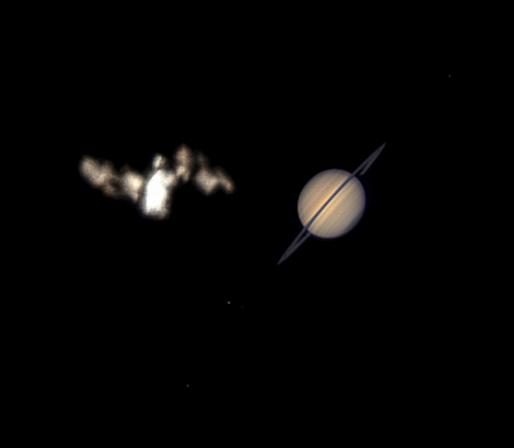
2025 July 18

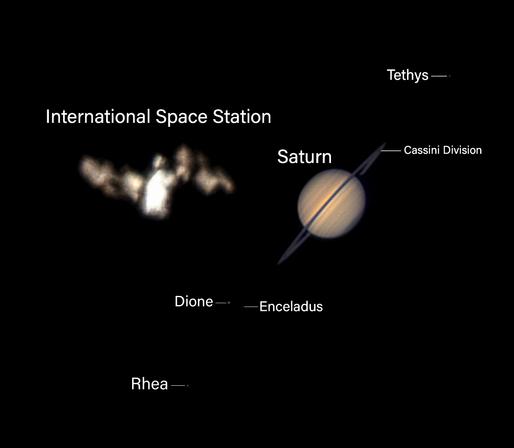
ISS Meets Saturn
* Image Credit & Copyright: A.J. Smadi
https://www.instagram.com/aj.smadi/

Explanation:
This month, bright planet Saturn rises in evening skies, its rings oriented nearly edge-on when viewed from planet Earth. And in the early morning hours on July 6, it posed very briefly with the International Space Station when viewed from a location in Federal Way, Washington, USA. This well-planned image, a stack of video frames, captures their momentary conjunction in the same telescopic field of view. With the ISS in low Earth orbit, space station and gas giant planet were separated by almost 1.4 billion kilometers. Their apparent sizes are comparable but the ISS was much brighter than Saturn and the ringed planet's brightness has been increased for visibility in the stacked image. Precise timing and an exact location were needed to capture the ISS/Saturn conjunction.
https://www.nasa.gov/spot-the-station/
https://www.nasa.gov/missions/station/iss-research/observing-our-planet-from-low-earth-orbit/
https://apod.nasa.gov/apod/image/2507/ISSMeetsSaturn1_1024.jpg

https://apod.nasa.gov/apod/ap250718.html

#Space_Culture_Club #space #iss #astrophotography #photography #science #astronomy #nature #NASA

"This type of cloud certainly has nothing natural or close to nature about it, but despite symmetry rather the aesthetics of destruction. Nevertheless spectacular .."

2006 August 22

A Smoke Angel from Airplane Flares
* Credit: Russell E. Cooley IV, USAF
https://www.af.mil/

Explanation:
What type of cloud is that? It is not a naturally occurring one. Looking perhaps a bit like a gigantic owl monster, the cloud pictured above resulted from a series of flares released by an air force jet over the Atlantic Ocean in May. The jet that released the flares, a C-17 Globemaster III, is seen on the right. The flares release smoke and the resulting pattern is sometimes known as a smoke angel. The circular eyes of the above smoke angel are caused by air spiraling off the plane's wings and are known as wingtip vortices.

https://apod.nasa.gov/apod/ap060822.html

#Space_Culture_Club #space_related #earth #atmophere #clouds #photography #science #physics #tech #army #defense

2015 December 24

Star Colors and Pinyon Pine
* Image Credit & Copyright: Stan Honda
http://www.stanhonda.com/

Explanation:
Beautiful, luminous decorations on this pinyon pine tree are actually bright stars in the constellation Scorpius and the faint glow of the central Milky Way. Captured in June from the north rim of the Grand Canyon of planet Earth, the shallow, close focus image has rendered pine needles on the tree branch sharp, but blurred the distant stars, their light smeared into remarkably colorful disks. Of course, temperature determines the color of a star. Most of the out-of-focus bright stars of Scorpius show a predominately blue hue, their surface temperatures much hotter than the Sun's. Cooler and larger than the Sun, and noticably redder on the scene, is giant star Antares at the heart of the scorpion. In focused, telescopic views the whitish disk at the upper right would be immediately recognizable though, reflecting the Sun's light as ringed gas giant Saturn.
https://apod.nasa.gov/apod/ap110211.html

https://apod.nasa.gov/apod/ap151224.html

#Space_Culture_Club #space_related #astroart #art #photography #science #nature

"To all conspiracy theoists and myth hunters among us: This is NOT proof that Supersonic aircraft are not descended from mammals!"

2007 August 19
(first released 2001 February 21)

A Sonic Boom
* Credit: Ensign John Gay, USS Constellation, US Navy
https://www.navy.mil/
https://en.wikipedia.org/wiki/USS_Constellation_%28CV-64%29

Explanation:
Is this what a sonic boom looks like? When an airplane travels at a speed faster than sound, density waves of sound emitted by the plane cannot precede the plane, and so accumulate in a cone behind the plane. When this shock wave passes, a listener hears all at once the sound emitted over a longer period: a sonic boom. As a plane accelerates to just break the sound barrier, however, an unusual cloud might form. The origin of this cloud is still debated. A leading theory is that a drop in air pressure at the plane described by the Prandtl-Glauert Singularity occurs so that moist air condenses there to form water droplets. Above, an F/A-18 Hornet was photographed just as it broke the sound barrier. Large meteors and the space shuttle frequently produce audible sonic booms before they are slowed below sound speed by the Earth's atmosphere.
https://www.pbs.org/wgbh/nova/barrier/boom/concept2.html
https://www.pbs.org/wgbh/nova/barrier/boom/concept3.html
https://www.phy.ntnu.edu.tw/~hwang/Doppler/Doppler.html
https://www.phy.ntnu.edu.tw/~hwang/airplane/airplane.html

https://apod.nasa.gov/apod/ap070819.html

#Space_Culture_Club #space_related #earth #atmophere #clouds #sonicboom #photography #science #physics #tech #army #defense

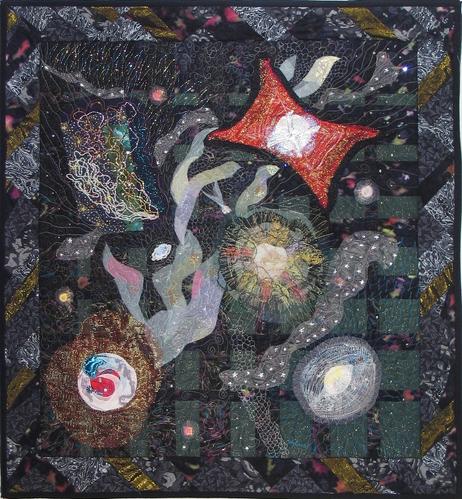
"How about a little manual work for a change to really come down from the stress of the day? Let's be inspired by the quilting of Judy W. Ross and make ourselves comfortable with a cup of tea."

2004 November 25

What the Hubble Saw
* Credit & Copyright: Judy W. Ross, Point Roberts, WA

Explanation:
In this striking 41 inch by 38 inch quilt, astronomy enthusiast Judy Ross has interpreted some of the Hubble Space Telescope's best galactic and extragalactic vistas. Featured in past APODs, clockwise from the lower right are; the Red Rectangle Nebula, NGC 2392, the Sleeping Beauty Galaxy, V838 Monocerotis - the Milky Way's most mysterious star, and supernova remnant N49 - the cosmic debris from an exploded star. Of course, quilts have been used historically to represent astronomical concepts. And while inspired by the images of the cosmos that she incorporates into her quilts, Ross reports that she is still a little daunted by the intricacies of the Cat's Eye Nebula revealed by the Hubble's sharp vision.
https://quiltindex.org/

https://apod.nasa.gov/apod/ap041125.html

#space #NASA #astrophotography #photography #art #astroart #quilting #quilt #craft #space_related #Space_Culture_Club
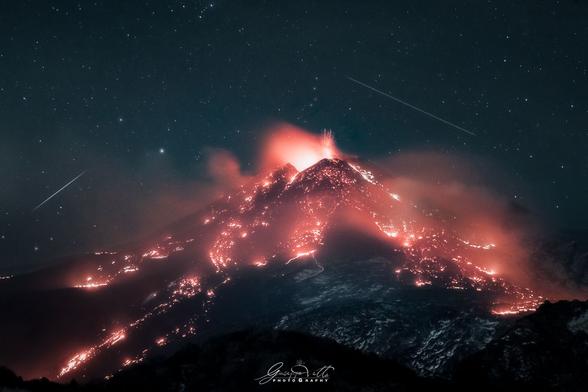
"After a somewhat clumsy and obviously drunk young man has just vomited on the carpet in the entrance area, in order to enable him to recover quickly, sufficient fresh air was provided and we now make a pleasant fire in the fireplace."

2021 March 3

Stars over an Erupting Volcano
* Image Credit & Copyright: Giuseppe Vella
https://www.instagram.com/Peppe.vella_photography/

Explanation:
Mt. Etna has been erupting for hundreds of thousands of years. Located in Sicily, Italy, the volcano produces lava fountains over one kilometer high. Mt. Etna is not only one of the most active volcanoes on Earth, it is one of the largest, measuring over 50 kilometers at its base and rising nearly 3 kilometers high. Pictured erupting last month, a lava plume shoots upwards, while hot lava flows down the volcano's exterior. Likely satellite trails appear above, while ancient stars dot the sky far in the distance. This volcanic eruption was so strong that nearby airports were closed to keep planes from flying through the dangerous plume. The image foreground and background were captured consecutively by the same camera and from the same location.

https://apod.nasa.gov/apod/ap210303.html

#space #earth #volcano #NASA #photography #nature #space_related #Space_Culture_Club
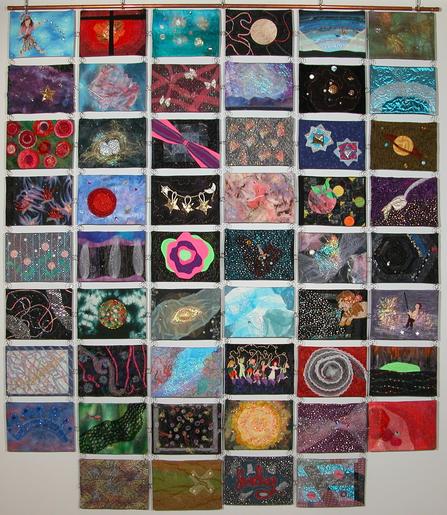
"Before going to bed, we dedicate ourselves once again to the works of Judy W. Ross. Because in an anniversary year, all those involved and supporters should receive the recognition they deserve."

2003 October 17

Astronomy Quilt of the Week
* Credit & Copyright: Judy W. Ross, Point Roberts, WA

Explanation:
Demonstrating her mastery of a traditional astronomical imaging technique quilter and astronomy enthusiast Judy Ross has produced this spectacular composition of "Astronomy Quilt Piece of the Week". Her year-long effort resulted in an arrangement for a six by seven foot quilt consisting of 52 individual pieces (11 inches by 8 inches), one for each week, which she reports were inspired by her steady diet of APOD's daily offerings. Some of the pieces are based on actual pictures, such as the Hubble Space Telescope's view of planet forming AB Aurigae or Bill Keel's image of the nearby Pinwheel Galaxy. Others, with titles like the Blue Carpet Nebula and Duck Contemplates Black Hole, are from her own creative imaginings.

#space #NASA #astrophotography #apod #aniversary #photography #art #astroart #quilting #quilt #craft #space_related #Space_Culture_Club
2023 May 21

Tardigrade in Moss
* Image Credit & Copyright: Nicole Ottawa & Oliver Meckes / Eye of Science / Science Source Images
https://www.sciencesource.com/

Explanation:
Is this an alien? Probably not, but of all the animals on Earth, the tardigrade might be the candidate. That's because tardigrades are known to be able to go for decades without food or water, to survive temperatures from near absolute zero to well above the boiling point of water, to survive pressures from near zero to well above that on ocean floors, and to survive direct exposure to dangerous radiations. The far-ranging survivability of these extremophiles was tested in 2011 outside an orbiting space shuttle. Tardigrades are so durable partly because they can repair their own DNA and reduce their body water content to a few percent. Some of these miniature water-bears almost became extraterrestrials in 2011 when they were launched toward to the Martian moon Phobos, and again in 2021 when they were launched toward Earth's own moon, but the former launch failed, and the latter landing crashed. Tardigrades are more common than humans across most of the Earth. Pictured here in a color-enhanced electron micrograph, a millimeter-long tardigrade crawls on moss.

https://apod.nasa.gov/apod/ap230521.html

#space #space_related #earth #photography #science #nature #biology #animal #tardigrade #aliens #survivor #Space_Culture_Club #NASA #ESA

By contributors to Wikimedia projects

Tardigrades,

known colloquially as water bears or moss piglets, are a phylum of eight-legged segmented micro-animals. They were first described by the German zoologist Johann August Ephraim Goeze in 1773, who called them Kleiner Wasserbär 'little water bear'. In 1776, the Italian biologist Lazzaro Spallanzani named them Tardigrada, which means 'slow walkers'.

They live in diverse regions of Earth's biosphere – mountaintops, the deep sea, tropical rainforests, and the Antarctic. Tardigrades are among the most resilient animals known, with individual species able to survive extreme conditions – such as exposure to extreme temperatures, extreme pressures (both high and low), air deprivation, radiation, dehydration, and starvation – that would quickly kill most other forms of life. Tardigrades have survived exposure to outer space.

There are about 1,500 known species in the phylum Tardigrada, a part of the superphylum Ecdysozoa. The earliest known fossil is from the Cambrian, some 500 million years ago. They lack several of the Hox genes found in arthropods, and the middle region of the body corresponding to an arthropod's thorax and abdomen. Instead, most of their body is homologous to an arthropod's head.

Tardigrades are usually about 0.5 mm (0.02 in) long when fully grown. They are short and plump, with four pairs of legs, each ending in claws (usually four to eight) or sticky pads. Tardigrades are prevalent in mosses and lichens and can readily be collected and viewed under a low-power microscope, making them accessible to students and amateur scientists. Their clumsy crawling and their well-known ability to survive life-stopping events have brought them into science fiction and popular culture including items of clothing, statues, soft toys and crochet patterns. [...]

https://en.wikipedia.org/wiki/Tardigrade

#space #space_related #earth #photography #science #nature #biology #animals #tardigrade #aliens #Space_Culture_Club #NASA #ESA

@grobi Error 404 behind both Flickr links ...