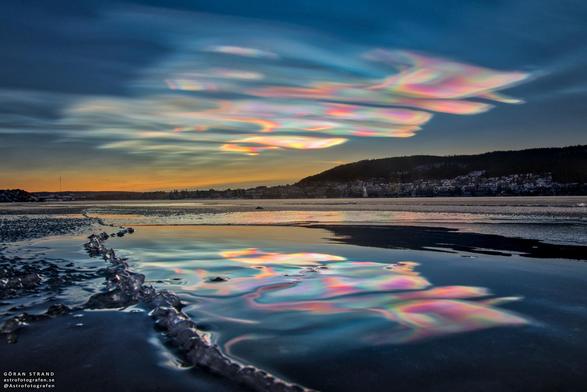
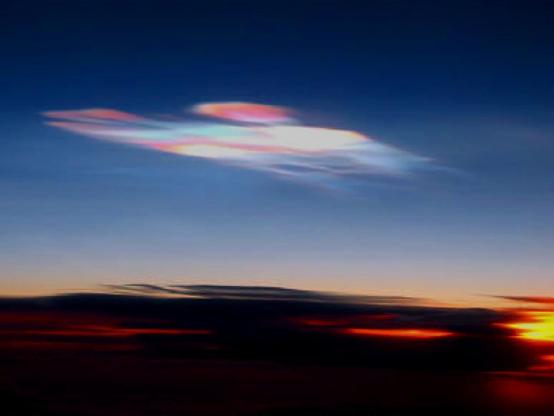
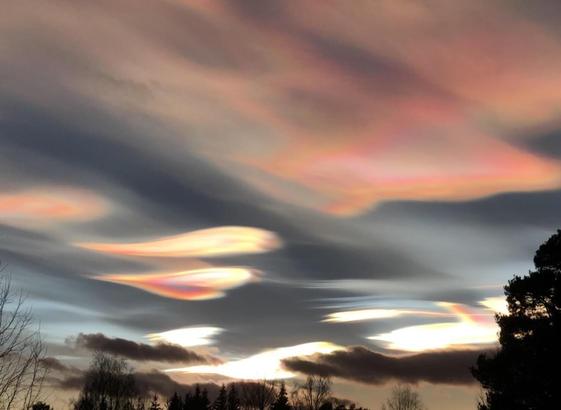
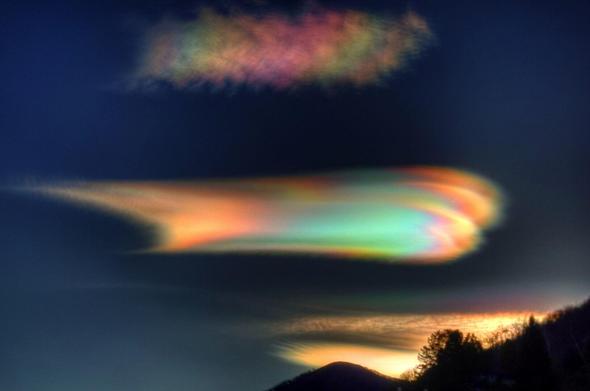
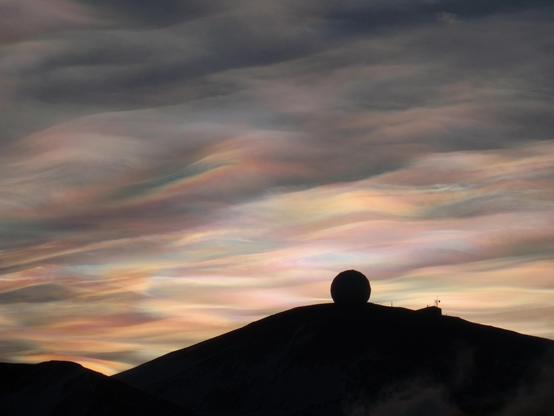
This is a GIF i exerpt from a time lapse video of the very beautiful Polar Stratospheric Clouds that was visible on the 12th of December 2019. This footage was taken by Photographer Göran Strand from Sweden between 13:40 and 14:39 UTC on 2019-12-31

CREDITS
Göran Strand
http://www.astrofotografen.se/

Link to original Video:
https://www.youtube.com/watch?v=VljrlBkJUl0

#space #earth #atmophere #clouds #weather #photography #science #physics #meteorology #nature #education

"So dearest dev-ops, are you still breathing? Don't forget, so relaxed in and out .. in and out .. and from now on we think of something very nice and relaxed when we think of the word cloud .."

2024 July 7

Iridescent Clouds over Sweden
* Image Credit: Goran Strand
https://astrofotografen.se/

Explanation:
Why are these clouds multi-colored? A relatively rare phenomenon in clouds known as iridescence can bring up unusual colors vividly -- or even a whole spectrum of colors simultaneously. These polar stratospheric clouds also, known as nacreous and mother-of-pearl clouds, are formed of small water droplets of nearly uniform size. When the Sun is in the right position and, typically, hidden from direct view, these thin clouds can be seen significantly diffracting sunlight in a nearly coherent manner, with different colors being deflected by different amounts. Therefore, different colors will come to the observer from slightly different directions. Many clouds start with uniform regions that could show iridescence but quickly become too thick, too mixed, or too angularly far from the Sun to exhibit striking colors. The featured image and an accompanying video were taken late in 2019 over Ostersund, Sweden.

https://apod.nasa.gov/apod/ap200115.html

#space #earth #atmophere #clouds #weather #photography #science #physics #meteorology #nature #education

2020 January 10

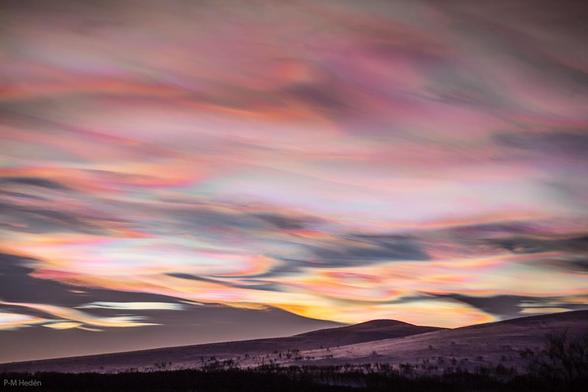
Nacreous Clouds over Sweden
* Image Credit & Copyright: P-M Hedén (Clear Skies, TWAN)
https://www.clearskies.se/
https://twanight.org/profile/p-m-heden/

Explanation:
Vivid and lustrous, wafting iridescent waves of color filled this mountain and skyscape near Tanndalen, Sweden on January 3 2020. Known as nacreous clouds or mother-of-pearl clouds, they are rare. This northern winter season they have been making unforgettable appearances at high latitudes, though. A type of polar stratospheric cloud, they form when unusually cold temperatures in the usually cloudless lower stratosphere form ice crystals. Still sunlit at altitudes of around 15 to 25 kilometers the clouds can diffract sunlight after sunset and before the dawn.

https://apod.nasa.gov/apod/ap200110.html

#space #earth #atmophere #clouds #weather #photography #science #physics #meteorology #nature #education

2025 February 1

Nacreous Clouds over Sweden
* Image Credit & Copyright: Vojan Höfer
https://www.astro-novinky.eu/index.php/2025/02/01/cesky-sportovec-k-vlastnimu-prekvapeni-uspel-svym-snimkem-vzacneho-ukazu-v-nasa/

Explanation:
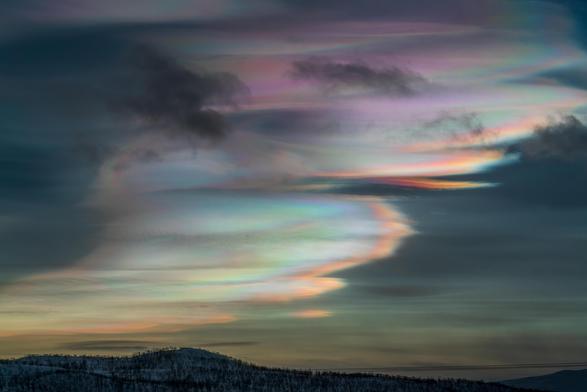
Vivid and lustrous, wafting iridescent waves of color wash across this skyscape from northern Sweden. Known as nacreous clouds or mother-of-pearl clouds, they are rare. But their unforgettable appearance was captured in this snapshot on January 12 with the Sun just below the local horizon. A type of polar stratospheric cloud, they form when unusually cold temperatures in the usually cloudless lower stratosphere form ice crystals. Still sunlit at altitudes of around 15 to 25 kilometers, the clouds diffract the sunlight even when the Sun itself is hidden from direct view

https://apod.nasa.gov/apod/ap250201.html

#space #earth #atmophere #clouds #weather #photography #science #physics #meteorology #nature #education

2023 February 9

Nacreous Clouds over Lapland
* Image Credit & Copyright: Dennis Lehtonen
https://www.lensculture.com/dennis-lehtonen

Explanation:
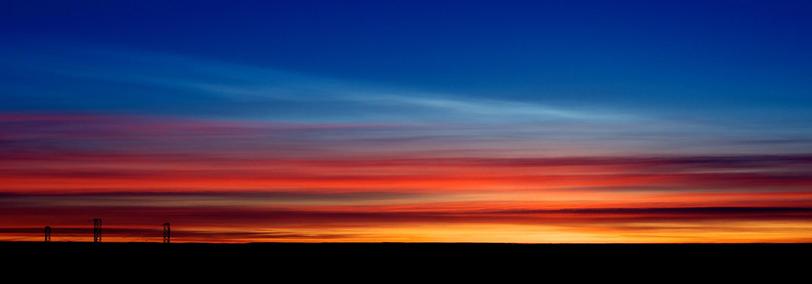
Vivid and lustrous, wafting iridescent waves of color wash across this skyscape from Kilpisjärvi, Finland. Known as nacreous clouds or mother-of-pearl clouds, they are rare. But their unforgettable appearance was captured looking south at 69 degrees north latitude at sunset on January 24. A type of polar stratospheric cloud, they form when unusually cold temperatures in the usually cloudless lower stratosphere form ice crystals. Still sunlit at altitudes of around 15 to 25 kilometers, the clouds can diffract sunlight even after sunset and just before the dawn.

https://apod.nasa.gov/apod/ap230209.html

#space #earth #atmophere #clouds #weather #photography #science #physics #meteorology #nature #education

PSCs are classified into two main types, each of which consists of several subtypes.

+ Type I clouds have a generally stratiform appearance resembling cirrostratus or haze. They are sometimes sub-classified according to their chemical composition which can be measured using LIDAR. The technique also determines the height and ambient temperature of the cloud. They contain water, nitric acid and/or sulfuric acid and are a source of polar ozone depletion. The effects on ozone depletion arise because they support chemical reactions that produce active chlorine which catalyzes ozone destruction, and also because they remove gaseous nitric acid, perturbing nitrogen and chlorine cycles in a way which increases ozone depletion.
++ Type Ia clouds consist of large, aspherical particles, consisting of nitric acid trihydrate (NAT).
++ Type Ib clouds contain small, spherical particles (non-depolarising), of a liquid supercooled ternary solution (STS) of sulfuric acid, nitric acid, and water.
++ Type Ic clouds consist of metastable water-rich nitric acid in a solid phase.

+ Type II clouds, which are very rarely observed in the Arctic, have cirriform and lenticular sub-types and consist of water ice only.

Only Type II clouds are necessarily nacreous whereas Type I clouds can be iridescent under certain conditions, just as any other cloud. The World Meteorological Organization no longer uses the alpha-numeric nomenclature seen in this article, and distinguishes only between super-cooled stratiform acid-water PSCs and cirriform-lenticular water ice nacreous PSCs.
[..]

CREDIT:
Contributors to Wikimedia projects
+ Image:
François Guerraz - own work

https://en.wikipedia.org/wiki/Polar_stratospheric_cloud

#space #earth #atmophere #clouds #weather #photography #science #physics #meteorology #nature #education

[..]

Forward scattering of sunlight within the clouds produces a pearly-white appearance. Particles within the optically thin clouds cause colored interference fringes by diffraction. The visibility of the colors may be enhanced with a polarising filter.
[..]

CREDIT:
Contributors to Wikimedia projects
+ Image:
NASA
(uploaded by Foobaz)

#space #earth #atmophere #clouds #weather #photography #science #physics #meteorology #nature #education

[..]

PSCs form at very low temperatures, below −78 °C (−108 °F). These temperatures can occur in the lower stratosphere in polar winter. In the Antarctic, temperatures below −88 °C (−126 °F) frequently cause type II PSCs. Such low temperatures are rarer in the Arctic. In the Northern hemisphere, the generation of lee waves by mountains may locally cool the lower stratosphere and lead to the formation of lenticular (lens-shaped) PSCs.
[..]

CREDIT:
Contributors to Wikimedia projects
+ Image:
by Brillern

#space #earth #atmophere #clouds #weather #photography #science #physics #meteorology #nature #education

[..]

The stratosphere is very dry; unlike the troposphere, it rarely allows clouds to form. In the extreme cold of the polar winter, however, stratospheric clouds of different types may form, which are classified according to their physical state (super-cooled liquid or ice) and chemical composition.

Due to their high altitude and the curvature of the surface of the Earth, these clouds will receive sunlight from below the horizon and reflect it to the ground, shining brightly well before dawn or after dusk.
[..]

CREDIT:
Contributors to Wikimedia projects
+ Image:
Karin Switzerland

#space #earth #atmophere #clouds #weather #photography #science #physics #meteorology #nature #education

"I promised the stressed dev-ops among us more relaxation, so after all the thunderstorm rumbling we put on our coloured glasses again and breathe in and out deeply and completely relaxed again ..
Cool and more relaxed:"

SUBTOPIC> Polar Stratospheric Clouds

From Wikipedia, the free encyclopedia

A polar stratospheric cloud (PSC) is a cloud that forms in the winter polar stratosphere at altitudes from 15,000 to 25,000 m (49,000 to 82,000 ft). They are best observed during civil twilight, when the Sun is between 1° and 6° below the horizon, as well as in winter and in more northerly latitudes. One main type of PSC is composed of mostly supercooled droplets of water and nitric acid and is implicated in the formation of ozone holes. The other main type consists only of ice crystals, which are not harmful. This type of PSC is also called nacreous (; from nacre, or mother of pearl), due to its iridescence.
[..]

CREDIT:
Contributors to Wikimedia projects
+ Image:
Alan Light from Charlotte, USA. At Commons

#space #earth #atmophere #clouds #weather #photography #science #physics #meteorology #nature #education