Airlines are like "instead of all those agents, we'll make a sort of assembly line manned by customers. Check in with one machine, drop your baggage off with another."

Then literally anything happens with the computer network requiring an elevated number of customers to need manual intervention, and suddenly you have an enormous immobile line while every single customer lines up before the two (2) remaining agents.

Corporations don't care about "efficiency" they just wanna fire people

I really believe this. We were told capitalist entities will act to minimize costs and maximize profit. But what corporations actually seek to do, for whatever reason, is minimize *labor* cost. They prefer to bear any other kind of cost. They will minimize labor costs even if it increases overall costs and/or hurts profits
All the airlines in Toronto now use this system where the machine prints you out a sticker tag you loop over your luggage handle, and then when you put it on the belt to be sorted a machine reads the tag. But it appears it only works if you put the tag on one way but not the other, chirality matters, or there's something the user can do wrong that makes the tag unscannable. So every airline has to inject a human into the process there to make sure you get the tag right, at the most awkward place
The process was designed to remove a human from this exact spot, and therefore there is no room to fit a human in, but now they need to fit a human in
@mcc I was in a car park last week. There was someone standing next to the ticket machine to tell everyone that the ticket machine was really slow, and that they should wait for it to respond.
@mcc I’ve had to deal with this idiotic system twice in one year now, and both times, I’ve yelled out loud in frustration about how stupidly inefficient the system was. Sure, the one benefit is not having to talk to people, but a major downside is being forced to talk to people anyway because the tag won’t scan no matter how you orient the luggage.
@mcc Our Ikea has introduced a dedicated checkout line that you can only use if you have their app, clearly in an effort to similarly reduce staffing.
Except, apparently, that is so unclear that they put a full size advertisement cardboard in front of it, blocking the lane, and have a human standing next to it, informing all would-be passers that this is the special lane, getting visual confirmation that the app is installed, and then temporarily moving the cardboard to let one customer pass.
@henryk Der inLichtenberg hat das, dazu aber auch eine normale Self-Checkout-Lane. Natürlich nicht ausgeschildert, auf meinen diesbezüglichen Hinweis meinte man nur "Ja, das ist doof, aber so vorgegeben, weil alle Filialen einheitlich sein sollen".
@mcc Hmm, Sabotage the system anyone?

@mcc I feel like the kind of people who would know that this would be something that would happen in the absence of check-in staff would be exactly the kind of people that (1) would get downsized when possible and (2) wouldn't be the people listening to the salesguy pushing the kiosk solution.

I worked (contract) IT at Eli Lilly for a couple of years, a million years ago. Lilly people who learned too much about the areas they managed were *downgraded* in people's assessment of their ability.

@mcc More generally, I've seen it referred to as "soft cost blindness."

Firing people has a hard, objective value. Slowing down your business and frustrating your customers has a murky, intangible cost. Analyzing that sounds hard, so let's just 🪄🎩 hey look at that, the costs are gone, it's all upside now!

@curtmack @mcc yeah, like people are going to go get on their plane anyway. Whatever you do to piss them off. It's still effectively cost saving to make their experience shitter
@noodlemaz @curtmack until it hits the point you fly less.
@mcc @noodlemaz @curtmack it's starting to get to the point where i know some people who'd rather spend 20h on trains than fly. and they aren't even train nerds or anything!
@mei @curtmack @mcc it's very luck of the draw. I'd rather train it. But UK trains suck a$$ and we live close to airport terminals. For people farther out, it would make sense to get trains but pricing can be prohibitive, esp for big families.
Really depends. Doing train rtn to Germany in Aug.
@noodlemaz or, they won't and they've already paid, so fuck 'em!
@curtmack @mcc its bc a corporation just does not want to rely on people, in spite of them being the reason it is able to exist. It’s like the primary contradiction of free market ideals. You need people to create value and you need people in the world with purchasing power, but you somehow want to externalise both. It’s no coincidence that all trendy businesses love llm and cryptocoins, it lets them potentially cut out the “middleman” and externalise more costs.
@mcc See also, companies realizing they’d come out ahead if they’d pay more due to increased morale and lower turnover, and it being treated like a big revelation.
@mcc Which explains current AI hype so well…
@mcc And all because people are _so_ unreasonable and want things like time off, regular pay raises, and a work-life balance.

@mcc Hence the drive to always offshore jobs, or farm them out to consulting firms. Costs go up, quality goes down.

I'm convinced this is all a result of the rise of the MBA in the 1980s-1990s, when it became the norm to consider employees as a cost instead of an asset.

@mcc this is unfortunately fairly logical: labor is never going to get cheaper, every other input generally does. And the easiest way to do this isn't actually through improving productivity, it's shifting tasks from employees to customers!
@mcc yeah this is 100% true. I often wonder how much of it is explicit vs emergent strategy. Because when you look at capitalists as a class, and then consider the last couple of centuries of history, it seems obvious what the deal is there, but I doubt they're all thinking in those exact terms
@ajswritesthings sometimes I think human society and history would be much easier to explain if people didn't realize why they were making the decisions they were making.

@mcc fwiw there's literal studies showing the exact same thing

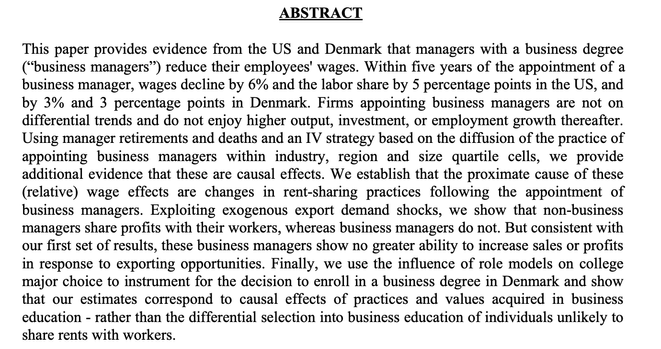
"This paper provides evidence from the US and Denmark that managers with an [MBA] reduce their employees' wages. [...] These business managers show no greater ability to increase sales or profits."

via: https://www.nber.org/system/files/working_papers/w29874/w29874.pdf

@tef @mcc brb, adding "You got an MBA?" to my list of questions to ask during an interview

@rimu

"What percentage of managers at your company have business degrees?" is indeed a great question.

@tef @mcc

@tef @mcc Interestingly enough there's also research that shows that in a similar way to most fund managers underperforming the market (i.e. worse than random selection) - most company executives underperform the market, and even successful ones cannot replicate their success in their next role (with rare exceptions).
This is why after Jack Welch left GE as CEO to take up a role as COO of IAC, there was no sequel to his book "Winning"...
@mcc my personal pet theory as to the "why" of this is because fees paid for "technological" solutions go to their friends and friends' companies and stocks, whereas wages are just "lost".

I have no evidence to back this up, but it does feel like they explicitly are attempting to block class mobility and that's certainly one way to do it.
@aud @mcc Corporate finance gets real wonky when you start digging into it. Capital expenditure vs Operational Expenditure. Those have to be reported different ways on earnings reports and wages typically fall under the latter (though there are some exceptions).
@aud @mcc There's also something tax-related on CapEx (because it relates to an investment into the business, theoretically). But I'm not an accountant and I can't rattle off the differences.
@cthos The main thing, and apologies if you know this, is that capex gets treated as an asset initially and then expensed over the expected life of whatever you bought (since the assumption’s that you’ll be benefiting for years), versus opex gets realized as an expense immediately. That means $1M of spend on tech is only going to reduce your net income by a fraction of that $1M in the year you spend it (and every year after), but $1M of spend on labour hits your bottom line immediately.

@cthos So barring specific tax incentives to invest in capital improvements (which I vaguely remember exist in certain cases, tax is very much not my field), opex is generally preferable strictly from a tax perspective since you’re getting the deduction right away, but if you’re trying to maximize net income in the short term, capital expenditures have an advantage in that regard assuming similar ROI.

I’m speaking very, very broadly, but should be accurate in a general sense.

@Serenus Yeah, amortization is the term? And you can treat spending on say, contractor labor, in that capex category which smooths out your P/L and nets you an "Asset" on the balance sheet. So if you were to say, prioritize capex spending, you're more likely to hire contractors.

That said, like LLMs have to be an Opex spend so I dunno how much if any this factors into @aud's suspicions.

@cthos Contractor versus internal labour isn’t the dividing line so much as it is what that labour’s going towards? Again very much generalizing, but it boils down to whether the labour’s going towards something that’ll install or increase the useful life of a capital asset.

That said, AI related spend may or may not be considered capex. A sub to chatgpt is going to be opex, but if you’re building some sort of integration or platform that you’ll be using long term that’ll likely go to capex?

@Serenus In my experience basically every internal AI project winds up being a ChatGPT wrapper, so that sounds like a fun thing to have to track on the balance sheet.

But I didn't think you could necessarily point someone's salary as an expense against a capital project, or perhaps it was that accounting for a salary makes for an accounting headache that's more trouble than it's worth?

@Serenus Oh and yes, I used a bit of a shortcut in the upstream post to say if you're doing a capex project with a fixed deliverable, you can throw contractors at it and pretty easily say "everything they're charging goes here", because you're contracting them specifically for that project.

@cthos You wouldn’t necessarily book the salary directly against the project, but rather track time spent on the project and then book the cost of that time against the project (or at least that’s what I’ve seen done). It’s a headache, but if you’re doing capital heavy work it becomes necessary to get the tracking system in place.

And yeah, I have no idea how that in particular would be treated. My gut feeling is that at least some of it would be capex, but I can’t say I know for sure?

@Serenus I have a hunch that for the GenAI companies in particular we're going to find out they were doing some very "interesting" accounting (like the one that went under the other day!)
@cthos @aud @mcc

capex is a way to signal investors you're hiring people who could have agency and start a competition business. op cost show investors how much money a corporate raider can make by verticalizing (layoffs), so dictates acquisition premium and most of stock price is faith revenue is detached from it, which is the job of the ceo saying things like we're AI now.
@aud @mcc And firing people seems to attract new investors.
@catch56 @mcc i should've gotten my ass into the lab no earlier than 11am and knocked off not a moment after 4pm all through the 90s. maybe 3pm, i typed really fast back then.
@mcc Short term personal gain for some manager is the *only* guiding principle at most larger corps...as if a being were made entirely of cancer cells.
@mcc Beyond the obvious power imbalance, you could explain this by labor appearing more negotiable than machinery, thus creating the possibility of driving labor costs down as far as labor will tolerate it. If your machine stops working, you can't tell it tog get back to work; you HAVE to repair or replace it. If your worker stops working, you can tell them to make do with less lest you fire them and hire someone willing to do their work for half the pay.
@mcc The shareholders always prefer displays of dominance over money

@mcc It feels like a form of measurability bias? With the added ouroboros of "we don't measure it because it isn't important" > "it must not be important, we don't measure it" (repeat ad nauseum).

Not gonna argue with the folks bringing in Marx, it does always come back around to that eventually, but I think examining the specific mechanics of exploitation is instructive. It equips us to counter them at the individual level.

@pandabutter My personal assumption is it's entirely because employees give them Trouble, they have to expend thought on managing them. I don't think upper/middle management is trying to even push their individual financial incentives. I think they're just trying to reduce their workload
@mcc it's kind of strange actually. Any kind of opex: "yay I get tax back!!!" Specifically salaries: "boo hoo all my profits..."
@mcc oh, I can sing a tale. Last year, stuck in Frankfurt for almost 3 days. 75,000 people stuck .. Amazing. The lines were epic.
@mcc same with self checkout.
@kimlockhartga @mcc Self checkout at Costco at least is pretty decent, it's tucked into a corner and the majority is still normal checkout. There's usually one or two staff there helping with misc problems, and the line moves at least 3x faster than normal queues because only people with a few items & uses credit card uses it.
@mcc same shit with supermarket self checkout, where instead of two fast checkout lines you have… a bunch of self checkout machines and 2-3 workers troubleshooting them. It doesn’t even save labor
@bruno @mcc it has made theft easier, or so I've heard
@mcc "efficiency" is defined as "having fewer humans they have to pay".
@mcc to them efficiency is solely conceived of in dollar terms. ROI. Noting else matters.

@mcc It's deeper than that.

A lot of the memes about "efficiency" are anti-human. A modern corporation may genuinely believe to be pursuing "efficiency", but going for it according to the popular misconceptions will lead to firing people every time out of every.