We've all been there: it's puzzle time, but once you dump out the pieces and start laying them flat, you realize you don't have enough space on your table. Join me as we use physics to find out ✨HOW BIG A TABLE YOU NEED FOR YOUR JIGSAW PUZZLE ✨

https://doi.org/10.48550/arXiv.2312.04588
#SciComm

How big a table do you need for your jigsaw puzzle?

Jigsaw puzzles are typically labeled with their finished area and number of pieces. With this information, is it possible to estimate the area required to lay each piece flat before assembly? We derive a simple formula based on two-dimensional circular packing and show that the unassembled puzzle area is $\sqrt{3}$ times the assembled puzzle area, independent of the number of pieces. We perform measurements on 9 puzzles ranging from 333 cm$^2$ (9 pieces) to 6798 cm$^2$ (2000 pieces) and show that the formula accurately predicts realistic assembly scenarios.
arXiv.org
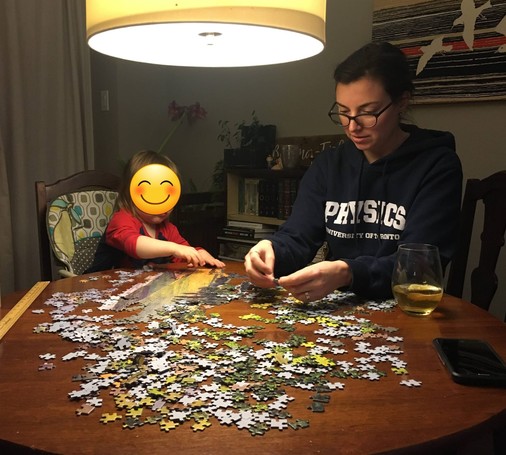
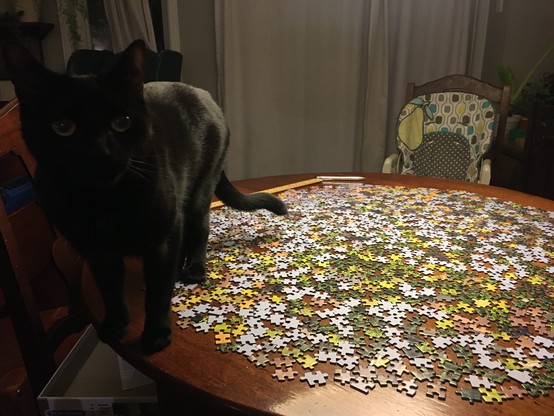
This work was a pandemic collaboration between me and the brilliant Kent Bonsma-Fisher, with assistance from our toddler and cat. The result, in his words, was "the cleanest dataset I have ever collected." Today our results are public on #arXiv!
TL;DR: an unassembled jigsaw puzzle takes up an area that is the square root of 3 times the area of the assembled puzzle, or about 1.7 times the assembled area. This is *independent of the number of pieces*.
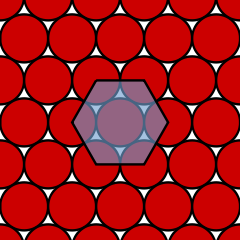
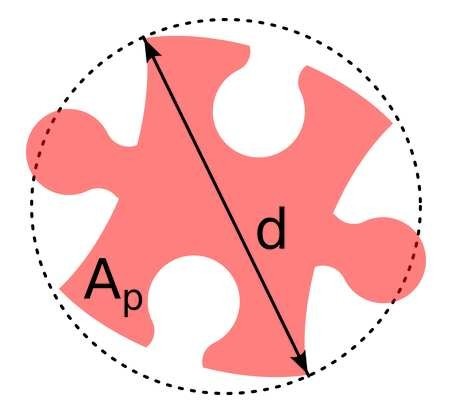
We derived a theory with a "spherical cow in a vacuum" approach: we approximated each puzzle piece area as a circle, then calculated the area of the circles packed together. Our prediction: the unassembled area is sqrt(3) times the assembled area. Then we took data.
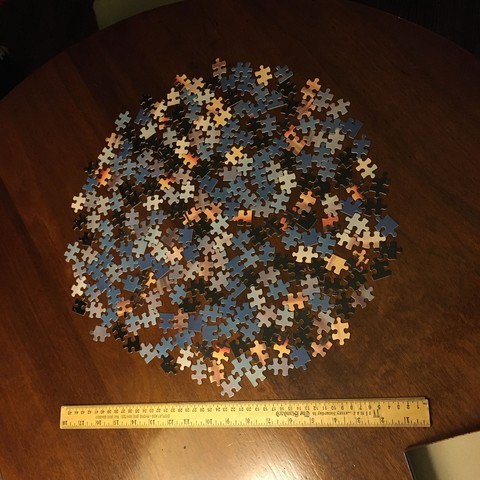
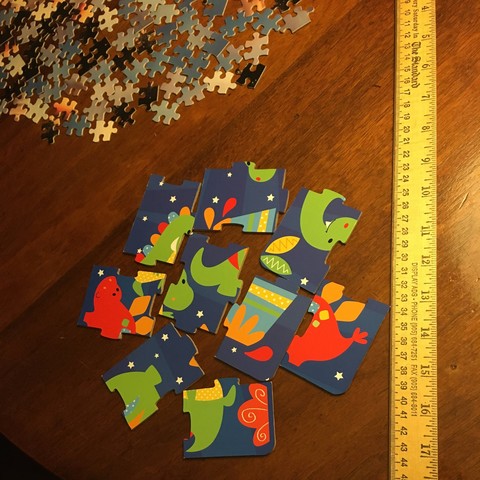
We built 9 puzzles across a variety of total sizes and with piece numbers ranging from 9 to 2000. We laid out all the pieces flat, trying to be realistic by not paying much attention to how they were arranged and not spending time trying to get them closer together.
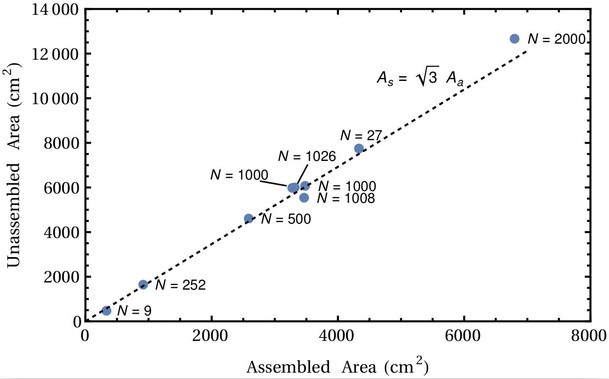
The results were the most incredible agreement between theory and data I've ever seen in over a decade of being a physicist. I think I gasped when I saw this plot. Without any fitting, our simple theory *very accurately* predicted the unassembled area of all these puzzles.
We were surprised that the unassembled area didn't depend on the number of puzzle pieces. The intuition is this: if you have a small number of large pieces, the gaps between pieces are big, but this is multiplied by a small total number of pieces, and vice versa for small pieces.
So there you have it: you'll need a puzzle table just under twice as big as your assembled puzzle in order to not resort to the box lid or that random side table. Grab a puzzle and impress your relatives this holiday season with your predictive powers!
@mbonsma Now this is the content I wish to see online. And useful as my wife and mother-in-law are puzzle fanatics. :)
@mbonsma This is very timely - thank you! One of my favorite holiday traditions will now be a bit more orderly. 🧩❤️

@mbonsma We completed this puzzle yesterday, and I can say anecdotally that your findings align with my experience. Also, the puzzle is filled with people and bikes!

#BikeTooter #Puzzle

@uxmark
Coming from a family of puzzlers, this is a very helpful thread. We quarantined together (wife & I, 2 daughters, son-in-law, granddaughter, 3 cats and 1 dog) and completed 60+ puzzles in about a year. Cats and dog not helpful. Puzzle mat is a must for serious puzzlers.

@mbonsma
What a great puzzle. My Toronto residing daughters, both bike riders, would love this. Do you have a link to where it can be purchased?

#Puzzle #PuzzleLove

@paulbusch @mbonsma I received it as a gift, and don’t know where it was bought. But this is the maker, and this particular puzzle is visible here:

https://www.cavallini.com/1000-piece-puzzles

I finished this puzzle right after finishing another puzzle that features cans of beer. If you look at the emoji in my name, that might explain a lot
😀🍻🚴🏼

Cavallini Papers & Co.

Cavallini
@mbonsma Well, it turns out that there’s a piece missing in that puzzle in the photo. My wife found it on the floor this morning, with teeth marks from our dog in it. So who can spot the missing piece in that photo? 😀🧩
@mbonsma now I'm going to have to think about how this interacts with sorting trays, which I find immensely useful.
@mbonsma Fascinting. Does this scale up to popped corn? Is there a taxonomy of popped corn, for that matter? Or, or... Soma cube likewise?
@Kencf618033 we are working on the 3D version now! The big question is what physical analogy to use. I think popped corn is a great example - they're not exactly spheres, but assuming spherical packing would probably give you a very good estimate of the volume. But what would "assembled" popcorn be? 🤔

@mbonsma If you're asking for a collective noun I would suggest "a cinema of popped corn". And presumably (as with autistic brains) patterns would emerge given a sufficent sample size. Let me find that study...

https://arstechnica.com/science/2015/01/the-connections-in-autistic-brains-are-idiosyncratic-and-individualized/

(I'd reposted this here too.)
#ActuallyAutistic

The connections in autistic brains are idiosyncratic and individualized

Each autistics' brain is distinct; non-autistics' brains are remarkably uniform.

Ars Technica
@mbonsma We're gonna need a bigger table.
@mbonsma a followup paper could examine the space required for @nervous_jessica's infinite puzzles that have no edges, allowing every piece to be a center piece https://n-e-r-v-o-u-s.com/blog/?p=8293
Earth and Moon Infinity Puzzles ™

Explore the Earth and Moon through our mind-bending, never-ending jigsaw puzzles. The Earth Infinity Puzzle is a map of the globe unlike any you’ve seen before. Start anywhere and see where your jo…

Nervous System blog
@mbonsma I'd be very interested in a mathematical model for this, I need to ask some geometry friends whether they can come up with something useful!
@mbonsma I love this!!
I've just added a reference to your work to my "Puzzle Pastimes" post, thanks!
https://karendcampe.wordpress.com/2020/05/20/puzzle-pastimes/
Puzzle Pastimes

In the current circumstances of staying home during the Covid-19 pandemic, I’ve spent a lot of time doing puzzles.  Some are jigsaw, some are pencil & paper, and all of them have got me th…

Reflections and Tangents
@mbonsma that's impressive, definitely worthy of an Ig Nobel prize 👍

@mbonsma I saw the initial claim, disagreed, came here, this is the key point.

You have some nice, orderly definition of jigsaw pieces which you haven't explicated in this thread which does not allow for topologically complicated pieces. For example, what if many piece have thin "tendrils" which are as long and as wide as the whole puzzle? (I won't even go into what might be possible with jigsaw pieces that aren't measurable sets, see the Banach-Tarski paradox!)

@TomSwirly @mbonsma I was at first confused why this was categorised as “physics”, but when I saw the simplifications, it all made sense.
@TomSwirly @mbonsma I must’ve skipped over the “topologically complicated” section of puzzles in my local bookstore.

@stillmoms @mbonsma

"Topologically complicated" might be simple as a bunch of long, thin right-angle pieces.

The proof seems to assume that puzzle pieces are neatly bounded by small circles, which is very specific, you can think of all sorts of interesting puzzles where this would not be the case.

If you're going to claim to have a proof, the conditions need to rule any edge cases where it doesn't work, or it isn't a proof.

@TomSwirly @mbonsma I'm no scientist, nor mathematician, but my impression is that this is not being offered as some sort of rigorous, theoretical mathematical proof applicable to all real or imagined puzzles—it's a study of "typical" jigsaw puzzles in the real world, meant to predict “realistic assembly scenarios”. The word "proof" appears nowhere.

Grousing that it doesn't address unrealistic, imaginary puzzles is like complaining that a Klein bottle is a bad vessel for transporting liquids.

@stillmoms @mbonsma

Oops, I'm sorry, you're right - "proof" didn't appear in there, I thought it did. Yes, my standards are lower for non-proofs. 😃

I don't see a puzzle with long or thin shapes in it as being "unrealistic" though.

One of the simplest non-trivial tiling puzzles are pentominos https://en.wikipedia.org/wiki/Pentomino#Constructing_rectangular_dimensions which have both long and right angle pieces.

Pentomino - Wikipedia

@TomSwirly @stillmoms you are very welcome to develop a more comprehensive theory of puzzle packing area!
@TomSwirly two things: first, we did not specifically select for "normal" puzzles and the theory still works, aka most puzzles have pieces that are kind of vaguely square even with nubs and holes. One of the puzzles was a very large linear children's floor puzzle. Second, I'm not convinced it *would* break down even if the pieces had a wider distribution of shapes, because they might still pack according to circles with the average area, on average. More data needed!
@TomSwirly @mbonsma There WAS specification of "spherical cow in a vacuum" which I thought would eliminate topologically complicated pieces.

@mbonsma Great research! Tonight I felt like doing a jigsaw, so I did some research of my own with a puzzle with nontraditional piece shapes. Here's a Geode puzzle from Nervous System.

Unassembled, the pieces are loosely packed into rectangle about 27✕30cm. Area 810 cm².
Assembled, it's roughly a circle of diameter 21cm. Area 346cm².
Ratio: 2.34.

Do with that whatever you want. But do try a Nervous System puzzle. They're different!

@kbob very cool, thanks for the contrasting data point!
@mbonsma
How much room does it take outside your head?
@mbonsma Haha, great.
That sounds suspiciously like a future Ig Nobel submission.
@mbonsma @leekelleher Curious to know if you've made any similar conclusions in your vast puzzle-streak? 😁

@greystate Ha, I like the maths at play here!

For me, I hit an awkward table/space situation with a 1500 piece puzzle, but always been fine with 1000 piece ones, so I stick to those now.
No maths, just "once bitten twice shy".

@mbonsma is it dependent on the shape of the pieces?
@BerndGoldschmidt it might break down for some very irregular piece shapes, but it seems like not really! That's the beauty of the simplification, anything "not square" about the pieces is a small variation that seems to not matter.
@mbonsma @gruber
So you would want a table around at least 3x the area. 1 (area) assembled puzzle)+ >1.7(area) assuming all pieces unassembled flat on table, a the assembled working area.

@mbonsma @gruber

4x4 card table for 2x3 foot puzzle.

@Chancerubbage @gruber I would argue that you don't need an extra full puzzle area for assembly - at least in my experience, some pieces hang out inside the partially assembled puzzle during the process. You definitely need *some* area to work, but as soon as you start assembling, the total area starts to go down.
@mbonsma @gruber I read and understand the proof, just adding elbow room. For comfort, and to provide a loose generous rule of thumb. No stacking or boxing, no ‘storage’ within assembly space, space between assembled groups. I know people work with less, just haven’t considered ‘logistics’ that way. It’s not unusual for me to sell dozens of jigsaw puzzles a day.
@mbonsma This, as stated, is obviously incorrect. Otherwise the boxes that the puzzles come in would be larger in area than the assembled puzzle. However they are always smaller in area than the assembled puzzle.
@platkus we and you are making different assumptions about what constitutes the area of a puzzle. Our question was "how much area does it take to lay out all the pieces in a single layer", while of course in the box they don't need to be in a single layer. In the extreme case, you could stack every piece on top of the others and say the area of an unassembled puzzle is 1 piece. That's fine! Just not what we were trying to figure out.
@mbonsma Right. I was just pointing out that your post didn’t make the parameters clear. That’s why I said “as stated” it was incorrect.
@platkus this is a weird hill to die on, the parameters are very clear both in the paper and later in this thread
https://mastodon.social/@mbonsma/111564845145935604
@mbonsma Sure, but not everyone is going to read the paper or the thread. I don’t see any reason the parameters couldn’t have been stated in this initial post. Not a big deal, but just pointing out that it could have been made clearer.
@platkus my dude, laying out all the pieces flat is ALSO in the very first post in this thread! You're replying to the third post! https://mastodon.social/@mbonsma/111564828670828672
@mbonsma This post came into my timeline because somebody I follow boosted it. I guess they happened to boost the third post and not the first one. Not my fault. 🤷‍♂️
@platkus If you didn't read the research or even the thread, you shouldn't critique the research or the thread.