We've all been there: it's puzzle time, but once you dump out the pieces and start laying them flat, you realize you don't have enough space on your table. Join me as we use physics to find out ✨HOW BIG A TABLE YOU NEED FOR YOUR JIGSAW PUZZLE ✨

https://doi.org/10.48550/arXiv.2312.04588
#SciComm

How big a table do you need for your jigsaw puzzle?

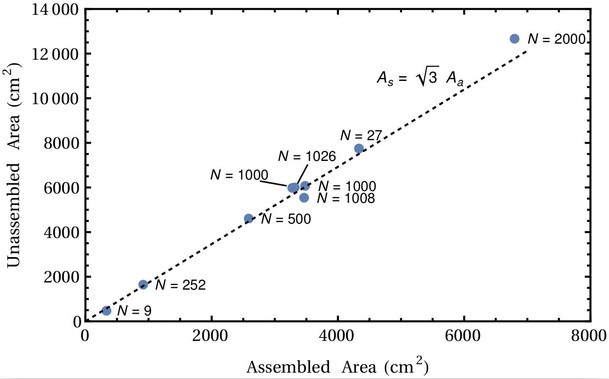
Jigsaw puzzles are typically labeled with their finished area and number of pieces. With this information, is it possible to estimate the area required to lay each piece flat before assembly? We derive a simple formula based on two-dimensional circular packing and show that the unassembled puzzle area is $\sqrt{3}$ times the assembled puzzle area, independent of the number of pieces. We perform measurements on 9 puzzles ranging from 333 cm$^2$ (9 pieces) to 6798 cm$^2$ (2000 pieces) and show that the formula accurately predicts realistic assembly scenarios.
arXiv.org
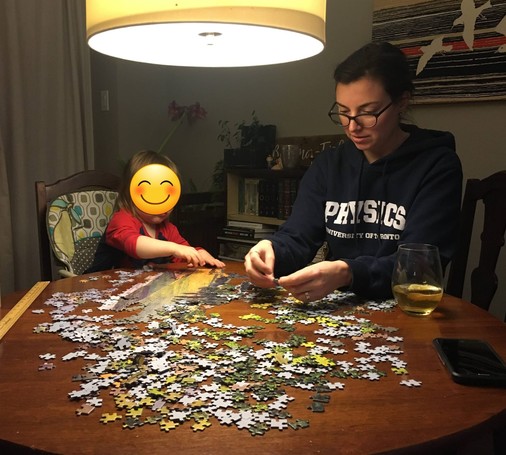
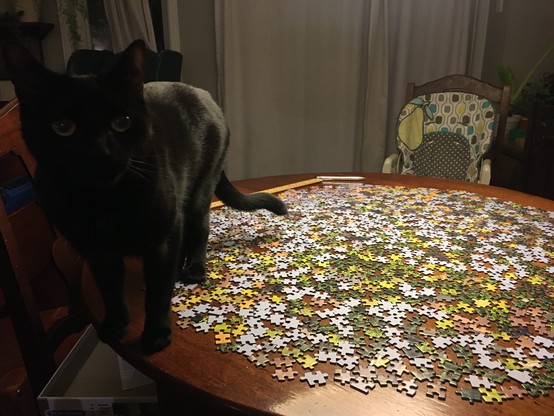
This work was a pandemic collaboration between me and the brilliant Kent Bonsma-Fisher, with assistance from our toddler and cat. The result, in his words, was "the cleanest dataset I have ever collected." Today our results are public on #arXiv!
TL;DR: an unassembled jigsaw puzzle takes up an area that is the square root of 3 times the area of the assembled puzzle, or about 1.7 times the assembled area. This is *independent of the number of pieces*.
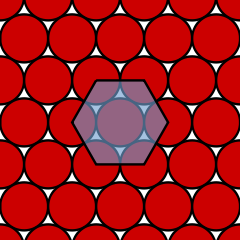
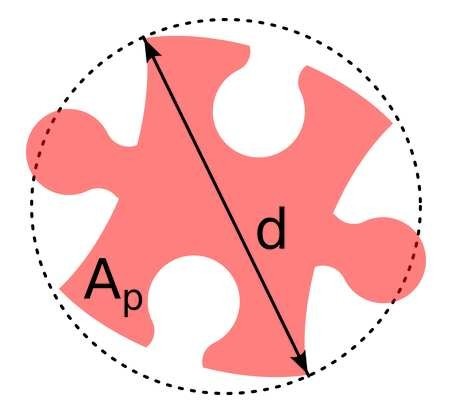
We derived a theory with a "spherical cow in a vacuum" approach: we approximated each puzzle piece area as a circle, then calculated the area of the circles packed together. Our prediction: the unassembled area is sqrt(3) times the assembled area. Then we took data.
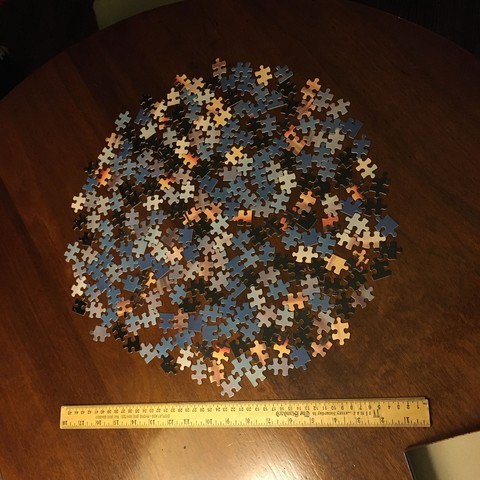
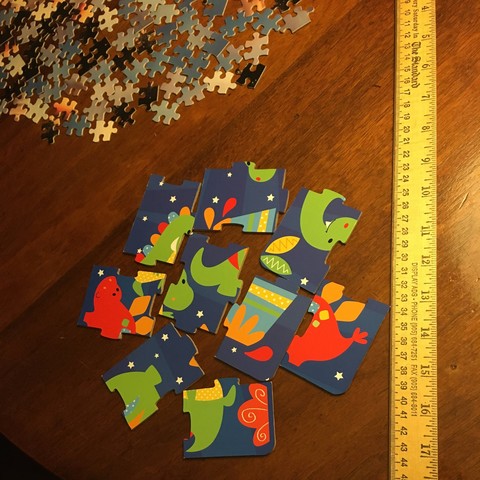
We built 9 puzzles across a variety of total sizes and with piece numbers ranging from 9 to 2000. We laid out all the pieces flat, trying to be realistic by not paying much attention to how they were arranged and not spending time trying to get them closer together.
The results were the most incredible agreement between theory and data I've ever seen in over a decade of being a physicist. I think I gasped when I saw this plot. Without any fitting, our simple theory *very accurately* predicted the unassembled area of all these puzzles.
We were surprised that the unassembled area didn't depend on the number of puzzle pieces. The intuition is this: if you have a small number of large pieces, the gaps between pieces are big, but this is multiplied by a small total number of pieces, and vice versa for small pieces.
So there you have it: you'll need a puzzle table just under twice as big as your assembled puzzle in order to not resort to the box lid or that random side table. Grab a puzzle and impress your relatives this holiday season with your predictive powers!

@mbonsma We completed this puzzle yesterday, and I can say anecdotally that your findings align with my experience. Also, the puzzle is filled with people and bikes!

#BikeTooter #Puzzle

@uxmark
Coming from a family of puzzlers, this is a very helpful thread. We quarantined together (wife & I, 2 daughters, son-in-law, granddaughter, 3 cats and 1 dog) and completed 60+ puzzles in about a year. Cats and dog not helpful. Puzzle mat is a must for serious puzzlers.

@mbonsma
What a great puzzle. My Toronto residing daughters, both bike riders, would love this. Do you have a link to where it can be purchased?

#Puzzle #PuzzleLove

@paulbusch @mbonsma I received it as a gift, and don’t know where it was bought. But this is the maker, and this particular puzzle is visible here:

https://www.cavallini.com/1000-piece-puzzles

I finished this puzzle right after finishing another puzzle that features cans of beer. If you look at the emoji in my name, that might explain a lot
😀🍻🚴🏼

Cavallini Papers & Co.

Cavallini