We've all been there: it's puzzle time, but once you dump out the pieces and start laying them flat, you realize you don't have enough space on your table. Join me as we use physics to find out ✨HOW BIG A TABLE YOU NEED FOR YOUR JIGSAW PUZZLE ✨

https://doi.org/10.48550/arXiv.2312.04588
#SciComm

How big a table do you need for your jigsaw puzzle?

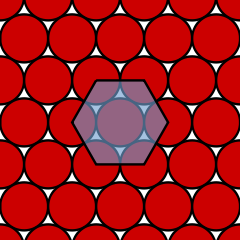
Jigsaw puzzles are typically labeled with their finished area and number of pieces. With this information, is it possible to estimate the area required to lay each piece flat before assembly? We derive a simple formula based on two-dimensional circular packing and show that the unassembled puzzle area is $\sqrt{3}$ times the assembled puzzle area, independent of the number of pieces. We perform measurements on 9 puzzles ranging from 333 cm$^2$ (9 pieces) to 6798 cm$^2$ (2000 pieces) and show that the formula accurately predicts realistic assembly scenarios.
arXiv.org
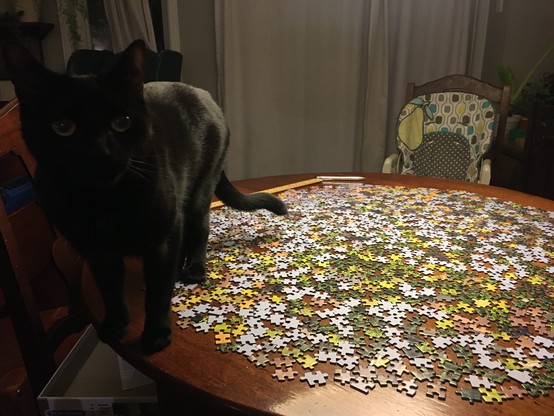
This work was a pandemic collaboration between me and the brilliant Kent Bonsma-Fisher, with assistance from our toddler and cat. The result, in his words, was "the cleanest dataset I have ever collected." Today our results are public on #arXiv!
TL;DR: an unassembled jigsaw puzzle takes up an area that is the square root of 3 times the area of the assembled puzzle, or about 1.7 times the assembled area. This is *independent of the number of pieces*.
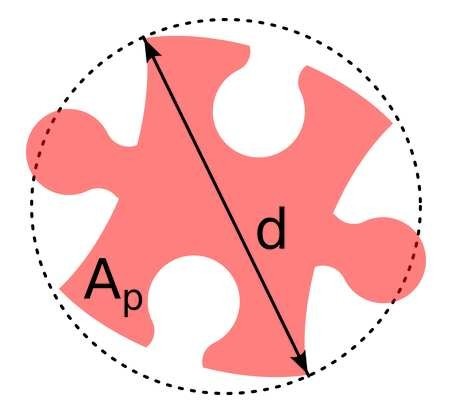
We derived a theory with a "spherical cow in a vacuum" approach: we approximated each puzzle piece area as a circle, then calculated the area of the circles packed together. Our prediction: the unassembled area is sqrt(3) times the assembled area. Then we took data.

@mbonsma I saw the initial claim, disagreed, came here, this is the key point.

You have some nice, orderly definition of jigsaw pieces which you haven't explicated in this thread which does not allow for topologically complicated pieces. For example, what if many piece have thin "tendrils" which are as long and as wide as the whole puzzle? (I won't even go into what might be possible with jigsaw pieces that aren't measurable sets, see the Banach-Tarski paradox!)

@TomSwirly @mbonsma I must’ve skipped over the “topologically complicated” section of puzzles in my local bookstore.

@stillmoms @mbonsma

"Topologically complicated" might be simple as a bunch of long, thin right-angle pieces.

The proof seems to assume that puzzle pieces are neatly bounded by small circles, which is very specific, you can think of all sorts of interesting puzzles where this would not be the case.

If you're going to claim to have a proof, the conditions need to rule any edge cases where it doesn't work, or it isn't a proof.

@TomSwirly @mbonsma I'm no scientist, nor mathematician, but my impression is that this is not being offered as some sort of rigorous, theoretical mathematical proof applicable to all real or imagined puzzles—it's a study of "typical" jigsaw puzzles in the real world, meant to predict “realistic assembly scenarios”. The word "proof" appears nowhere.

Grousing that it doesn't address unrealistic, imaginary puzzles is like complaining that a Klein bottle is a bad vessel for transporting liquids.

@stillmoms @mbonsma

Oops, I'm sorry, you're right - "proof" didn't appear in there, I thought it did. Yes, my standards are lower for non-proofs. 😃

I don't see a puzzle with long or thin shapes in it as being "unrealistic" though.

One of the simplest non-trivial tiling puzzles are pentominos https://en.wikipedia.org/wiki/Pentomino#Constructing_rectangular_dimensions which have both long and right angle pieces.

Pentomino - Wikipedia

@TomSwirly @stillmoms you are very welcome to develop a more comprehensive theory of puzzle packing area!