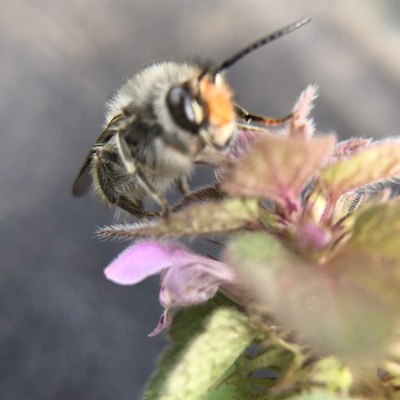
I still cannot get over the wonder and mystery of what gall wasps can do to plants. This is bio-engineering! The wasp lays her egg and somehow the plant makes a structure that is not a fruit, it is not a seed, it is not a leaf or stem. It's a wholly recombinant architecture customized to the needs of the growing young larva. The plant provides food and shelter-- It's like a cancer, but with a purpose.

How did it evolve? How is it done!?

(Photo by Timothy Boomer, https://wildmacro.com/)

Natural History Photography | Wild Macro

Insect, Spider, Wildflower, Mushroom & Natural History Fine Art Photography By Timothy Boomer.

@futurebird and (at least in some cases) it stops growing when the wasp doesn't need it any more
@futurebird i describe it as a benign growth, like those random lumps old dogs get, but one you can live inside

@futurebird

There is a great article producing "how did that evolve" and "what the hell is going on here" and a little "they can do that?" And a couple "wait, what's"

"Plant Cells of Different Species Can Swap Organelles"

"In grafted plants, shrunken chloroplasts can jump between species by slipping through unexpected gateways in cell walls."

https://www.quantamagazine.org/plant-cells-of-different-species-can-swap-organelles-20210120/

Plant Cells of Different Species Can Swap Organelles

In grafted plants, shrunken chloroplasts can jump between species by slipping through unexpected gateways in cell walls.

Quanta Magazine
@kevinrns @futurebird Wait, what? I'm not a biologist, but whoa!
@leftfieldfarm @kevinrns @futurebird why stick with plants: there is a species of sea slug that can steal chloroplasts, and apparently have them continue to work for them, creating photosynthetic slugs.

@sophieschmieg @leftfieldfarm @futurebird

Stealing is the wrong word.

A cell shrinks its own chloroplasts, the photosynthesis structures (!) down to a fraction of their useful size, like it always had the ability (what?) and opens a hole in its cell wall (what? WHAT?) large enough (what?) to pass these structures out.... and the OTHER SPECIES cell walls open up (what!?) And the structures allowing eating sunlight are INSTALLED (WHAT?)

A priori mutual life support. A PRIORI.

WHAT?!

@sophieschmieg @leftfieldfarm @futurebird

Just think about it, we HAVE NO IDEA how hive minds work. Insects organize the behavious of individual creatures to accomplish massive complex tasks, building bridges, carrying plant matter that can rot over great distanxes so it can be installed to rot in another place.

And this is a cell (A CELL) acting to preserve not just another family member, "here ya go mike" but to a different species.

@kevinrns @sophieschmieg @leftfieldfarm We have some ideas- if you’re talking eusocial insects — i don’t think anything has a true “hive mind” in the sense of linked thinking— but super organisms like ants do make decisions. And we know a bit about how!

@futurebird @sophieschmieg @leftfieldfarm

a bit. I used the example of the hive mind to highlight how motivation for action, and the process of determining WHAT action, and the process of communicating those complexities to millimeter scaled complexities represent inherent properties of life.

How does a hive mind determine a war would be bad, and standing in the way would help, and how distribute evenly . . . the NUMBER of choices diasplayed here astounds me.

@currentbias @futurebird @sophieschmieg @leftfieldfarm

Its hard to see, but the ants have a line of ants, just like the bigger termites ...

@kevinrns @futurebird @sophieschmieg @leftfieldfarm hive mind maybe not determine that, but the META hive mind does. i.e. the hive mind of millions of generations of evolving hives
@kevinrns "The only way to win is not to play".

@futurebird @sophieschmieg @leftfieldfarm

Yeah, the hive mind has chemical structures that can transit various levels of instruction for action, sure, but a choice was made to not war in the ant gif, a choice was made to stop it by separation, and on and on up a GANTT diagram.

So the chemicals can transmit action, but how the mountain of choices was sifted to stimulate the chemical clues distributed, is the "huhhh whaaa?" of the behavior.

@futurebird @kevinrns @sophieschmieg @leftfieldfarm yes... for instance see the works of
Thomas Seeley on honeybees
and
Deborah Gordon on Pheidole ants

@sophieschmieg @leftfieldfarm @kevinrns @futurebird The streams are crossing in the most delightful way possible. From a couple of days ago:

https://youtu.be/Jm7nZMHX2Cs

These Sea Slugs EAT SUNLIGHT and RIP THEIR OWN HEADS OFF 🤘🔥🤘 | Alien Ocean

YouTube
@futurebird We need to figure out how they do it and use similar techniques to build living, growing, carbon-negative buildings.
@futurebird Not all galls are so pretty.
@MacSmiley @futurebird ::tiny insect real estate agent voice:: they're "rustic" and have "character"
@MacSmiley @futurebird “Oh, this is pretty. Wait, they said not so pretty. Looks up thread. Yeah, I can see how this tree isn’t as nice and colorful. But still somewhat pretty.”
@becomingwisest @futurebird You have some gall to tell me that’s a pretty tree. 😜
@futurebird that's a fairy house, of course.

@futurebird

I knew nothing about this. This is sooo fascinating.

@futurebird
Aren't figs made like this too?

Figs... those sweet wonderful pockets of yummmm?!

@futurebird it made a little mushroom house!
@futurebird its a cute little cute mushroom hut for baby wasps!!! :3 :3
@futurebird Insect had some agent in its egg-goop that caused a lesion on the leaf that protected its eggs somewhat, then that advantage evolved. Not much more astounding than an eye imo 😄
@futurebird smol house for angry bee
@futurebird At a young age, I was fascinated by the "galls" on some weed stems in Ontario. I opened up several to discover a tiny larva inside and since then have been fascinated by how insects and plants co-evolved.

@futurebird I would suspect a symbiosis here, in the sense the plant would not have evolved to do that unless there were some evolutionary benefit to the plant. Perhaps the wasp offers protection against other predators or infections by some means.

As a winemaker I've been observing and studying something similar in connection with the relationship between apples and grapes and endogenous yeasts which used to be called "wild" but the properties of which now seem anything but wild. These yeasts seem to grow inside the fruits because they survive a wash in tapwater.

When I crush locally sourced unsprayed apples to make natural cider, the endogenous yeasts also produce better tasting cider than cultivated wine yeasts based on comparative observation and tasting.

@futurebird Consider mitochondria.
Did we get infected with them?
Or did we absorb them to exploit their special oxygen-handling skills?
Now they're "organs" for our individual cells.

Similarly for chloroblasts in plants.

With some insect-plant relationships, we might wonder if they're really separate at all.

@futurebird The science fiction species I'm writing are plant-people. Their "technology" is largely biohacking of their (and other plant) physiology.

A backpack? It's a living plant grafted to the host. A space ship? One of the People sacrificed themselves to be mutated into that vessel. Communication and transportation? "World trees" link colonies whose space-born seeds offer zero-risk expansion. #peirspapre #spapre

The complexity of life and its interactions will never cease to amaze.

@alice That sounds AMAZING!!!!
@alice @futurebird This reminds me a lot of the Zerg from Starcraft (and their method of evolution/creation), except considerably less evil.

@lawlznet @futurebird Well, and key point: consciously derived. The Zerg weren't really given a choice in the matter.

But don't worry, the evil snuck in with the #spapre goddess during the formation of the universe. But its goal is survival; hard to call that truly evil—except to the exclusion of all life which it sees as antithetical in the long-term. Parasitic, almost. But parasitic to universes.

(Life speeds up the "heat-death" of the universe… that evil sure takes a long view of things!)

@alice @futurebird "Life... uh... finds a way." :p

@lawlznet @futurebird (with some internal knowledge not as yet shared)

👹 And wave functions… collapse.

@alice @futurebird Is this something You are working on for its own sake, or is it part of a novel or game? I want to learn more about these industrious plant people! 😃

@yewscion @futurebird I’m planning on swapping my instance over to something more conducive to long-form posting, to better share what I’ve got. Short answer: both.

I have a #Stellaris species collection + series of event chains (my favourite chain: archaeologists excavating an archaeologist excavation… yo dawg) as well as at least two novels planned. “Children of the People” (the term for orphans of war) and one covering the Awakening (to being a sentient species) and the first #spapre Avatar.

@alice @futurebird Exciting! I'll look forward to Your future postings on them! 😃 Thanks for sharing!
@alice @yewscion @futurebird I'm super interested in a #Stellaris species collection and some wacky space archaeology stories.
@futurebird Have you read Venomous Lumpsucker? There's a bit about wasps that this reminded me of. Also a fantastic satire on biodiversity and capitalism.
@futurebird TINY LITTLE MUSHROOM HOUSE (っ◕ヮ◕ς)
@futurebird I think it was Harold Bloom who once said "all wonder is the effect of novelty upon ignorance." A depressing and small-minded way of thinking about the world, imo.

Given that Mr. Bloom said this in the context of contemplating omniscience or "infinite knowledge", it's ironic that the wonder we experience only
increases with knowledge and greater understanding.

The ignorant person doesn't appreciate how amazing even some of the simplest things in nature really are. They don't give it much thought at all. Even a single cell is a fascinatingly intricate and endlessly interesting piece of biological machinery.

Embrace the wonder!
😍
@futurebird
Brilliant thread of replies. I've learnt so much.
Thought provoking.
@futurebird The ability of wasps to mess with other organisms to raise their young knows no bounds.