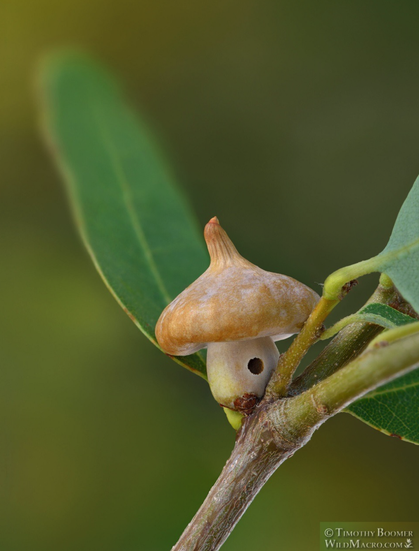
I still cannot get over the wonder and mystery of what gall wasps can do to plants. This is bio-engineering! The wasp lays her egg and somehow the plant makes a structure that is not a fruit, it is not a seed, it is not a leaf or stem. It's a wholly recombinant architecture customized to the needs of the growing young larva. The plant provides food and shelter-- It's like a cancer, but with a purpose.

How did it evolve? How is it done!?

(Photo by Timothy Boomer, https://wildmacro.com/)
Natural History Photography | Wild Macro

Insect, Spider, Wildflower, Mushroom & Natural History Fine Art Photography By Timothy Boomer.

@futurebird

There is a great article producing "how did that evolve" and "what the hell is going on here" and a little "they can do that?" And a couple "wait, what's"

"Plant Cells of Different Species Can Swap Organelles"

"In grafted plants, shrunken chloroplasts can jump between species by slipping through unexpected gateways in cell walls."

https://www.quantamagazine.org/plant-cells-of-different-species-can-swap-organelles-20210120/

Plant Cells of Different Species Can Swap Organelles

In grafted plants, shrunken chloroplasts can jump between species by slipping through unexpected gateways in cell walls.

Quanta Magazine
@kevinrns @futurebird Wait, what? I'm not a biologist, but whoa!
@leftfieldfarm @kevinrns @futurebird why stick with plants: there is a species of sea slug that can steal chloroplasts, and apparently have them continue to work for them, creating photosynthetic slugs.

@sophieschmieg @kevinrns @futurebird

Now I've gotta learn more biology. :D