
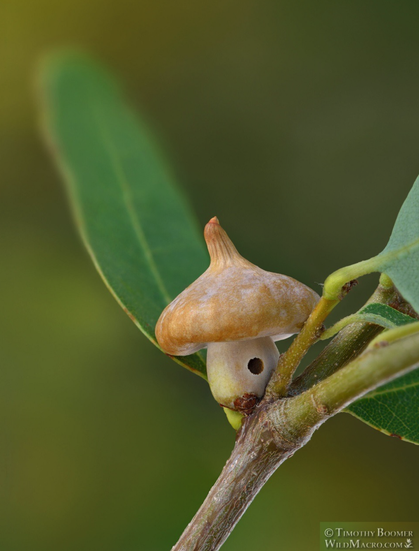
I still cannot get over the wonder and mystery of what gall wasps can do to plants. This is bio-engineering! The wasp lays her egg and somehow the plant makes a structure that is not a fruit, it is not a seed, it is not a leaf or stem. It's a wholly recombinant architecture customized to the needs of the growing young larva. The plant provides food and shelter-- It's like a cancer, but with a purpose.

How did it evolve? How is it done!?

(Photo by Timothy Boomer, https://wildmacro.com/)
Natural History Photography | Wild Macro

Insect, Spider, Wildflower, Mushroom & Natural History Fine Art Photography By Timothy Boomer.

@futurebird The science fiction species I'm writing are plant-people. Their "technology" is largely biohacking of their (and other plant) physiology.

A backpack? It's a living plant grafted to the host. A space ship? One of the People sacrificed themselves to be mutated into that vessel. Communication and transportation? "World trees" link colonies whose space-born seeds offer zero-risk expansion. #peirspapre #spapre

The complexity of life and its interactions will never cease to amaze.

@alice @futurebird This reminds me a lot of the Zerg from Starcraft (and their method of evolution/creation), except considerably less evil.

@lawlznet @futurebird Well, and key point: consciously derived. The Zerg weren't really given a choice in the matter.

But don't worry, the evil snuck in with the #spapre goddess during the formation of the universe. But its goal is survival; hard to call that truly evil—except to the exclusion of all life which it sees as antithetical in the long-term. Parasitic, almost. But parasitic to universes.

(Life speeds up the "heat-death" of the universe… that evil sure takes a long view of things!)

@alice @futurebird "Life... uh... finds a way." :p

@lawlznet @futurebird (with some internal knowledge not as yet shared)

👹 And wave functions… collapse.