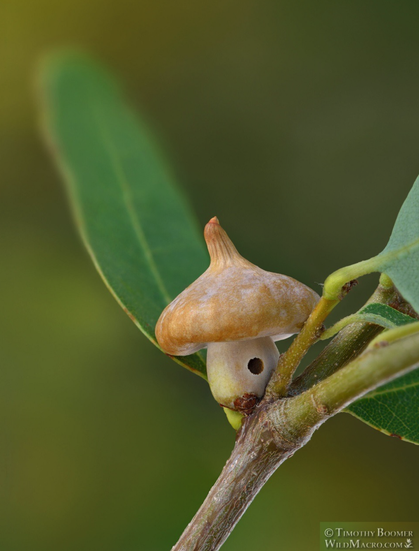
I still cannot get over the wonder and mystery of what gall wasps can do to plants. This is bio-engineering! The wasp lays her egg and somehow the plant makes a structure that is not a fruit, it is not a seed, it is not a leaf or stem. It's a wholly recombinant architecture customized to the needs of the growing young larva. The plant provides food and shelter-- It's like a cancer, but with a purpose.

How did it evolve? How is it done!?

(Photo by Timothy Boomer, https://wildmacro.com/)
Natural History Photography | Wild Macro

Insect, Spider, Wildflower, Mushroom & Natural History Fine Art Photography By Timothy Boomer.

@futurebird

There is a great article producing "how did that evolve" and "what the hell is going on here" and a little "they can do that?" And a couple "wait, what's"

"Plant Cells of Different Species Can Swap Organelles"

"In grafted plants, shrunken chloroplasts can jump between species by slipping through unexpected gateways in cell walls."

https://www.quantamagazine.org/plant-cells-of-different-species-can-swap-organelles-20210120/

Plant Cells of Different Species Can Swap Organelles

In grafted plants, shrunken chloroplasts can jump between species by slipping through unexpected gateways in cell walls.

Quanta Magazine
@kevinrns @futurebird Wait, what? I'm not a biologist, but whoa!
@leftfieldfarm @kevinrns @futurebird why stick with plants: there is a species of sea slug that can steal chloroplasts, and apparently have them continue to work for them, creating photosynthetic slugs.

@sophieschmieg @leftfieldfarm @futurebird

Stealing is the wrong word.

A cell shrinks its own chloroplasts, the photosynthesis structures (!) down to a fraction of their useful size, like it always had the ability (what?) and opens a hole in its cell wall (what? WHAT?) large enough (what?) to pass these structures out.... and the OTHER SPECIES cell walls open up (what!?) And the structures allowing eating sunlight are INSTALLED (WHAT?)

A priori mutual life support. A PRIORI.

WHAT?!

@sophieschmieg @leftfieldfarm @futurebird

Just think about it, we HAVE NO IDEA how hive minds work. Insects organize the behavious of individual creatures to accomplish massive complex tasks, building bridges, carrying plant matter that can rot over great distanxes so it can be installed to rot in another place.

And this is a cell (A CELL) acting to preserve not just another family member, "here ya go mike" but to a different species.

@kevinrns @sophieschmieg @leftfieldfarm We have some ideas- if you’re talking eusocial insects — i don’t think anything has a true “hive mind” in the sense of linked thinking— but super organisms like ants do make decisions. And we know a bit about how!

@futurebird @sophieschmieg @leftfieldfarm

Yeah, the hive mind has chemical structures that can transit various levels of instruction for action, sure, but a choice was made to not war in the ant gif, a choice was made to stop it by separation, and on and on up a GANTT diagram.

So the chemicals can transmit action, but how the mountain of choices was sifted to stimulate the chemical clues distributed, is the "huhhh whaaa?" of the behavior.