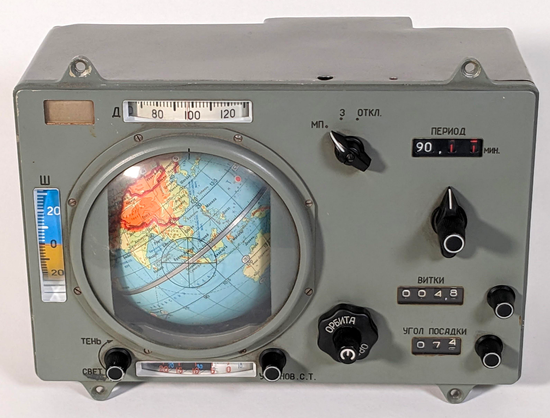
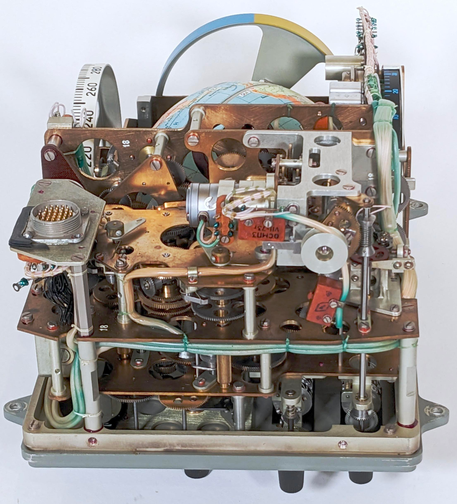
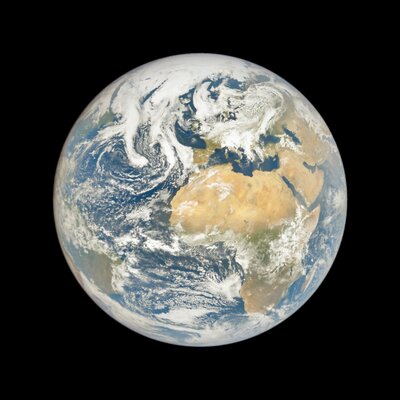
The Globus INK (1967) is a remarkable piece of Soviet spacecraft equipment. Its rotating globe showed cosmonauts the position of their Soyuz spacecraft. An electromechanical analog computer, it used gears, cams, and differentials to compute the position. Let's look inside 🧵
The Globus used complex gear trains driven by solenoids to move the globe.
The globe uses a clever mechanism to rotate in two dimensions. Rotating along the dotted axis traces out the 51.8° orbit. Turning a concentric shaft causes the two halves of the globe to rotate around the polar axis, held by the fixed metal equator.
The spacecraft's initial position was entered into the Globus by turning the central knob, rotating the globe. The Globus did not receive any position input from an inertial measurement unit (IMU) but just projected the spacecraft's location from the initial value.
The orbital period could be adjusted ±5 minutes. Followers riding on a spiral cone cam turned at adjustable speeds based on their position, slow at the top, faster at the bottom. Three adjustments (minutes, tenths, and hundredths) were added by differential gears.
Latitude and longitude were displayed on indicators. They depended on complex trig functions, computed by specially-shaped cams. Coincidentally, the latitude indicator matches the Ukrainian flag. 🇺🇦
The globe showed geographical features as well as the boundaries of the USSR and politically-aligned regions. As well as tracking their position, cosmonauts could judge the safety of potential landing sites, both physically and politically.
But why does the globe have dots indicating NASA communication sites such as Goldstone, Bermuda, and Merritt Island? This Globus must be from the Apollo-Soyuz project (1975), where an Apollo spacecraft docked with Soyuz in orbit.
To determine the landing position, the globe rotated through a specified angle, simulating a partial orbit. A drive motor did this rotation, stopping when the swing arm hit the adjustable angle limit switch. A second limit switch handled rotation back to the orbital position.
This photo shows the Globus in the Soyuz-TM control panel (1986). Soviet control panels were very different from American ones, grids of buttons instead of masses of switches and meters.
Source: https://web.mit.edu/slava/space/essays/essay-tiapchenko4.htm
IDS for Soyuz-TMA and the International Space Station

Here's a closer look at three sets of differential gears. The Globus made heavy use of differentials to add or subtract rotational values.
Although mostly mechanical, the Globus used relays to control the landing position motor. Pairs of diodes across the relays absorbed inductive kickback. A potentiometer to output the orbital position as a voltage.
This view of the Globus shows the wiring bundles. There are a lot of wires for a device that is mostly mechanical.
For more details on the Globus INK, see my blog post: https://www.righto.com/2023/01/inside-globus-ink-mechanical-navigation.html.
Thanks to Marcel for providing the unit and letting us disassemble it. I hope to get it operational, so stay tuned.
Inside the Globus INK: a mechanical navigation computer for Soviet spaceflight

The Soviet space program used completely different controls and instruments from American spacecraft. One of the most interesting navigati...

@kenshirriff looks like the link doesn't work because it needs www. for the domain
@kenshirriff HTTP 404 error
@HeNeArXn It should work now; the original link didn't survive cut-and-paste.
@kenshirriff The Mercury spacecraft had a similar mechanical globe called the Earth Path Indicator: https://www.rrauction.com/auctions/lot-detail/340932005505026
Mercury Program Earth Path Indicator | Sold for $99,209 | RR Auction

Project Mercury Earth Path Indicator manufactured by the Minneapolis Honeywell Regulator Company, measuring 5″ x 5.25″ x 9.5″, with face featuring a window to interior Earth globe and five knobs marked “Orbit Time,” “Wind,” “Polar,” “Inclination Degrees,” and “Orbital.” The back plate is stamped “A 1959, MFD JUN 1960,” with Honeywell parts label affixed directly above: “MFRS. Part No. DJG280A1, Series A6, Serial No. J-17, Earth Path Indicator.” Includes four original faceplate screws. The device is still functional—turning the Wind knob makes the Earth slowly rotate as the mechanism ticks. The “Inclination Degrees” shows how many degrees from exactly along the equator the orbital track was, and is set for 32.5 degrees—the orbital inclination of Glenn’s MA-6 flight. fine condition, with expected wear from use. Consignor notes that it originates from the collection of a former NASA employee. The Earth Path Indicator (EPI), also called an Earth Orbit Indicator, was one of the navigational tools installed in the Mercury space capsule. An unusual precursor to a modern GPS, the device consists of a small revolving globe driven by a clockwork mechanism. Once in stable orbit, the astronaut would wind up the clockwork, and set the position of a tiny scale model of the Mercury capsule, under which the globe would slowly rotate. A means of replicating the Earth below, the EPI would inform the astronaut of his orbital tracking and where he was in relation to countries, cities, oceans, ground stations, and eventually the point of re-entry into the Earth’s atmosphere. This information was critical to making observations of the Earth, maintaining communications, and concluding the mission with a safe and successful splashdown. The EPI was launched in 1961 on an unmanned test flight, and then on the 1962 Mercury flights of John Glenn and Scott Carpenter, the first Americans to orbit the Earth. The EPI was ultimately deemed superfluous and was part of the hardware removed for Wally Schirra’s Mercury-Atlas 8 mission.

@emgre @kenshirriff interestingly that one doesn't seem to be driven at a great circle, so I wonder how that works reliably (since then it can't be fixed to the globe and be able to show every position?)
@kenshirriff amazing info, thanks for sharing!
@kenshirriff this is so fascinating. Thank you for the stellar write up on it!
@kenshirriff I suspect that its accuracy would have been poor, going by the mechanical nav kit I’ve used or seen used in Jaguar and Harrier.
@kenshirriff I'm fascinated by #9, which is right at the intersection of Honduras, Guatemala, and Belize. The nearest big city near the mark is San Pedro Sula, Honduras. But the closet *soviet-aligned* country would be Nicaragua, even though the mar is really too far west for that. But in 2017 ROSCOSMOS opened a GLOSNASS station in Laguna de Nejapa, Nicaragua, so its not impossible there was earlier coordination.
@kenshirriff Diplomatic relations between Honduras and the USSR weren't established until 1990, and even today the nearest embassy is in Nicaragua; but there was until recently an "honorary consulate" on the outskirts of San Pedro Sula, at "Plaza de Metal. Colonia El Playón, 2ª planta (contiguo a la Alianza Francesa), Código postal: 21101, San Pedro Sula"
https://goo.gl/maps/f3PesfjhPJKeSNZ7A
Bevor Sie zu Google Maps weitergehen

@kenshirriff The third possibility is Guatemala (which still claims the territory of Belize) which has had diplomatic relations with Russia since 1945, and they were "frozen" but not interrupted at the time of Apollo-Soyuz in 1975. That part of Guatemala is pretty undeveloped, though. *Maybe* Puerto Barrios could have supported a tracking site?
@cscott Those are interesting suggestions. I did a bunch of web searching to try to figure out what #9 marks on the map but couldn't determine anything.
@kenshirriff Yes, me too. I lived in Guatemala and Honduras for a number of years growing up, and just judging from level of economic activity/ready availability of logistical support I'd say that San Pedro Sula is the most likely option. I'd love to take a look at the honorary consulate there and see if there are any remaining traces of a tracking dish, which must have been fairly large. I don't think the Puerto Barrios region in Guatemala could have supported the construction, transportation, and logistics needs of a large dish. On the other hand, if it was intended to be *covert*, then there is plenty of dense terrain there in which to hide a station, and it's *possible* you could ship large pieces in from the Caribbean port. That would be some spy-thriller stuff, though, and I can't imagine the three-letter agencies in the US would be too happy about the USSR operating heavy machinery covertly on our doorstep.

@kenshirriff Huh, North Korea is outside of the red border?
@PavelASamsonov @kenshirriff I guess they knew which friends were reliable and which ones were not.
@KanaMauna @kenshirriff Then it's weird to have Yugoslavia on there given that Tito was explicitly anti-Soviet by 1975.
@kenshirriff @PavelASamsonov True. Maybe this item dates to early in the Apollo-Soyuz project, which started in 1972?
Ken Shirriff (@[email protected])

Attached: 1 image But why does the globe have dots indicating NASA communication sites such as Goldstone, Bermuda, and Merritt Island? This Globus must be from the Apollo-Soyuz project (1975), where an Apollo spacecraft docked with Soyuz in orbit.

OldBytes Space - Mastodon
@kenshirriff @KanaMauna Yeah but Yugoslavia split with the USSR in 1948, there's no time during the space race when it would have been considered an ideological ally
@PavelASamsonov @kenshirriff @KanaMauna
They somewhat reconciled under Khruschev (see the Belgrade declaration of 1955). The Hungarian revolution soured the things, but probably Yugoslavia was still a better bet than China or NK (due to the fresh Sino-Soviet split)
@kenshirriff as a kid of the '80, that's a strange series of country boundaries in the European zone, I mean, Poland with both Germanies?

@kenshirriff Creating a physical mechanism to do this is really cool. But the "no positional input" part is a little less amazing when you realize that the TLEs they use nowadays to predict orbital positions do this exact same thing.

The craft is traveling ballistically, so its position is uniquely determined by the starting conditions. This was has been routine math for decades.

But again, make it portable and mechanical is super neat.

@kenshirriff Seeing Monrovia on the Globus makes me both happy and wonder about the criteria for being on there.
I know Gagarin visited Liberia in '62 as part of some cultural exchange, but I didn't think the relationship was more significant than that.
@kenshirriff How do you drive gear trains with a solenoid? I see a spring and lever arm. Is it a ratchet mechanism? If they were able to time a solenoid accurately, that would make their time tracking problem a lot simpler. It could be a "mechanical crystal" oscillator timepiece.
@davidr The solenoid receives 1 hertz pulses from the spacecraft's timing unit. The solenoid drives a ratchet that turns the wheel one tooth at a time.
@kenshirriff Sooo...yes. The solenoid is taking the place of a piezoelectric crystal or a simple mechanical pendulum. A sort of hybrid electromechanical time regulation core.
@davidr No, the solenoid is just a solenoid and doesn't provide any regulation. If you pulse it half as fast, the globe turns half as fast. The quartz crystal is in the spacecraft's timing unit. See my article on the Soyuz clock: http://www.righto.com/2020/01/inside-digital-clock-from-soyuz.html
Inside the digital clock from a Soyuz spacecraft

We recently obtained a clock that flew on a Soyuz space mission. 1 The clock, manufactured in 1984, is much more complex inside than you'd ...

@kenshirriff I mean...if you pulse a pendulum half as fast a grandfather clock also runs slow. That's what a time regulator is supposed to do.

But the point that the 1Hz signal is generated elsewhere is a fair one. The solenoid is a time regulation translator from the electrical realm to the mechanical.

@davidr @kenshirriff
The beats of a pendulum is governed by the length of the pendulum. The pendulum is not pulsed as part of the time keeping the escapement provides the energy to keep the pendulum oscillating.
@kenshirriff I’ve seen one of those! So cool to learn how it works 🤩
Inside the digital clock from a Soyuz spacecraft

We recently obtained a clock that flew on a Soyuz space mission. 1 The clock, manufactured in 1984, is much more complex inside than you'd ...

@kenshirriff I want this in my car's dash

@kenshirriff

Otherwise known as an Antikythera...

@kenshirriff I wonder if it would be feasible to make a 3D-printed functioning replica
@kenshirriff Really cool. Looks like a rabbit hole I need to go down.
@kenshirriff what an incredible yet cheesy looking piece of tech. kudos for the alttext on everything too!!
@kenshirriff so clever! We had on in the office back at Maxis, but I never dared look inside to see how it works…
@cypnk, this thread might be relevant to your interests 👆
@kenshirriff This is really interesting, it would be really cool to see this thing working. Would it be loud?
@bxroberts I think just click-click-click from the solenoids.
@kenshirriff couldn’t they just look out the window????