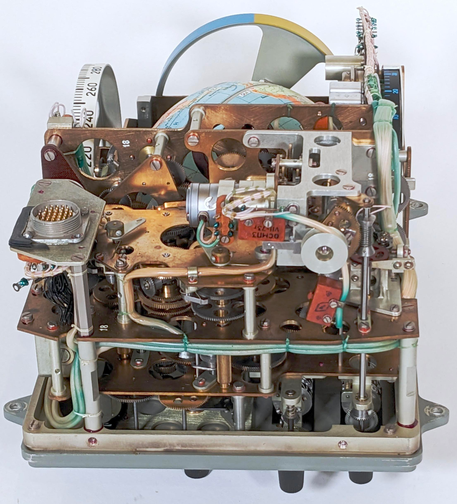
The Globus INK (1967) is a remarkable piece of Soviet spacecraft equipment. Its rotating globe showed cosmonauts the position of their Soyuz spacecraft. An electromechanical analog computer, it used gears, cams, and differentials to compute the position. Let's look inside 🧵
The Globus used complex gear trains driven by solenoids to move the globe.
The globe uses a clever mechanism to rotate in two dimensions. Rotating along the dotted axis traces out the 51.8° orbit. Turning a concentric shaft causes the two halves of the globe to rotate around the polar axis, held by the fixed metal equator.
The spacecraft's initial position was entered into the Globus by turning the central knob, rotating the globe. The Globus did not receive any position input from an inertial measurement unit (IMU) but just projected the spacecraft's location from the initial value.
The orbital period could be adjusted ±5 minutes. Followers riding on a spiral cone cam turned at adjustable speeds based on their position, slow at the top, faster at the bottom. Three adjustments (minutes, tenths, and hundredths) were added by differential gears.
Latitude and longitude were displayed on indicators. They depended on complex trig functions, computed by specially-shaped cams. Coincidentally, the latitude indicator matches the Ukrainian flag. 🇺🇦
The globe showed geographical features as well as the boundaries of the USSR and politically-aligned regions. As well as tracking their position, cosmonauts could judge the safety of potential landing sites, both physically and politically.
@kenshirriff Huh, North Korea is outside of the red border?
@PavelASamsonov @kenshirriff I guess they knew which friends were reliable and which ones were not.
@KanaMauna @kenshirriff Then it's weird to have Yugoslavia on there given that Tito was explicitly anti-Soviet by 1975.
@kenshirriff @PavelASamsonov True. Maybe this item dates to early in the Apollo-Soyuz project, which started in 1972?
 Ken Shirriff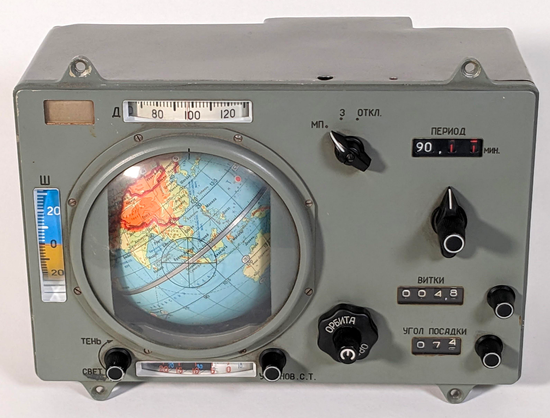


 Pavel A. Samsonov
 KanaMauna
 первичный бульон с пельмешками