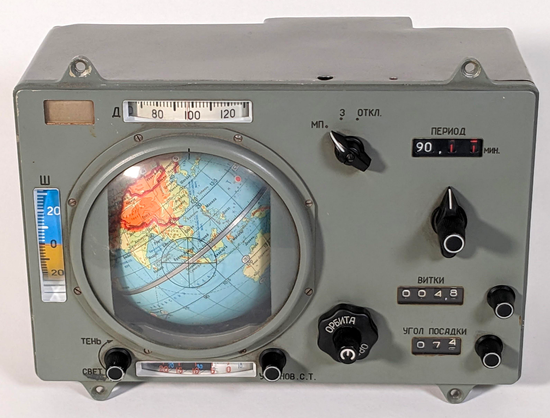
The Globus INK (1967) is a remarkable piece of Soviet spacecraft equipment. Its rotating globe showed cosmonauts the position of their Soyuz spacecraft. An electromechanical analog computer, it used gears, cams, and differentials to compute the position. Let's look inside đź§µ
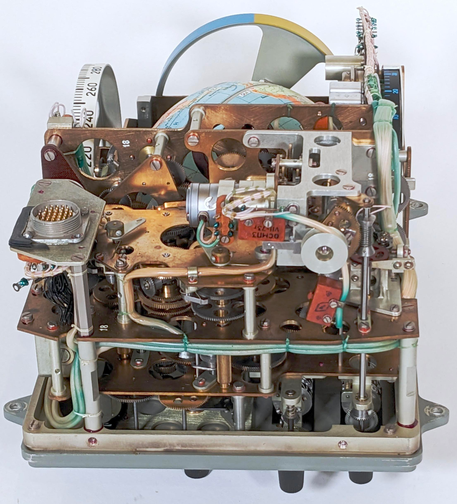
The Globus used complex gear trains driven by solenoids to move the globe.
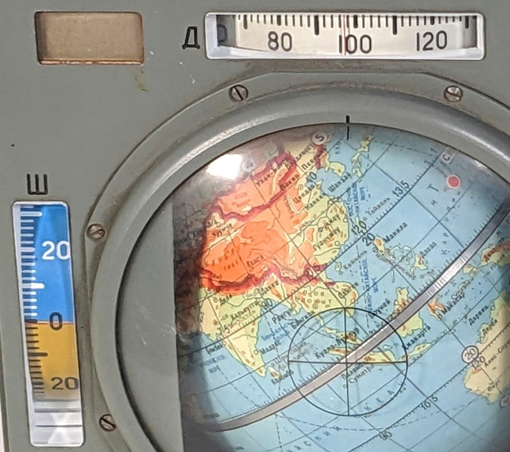
The globe uses a clever mechanism to rotate in two dimensions. Rotating along the dotted axis traces out the 51.8° orbit. Turning a concentric shaft causes the two halves of the globe to rotate around the polar axis, held by the fixed metal equator.
The spacecraft's initial position was entered into the Globus by turning the central knob, rotating the globe. The Globus did not receive any position input from an inertial measurement unit (IMU) but just projected the spacecraft's location from the initial value.
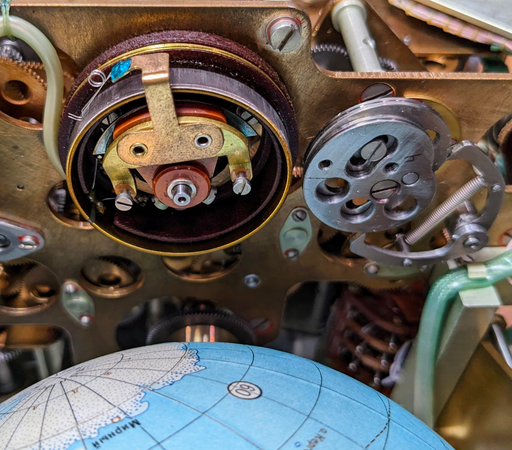
The orbital period could be adjusted ±5 minutes. Followers riding on a spiral cone cam turned at adjustable speeds based on their position, slow at the top, faster at the bottom. Three adjustments (minutes, tenths, and hundredths) were added by differential gears.
Latitude and longitude were displayed on indicators. They depended on complex trig functions, computed by specially-shaped cams. Coincidentally, the latitude indicator matches the Ukrainian flag. 🇺🇦
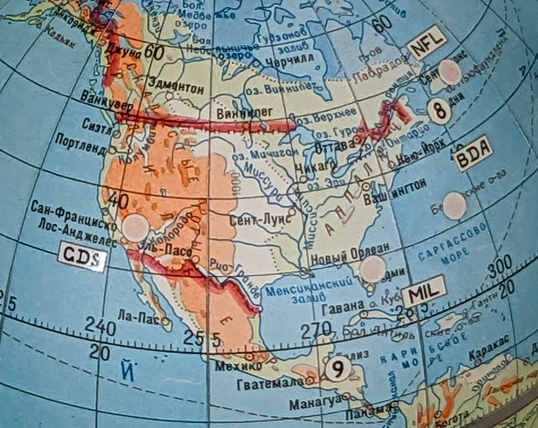
The globe showed geographical features as well as the boundaries of the USSR and politically-aligned regions. As well as tracking their position, cosmonauts could judge the safety of potential landing sites, both physically and politically.
But why does the globe have dots indicating NASA communication sites such as Goldstone, Bermuda, and Merritt Island? This Globus must be from the Apollo-Soyuz project (1975), where an Apollo spacecraft docked with Soyuz in orbit.
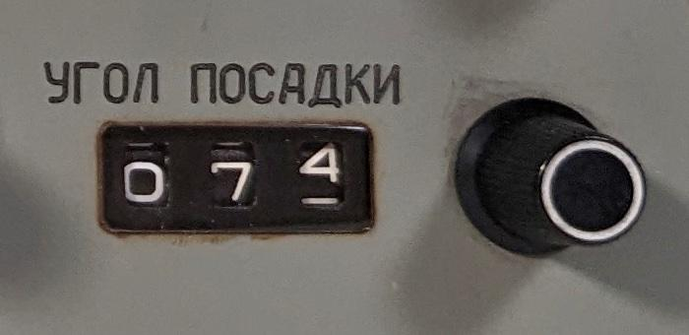
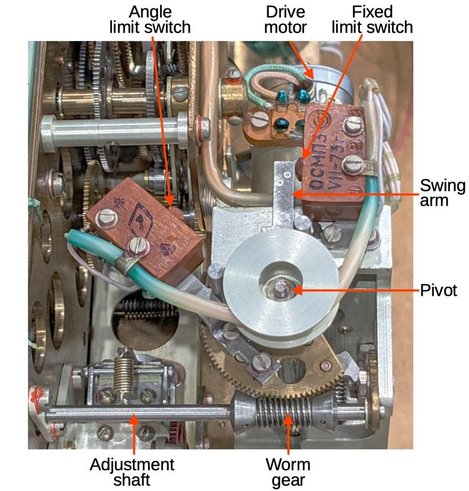
To determine the landing position, the globe rotated through a specified angle, simulating a partial orbit. A drive motor did this rotation, stopping when the swing arm hit the adjustable angle limit switch. A second limit switch handled rotation back to the orbital position.
This photo shows the Globus in the Soyuz-TM control panel (1986). Soviet control panels were very different from American ones, grids of buttons instead of masses of switches and meters.
Source: https://web.mit.edu/slava/space/essays/essay-tiapchenko4.htm
IDS for Soyuz-TMA and the International Space Station

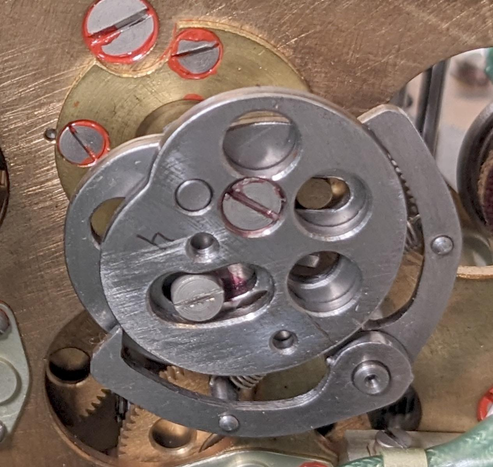
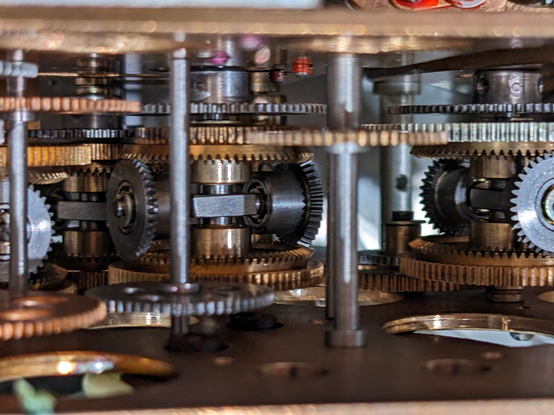
Here's a closer look at three sets of differential gears. The Globus made heavy use of differentials to add or subtract rotational values.
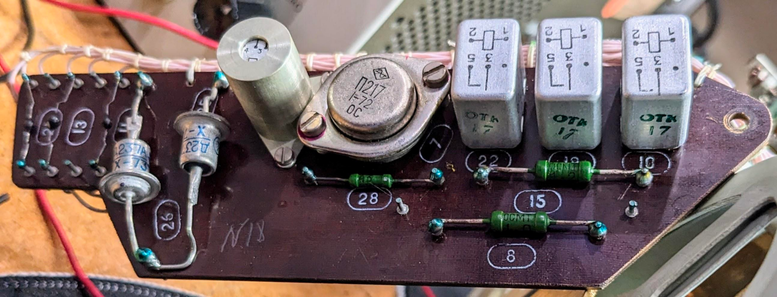
Although mostly mechanical, the Globus used relays to control the landing position motor. Pairs of diodes across the relays absorbed inductive kickback. A potentiometer to output the orbital position as a voltage.
This view of the Globus shows the wiring bundles. There are a lot of wires for a device that is mostly mechanical.
For more details on the Globus INK, see my blog post: https://www.righto.com/2023/01/inside-globus-ink-mechanical-navigation.html.
Thanks to Marcel for providing the unit and letting us disassemble it. I hope to get it operational, so stay tuned.
Inside the Globus INK: a mechanical navigation computer for Soviet spaceflight

The Soviet space program used completely different controls and instruments from American spacecraft. One of the most interesting navigati...

@kenshirriff looks like the link doesn't work because it needs www. for the domain
@kenshirriff HTTP 404 error
@HeNeArXn It should work now; the original link didn't survive cut-and-paste.
@kenshirriff The Mercury spacecraft had a similar mechanical globe called the Earth Path Indicator: https://www.rrauction.com/auctions/lot-detail/340932005505026
Mercury Program Earth Path Indicator | Sold for $99,209 | RR Auction

Project Mercury Earth Path Indicator manufactured by the Minneapolis Honeywell Regulator Company, measuring 5″ x 5.25″ x 9.5″, with face featuring a window to interior Earth globe and five knobs marked “Orbit Time,” “Wind,” “Polar,” “Inclination Degrees,” and “Orbital.” The back plate is stamped “A 1959, MFD JUN 1960,” with Honeywell parts label affixed directly above: “MFRS. Part No. DJG280A1, Series A6, Serial No. J-17, Earth Path Indicator.” Includes four original faceplate screws. The device is still functional—turning the Wind knob makes the Earth slowly rotate as the mechanism ticks. The “Inclination Degrees” shows how many degrees from exactly along the equator the orbital track was, and is set for 32.5 degrees—the orbital inclination of Glenn’s MA-6 flight. fine condition, with expected wear from use. Consignor notes that it originates from the collection of a former NASA employee. The Earth Path Indicator (EPI), also called an Earth Orbit Indicator, was one of the navigational tools installed in the Mercury space capsule. An unusual precursor to a modern GPS, the device consists of a small revolving globe driven by a clockwork mechanism. Once in stable orbit, the astronaut would wind up the clockwork, and set the position of a tiny scale model of the Mercury capsule, under which the globe would slowly rotate. A means of replicating the Earth below, the EPI would inform the astronaut of his orbital tracking and where he was in relation to countries, cities, oceans, ground stations, and eventually the point of re-entry into the Earth’s atmosphere. This information was critical to making observations of the Earth, maintaining communications, and concluding the mission with a safe and successful splashdown. The EPI was launched in 1961 on an unmanned test flight, and then on the 1962 Mercury flights of John Glenn and Scott Carpenter, the first Americans to orbit the Earth. The EPI was ultimately deemed superfluous and was part of the hardware removed for Wally Schirra’s Mercury-Atlas 8 mission.

@emgre @kenshirriff interestingly that one doesn't seem to be driven at a great circle, so I wonder how that works reliably (since then it can't be fixed to the globe and be able to show every position?)
@kenshirriff amazing info, thanks for sharing!
@kenshirriff this is so fascinating. Thank you for the stellar write up on it!
@kenshirriff I suspect that its accuracy would have been poor, going by the mechanical nav kit I’ve used or seen used in Jaguar and Harrier.