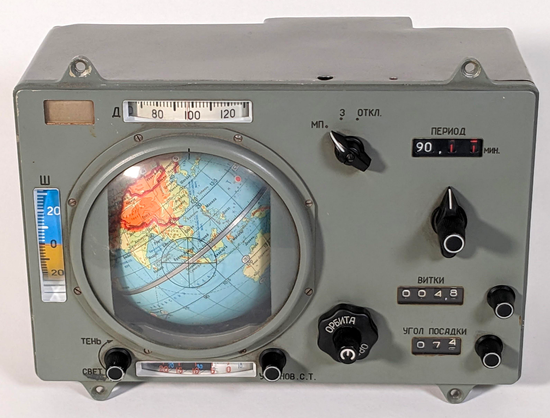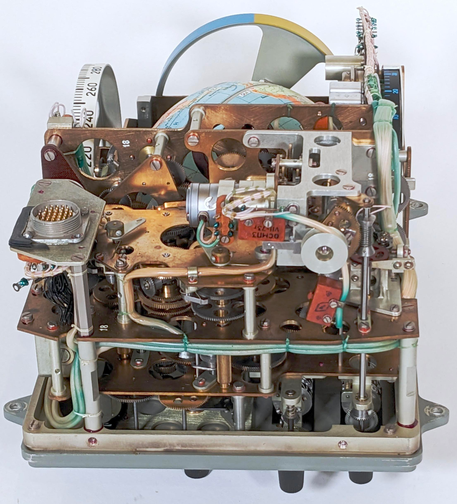
The Globus INK (1967) is a remarkable piece of Soviet spacecraft equipment. Its rotating globe showed cosmonauts the position of their Soyuz spacecraft. An electromechanical analog computer, it used gears, cams, and differentials to compute the position. Let's look inside ๐Ÿงต
The Globus used complex gear trains driven by solenoids to move the globe.
@kenshirriff How do you drive gear trains with a solenoid? I see a spring and lever arm. Is it a ratchet mechanism? If they were able to time a solenoid accurately, that would make their time tracking problem a lot simpler. It could be a "mechanical crystal" oscillator timepiece.
@davidr The solenoid receives 1 hertz pulses from the spacecraft's timing unit. The solenoid drives a ratchet that turns the wheel one tooth at a time.
@kenshirriff Sooo...yes. The solenoid is taking the place of a piezoelectric crystal or a simple mechanical pendulum. A sort of hybrid electromechanical time regulation core.
@davidr No, the solenoid is just a solenoid and doesn't provide any regulation. If you pulse it half as fast, the globe turns half as fast. The quartz crystal is in the spacecraft's timing unit. See my article on the Soyuz clock: http://www.righto.com/2020/01/inside-digital-clock-from-soyuz.html
Inside the digital clock from a Soyuz spacecraft

We recently obtained a clock that flew on a Soyuz space mission. 1 The clock, manufactured in 1984, is much more complex inside than you'd ...

@kenshirriff I mean...if you pulse a pendulum half as fast a grandfather clock also runs slow. That's what a time regulator is supposed to do.

But the point that the 1Hz signal is generated elsewhere is a fair one. The solenoid is a time regulation translator from the electrical realm to the mechanical.

@davidr @kenshirriff
The beats of a pendulum is governed by the length of the pendulum. The pendulum is not pulsed as part of the time keeping the escapement provides the energy to keep the pendulum oscillating.