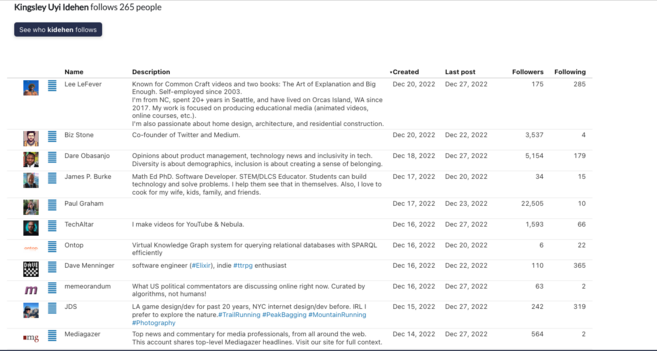
Here's a really neat @observablehq notebook (by @mauforonda ) for exploring @Mastodon follow-networks.

https://observablehq.com/@mauforonda/who-to-follow-on-mastodon

By offering a #CSV export option it simplifies the process of creating a shared #GoogleSpreadsheet rendition which is also a one-click journey to a #KnowledgeGraph.

https://docs.google.com/spreadsheets/d/18Pi1AeQezbTdjjPcb6ol0Rxwx-hq5JkA4RoPsTapPqw/edit#gid=1714230245&range=A1

/cc @judell

#DataConnectivity #OpenWeb

Who to follow on mastodon

Pick an interesting person See who they follow and select any you'd like to follow yourself Download a CSV you can import in your mastodon settings and follow them all ! ** ** follows ** ** ** ** of ** ** want to be discovered <sup>see below for an explanation</sup> Here's how you can import the CSV ... or maybe you want to download all entries and attributes in the table Why aren't all accounts shown in the table? Some people don't want their names to appear in directories. Here's the option in settings wh

Observable

Once data exists in structured form its reusability increases immensely.

For instance, I can construct a #CSV #URL scoped to my #GoogleSpreadheet (https://docs.google.com/spreadsheets/d/18Pi1AeQezbTdjjPcb6ol0Rxwx-hq5JkA4RoPsTapPqw/gviz/tq?tqx=out:csv&range=A1:AA729&sheet=ConsolidatedFollows) that functions as a Data Source Name (#DSN) for automated conversion into a #KnowledgeGraph using terms defined in a variety of vocabularies.

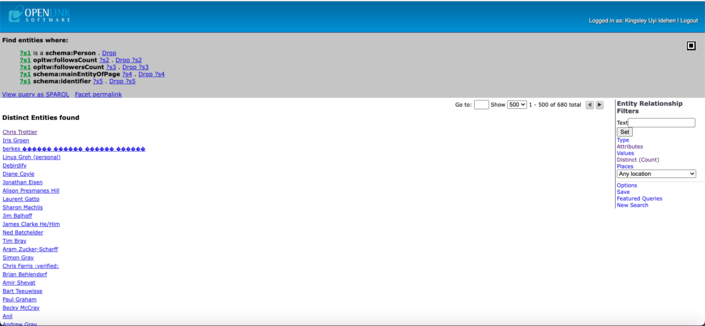
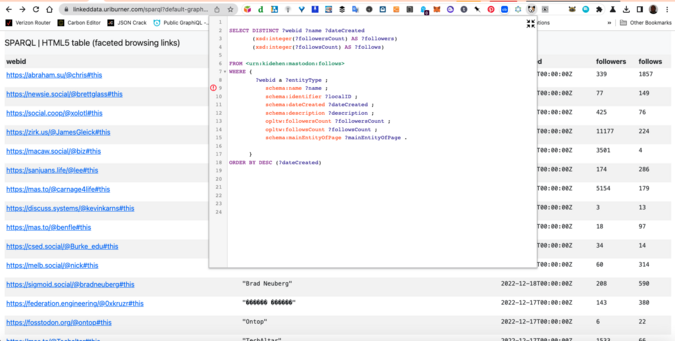
Here's a #SPARQL Query against said Knowledge Graph.

https://linkeddata.uriburner.com/sparql?default-graph-uri=&query=%23+DEFINE+get%3Asoft+%22soft%22+%0D%0ASELECT+DISTINCT+%3Fwebid+%3Fname+%3FdateCreated%0D%0A+++++++%23+%28+IF%28+%3FfollowsCount+%3E+0%2C+%28%3FfollowsCount+%2F+%3FfollowersCount%29%2C+%22NA%22%29+AS+%3FfollowerTofolloweeRatio+%29%0D%0A+++++++%28xsd%3Ainteger%28%3FfollowersCount%29+AS+%3Ffollowers%29%0D%0A+++++++%28xsd%3Ainteger%28%3FfollowsCount%29+AS+%3Ffollows%29%0D%0A+++++++%0D%0AFROM+%3Curn%3Akidehen%3Amastodon%3Afollows%3E+%0D%0AWHERE+%7B+%0D%0A++++++++%3Fwebid+a+%3FentityType+%3B%0D%0A+++++++++++schema%3Aname+%3Fname+%3B%0D%0A+++++++++++schema%3Aidentifier+%3FlocalID+%3B%0D%0A+++++++++++schema%3AdateCreated+%3FdateCreated+%3B%0D%0A+++++++++++schema%3Adescription+%3Fdescription+%3B%0D%0A+++++++++++opltw%3AfollowersCount+%3FfollowersCount+%3B%0D%0A+++++++++++opltw%3AfollowsCount+%3FfollowsCount+%3B+%0D%0A+++++++++++schema%3AmainEntityOfPage+%3FmainEntityOfPage+.%0D%0A%0D%0A++++++%7D+%0D%0AORDER+BY+DESC+%28%3FdateCreated%29%0D%0A%0D%0A%0D%0A%0D%0A%0D%0A&should-sponge=&format=text%2Fx-html%2Btr&timeout=30000

Just click to explore.

/cc @observablehq @mauforonda @Mastodon @judell

#LinkedData #DataConnectivity

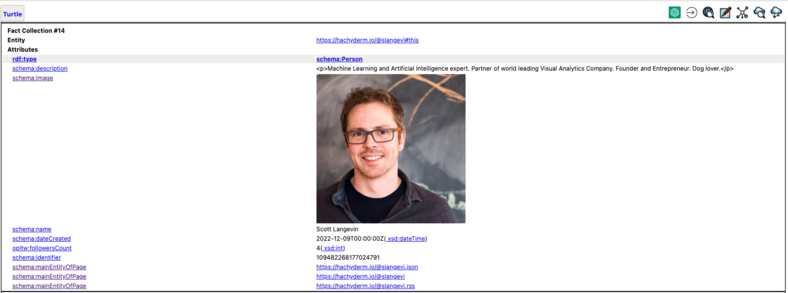
About: Scott Langevin

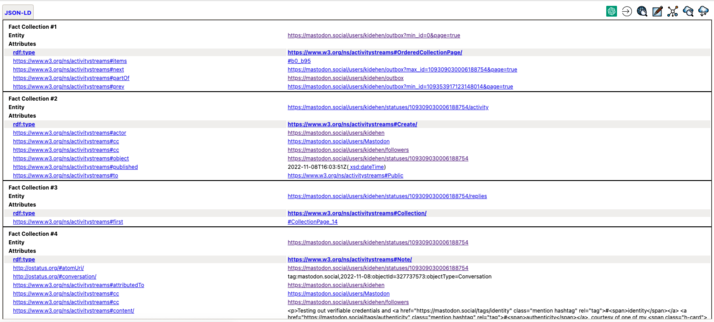
Also note a few important items exposed in the sample entity description page:

1. #ActivityStreams #URL
2. #RSS URL
3. Profile Page URL

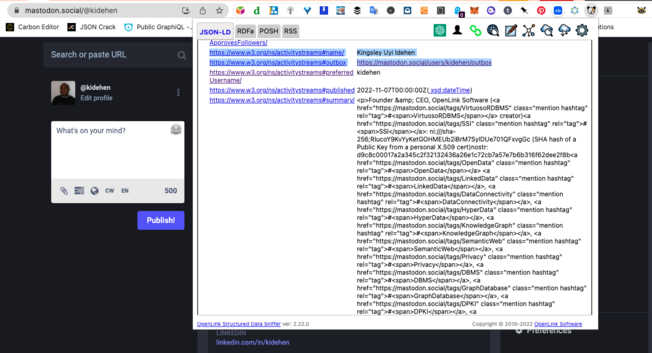
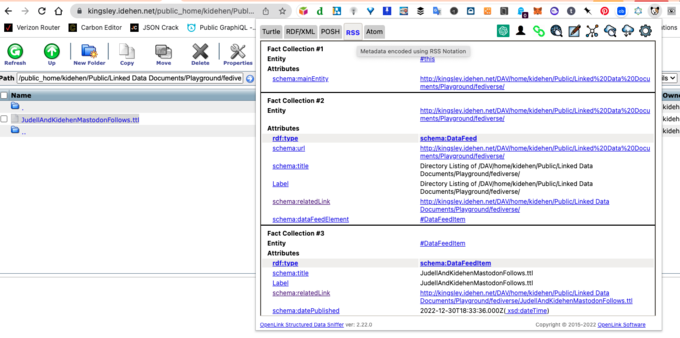
If you our Structured Data Sniffer (#OSDS) Browser Extension installed, you can even use it as an alternative explorer for navigating the #Web of Data creating by ActivityStreams generated by #ActivityPub operations.

That we are here today is a miracle, in the truest sense -- based on my 20+ year odyssey.😀

/cc @observablehq @mauforonda @Mastodon @judell

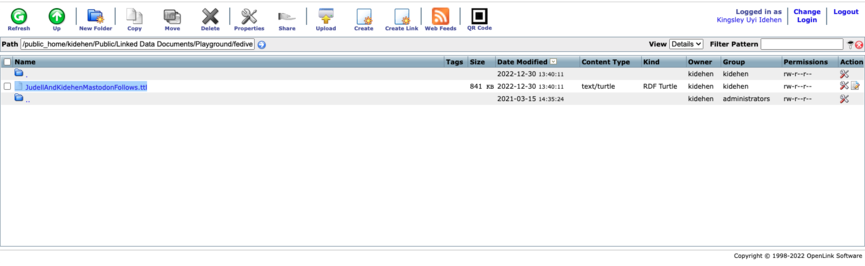
I've uploaded an #RDFTurtle document to my personal #ODSBriefcase at:

https://kingsley.idehen.net/public_home/kidehen/Public/Linked%20Data%20Documents/Playground/fediverse/JudellAndKidehenMastodonFollows.ttl

If you have our #OSDS Browser Ext. installed, you can start #Fediverse exploration via any profile of interest.

Specific steps:
1. Click on the #hyperlink that denotes the doc in my briefcase

2. Click on a hyperlink that denotes a user

3. Click on the hyperlink that denotes the #RSS or #ActivityStreams of a selected user

That's it.

/cc @observablehq @mauforonda @Mastodon @judell

#DataSpaces

Our #ODSBriefcase module hasn't changed an iota since it was created in the early days of the #Blogosphere.

What's changed is the fact that more tools are now using existing open standards (#RSS, #ActivityStreams, #Atom, #ActivityPub etc.) thanks to the #Web20 implosion (punctuated by #Twitter's recent dysfunction).

Open standards ensure interoperability and loose-coupling -- which ensures better solutions and longevity :)

/cc @observablehq @mauforonda @Mastodon @judell