 Accidental CISO
If you are doing vendor security assessments for your employer, it is your job to assess the risk associated with vendors so that your leadership can make decisions.
It is not your place to bully the vendor.
Thank you for coming to my Ted Talk.
If you are doing vendor security assessments for your employer, it is your job to assess the risk associated with vendors so that your leadership can make decisions.
It is not your place to bully the vendor.
Thank you for coming to my Ted Talk.

@wendynather @jack_daniel @accidentalciso And the 97% don't know about the conferences, or can't afford to go, or can't understand us when we talk, or can't afford to do what we tell them. They don't know about hardening guides, or can't figure out how to implement them, or don't have time.
But when they fail to patch a product that has yet another memory safety vuln (2/3 of CVEs for decades 😂) and get popped, you can count on us to blame them, revictimizing them. In infosec, "tsk tsk" is a renewable resource! We're great!

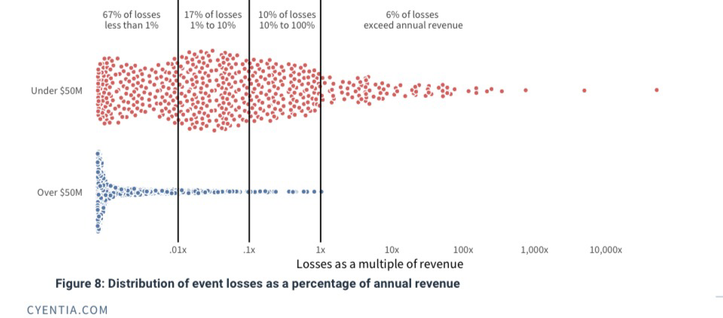
@wendynather @boblord @jack_daniel @accidentalciso Just gonna drop in a stat relevant to this conversation because that’s what I do…
Explanation: “Gartner defines a small business as one having less than $50M in annual revenue. So, that’s the distinction that appears here in red. It’s clear that the majority of loss events involving midsize and large firms (in blue) fall below 1% of their income, while the higher ratios on the right side of the spectrum are almost entirely populated by small businesses. Here’s a sobering stat: SMBs were the primary victim in 89% of all cyber loss events that exceeded 10% of revenue.” Source: https://www.cyentia.com/wp-content/uploads/IRIS-2022_Cyentia.pdf
@wendynather @DaveMWilburn @wade @boblord @jack_daniel @accidentalciso
I fear that the problem is only exacerbated as the "haves" move further and further away from the "have nots". We pay a premium for Data Science, Data Engineers, and a score of MBAs to explain why we should pay them all so much. In InfoSec, its seen as 'savings' or a 'risk aversion' with the primary goal to be shift the cost to anyone else.
How many billions are claimed yearly on the projects that could only exist because of the work ya'll do? Funny I only see InfoSec projects as cost drivers.
@DaveMWilburn @wade @wendynather @boblord @jack_daniel @accidentalciso Exactly why I started my own shop.
Now, to *find* these folks and convince them they need some basics ...

I've been thinking about what companies can do if they are under resourced in cybersecurity, and how they can improve security if they don't have a security team. https://hpatton.medium.com/improving-security-without-a-security-team-26b57cd9e801
@wendynather @boblord @jack_daniel @accidentalciso
Wendy what a great talk! I’d missed it at the time. You’re arguments are so on point you almost made me cry!
I’ve been giving some thought the idea of ‘neighbourhood watch’ as a structure through which to organize a community-oriented response to cyber threats for ecosystems. Let me know if you’d like me to share.
Also - im not sure if you’re aware of the work the Cyber Peace Institute does in terms of your notion of a cyber ‘peace corps’?
@SonOfSunTzu @wendynather @boblord @jack_daniel @accidentalciso
Hey Nick. Apologies for the late reply - I've been offline for while.
Sadly, yes, I think the arguments are all still the same...
@accidentalciso Disagree.
It is your place. Your employer specifically put you in that place when they tasked you with the assessment. Your job is to "get the vendor to tell you the truth".
How much bullying that's going to require is determined by the vendor. If they're upfront and honest, we can keep it to a minimum... but, thanks to all the vendors who aren't, we still have to do the dance. The best vendors know the dance and lead.
@accidentalciso I regularly find myself either being the one setting the security questions for our vendors or being the one answering them for our customers. A few thoughts I've ended up with:
- ISO 27001, SOC 2 and CSA CAIQ give us "common language", and help shorten many processes. If the VRM process isn't shortened by us as a vendor having those, it's usually a sign it's going to be a painful one. Compliance != security, but it should get rid of some questions about security basics.
- As a vendor, if we experience a particularly painful VRM process, we try to learn what was painful and make sure we're not inflicting the same on our own vendors.
- Vendors who respond "our Cloud provider is ISO27001 certified, so we're secure" need educating, not yelling at.
- If a customer asks us yes/no questions about whether we've got a specific technology deployed, it's often a sign that they are concerned about risk X and believe technology Y is the only way to mitigate it. If they can describe what risks they are most concerned about, we can describe to them how we mitigate those risks.
- Pragmatic, risk-based processes tend to be positive experiences that lead to good partnerships.
- Bullying and obstructive behaviour is likely a symptom of process or culture dysfunction.
 Lul4l1f3
 storyteller
 Trevor
 WowSuchCyber
 David Warrington
 FlemmingRiis
 NewsGoth Condensed (if you know you know)
 Viss
Viss Jack Daniel (often offline)
 XenoPhage
 Bob Lord 🔐
 Wendy Nather
 Wade Baker
 Dave Wilburn
  Alex
Alex Scott
Scott 
 Aranjedeath
 Gunnar Peterson
 Charl van der Walt 🌻🇵🇸
 Nick Drage
 Tarah Wheeler
 RisuToInu
 Matt Franz
 Mechele G
 Rob Landley
 Dan Kennedy
  Falcon Darkstar
 Ben
Ben Name_Too_Long
 Seclovin
 Nick Murison