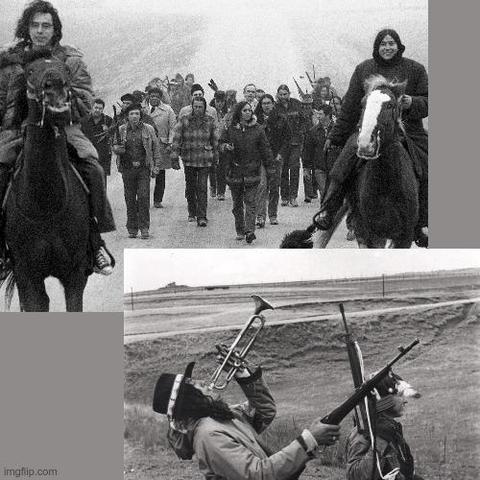
February 27, 1973 - Hundreds of Oglala Lakota Sioux and members of the American Indian Movement (AIM) occupied the village of Wounded Knee, South Dakota.

Angered over a long history of violated treaties, mistreatment, family dismemberment, cultural destruction, discrimination, and impoverishment through confiscation of resources, they particularly demanded the U.S. live up to the terms of the 1868 Fort Laramie Treaty. That treaty recognized the Sioux as an independent nation in the western half of South Dakota. Additionally, there had been a recent campaign of harassment and violence by tribal and FBI officials. Wounded Knee was chosen because of the 1890 massacre there of several hundred men, women and children by U.S. troops. The occupation lasted until May.

#WoundedKnee

#AmericanIndianMovement (#AIM) led, on #ThisDayInHistory in 1973, 250 #OglalaLakota in a 71-day occupation of the #WoundedKnee site, demanding the US gov. fulfil broken treaty promises. Instead of talking, feds besieged the site & engaged in 11 lethal firefights. Nothing changed.

Today in Labor History February 27, 1973: 300 Oglala Sioux activists from the American Indian Movement (AIM) liberated and occupied Wounded Knee, South Dakota. This was the site of the infamous Massacre at Wounded Knee (1890). They occupied the site to protest a campaign of terror against them by the FBI, and corrupt tribal officials, and the tribal thugs knowns as GOONs (Guardians of Oglala Nation). The occupation lasted over 2 months, before being quashed by the U.S. government. 3 Native activists were killed. Dennis Banks and Russell Means were indicted for their roll, but charges were later dropped due to prosecutorial misconduct.

#aim #indigenous #WoundedKnee #massacre #genocide #occupation #fbi #oglala #sioux #workingclass #LaborHistory #native #terrorism #AmericanIndianMovement

Passage Land: What Do the Living Owe the Dead?

Some questions cannot be answered. They can only be inhabited. For sixteen decades, three families have occupied the same stretch of Nebraska prairie, and for sixteen decades they have been asking variations of the same question: what do the living owe the dead? Passage Land is my attempt to inhabit that question long enough to understand why it refuses resolution.

The novel spans 1866 to 2026. The Vogels flee the collapsing Russian steppes, where the promises made to German settlers have curdled into conscription and confiscation. The Callahans escape Ireland’s famine legacy, carrying debts they can never repay and griefs they can never name. The Walking Aheads survive the massacre of their people, watching their children taken to schools designed to erase everything their ancestors knew. All three families end up on the same land. All three carry obligations to people who are no longer alive to receive payment.

I did not set out to write a 160-year saga. I set out to understand why the prairie holds its dead so close. Growing up in Nebraska, you learn early that the land remembers. The sod houses are gone but their foundations remain. The homestead claims are forgotten but the property lines persist. The treaties are broken but the people they displaced are still here, still farming, still remembering what was taken. The question that animates this novel is not historical. It is present tense: what happens when the people who inherit the land also inherit the debt?

The title comes from the Lakota concept of passage, the idea that we do not own land but move through it, that our tenure is temporary and our obligations extend beyond our lifespan. This stands in direct tension with the homesteading logic that brought both the Vogels and the Callahans to the prairie: the conviction that land can be possessed, improved, and passed down as property. The novel does not resolve this tension. It dramatizes it across six generations until the contradictions become unbearable.

Robert Vogel, in 2024, is the character who must finally confront what his family has avoided for over a century. He is sixty-three years old, a retired agricultural consultant, the last of the Vogel men still living on the original homestead. When Ruth Walking Ahead appears at his door with a proposition that could change everything, he must decide whether the debts of the dead can ever be settled, or whether some wounds are meant to stay open precisely because closing them would betray everyone involved.

The research for this book took years. Prairie Voice readers will recognize some of the historical threads: the Volga German migration, the Irish chain migration, the allotment era that broke reservation lands into individual parcels that could be sold, lost, or stolen. The novel weaves these threads together not to create a comprehensive history but to show how historical forces become family stories, how policy becomes inheritance, how what happened to someone’s great-grandmother in 1887 shapes what someone’s grandson decides in 2024.

I wrote this book because forgetting is too easy. The prairie encourages forgetting. The grass grows back. The graves sink into the soil. The names on the headstones become unreadable. But the obligations do not disappear just because we stop acknowledging them. They pass down through generations, accumulating interest, waiting for someone brave enough or foolish enough to finally open the ledger.

Ruth’s statement to Robert near the end of the novel captures what I hope readers will take away: “Sharing is not return.” There is no reconciliation that undoes what was done. There is no payment that settles the account. There is only the choice to acknowledge the debt or to pretend it does not exist. The novel asks which choice is more honest, and whether honesty is even the right criterion when the people owed are long dead and the people paying never agreed to the terms.

Passage Land is available now as a Kindle edition for $9.99 and paperback for $17.99 at Amazon. A free PDF is also available at David Boles Books for those who prefer that format.

This is not a comfortable book. It is not meant to be. But if you have ever stood on land that holds more history than the deed acknowledges, if you have ever wondered what your family’s presence cost someone else’s family, if you have ever suspected that the past is not past but merely patient, then this book was written for you.

#bolesBooks #davidBoles #farmCrisis1980s #GreatPlainsHistoricalFiction #LakotaSiouxFiction #multigenerationalSaga #NativeAmericanFiction #nebraska #NebraskaNovel #novel #woundedKnee
On #ThisDayInHistory, in 1890, #Lakota warriors faced US soldiers in the #DrexelMissionFight, killing one & wounding a few, just a day after the massacre at #WoundedKnee, in which the army killed 300 #indigenous people. The US won its lands through #genocide. Give the #LandBack.

Family Wants Search for Activist’s Remains at Site of Wounded Knee Occupation

Perry Ray Robinson disappeared after joining the American Indian Movement’s 1973 takeover on the Pine Ridge Reservation.

https://murica.website/2025/12/family-wants-search-for-activists-remains-at-site-of-wounded-knee-occupation/

Family Wants Search for Activist’s Remains at Site of Wounded Knee Occupation – The USA Potato

On #ThisDayInHistory in 1890, in an act of #genocide, the US military killed nearly 300 #Lakota #Sioux at #WoundedKnee on #PineRidgeReservation. Soldiers went in to disarm, then opened fire on men, women, and children. 19 killers were given the #MedalOfHonor for this massacre.

Today in Labor History December 29, 1890: U.S. Army troops slaughtered 300 Sioux men, women and children in the Wounded Knee Massacre on Pine Ridge Indian Reservation, South Dakota. Two weeks earlier, they had killed Sitting Bull for failing to stop the Ghost Dance. The people living in Sitting Bull’s camp fled to the Pine Ridge Reservation, where the U.S. Army caught up to them on December 29. They began disarming the Lakota warriors. However, Black Coyote didn’t want to give up his rifle, because he had paid a lot for it. When his rifle went off in the struggle, the U.S. Army began shooting indiscriminately at the mostly unarmed Lakota. In addition to the 300 Lakota who died, 25 U.S. soldiers also died. And 20 soldiers were given the Medal of Honor.

L. Frank Baum, author of “Wizard of Oz,” was a newspaper editor at the time. He wrote, “Having wronged them for centuries, we had better, in order to protect our civilization, follow it up by one more wrong and wipe these untamed and untamable creatures from the face of the earth. In this lies future safety for our settlers and the soldiers who are under incompetent commands.” Sound similar to some of the current quotes coming from Israeli and U.S. politicians with regards to Palestine? Or MAGA fascists with regards to immigrants and trans folk? And then there was General Martinez, who launched the 1932 genocide against El Salvador’s indigenous people, and against it’s communists and union activists, who said that the U.S. was great because it had wiped out its indigenous population, and for El Salvador to become great, it must do so, too.

#workingclass #LaborHistory #WoundedKnee #indigenous #genocide #lakota #treaty #nativeamerican #sioux #ghostdance #indigenousrights #palestine #israel #FreePalestine #EndTheOccupation #EndThesiege #israel #communism #elsalvador

December 29, 1890 - The U.S. Army killed approximately 300 Lakota Sioux at Wounded Knee, in the new state of South Dakota. The 7th Cavalry (Custer's old command) fired their artillery amidst mostly unarmed women, children, and fleeing men. The Wounded Knee Massacre historically considered the final major military battle in the genocide against Native Americans. 20 soldiers received Congressional Medals of Honor for their "bravery.”

Encroaching white settlement after gold was found in 1874 on Sioux lands led to conflicts. The Great Sioux Agreement of 1889 established reservations for the native inhabitants and encouraged further white settlement on Indian land.

#WoundedKnee

Il massacro di #WoundedKnee del 29 dicembre 1890, sulle rive del torrente omonimo nel South Dakota, non fu una battaglia ma la brutale carneficina che segnò l’epilogo delle Guerre indiane e l’atto finale della sanguinosa conquista del Nord America. Ma ciò che rende Wounded Knee un simbolo della controversa memoria storica americana sono le onorificenze assegnate per tale atto: ben 24 soldati ricevettero infatti la Medaglia all’onore, la più alta onorificenza militare #USA. Con la campagna “Remove the Stain Act”, e la conseguente proposta di legge del 2019 depositata da deputati indigeni e democratici, i nativi americani chiedono da anni che queste medaglie vengano ritirate. L’amministrazione #Trump, però, non è dello stesso avviso e ha confermato quelle medaglie.
(L'indipendente)