 13
13Solar Supercapacitor Lamp Probably Won’t Get You Saved At Sea https://hackaday.com/2026/01/29/solar-supercapacitor-lamp-probably-wont-get-you-saved-at-sea/
#LEDHacks #Solar #Solarlight #Supercapacitor
#LEDHacks #Solar #Solarlight #Supercapacitor

Wir bringen Licht ins Dunkel! Wir bauen durch Spenden Solarsysteme fuerEntwicklungsländer! Eigenentwicklung + Wetterbericht + Fruehwarnsystem Bisher aktiv in: <a href="https://pixelfed.de/discover/tags/Nepal?src=hash" title="#Nepal" class="u-url hashtag" rel="external nofollow noopener">#Nepal</a>, <a href="https://pixelfed.de/discover/tags/Tanzania?src=hash" title="#Tanzania" class="u-url hashtag" rel="external nofollow noopener">#Tanzania</a>, <a href="https://pixelfed.de/discover/tags/Gambia?src=hash" title="#Gambia" class="u-url hashtag" rel="external nofollow noopener">#Gambia</a> Mastodon: <a href="https://sueden.social/@lightforlife" rel="external nofollow noopener">https://sueden.social/@lightforlife</a>

54 Beiträge, 2 Folge ich, 55 Folgende · Wir bringen Licht ins Dunkel! Wir bauen durch Spenden Solarsysteme für Entwicklungsländer! Eigenentwicklung + Wetterbericht + Frühwarnsystem Bisher aktiv in: #Nepal, #Tanzania, #Gambia ! Beiträge werden nach 2 Jahren gelöscht !
You Can Turn Soft Drink Bottles Into Handy Solar Lamps
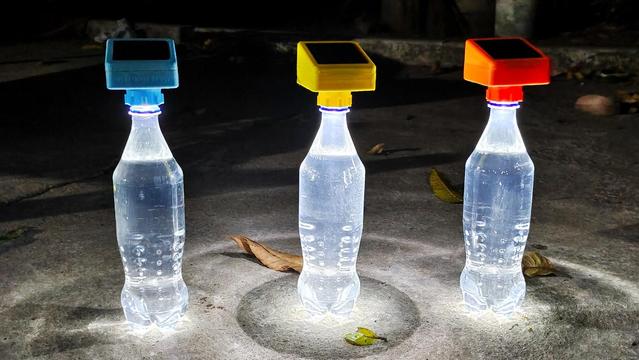
Solar lights are a popular garden decoration. Of course, they're available cheaply from most hardware and garden stores, but if you're more of the DIY type, you might like to build your own. [opengreenenergy] has done just that, using recycled materials for a cheap and simple design.
The design was inspired by the Moser bottle, which is a water-filled bottle used to diffuse sunlight into a room during the day. Instead of sunlight, however, this design uses an LED to provide the light, for decorating a garden or for use when out camping or traveling.
In this design, a solar panel is used to charge a lithium-polymer battery during the day using a LP4060B5F charge controller IC. It's paired with a AP6685 battery protection IC to ensure the battery is not overly discharged or otherwise damaged in use. When the solar panel stops putting out power when it gets dark, the LED is automatically switched on. It can be set to a low or high brightness to provide more runtime or more light as needed.
All the circuitry is wrapped up in a neat 3D-printed case that allows the hardware to be screwed directly on top of a regular soft drink bottle. Paired with some water in the bottle, and perhaps a little bleach to stave off algal growth, the result is a handy, portable light that also has enough mass to avoid it being blown over easily.
It's interesting to compare the design to commercial versions that aim to pare costs down to a minimum. Video after the break.
Adding MQTT To A Solar Powered PIR Light
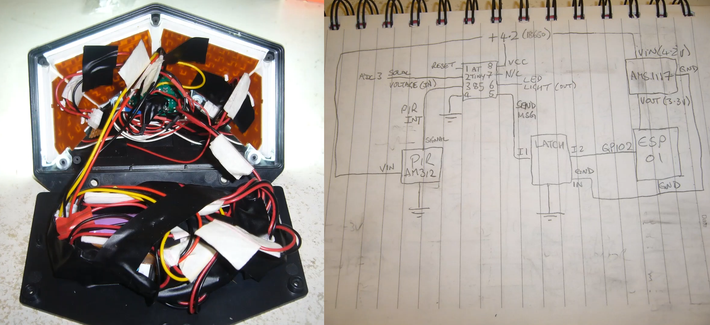
The size and price of the ESP wifi modules have quickly made them into one of the preferred building blocks for IoT devices. Unfortunately they are not particularly well suited for very low power applications. [LittlePetieWheat] wanted to add MQTT to a cheap PIR solar light, so he paired an ESP with an Attiny85 to hold it to a strict power budget.
Most of these lights contain some sort of no-name microcontroller that monitors the analog PIR sensor, and turns on the LEDs as required. [LittlePetieWheat] replaced the PIR sensor with one that gives a digital output for simpler interfacing. The Attiny serves as the low power brains of the project. Its tasks include reading the solar panel and battery voltages, and PIR output. When movement is detected by the sensor, it activates a clever little latching power circuit to power on the ESP01 just long enough to send a MQTT message. The LEDs are only turned on if there is no power coming from the solar panel. The solar power is stored in a 18650 battery.
The Attiny85 might not be a powerhouse, but it is perfect for simple, low power applications like this. We've also seen it pushed to its limits by running tiny machine learning models, or receiving software updates over I2C.

 moho518
 LandingStream
 𝕮𝖍𝖗𝖎𝖘𝖙𝖎𝖓𝖆 𝖛𝖔𝖓 𝖂𝖊𝖑𝖑𝖊𝖆𝖓
 unfa🇺🇦
 Light for Life e.V.
 Light for Life e.V.
 hackaday unofficial